Comments
[Edit: I no longer feel confident about this comment; see thread right below]
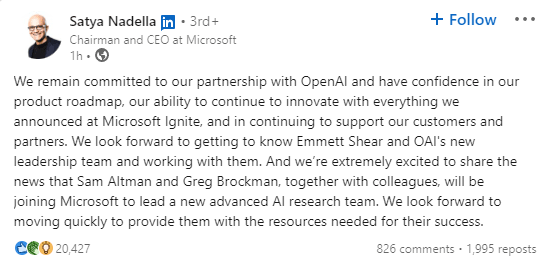
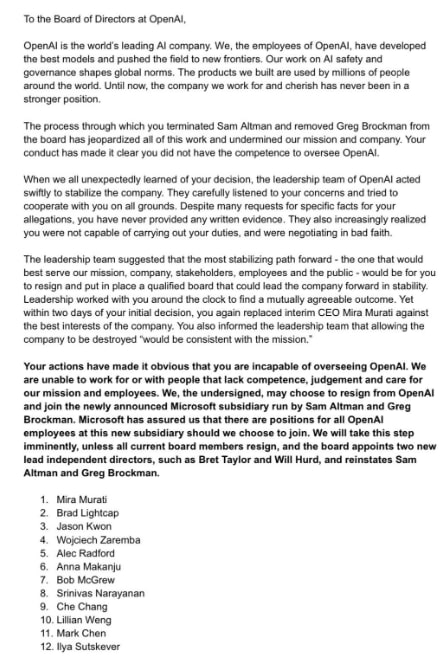
Hm, I don't think Altman looks good here either.
We have to wait and see how public or the media will react, but to me, this looks like it casts doubts on some things he said previously about his specific motivations for building AGI. It's hard to square that working under Microsoft's leadership (and their need to compete with other companies like Alphabet) is a good environment for making AGI breakthroughs and thinking that it'll likely go really well.
Although, maybe he's planning to only build specific apps for Microsoft rather than intends to build AGI there? That would seem like an atypical reduction of ambition/scope to me. Or maybe the plan is "amass more money and talent and then go back to OpenAI if possible, or otherwise start a new AGI thing with more independence from profit-driven structure. That would be more more understandable, but also feels like he'd be being very agentic about this goal in a way that's scary and like I have to trust this one person's judgment about pulling the brakes when it becomes necessary, even though there's now evidence that many people think he's not been cautious enough already recently.
I guess we have to wait and see.

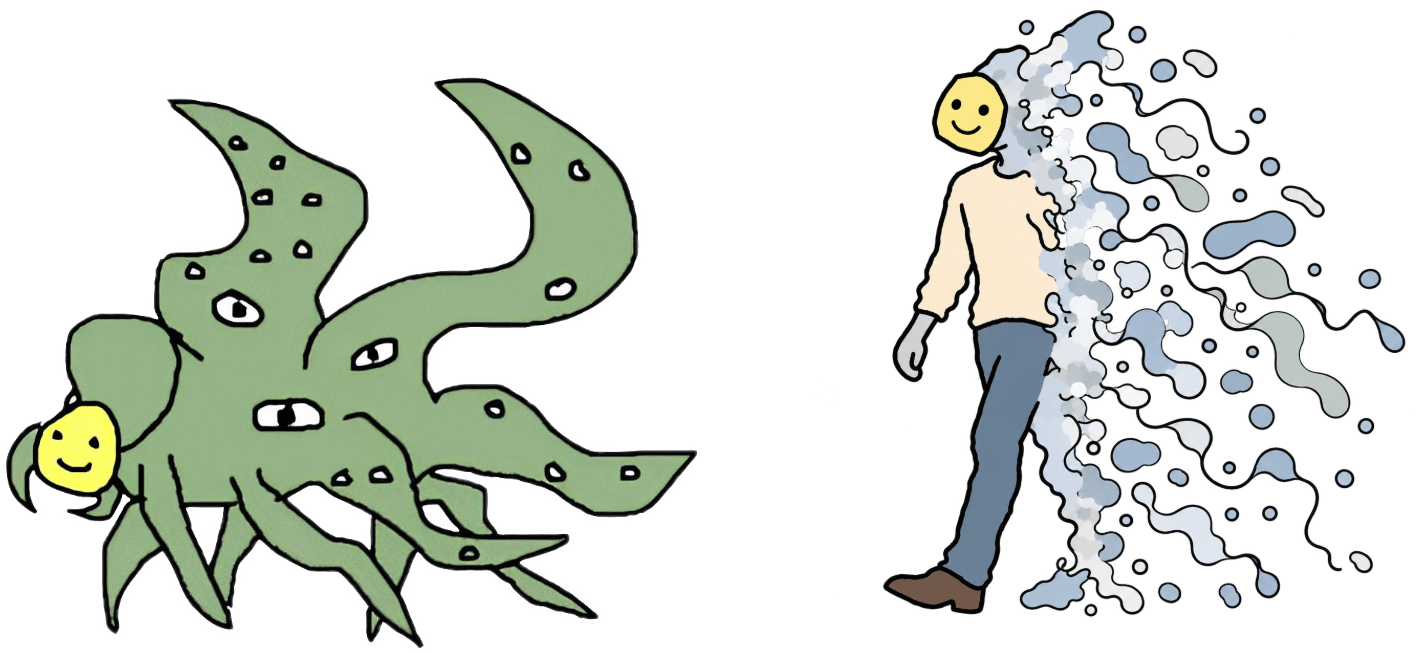
It seems that EA tried to "play politics" with Sam Altman and OpenAI, by doing things like backing him with EA money and credibility (in exchange for a board seat) without first having high justifiable trust in him, generally refraining from publicly (or even privately, from what I can gather) criticizing Sam and OpenAI, Helen Toner apologizing to Sam/OpenAI for expressing even mild criticism in an academic paper, springing a surprise attack or counterattack on Sam by firing him without giving any warning or chance to justify himself.
I wonder how much of this course of action was intended / carefully considered, and whether/what parts people still endorse in retrospect. Or more generally, what lessons are people drawing from this whole episode?
I'm personally unsure whether to update in the direction of "play politics harder/better" or "play politics less and be principled more" or maybe "generally be more principled but play politics better when you have to"? Or even "EA had a pretty weak hand throughout and played it as well as can be reasonably expected"? (It sucks that insiders who can best answer these questions are choosing or committed to not talking.)
EDIT: this is going a bit viral, and it seems like many of the readers have missed key parts of the reporting. I wrote this as a reply to Wei Dai and a high-level summary for people who were already familiar with the details; I didn't write this for people who were unfamiliar, and I'm not going to reference every single claim in it, as I have generally referenced them in my prior comments/tweets and explained the details & inferences there. If you are unaware of aspects like 'Altman was trying to get Toner fired' or pushing out Hoffman or how Slack was involved in Sutskever's flip or why Sutskever flip-flopped back, still think Q* matters, haven't noticed the emphasis put on the promised independent report, haven't read the old NYer Altman profile or Labenz's redteam experience etc., it may be helpful to catch up by looking at other sources; my comments have been primarily on LW since I'm not a heavy EAF user, plus my usual excerpts.
It was a pretty weak hand. There is this pervasive attitude that Sam Altman could have been dispensed with easily by the OA Board if it had been more competent; this strange implicit assumption that Altman is some johnny-come-lately where the Board screwed up by hiring him. Commenters seem to ignore the long history here - if anything, it was he who screwed up by hiring the Board!
Altman co-founded OA. He was the face in initial coverage and 1 of 2 board members (with Musk). He was a major funder of it. Even Elon Musk's main funding of OA was through an Altman vehicle. He kicked out Musk when Musk decided he needed to be in charge of OA. Open Philanthropy (OP) only had that board seat and made a donation because Altman invited them to, and he could personally have covered the $30m or whatever OP donated for the seat; and no one cared or noticed when OP let the arrange lapse after the initial 3 years. (I had to contact OP to confirm this when someone doubted that the seat was no longer controlled by OP.) He thought up, drafted, and oversaw the entire for-profit thing in the first place, including all provisions related to board control. He voted for all the board members, filling it back up from when it was just him (& Greg Brockman at one point IIRC). He then oversaw and drafted all of the contracts with MS and others, while running the for-profit and eschewing equity in the for-profit. He designed the board to be able to fire the CEO because, to quote him, "the board should be able to fire me". He interviewed every person OA hired, and used his networks to recruit for OA. And so on and so forth
Credit where credit is due - Altman may not have believed the scaling hypothesis like Dario Amodei, may not have invented PPO like John Schulman, may not have worked on DL from the start like Ilya Sutskever, may not have created GPT like Alec Radford, may not have written & optimized any code like Brockman's - but the 2023 OA organization is fundamentally his work.
The question isn't, "how could EAers* have ever let Altman take over OA and possibly kick them out", but entirely the opposite: "how did EAers ever get any control of OA, such that they could even possibly kick out Altman?" Why was this even a thing given that OA was, to such an extent, an Altman creation?
The answer is: "because he gave it to them." Altman freely and voluntarily handed it over to them.
So you have an answer right there to why the Board was willing to assume Altman's good faith for so long, despite everyone clamoring to explain how (in hindsight) it was so obvious that the Board should always have been at war with Altman and regarding him as an evil schemer out to get them. But that's an insane way for them to think! Why would he undermine the Board or try to take it over, when he was the Board at one point, and when he made and designed it in the first place? Why would he be money-hungry when he refused all the equity that he could so easily have taken - and in fact, various partner organizations wanted him to have in order to ensure he had 'skin in the game'? Why would he go out of his way to make the double non-profit with such onerous & unprecedented terms for any investors, which caused a lot of difficulties in getting investment and Microsoft had to think seriously about, if he just didn't genuinely care or believe any of that? Why any of this?
(None of that was a requirement, or even that useful to OA for-profit. Other double systems like Mozilla or Hershey don't have such terms, they're just normal corporations with a lot of shares owned by a non-profit, is all. OA for-profit could've been the same way. Certainly, if all of this was for PR reasons or some insidious decade-long scheme of Altman to 'greenwash' OA, it was a spectacular failure - nothing has occasioned more confusion and bad PR for OA than the double structure or capped-profit. See, for example, my shortly-before-the-firing Twitter argument with well-known AI researcher Delip Rao who repeatedly stated & doubled down on the claim that the OA non-profit legally owned the OA for-profit was not just factually wrong but misinformation. He helpfully linked to a page about political misinformation & propaganda campaigns online in case I had any doubt about what the term 'misinformation' meant.)
What happened is, broadly: 'Altman made the OA non/for-profits and gifted most of it to EA with the best of intentions, but then it went so well & was going to make so much money that he had giver's remorse, changed his mind, and tried to quietly take it back; but he had to do it by hook or by crook, because the legal terms said clearly "no takesie backsies"'. Altman was all for EA and AI safety and an all-powerful nonprofit board being able to fire him, and was sincere about all that, until OA & the scaling hypothesis succeeded beyond his wildest dreams†, and he discovered it was inconvenient for him and convinced himself that the noble mission now required him to be in absolute control, never mind what restraints on himself he set up years ago - he now understands how well-intentioned but misguided he was and how he should have trusted himself more. (Insert Garfield meme here.)
No wonder the board found it hard to believe! No wonder it took so long to realize Altman had flipped on them, and it seemed Sutskever needed Slack screenshots showing Altman blatantly lying to them about Toner before he finally, reluctantly, flipped. The Altman you need to distrust & assume bad faith of & need to be paranoid about stealing your power is also usually an Altman who never gave you any power in the first place! I'm still kinda baffled by it, personally.
He concealed this change of heart from everyone, including the board, gradually began trying to unwind it, overplayed his hand at one point - and here we are.
So, what could the EA faction of the board have done? ...Not much, really. They only ever had the power that Altman gave them in the first place.
* I don't really agree with this framing of Sutskever/Toner/McCauley/D'Angelo as "EA", but for the sake of argument, I'll go with this labeling.
† Please try to cast your mind back to when Altman et al would be planning all this in 2018-2019, with OA rapidly running out of cash after the mercurial Musk's unexpected-but-inevitable betrayal, its DRL projects like OA5 remarkable research successes but commercially worthless, and just some interesting results like GPT-1 and then GPT-2-small coming out of their unsupervised learning backwater from Alec Radford tinkering around with RNNs and then these new 'Transformer' things. The idea that OA might somehow be worth over ninety billion dollars, yes, that's 'billion' with a 'b' in scarcely 3 years would have been insane, absolutely insane, not a single person in the AI world would have taken you seriously if you had suggested that and if you emailed any of them asking about how plausible that was, they would have added an email filter to send your future emails to the trash bin. It is very easy to be sincerely full of the best intentions and discuss how to structure your double corporation to deal with windfalls like growing to a $1000b market cap when no one really expects that to happen, certainly not in the immediate future... Thus, no one is also sitting around going, 'well wait, we required the board to not own equity, but if the company is worth even fraction of our long-term targets, and it's recruiting with stock options like usual, then each employee is going to have, like, $10m or even $100m of pseudo-equity in the OA for-profit. That seems... problematic. Do we need to do something about it?'
Thanks, I didn't know some of this history.
Two explanations come to my mind:
Both of reasons these probably played some causal role in what happened, but may well have been subconscious considerations. (Also entirely possible that he changed his mind in part for what we'd consider fair reasons.)
Some ideas for what they could have done:
Nitpicks:
Re 2: It's plausible, but I'm not sure that this is true. Points against:
(EDIT 2023/12/04: Changed wording to be slightly more precise and slightly less strong) So there's at least some evidence that any or all of Hoffman/Hurd/Zilis (the 3 board members that left recently) would've opposed Sam trying to ouster Toner. Far from certain, but I'd currently say[3] >50% (EDIT: that at least one of them would be opposed). Especially if it turns out that one or all of them were themselves pushed out by Altman and they started sharing notes. Of course, ousting Altman in retaliation is a pretty big move, and the more politically savvy ones might've found a better compromise solution.
His wikipedia page says "On September 20, 2023, Hurd unveiled a detailed plan for how he would regulate AI if elected President, comparing AI to nuclear fusion, and proposing creating a branch of the executive to deal solely and directly on the issue of AI, and proposing strict regulations on civilian AI usage." The last one in particular doesn't sound necessarily conducive to OpenAI/Microsoft's advanced AI ambitions.
Convoluted wording because of "executives claimed that they were born via in vitro fertilization (IVF)."
Of course, this counterfactual is hard to verify. The Twitter backlash + OAI revolt probably means people would be hesitant to be publicly pro-Toner, now.
I haven't seen any coverage of the double structure or Anthropic exit which suggests that Amodei helped think up or write the double structure. Certainly, the language they use around the Anthropic public benefit corporation indicates they all think, at least post-exit, that the OA double structure was a terrible idea (eg. see the end of this article).
You don't know that. They seem to have often had near majorities, rather than being a token 1 or 2 board members.
By most standards, Karnofsky and Sutskever are 'doomers', and Zillis is likely a 'doomer' too as that is the whole premise of Neuralink and she was a Musk representative (which is why she was pushed out after Musk turned on OA publicly and began active hostilities like breaking contracts with OA). Hoffman's views are hard to characterize, but he doesn't seem to clearly come down as an anti-doomer or to be an Altman loyalist. (Which would be a good enough reason for Altman to push him out; and for a charismatic leader, neutralizing a co-founder is always useful, for the same reason no one would sell life insurance to an Old Bolshevik in Stalinist Russia.)
If I look at the best timeline of the board composition I've seen thus far, at a number of times post-2018, it looks like there was a 'near majority' or even outright majority. For example, 2020-12-31 has either a tie or an outright majority for either side depending on how you assume Sutskever & Hoffman (Sutskever?/Zilis/Karnofsky/D'Angelo/McCauley vs Hoffman? vs Altman/Brockman), and with the 2021-12-31 list the Altman faction needs to pick up every possible vote to match the existing 5 'EA' faction (Zilis/Karnofsky/D'Angelo/McCauley/Toner vs Hurd?/Sutskever?/Hoffman? vs Brockman/Altman) although this has to be wrong because the board maxes out at 7 according to the bylaws so it's unclear how exactly the plausible majorities evolved over time.
I am reasonably confident Helen replaced Holden as a board member, so I don't think your 2021-12-31 list is accurate. Maybe there was a very short period where they were both on the board, but I heard the intention was for Helen to replace Holden.
Ilya has always been a doomer AFAICT, he was just loyal to Altman personally, who recruited him to OA. (I can tell you that when I spent a few hours chatting with him in... 2017 or something? a very long time ago, anyway - I don't remember him dismissing the dangers or being pollyannaish.) 'Superalignment' didn't come out of nowhere or surprise anyone about Ilya being in charge. Elon was... not loyal to Altman but appeared content to largely leave oversight of OA to Altman until he had one of his characteristic mood changes, got frustrated and tried to take over. In any case, he surely counts as a doomer by the time Zilis is being added to the board as his proxy. D'Angelo likewise seems to have consistently, in his few public quotes, been concerned about the danger.
A lot of people have indeed moved towards the 'doomer' pole but much of that has been timelines: AI doom in 2060 looks and feels a lot different from AI doom in 2027.
Hmm, OK. Back when I met Ilya, about 2018, he was radiating excitement that his next idea would create AGI, and didn't seem sensitive to safety worries. I also thought it was "common knowledge" that his interest in safety increased substantially between 2018-22, and that's why I was unsurprised to see him in charge of superalignment.
Re Elon-Zillis, all I'm saying is that it looked to Sam like the seat would belong to someone loyal to him at the time the seat was created.
You may well be right about D'Angelo and the others.
Hm, maybe it was common knowledge in some areas? I just always took him for being concerned. There's not really any contradiction between being excited about your short-term work and worried about long-term risks. Fooling yourself about your current idea is an important skill for a researcher. (You ever hear the joke about Geoff Hinton? He suddenly solves how the brain works, at long last, and euphorically tells his daughter; she replies: "Oh Dad - not again!")
Just judging from his Twitter feed, I got the weak impression D'Angelo is somewhat enthusiastic about AI and didn't catch any concerns about existential safety.
Another possibility is that Sam came to see EA as an incredibly flawed movement, to the point where he wanted EAs like Toner off his board, and just hasn't elaborated the details of his view publicly. See these tweets from 2022 for example.
I think Sam is corrupted by self-interest and that's the primary explanation here, but I actually agree that EA is pretty flawed. (Better than the competition, but still pretty flawed.) As a specific issue OpenAI might have with EA, I notice that EA seems significantly more interested in condemning OpenAI publicly than critiquing the technical details of their alignment plans. It seems like EAs historically either want to suck up to OpenAI or condemn them, without a lot of detailed technical engagement in between.
I checked the WSJ article linked to in this excerpt and I checked your comments on LessWrong, but I couldn't find any mention of Ilya Sutskever seeing Slack screenshots that showed Sam Altman lying. Would you mind clarifying?
Please forgive me if you're already covered this elsewhere.
That was covered in my 2023-11-25 comment.