Comments
Thanks for posting this retrospective! I’m curious about the quiz after fellowships - is that available anywhere?
Thanks for posting this retrospective! I’m curious about the quiz after fellowships - is that available anywhere?
Number of groups in the Fall ‘22 (Northern Hemisphere) UGAP cohort: 63, spread over 21 countries. We had about 112 organizers participate, of which 104 received a stipend.[1] [2]
Running this cohort (including the retreat) cost CEA’s Uni Groups team about 0.9FTE.[3]
This round of UGAP was preceded by the UGAP Starter Program, a 2-week program providing organizers with resources and a mentorship call. It had a lower barrier to entry than UGAP. We are not likely to run the starter program again - see here for a full retrospective on the Starter Program.
“How likely would you be to recommend that a new uni group apply for UGAP?”: 9.04 (n=58 organizers, down from a 9.2 rating from the previous cohort (with n=38))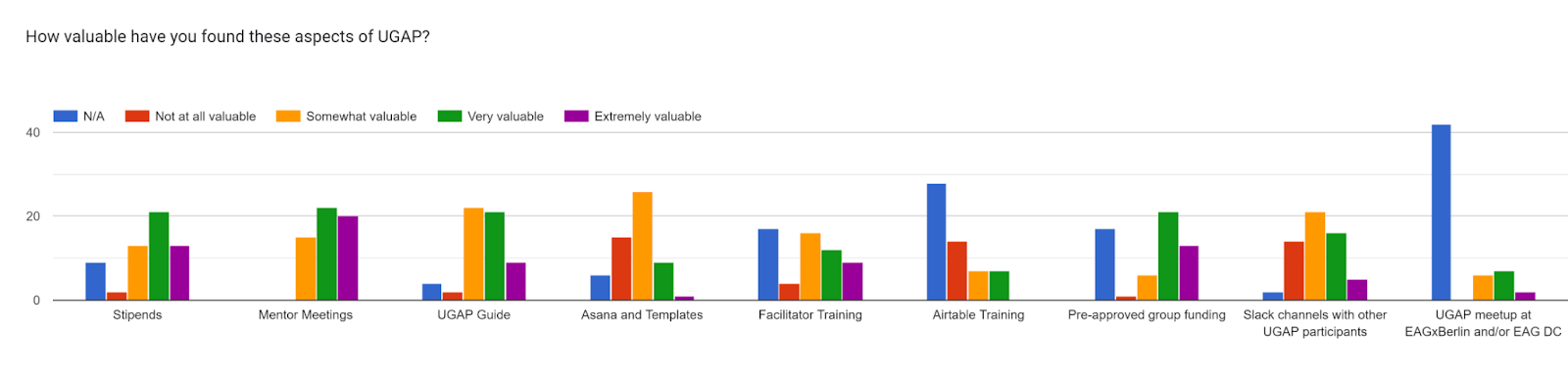
UGAP participants received mentorship on a weekly basis for about 1-3 months, and on a biweekly basis for the remainder of the semester.
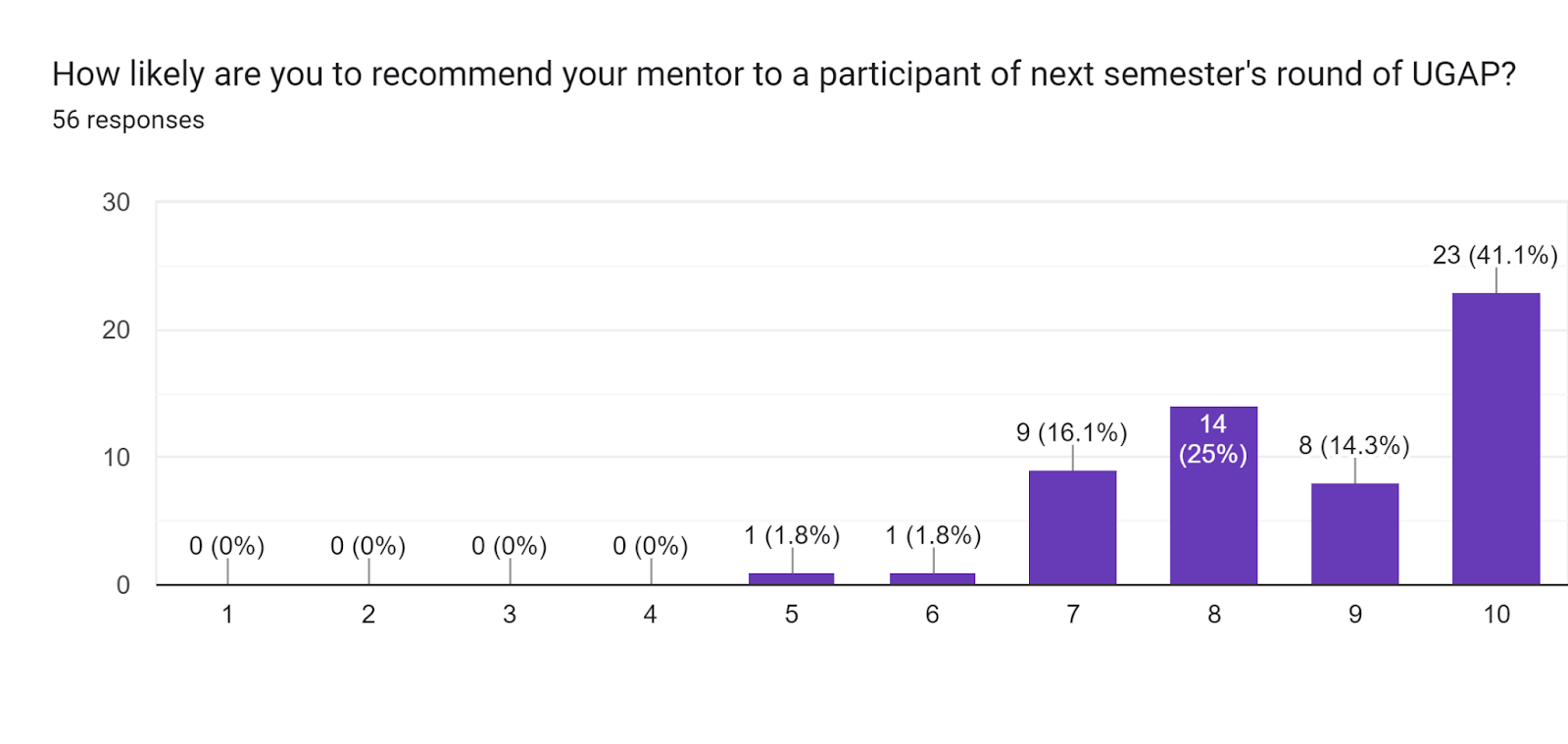
Some things to highlight:
We asked organizers how many of their group members they thought met the definition of HEA. We are quite skeptical of HEA as a good metric.[4] We also think group organizers are likely to overestimate the number of HEAs in their group, and maybe also whether these people got engaged with EA counterfactually. Yet, we think it’s good to share some results!
It’s unclear how many of these people are counterfactual (see below), but we’re overall quite excited about these numbers!
We asked group organizers to include a quiz in their post-fellowship survey, to check the EA understanding of their fellows. The results were better than baselines, but we still think these numbers could be higher, as the questions asked are fairly easy.
We asked organizers what their semester would’ve looked like if they hadn’t participated in UGAP. Summarizing their answers is hard, as it was an open-ended question. But these are some answers that were given often (20 organizers answered this question):
94.4% of the organizers said they’ll host another fellowship at their university. The remaining organizers answered “maybe”; none answered “no” (n=54).
Some impact stories we’re excited about:
Additionally, across all of the UGAP groups of this cohort:[6]

We ran a retreat for 38 of the UGAP participants who we thought could benefit most from attending it. We think the retreat was quite successful. You can find a review here.
The UGAP Starter Program had a number of problems that we’re addressing in various ways (including not running the Starter Program anymore). See the Starter Program Retrospective.
Other feedback we received, and improvements we’re working on:
The data collected from this round of UGAP makes us think that we’re providing a valuable service to new group organizers. The main costs of UGAP are a portion of our team’s time (0.9 for this past cohort, 0.6 FTE expected in the future) and mentor time (and the opportunity costs of those), but we think those costs are outweighed by the main benefits of UGAP: we think we found a repeatable program with product-market fit that supports new group organizers, helps identify talent, and contributes to building a global network of university group organizers.
Sign up here to be informed when applications open for a next round of UGAP!
A significant number of participants in this cohort (maybe 20%) were more experienced organizers than the level we normally expect UGAP participants to be at (namely: never organized a group before). Our program was less tailored to these already-existing groups, but we are still happy we accepted them in our program. We are now piloting an Organizer Support Program (OSP), which supports existing groups and their more experienced university group organizers.
The Spring ‘23 cohort of UGAP has significantly fewer groups (27) and organizers (42, 33 with stipend). We expect more people in the Fall ‘23 cohort, but not as many as during the Fall ‘22 semester.
~2 months of 3 people working on this 0.8 of their time during the admissions & kickoff period + ~4 months of the equivalent of one team member doing mentor calls full time + ~2 months of full-time work of one team member on the UGAP retreat.
We don’t think the HEA definition properly measures what we care about - it doesn’t properly define what significant actions we care about, doesn’t tell us anything about the ‘vibe’ of the group, and different organizers interpret the definition very differently. However, it was the best metric we had at the time (we are looking into alternatives) and it allows us to do some comparisons.
Counterfactual on the group existing, not necessarily of them participating in UGAP.
These numbers are not the main things that we evaluate UGAP or individual groups on, but they are interesting data points. In general, we are wary of (over)optimizing for quantity.


Great read and straight to the point! Glad our group got to participate in UGAP last semester, would definitely point starting groups/organizers to apply. :)