TL;DR
* GOAL 3 is a social enterprise that created IMPALA, a patient monitoring and digital platform system for low-resource settings. There is also a GOAL 3 foundation that raises funds to ensure underserved communities will be reached.
* A recently completed report from Rethink Priorities calculated IMPALA to have a cost per DALY averted of $7–17 in paediatr...
This month effective altruism has gotten lots of attention, including a cover story in The Economist. It feels pretty surreal to be on the receiving end of it. But I feel grateful these ideas have caught on, and even more grateful for the drive, earnestness, and compassion of so many people who took strange but well-argued ideas seriously and then actually acted on them....
Note: This post was crossposted from the Coefficient Giving Farm Animal Welfare Research Newsletter by the Forum team, with the author's permission. The author may not see or respond to comments on this post.
Subtitle: On vegan advocacy, effective altruism, and FIFA
I turn 40 today. Here are some hot takes.
On factory farming
1. Our biggest challenge is salience. If factory farming led the evening news, it wouldn’t last lo...
TL;DR: Giving 10% of your income implicitly assumes you have logarithmic utility and want everyone to make the exact same absolute drop in utility. But what if richer people should make an equal proportional sacrifice of utility? I derive the progressive donation schedules that fall out of this, show why you need an exemption baseline y0to prevent the math breaking when changing currencies, and map out what different CRRA utility functions (ρ) imply for real-world pledges.
One common way that people donate is through a fixed percentage pledge of their money. This can look like (non-exhaustively) their income, wealth, or corporate profit. Examples include GWWC (10%), One for the World (1%), EA for Christians (1%), CharityBox (1%), and Pledge1% (1%).
Under a logarithmic utility of money, though, a "fixed percentage pledge of money" is really just an "equal absolute sacrifice of your utility".
Mathematically, with log utility u(y)=lny, after-donation money ya=y−d, and equal absolute sacrifice u(y)−u(ya)=c, you get
lny−lnya=cya=e−cy
And because e−c is a constant, just
ya=ky
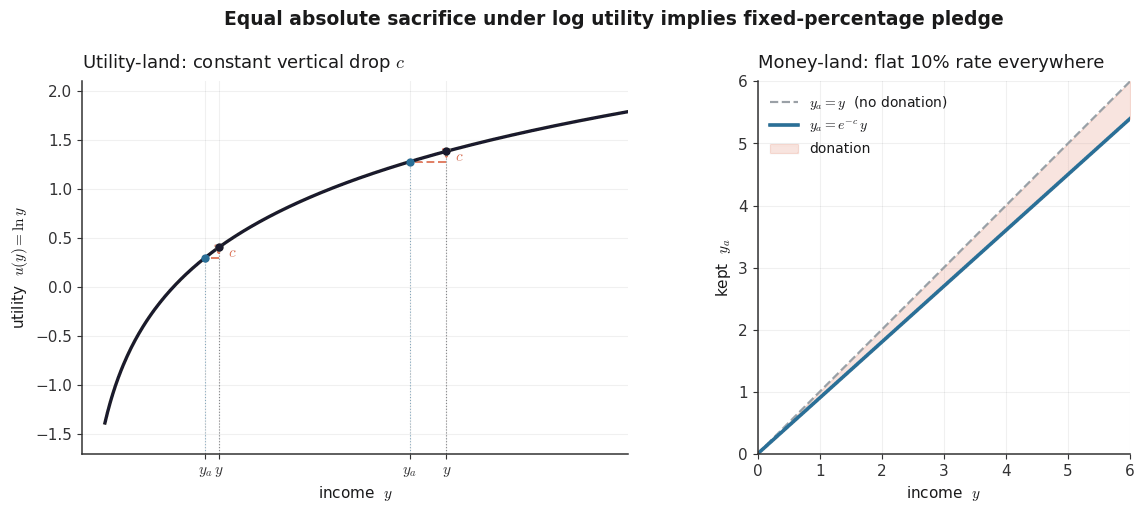
Which means you donate (1−k) of your money, i.e. a constant, fixed percentage of your money.[1] Visually, this is what it looks like in "money-land" and "utility-land":
Equal absolute sacrifice under log utility implies fixed-percentage pledge
Proportional sacrifice of utility
A natural question to ask next is then: what happens if you want to proportionally sacrifice your utility? Well, we can derive it just as well.
With equal proportional sacrifice u(y)−u(ya)u(y)=c, you get
lnya=(1−c)lnyya=y1−c
which means you donate (1−y−c) of your money, and are left with y−c of your money. This is a progressive, power-law schedule for your donation.
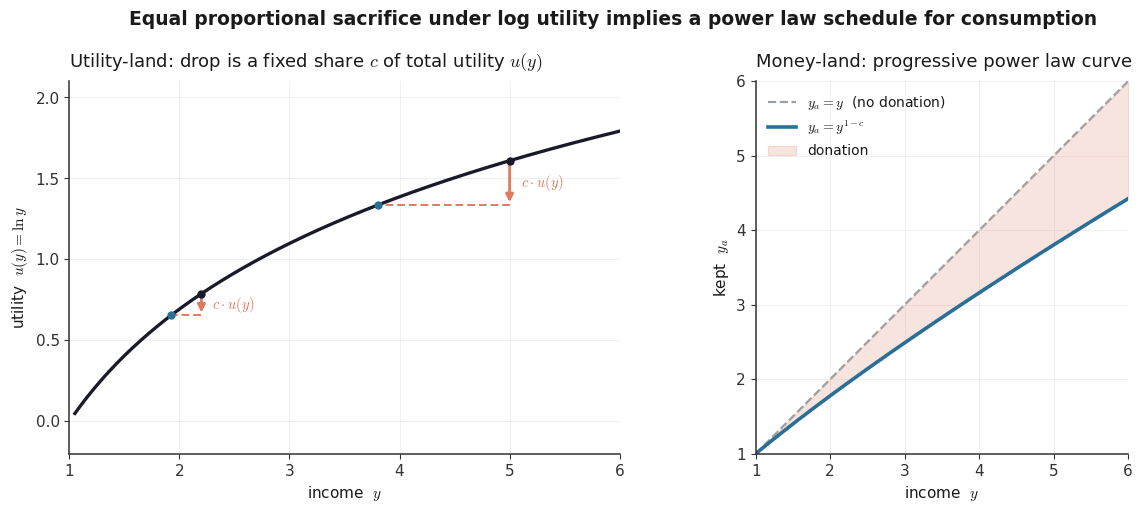
Again, we can visualize this as follows.
Equal proportional sacrifice under log utility implies a power law schedule for consumption
But notice that the above formula implies a weird conclusion about how you denominate your money. For example, say that we want to set it up such that the median US household donates 10% of their income. This means, with median US household income y of $83,780,
0.10=1−y−cc≈0.0092
But using the same c (proportional sacrifice of your utility), with the income y denominated in cents, or (my country's - Indonesia's - currency) IDR, you get consecutively a household income of 8,378,000 cents and IDR 1,500,000,000. This implies that your donation rate is
dcent=1−8,378,000−c≈13.77%
And eodem modo,
dIDR=1−1,500,000,000−c≈17.83%
The formula seems to imply that you'll have different percentages for your donation if you denominate your money differently. This is clearly not desirable for any kind of sensible schedule!
Indeed, a simple dimensional analysis of this power schedule shows that the left-hand and right-hand sides of the equation have different dimensions, and that the choice of dimension changes your schedule. Let [M] represent the dimension of money. With a post-donation money equation of ya=ky, you have
[M]=[M]1−c
which is only true when c=0, i.e. you not donating anything.
A way to salvage this is to make the left-hand and right-hand sides of the equation dimensionless. This is to say, we need to normalize both sides of the equation to some base reference level of money y0, i.e.
yay0=(yy0)1−c
What does this base reference of money y0 mean? This is the level of money at which, according to our progressive schedule of donation, you don't have to donate any of your money. And below it, you have a consumption budget that is larger than your money, which means that the schedule tells you that you are to be given money, instead of giving it.
In fact, this is the same equation that @Thomas Kwa🔹 arrived at in his post 'A sliding scale for donation percentage'. In that post, by setting it up so that (1) the median US household[2] donates 10% and (2) someone with $10M income donates 60%, he gets a result of y0 of ~$39.3k, and (1−c) of ~0.83.[3]
Kwa gave a nice interpretation of what (1−c) means. It's the elasticity of your personal consumption budget against your money.[4] So a 1% increase of your y (in Kwa's case, income) means a 0.83% increase in your consumption budget ya.[5] He showed elasticities of other luxury and normal goods, and interpreted that a change into this schedule means forgoing those goods that at your current level of income have an elasticity >(1−c).[6]
So we have understood y0 in terms of what it means in money-land. But what does it mean in utility-land? Why do we have to define y0 when using equal proportional sacrifice, but not when using equal absolute sacrifice?
This has to do with the fact that equal proportional sacrifice cares about where your utility changes sign. Looking at the formula again for equal proportional sacrifice,
u(y)−u(ya)u(y)=c
you see that when u(y) goes negative, you'd also need u(ya)>u(y), which means you receive money instead of donating it.[7] And the fact that your denominator goes to zero when u(y)=0⟹y=1 is a totally arbitrary choice, and depends a lot (as we've shown above) on how you measure y.
So introducing the y0 term in our original equal proportional sacrifice formula, we get
which has an eerily similar denominator to the one that we had before introducing y0.
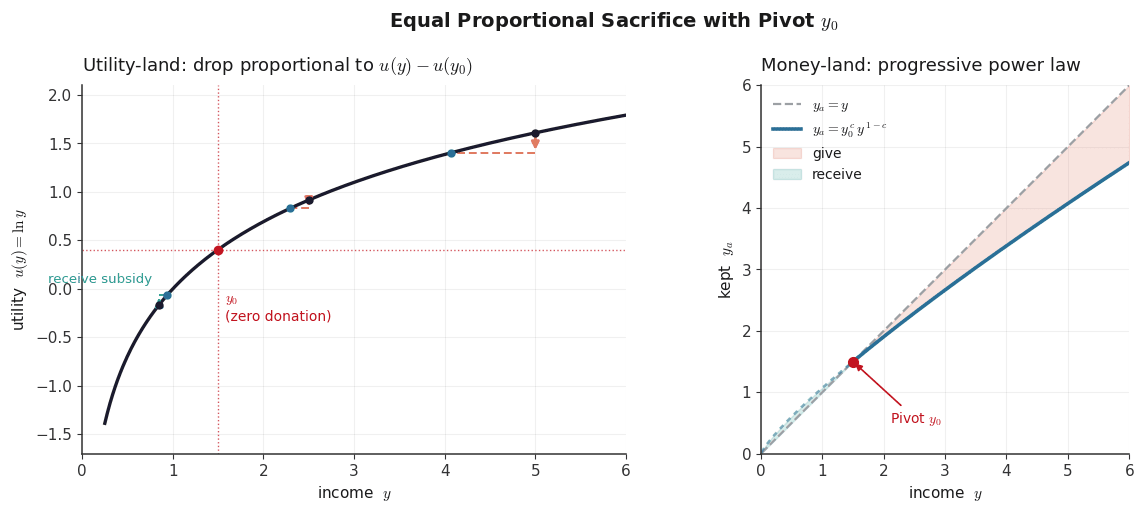
We can thus interpret that, in utility-land, what y0 does is act as a pivot, shifting the point at which the denominator in the equal proportional sacrifice formula switches sign — i.e. the point at which the pledge schedule tells you that you turn from being a giver to a receiver.
Equal proportional sacrifice requires a y0 pivot
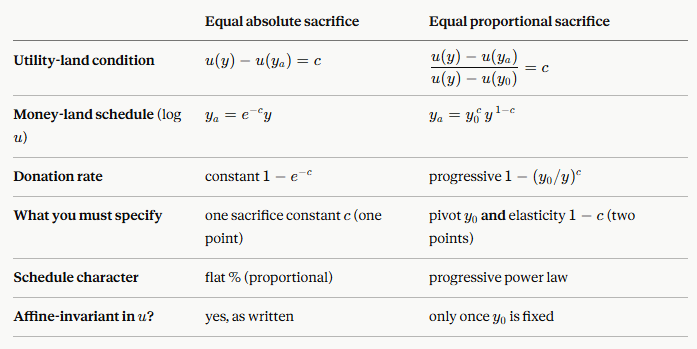
We can summarize the relationship we have found so far in the table below.
Comparing equal absolute sacrifice and equal proportional sacrifice under logarithmic utility
Non-log utility function
Using a logarithm to represent your utility of money is not the only way possible. In fact, logarithmic utility is just a special case of constant relative risk aversion (CRRA) utility functions, where you have a relative risk aversion of 1 (unity).
'Risk aversion' is really just a way of characterizing your utility function. It measures how much less or more willing you are when faced with uncertainties, usually operationalized as bets, as you get richer/poorer. The more risk averse you are, the more you are unwilling to take positive-EV bets.
For example, say I offer you a coin flip bet: heads you win $110, tails you lose $100. This seems like free money, as it has an EV of $5. But you may not be willing to take this bet, because you are averse towards the risk of losing your money.
'Risk aversion' then tells you if you are more or less willing to take this bet as you get richer. This implicitly tells me about the shape of your utility function — how 'convex' it is, and how much a given increase of money corresponds to an increase of your utility.
'Relative risk aversion' tests how you feel about proportional bets. Instead of absolute amounts, the bets are of a percentage of wealth (e.g. 10%). It asks: as you get richer, does risking 10% of my total net worth scare me more or less? One typical answer for human behavior here is that it's constant — i.e. risking 10% of everything feels roughly as intense, whether you're poor or rich.
Mathematically, a constant relative risk aversion (CRRA) utility looks like this:
u(y)=⎧⎪
⎪⎨⎪
⎪⎩y1−ρ−11−ρ,ρ≠1lny,ρ=1
I will not derive it here, but you can derive the above equation from the definition of CRRA.[8]ρ here is the coefficient of relative risk aversion, which equivalently means the elasticity of marginal utility. In other words, it's how fast a marginal dollar loses value as you get richer.
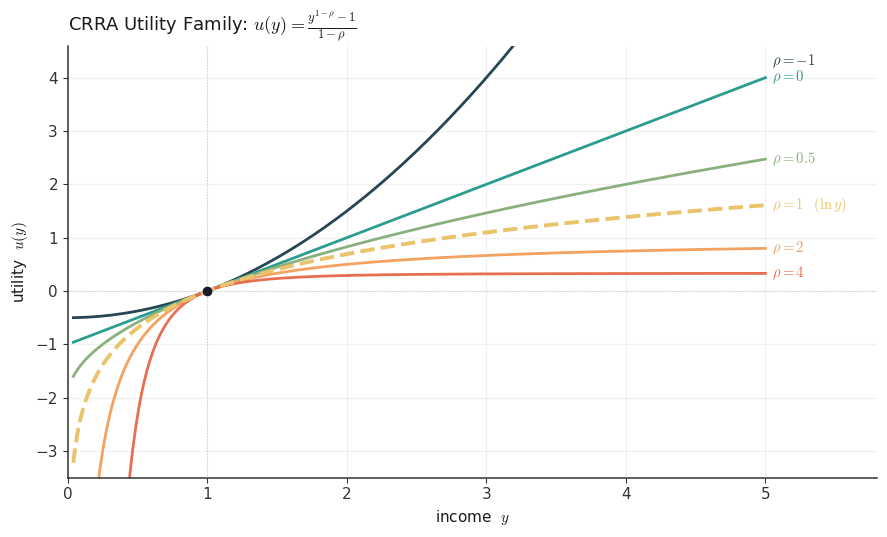
As we can see here, logarithmic utility is the edge case of when ρ is one. Utility is linear when ρ is 0, it becomes more 'convex' as you go negative (i.e. you become more risk-seeking), and becomes more 'concave' as you go positive (i.e. you become more risk-averse).
Various CRRA utility functions
Now, what does equal sacrifice mean here under these different CRRA utility functions? Deriving what the schedules would be under different notions of 'equal sacrifice', we get different schedules that depend on the value of your ρ.
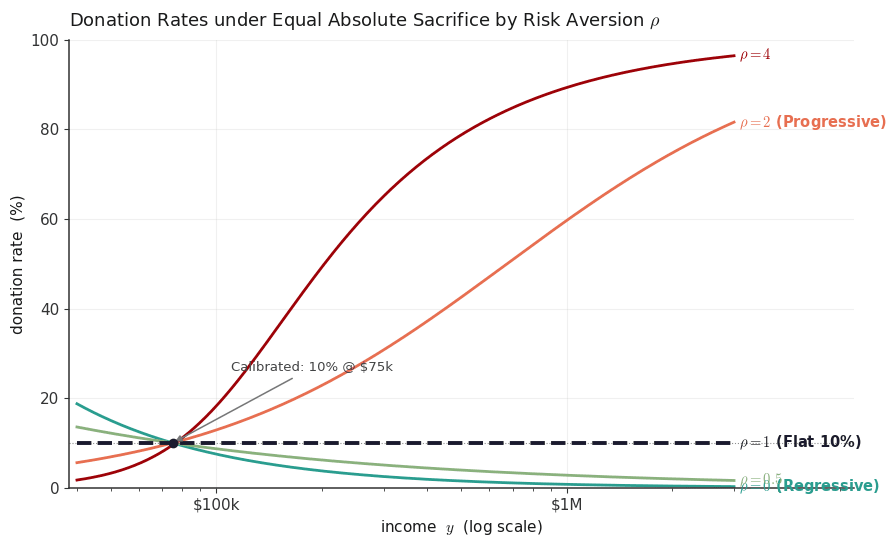
Specifically, for equal absolute sacrifice we get a consumption budget of
ya=(y1−ρ−(1−ρ)c)1/(1−ρ)
which is regressive for ρ<1, flat at ρ=1, and progressive for ρ>1. Visually, this looks like as follows.
Donation rates under equal absolute sacrifice under different CRRA ρ
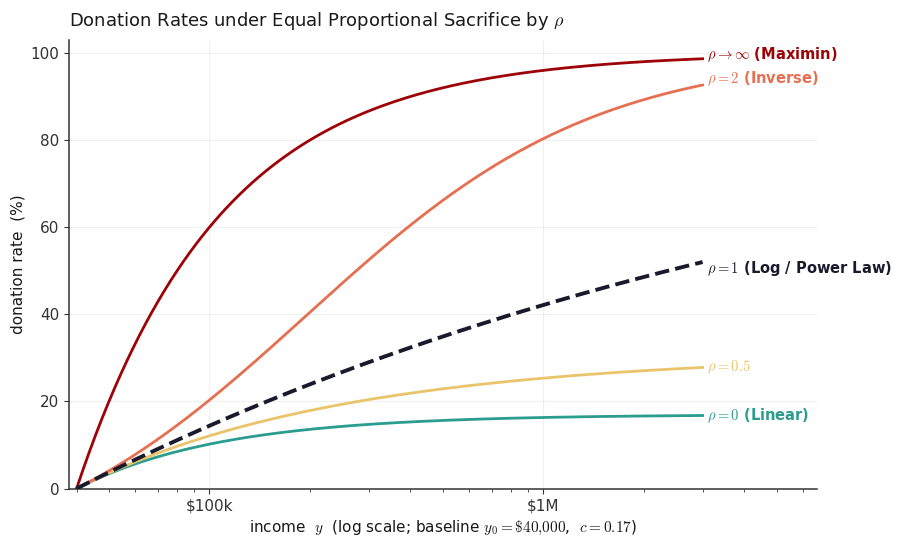
For equal proportional sacrifice, we get a consumption budget of
ya=[(1−c)y1−ρ+cy1−ρ0]1/(1−ρ),
which is a 'generalized' mean of your income y and the base level of income y0. And visually, this is:
Donation rates under equal proportional sacrifice under different CRRA ρ
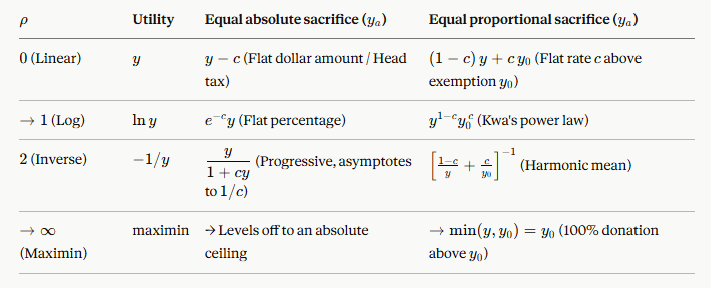
The table below is a summary of both equal sacrifices under different CRRA regimes.
Donation schedules under equal sacrifice across different risk aversion (ρ) regimes
Any sensible* donation schedule can be interpreted as equal absolute sacrifice
One surprising theorem that comes out of the public finance literature, from Young (1988), is that under mild assumptions you can always recover a utility function relative to which everyone sacrifices the same absolute utility.
Young states this theorem for apportioning a tax total to a population. Translated to a donation schedule ya(y), the assumptions are roughly:
Continuity — small changes in income produce small changes in what you give.
Separability — your donation depends only on your own money, not anyone else's.
Aggregate monotonicity — if the total to be raised goes up, everyone gives (weakly) more.
Incremental fairness — each extra bit of the total is apportioned according to people's current after-donation incomes.
Order preservation — whoever was richer before donating is still richer after (no reranking).
Given these, there exists an increasing, concave utility function under which the schedule is exactly equal absolute sacrifice.
OK, if the above is correct, of what use then is committing ourselves to a donation schedule based on some nicely-shaped utility function, if any utility function will do? Well, it's because we actually care about how our utility functions behave!
In particular, we care about scale invariance ("my pledge shouldn't change if I switch currencies"), which motivated our discussion about y0 above. In fact, CRRA ('isoelastic') utility is the unique family of utility functions whose marginal-utility ratios depend only on income ratios, rather than absolute dollar amounts (by definition!).
which itself smuggles in a notion of subsistence level y– that behaves like an additive pivot, instead of the multiplicative (and hence scale-free) pivot y0 that we have.
So, if "equal absolute sacrifice" plus "pick a sensible-looking progressive schedule" is always true for some utility function, then for our whole endeavor to not be vacuous, we need to commit ourselves to a specific utility function! And CRRA is a pretty sensible utility function to commit ourselves to.
Empirical estimates of the elasticity of marginal utility ρ
So, assuming we want to commit ourselves to a CRRA utility, what is the constant ρ that makes sense? There are some ways we can try to get an empirical estimate of ρ from different angles. Across economics, behavioral science, and public policy, researchers have tried to measure ρ using a variety of proxies.
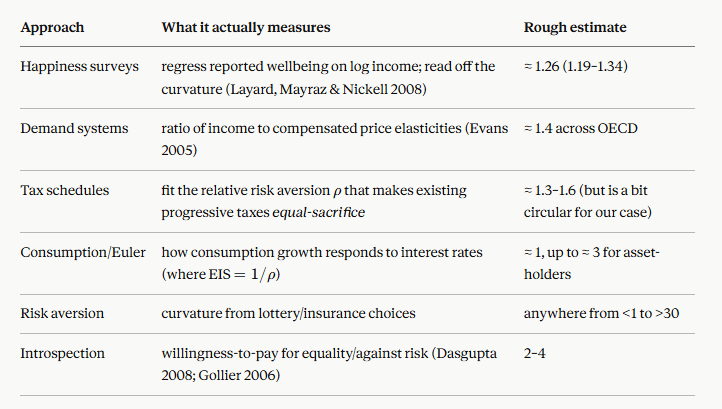
Here's a survey from Claude:
Different estimates of ρ, the elasticity of marginal utility
We can see here that the confidence intervals are kind of varied. But most seem to agree on a ρ of between [1,2], maybe with a tail to 4. But recall from our previous figure (donation rate under different ρ) that a swing from 1 to 2 changes a $1M earner's rate from roughly 40% to 80%. So our best estimates of the shape of utility functions do seem to propose at least a power-law schedule for your consumption budget ya, assuming equal proportional sacrifice.
Why do these different methods not agree? Well, it's because the single number ρ is being asked to do three different things at once:
Risk aversion — how much you dislike a gamble over money.
Diminishing marginal utility across people — how much less a dollar is worth to someone richer.
Intertemporal substitution — how willing you are to move consumption between time periods.
Under expected utility theory, with a CRRA utility function that is time-separable ('felicity function'), this parameter ρ serves all of them at once. And this need not be true, and does break down empirically. For our problem of determining donation pledge schedules, the morally relevant factor is (2), i.e. how much good a marginal dollar does for a poorer beneficiary. But a lot of estimates instead measure (1) or (3), and might not fit our case.
Besides that, humans aren't vNM maximizers anyway. Rabin's calibration theorem shows that an expected utility maximizer who turns down a 50-50 lose-$100/gain-$110 bet (like my setup in the above section) at every wealth level up to $300k must also turn down a 50-50 bet of losing $20k/gaining $160B. The general lesson is that any appreciable risk aversion over small stakes forces insane risk aversion over larger stakes, because one utility-of-money function has to govern both cases. So applying CRRA to model human behavior for risk-averseness seems to be a bit untrustworthy, at least across wide ranges of wealth. But we can still use it to model diminishing marginal utility, even though it's weaker on other fronts.
Should we even base pledge schedules on the principle of equal sacrifice?
The whole discussion about 'equal sacrifice' in the public finance literature really spawned out of the desire to have a sensible and rational basis for our taxation system. Notably, donation is different from taxation, in that donation is voluntary. We are not interacting with a state that can simply compel us to do things on the basis of implicit threat and a monopoly on violence.
More notably, discussion about 'equal sacrifice' is broadly a 'deontological' idea, and not a straightforwardly utilitarian/consequentialist one. It is not totally clear that by having an 'equal sacrifice' schedule we'd actually get an increase in the total amount of donation. A maximally progressive schedule extracts more from the rich (which is where the money is), but might scare those exact people off signing a pledge.
If we're consequentialists, with pledge schedules, what we're actually optimizing is
maxscheduleE[pledged×Pr(pledge∣schedule)]
i.e. find the donation schedule that leads to more people donating more of their money. In the case of tax, we essentially have Pr(pledge∣schedule)=1, because it's involuntary.
The principle of 'equal sacrifice' here then interacts with our overall goal of maximizing the total donation in two ways: (1) by changing how much a given person gives, and (2) by changing how likely they are to sign at all. So far, we have talked about (1).
But how about (2)? How does introducing the principle affect people's willingness to take a pledge? Well, for one, 'fairness' is a pretty persuasive principle, and touches a deep core of my little liberal-egalitarian heart. There seems to be evidence that people prefer this. We see that people reject purely utilitarian objectives for tax, and want something more equal-sacrifice-flavored. It buys fuzzies for people, and insofar as we get utils and fuzzies at the same time from it, the principle of 'equal sacrifice' is a pretty good principle on consequentialist grounds too.
Second, 'equal sacrifice' under different reasonable utility functions seems to yield pledge schedules that are simple and easy to understand. Under our CRRA with ρ between [1,2] and equal proportional sacrifice, we get a broadly progressive pledge schedule. We do trade off the simplicity that a fixed percentage pledge has, but we get a more equal and larger amount of donation from pledgers. Trading off simplicity may lower take-up, but in aggregate the increase in donation amount seems like a worthwhile deal — and people can always take the fixed percentage pledge anyway.
The likely audience for a pledge like this is also broadly EAs, and they are more likely than the general population to find it elegant and interesting to base their donating decisions on something that is a bit more theoretically grounded. It is satisfying that something as blunt as "give 10%" turns out to encode a specific claim about the shape of our implicit utility. Finding the latent model under our own behaviors, and checking whether we actually endorse its other implications, is what being a coherent agent feels like from the inside. Arguably, pursuing coherence and hopping on the train to Crazy Town is really thecollective pastime of our community 🙂.
Conclusion
A fixed percentage pledge is an equal absolute sacrifice of log utility.
A progressive, power-law pledge schedule is an equal proportional sacrifice of log utility — but you must define a reference y0 where you flip from donor to recipient, or else the schedule depends on how you denominate money.
Any sensible pledge schedule is really an equal absolute sacrifice of some utility function (Young, 1988).
But we care about how our utility function behaves, so not every utility function will do. Specifically, it should be scale invariant — i.e. a 10% loss of money feels the same at whatever level of money you have — which singles out CRRA utility functions.
Empirical parameters put the elasticity of marginal utility ρ between 1 and 2. Real-world estimates from happiness surveys (ρ≈1.26) and tax schedule fits (ρ≈1.3–1.6) suggest that human diminishing marginal utility falls in a moderately progressive regime. In this range, an equal-sacrifice pledge naturally asks for 20%–50%+ from high earners without resorting to arbitrary step-functions.
Pledge design is an exercise in mechanism design, not just ethics. While equal sacrifice is rooted in deontological fairness, consequentialists should still embrace it. A progressive schedule grounded in equal sacrifice offers a compromise: it feels intuitively fair, extracts more resources from high earners where marginal utility is low, and provides an elegant, theoretically grounded alternative to flat pledges.
And indeed this has been remarked before on the EA Forum, and in the public finance "equal sacrifice" literature, which goes back to J. S. Mill and was more recently formalized by H. P. Young (1990). ↩︎
To be clear, he uses a median American household income of $75k, which is a bit different from my $83k. This will slightly change the resulting values for y0 and (1−c). ↩︎
The elasticity of your donation d, however, depends on your y0! One better way to see this, is that, by way of identity, budget-share-weighted average of income elasticities always have to equal 1, i.e. ∑iwiηi=1. This means that if the elasticity of your post-donation money is constant <1, donation soaks up the residual and its elasticity starts high and comes down to 1 as income grows.↩︎
But this is only one way of 'balancing' the elasticities, and certainly not the most optimal one! You can, for example, reduce the consumption of all goods to 0.83 of your previous consumption. To calculate your optimal post-donation consumption bundle, shrink your budget to ya and re-solve your ordinary consumer problem at that smaller budget, letting the shares fall out. Only under homothetic preferences (all income-elasticities equal to 1) do 'scale every good down by 0.83' and 'reoptimize at the smaller budget' coincide. ↩︎
In a more technical manner, this is to say that our measure for equal proportional sacrifice is not invariant under affine transformation. In contrast, equal absolute sacrifice is invariant under affine transformation. ↩︎
CRRA is defined as η(y)=−yu′′(y)u′(y). After integrating, you arrive at a utility function that looks like u(y)=∫Ay−ρdy=Ay1−ρ1−ρ+B, which has a CRRA that is invariant under affine transformation. ↩︎