Regarding the extent to which PBAs displace demand for meat products or provide more options for vegetarians, some work led by my colleague Jessica Hope is relevant (summarized here).
I suspect other teams have forthcoming work on this as well. Very interesting subject!
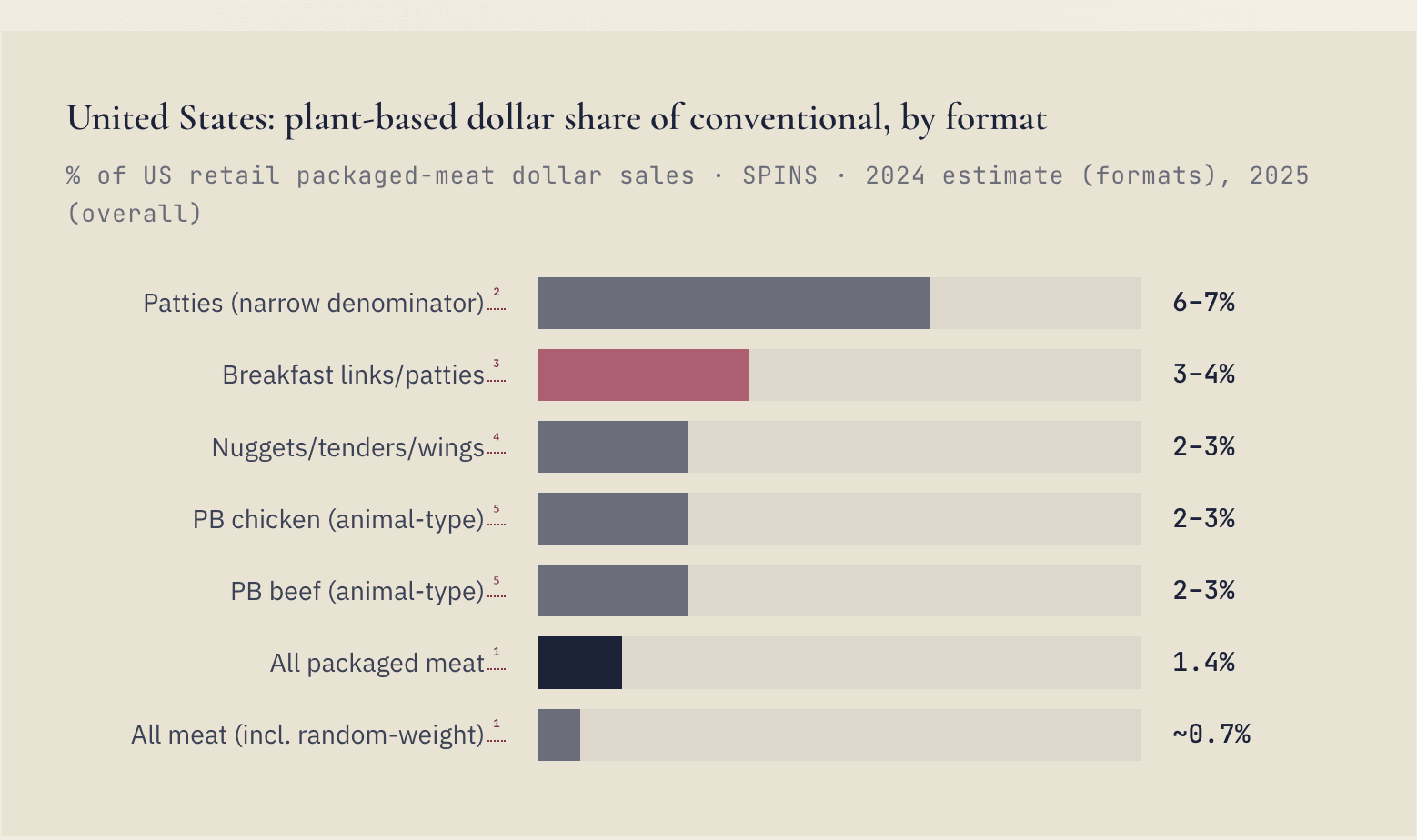
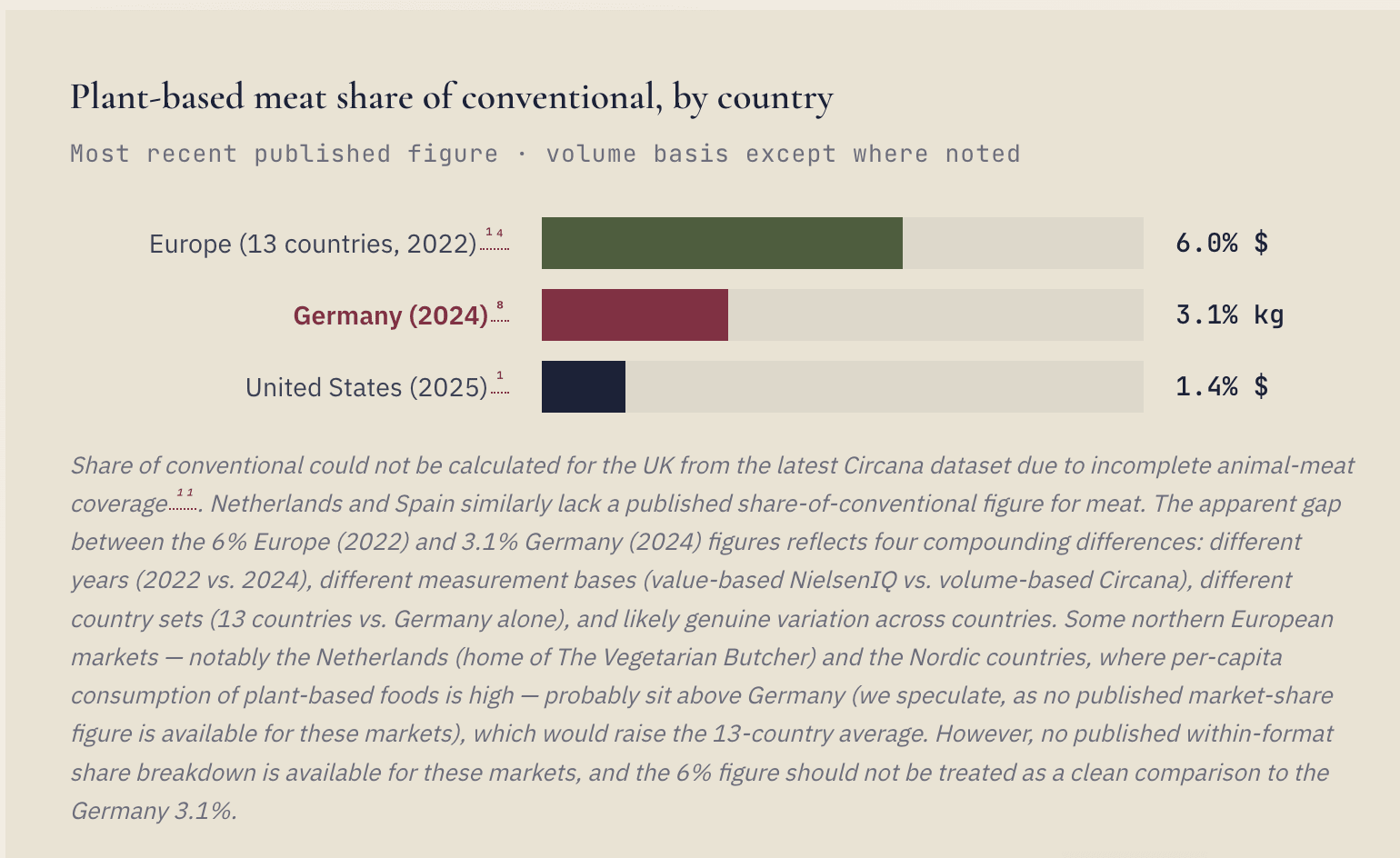
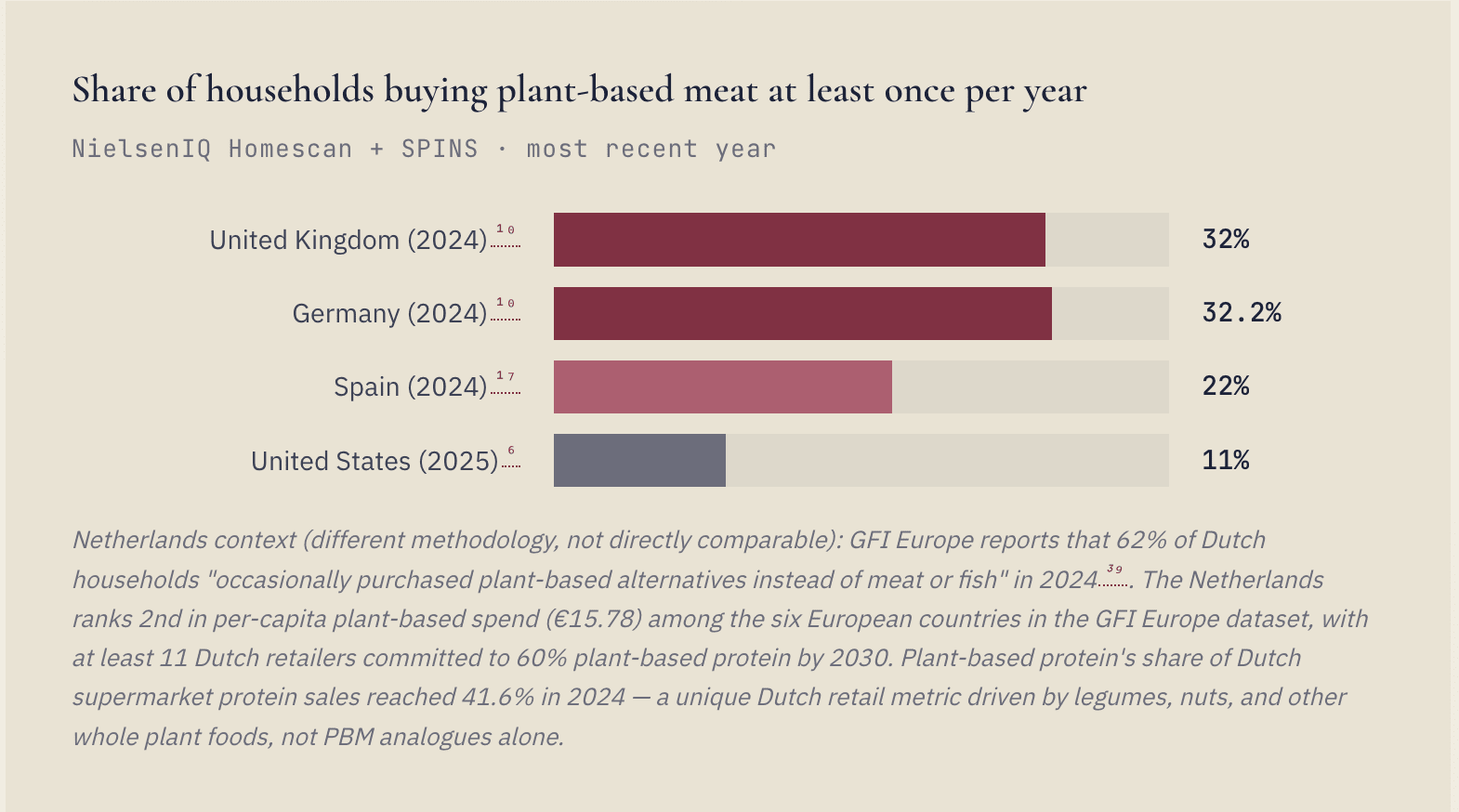
Hi, some feedback on the visual side of the figures: The scaling feels really strange when a value 6-7 % shows as a ~70% piece of the total, especially given that later on, a value of 32 % is shown as ~85% piece of the total.
Only the last graph seems to actually be scaled to 100 % at the total.
I think the first two would be clearer with a full-scale reference bar and "zoom-in" indication that the following ones display a smaller percentage as their total. And I'd say the third one has big enough values to scale to 100 %.
The scaling feels really strange when a value 6-7 % shows as a ~70% piece of the total
I should put a clear 'break indicator' on the x-axis, perhaps? Atm the comparisons only make sense within graph. Or what would you suggest? Wouldn't want to use up most of the page space for an 'empty' part of the graphing.
Group A: 0---> ______________________________________________________________________|
Group B: 0 -----------> _____________________________________________________________|
I was thinking maybe something like this - 1 extra bar with full scale and guiding lines capturing the proportion: 10 % Scale: 0--------|______________________________________________________________________| . . . . . . . . . . . . . . . . . . . . . . . . . . . . . . . . . . . . . . . . . . . . . . . . . . . . . . . . . . . . . . . . . . ↓ ↓ Group A: 0------------------------------------------------________________________________| Group B: 0--------------------------------------------------------________________________|
Or even just a down-open horizontal curly bracket ("top curly bracket") above the charts:
10 % ⏞ <---HTML code of the top curly bracket symbol Group A: 0------------------------------------------------________________________________| Group B: 0--------------------------------------------------------________________________|
Plant-based alternatives' market share and taste-comparability: Mature enough to justify studying substitution patterns, price-responses, and welfare implications? — EA Forum
Plant-based alternatives' market share and taste-comparability: Mature enough to justify studying substitution patterns, price-responses, and welfare implications?
AI Disclosure: This post itself was written by me with minimal LLM use (grammar checks, etc.) The linkedmaterial (and text in the images pasted below) is an ongoing iterative collaboration between human and AI input and feedback, and contains >30% AI generated text.
But in pre-workshop discussions, we've heard skepticism about:
I. Market share: Is the current PBA market share too small for any measured substitution to be important now or in the near future? (Quick take: It's around 1-2%, small but ~measureable.)
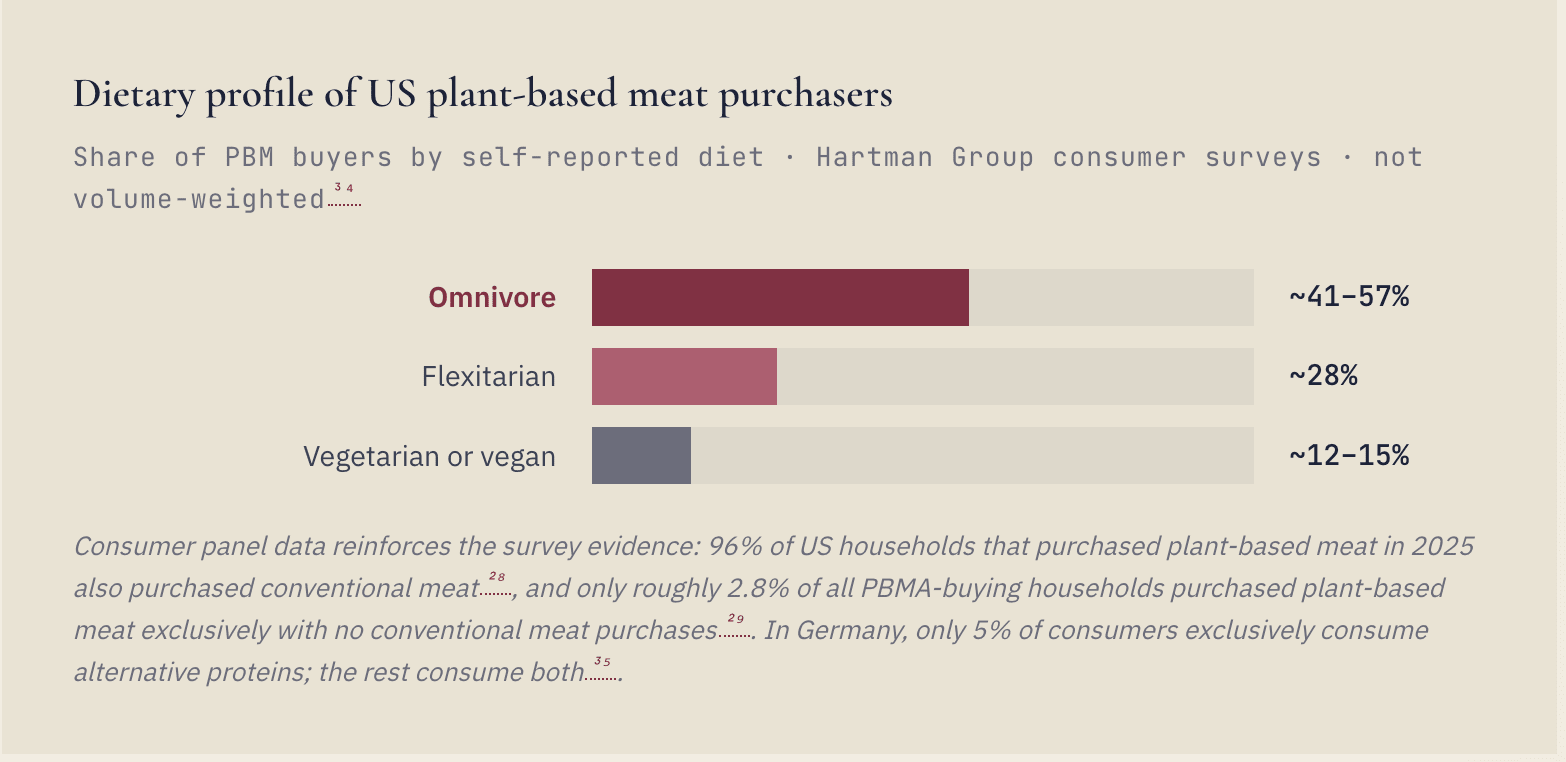
II. Audience/cannibalization: Are PBA products being 'mostly consumed by existing veg*ns' anyways, implying we shouldn't expect meaningful substitution[1]? (QT: Seems like omnivores are eating PBM.)
III.Maturity/taste comparability: Is the taste gap between PBA and conventional meat so large that current patterns will not be informative about the substitution we will see in the ~near future as these products improve? (QT: Mixed, ~15% of products seem taste-equivalent)
This comes on top of methodological/research questions that would be directly targeted in the PQ and workshop, including
A. Identification and reliablility of demand estimation. Can own- and cross-price elasticities and substitution patterns be reliably estimated in general? See e.g., Bray et al, which we're evaluating (package coming soon).
B. Data availability: Do we have enough real-world/meaningful data combining relevant PBA and animal-product consumption to permit meaningful statistical analysis?
C. Reliability of self-reports and hypothetical choice experiments/surveys
We've built (and continue to update) the linked shallow research report to inform issues I-III above, and give some early takes below. We're looking for your feedback; sidebar hypothes.is comments are especially welcome, and will be addressed (in addition to comments on this post).
This will also impact our PQ-evaluation and workshop plans. If the skeptics concerns seem very likely to hold, and there is consensus on this, we will pivot. (E.g., if I-III and/or B clearly hold, we might move towards focusing on animal-product substitution, with implications for food carbon taxes and meat taxes.)
Quick and early takes:
I. Market share is relatively small but meaningful; demand/price analyses have been done for smaller markets. By revenue, PBA represents roughly 1.4% of US packaged meat (0.7% of total meat), roughly twice this in Europe. It's a somewhat larger share of some key categories and markets (e.g., breakfast sausage and organic/specialty markets).
II. Evidence suggests it is mainly purchased (and likely consumed) by omnivores not by (or for) veg*ns.
This is not airtight, and we're digging further. The US survey data is mainly about purchasing, and GFI's UK report seems to lump in more traditional plant-based products like beans and falafel. Still, least in the UK GFI survey, we have 23% reporting having eaten PBM in the last month, and 14% in the last week. Only about 7% report describe themselves as vegetarian or vegan. So if respondents are being truthful at least half of the weekly PBM eaters in the UK are neither vegetarian nor vegan.
III. In NECTAR taste-studies on omnivores, most PBM products are not at taste parity, but 20/122 products did reach parity.
(Figures below pasted from the report for eye candy. NB, these may be adjusted as we refine this work).
NB: Careful about the "patties" category -- hamburgers can also be made from ground products.
Evidence seems fairly consistent that EU per capita consumption of PBM exceeds the US.
This is for purchasers, not consumers, so it could be omnivore purchasers buying these for veg*n family and guests. But other evidence suggests most consumers of PBM are omnivores.
Again, we are looking for feedback, corrections, and additions, and will adjust and acknowledge. Thanks in advance, and thanks to @Trevor Woolley, Jacob Schmeiss, and others, for relevant discussions.
Note: This post was crossposted from the Coefficient Giving Farm Animal Welfare Research Newsletter by the Forum team, with the author's permission. The author may not see or respond to comments on this post.
Subtitle: On vegan advocacy, effective altruism, and FIFA
I turn 40 today. Here are some hot takes.
On factory farming
1. Our biggest challenge is salience. If factory farming led the evening news, it wouldn’t last lo...
Impressions from the 21st Annual U.S. Cluster Headache Patient Conference, organized by Clusterbusters.
On the morning of the last day of the conference, E. was hanging out with other “clusterheads” outside the conference hotel when he started having a cluster headache attack. Before he could go back to his hotel room, J. offered E. his DMT v...
TL;DR:
The movement has an evidence problem. To solve it, for each intervention we need to know:
* What types of evidence that intervention needs
* What types of evidence different sources can give us
In this post, we outline a framework for evidencing an intervention through five stages:
...


Hi David, my colleagues and I have a forthcoming project that will address the substitution question using a large, novel dataset. (UPDATE: that preprint is now summarized in Research report: modern alternative proteins did not replace meat purchases in restaurants.)
Regarding the extent to which PBAs displace demand for meat products or provide more options for vegetarians, some work led by my colleague Jessica Hope is relevant (summarized here).
I suspect other teams have forthcoming work on this as well. Very interesting subject!
Thanks. Will have a look and try to incorporate this into our synthesis. Stay tuned for the potential upcoming workshop/