I’m not sure about whether this argument is reassuring even if you buy it. In economies with a lot of surplus labour, jobs certainly get filled, but we find menial things for people to do. Last time I was in India, there was a man employed to open the door for me at the bank so that I could use the ATM, in an example that feels particularly prescient. (There was a separate person standing next to him who was qualified to give directions, and a third who was a security guard—this man’s job was just to open the door for me).
I can imagine that this man feels like he is getting paid and can put food on the table, perhaps, but it is a stretch to imagine that his job gives him meaning, needed to happen, or had any point at all. Indeed, it is probably the case that a lot of India’s economic development has not occurred because of the vast amounts of surplus labour available—automatic doors do exist, after all.
India does not use genetically modified crops, for example, even though they have demonstrably higher yield. Why? Well, in one telling, GM crops would require less labour to tend to them, but they already have plenty of labour to slosh around. And you know what they say about idle hands…
A vast and rapid injection of surplus labour into the global economy is potentially very bad, but perhaps not in a way that is measurable in income or employment.
A vast and rapid injection of surplus labour into the global economy is potentially very bad
It is worth noting the speed and scope of an injection of surplus labour is not independent from how it impacts people. I am sceptical of a vast and rapid injection. However, if it happens, I would still expect it to be good.
This argument seems to be based on the view that "jobs" are just tasks that need to be done in the economy, and that it's better if we have AI/robots that can do those tasks more efficiently. But "jobs" have a dual role - for most people, they are also the main pathway for upward social mobility.
Financial capital follows a power law distribution. Human capital is normally distributed. Jobs are therefore the main mechanism we have in society for those who were not lucky enough to be born into financial capital to nevertheless earn a living and get a share of the vast wealth that "the economy" produces. If that mechanism is obliterated - what other ways are there to ensure people not born into financial capital to get wealth? Will they have to rely on altruism alone?
I have heard people worry that the new wealth produced by AI will all be concentrated in the hands of, say, five people, and the rest of us will be left to starve.
I think this is a strawman of actual wealth concentration concerns. Most reasonably informed people I know who hold these concerns aren't expecting AI's wealth to be concentrated in the hands of 5 people. But AI's wealth could easily be concentrated in the hands of the people who hold the majority of AI-related capital - say, the top 10% globally - 800 million people (and their descendants) - with few pathways for those not born into capital to get a share of that wealth. Even the top 1% globally is 80 million people.
If these 80 million people hold the vast majority of wealth and power, it is foolish to think that the rest of society can "just keep doing what they're currently doing", completely unaffected. For example, if the top 80 million people got incredibly wealthy to the point that they each got private jets (according to Google, there are currently only about 25k private jets), that alone could raise air pollution or carbon emissions in a way that definitely impacts the other 99% of the world.
Hello. You may be interested in how the distribution of income before tax (not wealth) has evolved across time. The 1 % of people with the highest income had around 20 % of the total income before tax both now, and 200 years ago.
The data in this area is pretty shaky. On the graph you have shared specifically:
Although the graph goes back to 1820, there is actually very limited data before WWI, as most countries didn't have income taxes back then (which is the main source of data). In fact, when you click on the individual countries, most of them do not go back before 1900. The US starts in 1913, China starts in 1979, India in 1923, Indonesia in 1984 and Nigeria in 1985. Japan's series doesn't start until 2008!! Clicking through the countries, it looks like countries with considerably less than half of the current world's population had any data before 1900, and I am not sure what extrapolations they had to make to get the "World" figures they use for teh graph.
I would also be very sceptical of income data for developing countries, which tend to have large "informal economies".
China is an interesting case. There is no doubt that China has experienced enormous economic growth since its economy opened up in the late 1970s. But the graph for China shows the income share of the top 10% growing from 28% of China's income to 41.7%! Caveats about data reliability still apply, but that is quite a shocking increase in inequality.
More generally - there is some evidence that median wages have started to decouple from general productivity growth, with the labour share of income declining over the past ~20-30 years. Economists argue about the data, the causes of this, and whether it is a temporary or lasting change. But some think it is because “superstar” firms with low labour shares have taken a greater market share thanks to globalisation and digitsation. See e.g. Autor et al (2020), and this 2018 OECD working paper.
In any case, I don't think we are going to resolve this disagreement by exchanging data because: (1) data is limited; (2) there are so many different ways to interpret the data and experts genuinely disagree on this; and (3) we can also argue over the extent to which the past predicts the future. I think there is only so much we can learn from the past as I am concerned AI can be different in important ways - i.e. I think it is very plausible that the distributional impacts of automating cognitive labour will be quite different to the impacts of automating physical labour or routine, administrative tasks, but I won't be able to prove this with data.
The main reason I replied wasn't to get into an argument over data as that can go on for days with no resolution. Rather, I replied because I saw this post already had a fair number of "disagree-votes" and only one comment explaining why, so I thought I should at least explain my alternative view.
Thanks for the good points. Here is the same graph for the United States (US). The income before tax of the 1 % of people with the most income was supposedly 20.4 % in 1913, and 20.7 % in 2024. I am sharing data for the US because it covers a long period (111 years), and "has been the world's largest economy since about 1900" until 2015.
Re: bets - I am highly uncertain about AI timelines myself. Amongst the EA/AI community, I think my timelines would be considered "long" - I expect major advancements in robotics will be needed for AI to displace more than about 20% of the current jobs in developed countries, and I don't expect that could happen within the next 10 years.
Here, I explain why I support job-destroying technologies such as AI and robots.
1. The Naive Concern
Nearly any beneficial technology can be attacked for “destroying jobs.” The latest suspect: AI. Many are now worried that computers will destroy white collar jobs. I, on the other hand, am only worried that it might not be good enough to destroy many jobs. I think the current round of hand-wringing about AI job-destruction is similarly fallacious to worries about other technological advances, such as machines that harvest food or manufacture cloth.
Here is a naive concern; perhaps this is what most people worrying about “job destruction” think: Suppose some new technology makes it possible to produce some good or service, X, using half as much labor per unit of X as was previously needed. Then half of the X-workers will get laid off. Or maybe total consumption of X will go up, so maybe fewer than half of the workers will get laid off, but still a lot. Also, the remaining workers will get less pay since there is “less need” for them.
On the other hand, the price of X for consumers will go down, profits will go up, and often the quality of X’s will also go up. (If there was a hand-made car, I don’t think it would be very good.)
In deciding whether the new technology is good or bad, we subjectively weigh our feelings about the X-workers against our feelings about the consumers. (We ignore the profits of the businesses, because who cares about them?) Most people have more sympathetic feelings when thinking about the poor X-workers, which makes it seem as if the technology is bad.
2. Past Job Destruction
In the Middle Ages, over 90% of the population were farmers.
Since then, we developed harvesting machines, fertilizers, better crop breeds, etc., that vastly increase food production, so that one farmer of today can produce the output of something like 100 medieval farmers. Today, under 5% of the population are farmers, and we have a lot more and better food. Presumably, a lot of farmers were forced to stop farming along the way.
If you follow the reasoning of section 1 above, this must have been a disaster. Why aren’t 85% of the population now unemployed? Somehow, we found new things for people to do. And we keep finding things for people to do, through every wave of technological advancement. The increased mechanization of factories did not lead to mass unemployment, nor did the computer revolution that occurred during my lifetime; they just made our society richer. There is no observed trend toward unemployment as technology advances.
If we had listened to the luddites, we would have avoided most of the great advances of the last 300 years, we’d still be living as peasants, and we wouldn’t have such wonders of modern civilization as indoor plumbing, cell phones, and my philosophy books.
3. The Broken Window Story
The reasoning of section 1 suggests that increased production might be overall, economically bad. The natural extension of this is to say that destruction is good. Not many people would like to put it like that, but the argument follows the same logic.
Bastiat gives the example of a child who breaks a shopkeeper’s window. Onlookers then say that this is good for the economy, because it creates business for the glazier, who will be hired to replace the window. The glazier will then have more money, which he will use to buy something else, thus further stimulating the economy, etc.
Saying that it is good to break a window is basically equivalent to saying that it is bad to stop the breaking of windows. The latter argument follows the same logic as section 1: if you stop people from breaking windows, then some number of people who are employed in replacing windows will lose their jobs.
What is wrong with the broken window argument? One problem is that it overlooks opportunity costs: because the shop owner has to pay to replace the window, he now has less money to spend on other things. Now, he’ll be unable to afford a copy of Understanding Knowledge. As a result, I will also have less money to spend on video games, etc. So the alleged stimulatory effect of the window-breaking is counter-balanced by its inhibition of other economic activity. Overall, the economy is about as well-off as it was before, except that now one person, the shopkeeper, has less stuff overall. E.g., he could have had a window and a copy of Understanding Knowledge; now, he only has a window. (For more, see Hazlitt’s Economics in One Lesson.)
If you agree that destruction is overall bad because it results in our having less stuff overall, then you should also agree that increased production is good because it results in our having more stuff overall.
4. The Concern About AI Wealth Concentration
I have heard people worry that the new wealth produced by AI will all be concentrated in the hands of, say, five people, and the rest of us will be left to starve.
This is very confused. If Sam Altman and Elon Musk accumulate some vast wealth through super-smart robots, but somehow none of this gets shared with the rest of society, why wouldn’t the rest of society just keep doing what we’re currently doing? How would Musk and Altman stop us from trading with each other? Since the rest of us, in this scenario, don’t have the robots, we keep making stuff using normal labor, to trade it to each other. Let’s say that somehow Elon gets all the farmers and all the textile workers fired so that robots can pick the fruit and sew the clothes. Why can’t the farmers go back to picking fruit using non-robot methods, to trade it to the textile workers, who also go back to making clothes using non-robot methods, etc.?
The wealth-concentration story doesn’t make sense, because in order for the AI companies to replace the farm workers, people must be buying the products from the robot farms, which means people must be able to afford them. The same goes for all the other products in the economy.
Of course, in previous rounds of automation and productivity-increase, there was no general trend of products becoming less available to ordinary people. Almost everything has steadily become more affordable.
5. How Technology Raises Wages
One way of describing the effect of productive technology is to say that we become able to produce the same amount of stuff using fewer workers. True. But the other way of saying it is that we become able to produce more stuff using the same number of workers. If you assume that total production is fixed, then it sounds like we’re going to get unemployment. But it’s closer to the truth to assume that total employment is fixed, in which case you just get more production, i.e., society gets richer. Why does the latter happen rather than the former? Basically because roughly the same number of people want to work, and there is basically no limit to how much stuff people are willing to consume.
Do productive technologies raise or lower wages in the industry that adopts them? They might lower wages due to less demand for workers. But they could also raise wages (for the people who continue to work in that industry) because each worker is now more productive. E.g., if one worker can now produce the amount that 100 workers used to produce, then that one worker’s labor is now much more valuable than it used to be.
Of course we cannot say that a round of automation or other technological improvement will always be good for everyone. There’s no guarantee that someone won’t be worse off in any given case. But the overall effect of productive technology in general is to make almost everyone vastly better off than people were in earlier centuries.
This is particularly true when the improvements are widespread, i.e., affecting many industries. When you have an improvement narrowly focused on one industry, then it is more likely that specific people in that industry will wind up worse off—certainly in the short term, and possibly even in the long term.
6. Say’s Law
Why don’t widespread productivity improvements produce the sort of unemployment, demand shortages, and impoverishment that people are worrying about? The answer lies in
Say’s Law: Aggregate supply = aggregate demand.
Aggregate supply is the total supply of all goods and services in the economy, i.e., the total value (as valued by the market) of the stuff that people are willing to sell. Aggregate demand is the total demand for all goods and services, i.e., the total amount that people are willing to pay for stuff. The reason these are said to be equal is that the supply creates the demand.
Note: This is not the idea that if you create some product, then people will start wanting that product just because you created it. It is not claiming that production alters people’s desires. (That might be true in some cases, but it’s not what Say’s Law is about.)
To see the basic point, it’s helpful to look past money, which is a distraction. Fundamentally, people don’t want money. Fundamentally, people trade valuable goods and services (“stuff”) for other valuable stuff, and money is just an intermediary that facilitates exchanges. When you “demand” blueberries in the economic sense, this just means that you offer something else of value in exchange for blueberries. Your total demand for stuff is the total amount of stuff that you are willing to trade for other stuff. And that is generally going to just be the total amount of stuff (including services) that you yourself provide. Your productivity creates your demand for other stuff, in the sense that you are only able to buy stuff because you have created some value that you can exchange for that stuff.
By the same token, the total demand of everyone for everything in the economy is determined by the total productivity of everyone in the economy. Note that “demand” in this context does not refer to people’s purely subjective desires; it refers to people’s ability and willingness to actually offer value in trade for the things that they are said to demand. Demand in that sense does not create supply; it is created by supply. This is why, if you want an economy to be stronger, you should not be trying to “stimulate demand”; you should be trying to increase productivity, and the rest will more or less take care of itself.
Btw, more recent economists have criticized Say’s Law; they think you can sometimes have an excess of supply and shortage of demand. This might happen if people increase the amount of money they want to hold and therefore refrain from consumption. If people are slow to adjust prices (including wages), then there can be an excess supply and some involuntary unemployment. However, I think these are relatively small and short-term effects, and they are not what the “technological unemployment” pessimists are worrying about. The latter people appear to be worrying that we’ll have massive unemployment because we “won’t need” workers anymore.
Say’s Law is the basic explanation for why productivity boosts over the last 200 years have not led to 90% unemployment. The productivity boosts themselves created the increased demand for labor that prevented the unemployment. People can always think of something useful for people to do. The more productive businesses are, the more they can afford to pay for people to do those things, whatever they are.
7. What Will the New Jobs Be?
Sometimes, techno-optimists try to respond to the unemployment worry by listing new jobs that will be created by the new technology. E.g., someone worries that combine harvesters are going to cause massive unemployment for farmers, and the optimist says, “Oh, don’t worry. There will be new jobs for, um, building combine harvesters. And oiling them. And repairing them, I guess.” (This almost makes it sound like we should be hoping for them to break down a lot.)
These defenses often sound lame. The new “jobs created” by the technology usually sound as if they’d be far less numerous than the jobs destroyed. If AI causes massive white collar layoffs, just how many “prompt engineer” positions do we expect to pop up to take all these disemployed workers?
That is the completely wrong approach to defending a new technology. It isn’t good because it will create jobs in that way. Insofar as it creates that kind of job—e.g., jobs fixing harvesters, or jobs checking AI outputs for hallucinations—the technology is flawed. The ideal situation is that new technologies don’t create any jobs of that kind.
The desired way for new technologies to create jobs is that they increase total productivity, which raises the total demand for all labor that is still being done by people.
Objection: “But given how amazing AI is, what if it literally replaces all human jobs?”
That would be amazing. If only that would happen! That would mean the end of scarcity. The fact that there was no demand for labor would mean that there was no work anyone could do that would add to total productivity, which would basically mean that we have satisfied all human desires (that labor previously contributed to satisfying) with no work. There would be no need for anyone to charge money for any of these things, since they’d be unlimited.
That won’t happen, though. AI will not do literally everything. I don’t know which occupations will expand and which will shrink. But in all previous rounds of productivity advances, we’ve found that there were still useful things for people to do. Whatever those things are, they wind up being worth more. As machines approach being able to do everything, the value of an hour of labor approaches infinity.
8. Trends
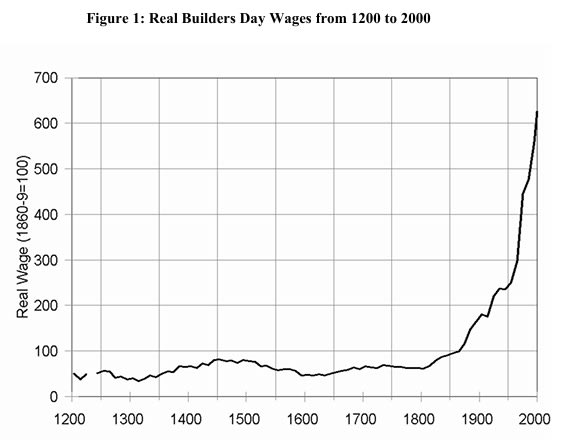
The value of an hour of labor has dramatically risen over the long term. Here’s a graph of worker wages in England since 1200 A.D. (source):
You can see the dramatic takeoff with the industrial revolution.
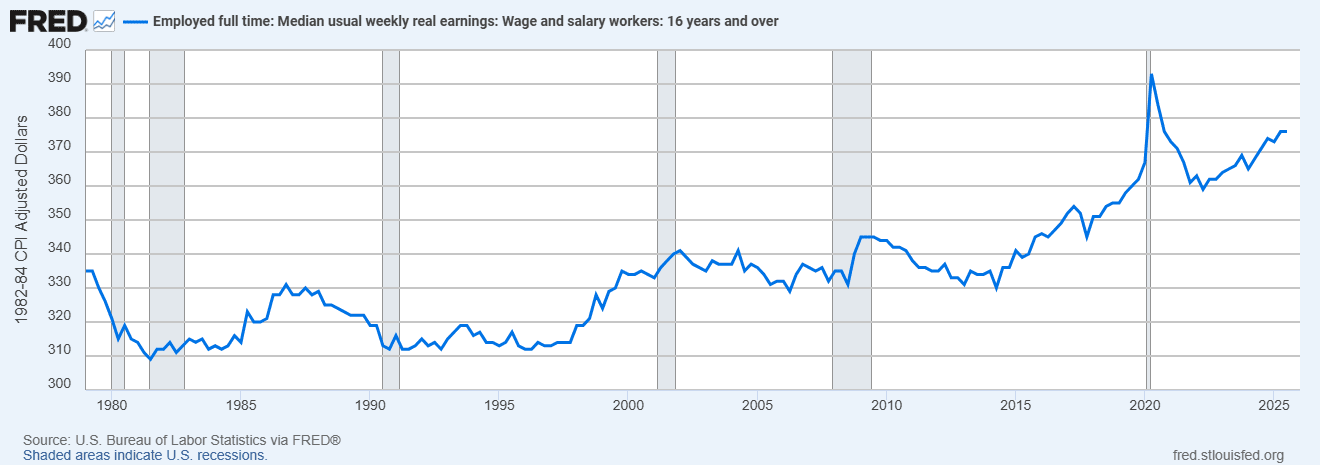
I know that I’m now going to hear that wages have stagnated in the U.S. recently, so here’s a graph of median wages in the U.S. since 1979 (source):
You can see that wages are on the increase.
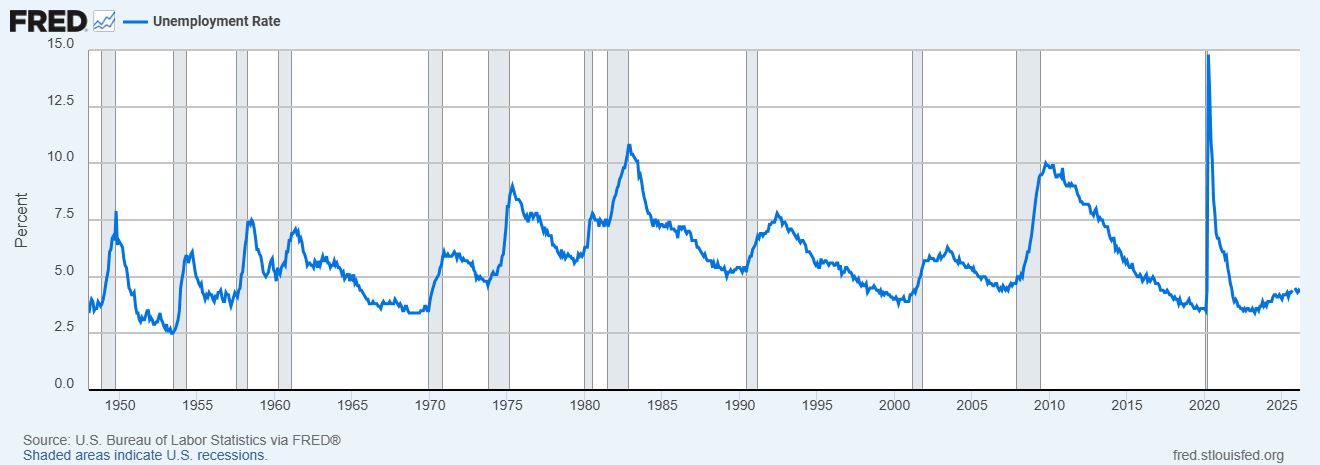
There is also no trend toward unemployment resulting from technology; here is the U.S. unemployment rate since 1948 (source):
In sum, there is no sign of the economic problems the alarmists are worried about actually happening.
By the way, there are some financial markets as well as economic experts that predict economic growth for the next few years. They generally expect moderate growth; there’s no sign of an imminent growth explosion due to AI or whatever else. (1, 2) Unfortunately, AI isn’t ready to take our jobs yet.
Note: This post was crossposted from the Coefficient Giving Farm Animal Welfare Research Newsletter by the Forum team, with the author's permission. The author may not see or respond to comments on this post.
Subtitle: On vegan advocacy, effective altruism, and FIFA
I turn 40 today. Here are some hot takes.
On factory farming
1. Our biggest challenge is salience. If factory farming led the evening news, it wouldn’t last lo...
On October 22nd starting at 10:00am Pacific Time, Every.org is matching donations to select animal welfare organizations at a 2:1 rate, up to $2,000 per donor per nonprofit (so if you give up to $2,000, they will contribute up to $4,000 and the nonprofit will get up to $6,000). The first donation a donor makes to each eligible nonprofit will be matched, and donors can get the match for multiple $2,000 donations. So, you can get more than $2,000 matched by donating $2,000 one time to multiple...
When speaking to candidates who are considering working with us at 80,000 Hours, I often hear people worry about replaceability.
The familiar version of the worry is about whether the organisation will hire someone else in your place. If it will, then the difference you make by taking the job is only the difference between you and them.
There are a couple of well-known answers to that. The person hired in your place probably cares about the world too, and would go on to do somethi...


I’m not sure about whether this argument is reassuring even if you buy it. In economies with a lot of surplus labour, jobs certainly get filled, but we find menial things for people to do. Last time I was in India, there was a man employed to open the door for me at the bank so that I could use the ATM, in an example that feels particularly prescient. (There was a separate person standing next to him who was qualified to give directions, and a third who was a security guard—this man’s job was just to open the door for me).
I can imagine that this man feels like he is getting paid and can put food on the table, perhaps, but it is a stretch to imagine that his job gives him meaning, needed to happen, or had any point at all. Indeed, it is probably the case that a lot of India’s economic development has not occurred because of the vast amounts of surplus labour available—automatic doors do exist, after all.
India does not use genetically modified crops, for example, even though they have demonstrably higher yield. Why? Well, in one telling, GM crops would require less labour to tend to them, but they already have plenty of labour to slosh around. And you know what they say about idle hands…
A vast and rapid injection of surplus labour into the global economy is potentially very bad, but perhaps not in a way that is measurable in income or employment.
Hi Huw. Thanks for sharing.
It is worth noting the speed and scope of an injection of surplus labour is not independent from how it impacts people. I am sceptical of a vast and rapid injection. However, if it happens, I would still expect it to be good.