Community-powered aggregation (scalable with retailer oversight) To scale beyond pilots, vegan product data can be aggregated from the vegan community through a dedicated reporting platform. To ensure reliability for retail partners, classifications are assigned confidence scores based on user agreement, contributor reliability, and historical accuracy. Only high-confidence data is shared with supermarkets.
Couldn't this be automated? Perhaps with occasional human checks? Food products are required to list their ingredients so it should be pretty easy to classify. Or maybe I'm missing something.
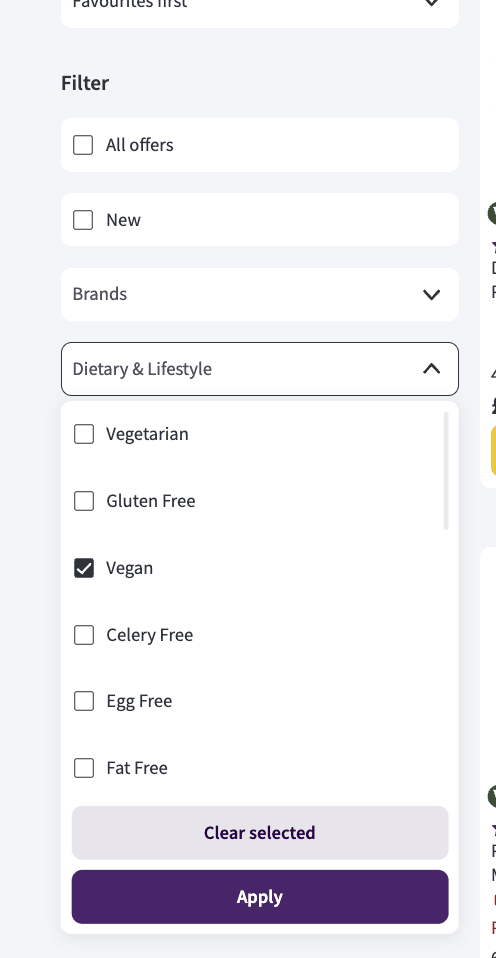
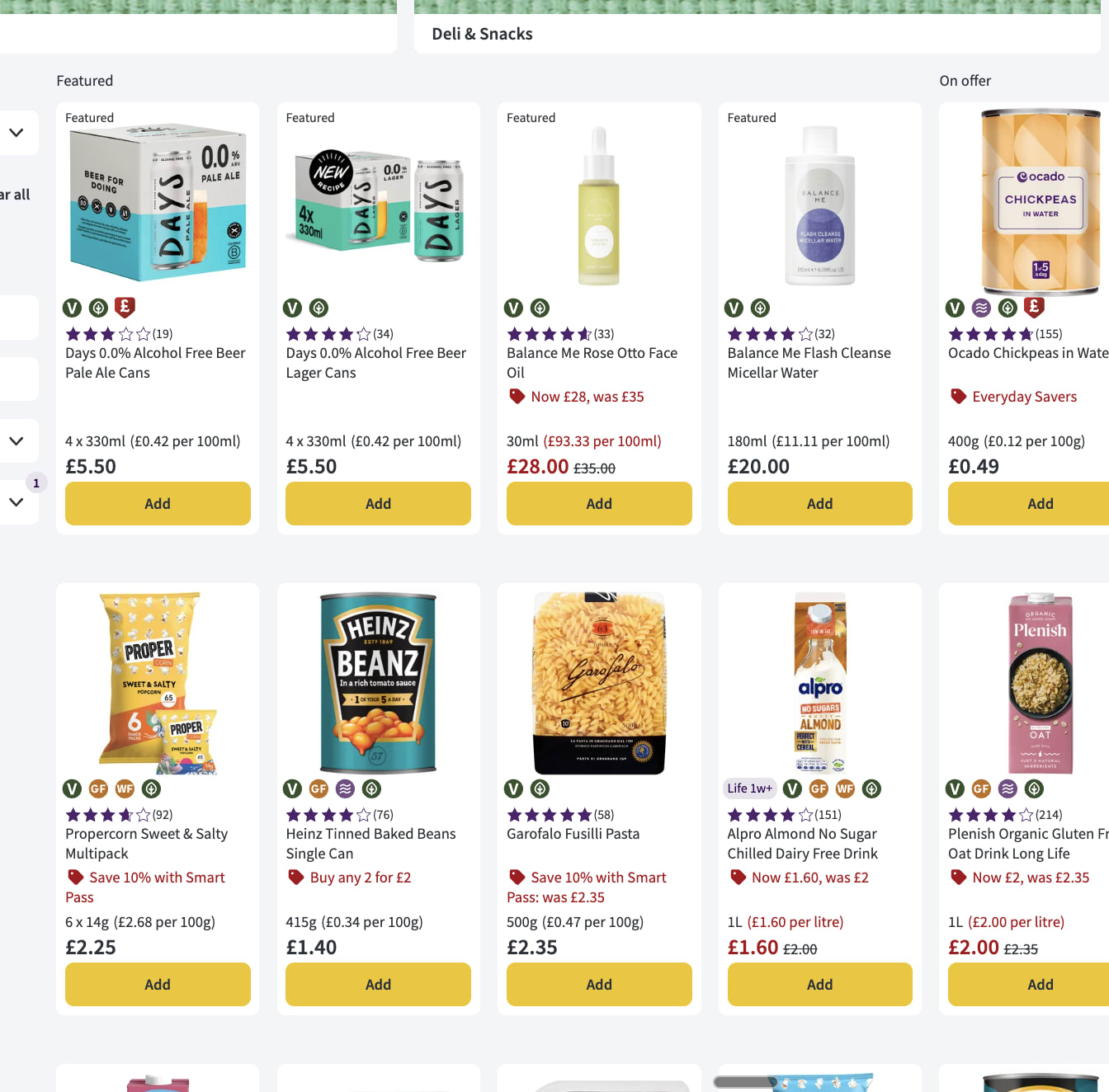
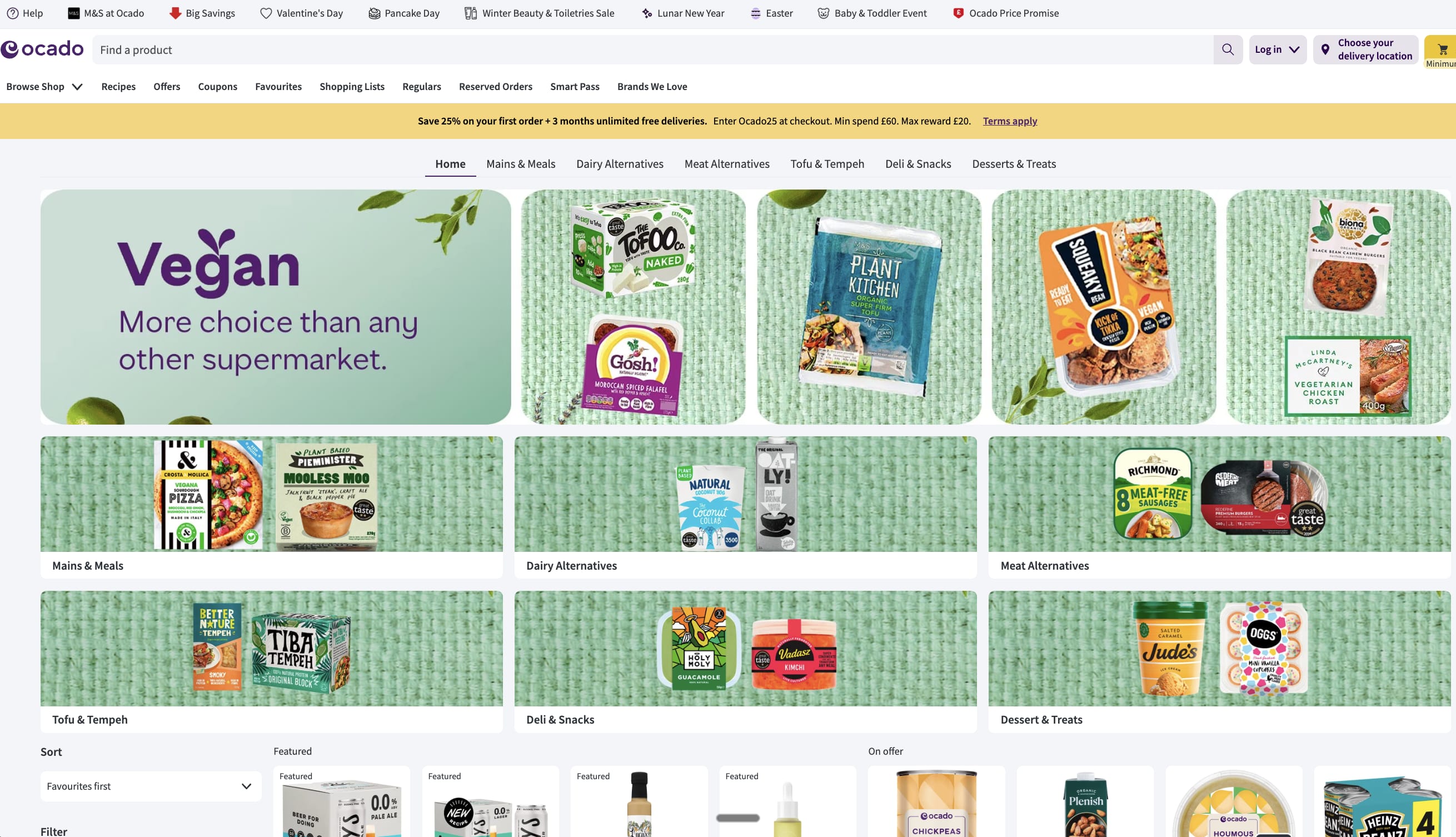
Yes, Ocado is one of the few strong real-world examples of what we’re proposing. Similarly, Albert Heijn, the largest supermarket chain in the Netherlands, offers a comparable vegan filter and is often cited as a key contributor to the country’s high adoption of plant-based diets.
The key point, though, is that cases like Ocado and Albert Heijn are exceptions, not the norm. Most online supermarkets lack the resources and incentives to systematically review and continuously update tens of thousands of SKUs for vegan status.
Because this intervention has high potential impact but is rarely implemented, it’s exactly where an external, mission-driven actor can add the most value. The goal is to make what works in a few frontrunners common everywhere.
The key point, though, is that cases like Ocado and Albert Heijn are exceptions, not the norm. Most online supermarkets lack the resources and incentives to systematically review and continuously update tens of thousands of SKUs for vegan status.
I'd go a step further: I suspect many supermarkets are going to perceive an incentive not to do this because it raises uncomfortable questions in consmers' minds about the ethical permissibility/goodness of their other items.
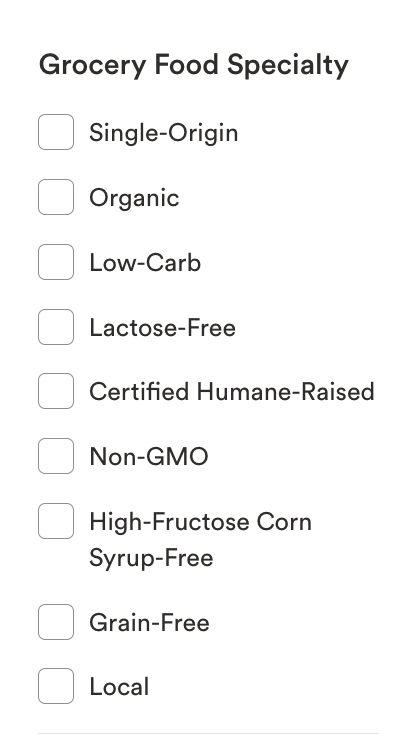
I wonder if this will be more palatable to them if "vegan" is just one of several filters, along with (e.g.) keto, paleo, halal, kosher. Right now the Whole Foods website has the following filters available -- would it be such a stretch to have some identitarian ones?
I really don't know.
I looked into this a bit when i was thinking about how hard it is to get high-welfare animal products at grocery stores (https://regressiontothemeat.substack.com/p/pasturism) and I made contact with a sustainability person at a prominent multinational grocery store and asked if they'd like to meet up during Earth Week to discuss such a filter. They did not write back. I relayed a version of this conversation to someone involved in grocery store pressure campaigns at a high-level, and that second person said, basically anything that implies that some of their food is better/more ethical than other options is going to be a nonstarter.
On the other hand, you've had some initial successes and it seems some grocery stores are already doing this! So I really hope it's plausible. If you're interested, I'm happy to flesh out the details of these prior interactions privately.
The key point, though, is that cases like Ocado and Albert Heijn are exceptions, not the norm.
As a partial pushback (and for reference for any vegans!), 6/8 biggest UK supermarkets which allow online shopping have these sort of filters. (Proof here)
These are definitely different to the 'whole website vegan toggle' option, and only available on some subset of pages. They also miss the 'norm-building' impact of having a very visible 'vegan toggle'. However, I'd tentatively doubt supermarkets would consider having the toggle, considering how crammed supermarket website homepages already are. (This of course probably isn't representative for China, which I think is the main point in this post.)
Most online supermarkets lack the resources and incentives to systematically review and continuously update tens of thousands of SKUs for vegan status.
Tesco uses Spoon Guru to create/manage filters (according to their app). Seems like it could be a more tractable 'off the shelf' solution for other supermarkets.
In the US, Instacart has a "dietary preferences" setting where you can opt to have more shown to you from categories like vegan, vegetarian, organic, etc. But when I tried it, it seemed to show me basically the same as usual.
I'm not sure whether these have been improving a lot over time but I feel like they usually miss a lot of items that are vegan? I was shopping with Ocado every week up until October last year and I never found the filter to be very good so I'd still check ingredients myself.
Thanks for this post – really would have liked having such a filter in the past.
We estimate that The Vegan Filter could cut the convenience barrier roughly in half by addressing the “supermarket barrier,” one of the largest friction points for new vegans.
Can you say more about why you estimate this to half the convenience barrier? I expect this to be much lower, maybe cutting the inconvenience of being vegan by 1-5%. The filter could still be worth the effort, of course :)
Sainsbury's used to offer this (called 'dietary profiles', maybe used to be offered in 2021 or so?) but it got broken at some point and they've never fixed it. They're already tagging new products as vegan or not, since they have a 'new + vegan' section, implying they wouldn't need to do any extra categorisation work — so I'm not sure why their dietary profiles are broken.
Here's the message that displays on their page if you have it turned on:
'The Dietary Profile service is currently unavailable while we build a new and improved service which will launch later this year. In the meantime please check individual product pages for further allergen information'
I'm not sure if it always said 'which will launch later this year' but I'm confident it's been broken since 2022 or so.
This would be convenient! I wonder if you could have a fairly-decent first pass via a Chrome extension that hides all non-vegan items from the UI (or just greys them out).
You could probably use LLMs to do a decent first-pass on whether items are vegan. It'll be obvious for many (e.g. vegetables, meat), and for non-obvious ones you could kick off a research agent who finds an up to date ingredient list or discussion thread. Then add the ability for users to correct classification mistakes and you'd probably be able to classify most foods quite accurately.
Then promote the Chrome extension via vegan magazines, influencers, veganuary, etc.
I used a meal logging app once and the database it had was incredible, though not perfect. If the item had a barcode, the app had its nutritional data. So extension, agent, even an app with a camera can all work. Of course, I live in the US.
This is a thoughtful suggestion, and technically it’s quite feasible. The key issue, though, is effortlessness, which is the main behavioral bottleneck we’re trying to solve.
A Chrome extension (or app) is, by definition, an opt-in solution. It only helps people who are already motivated enough to discover it, install it, and keep using it. In practice, that means it mainly serves committed vegans - not the much larger group of new vegans, flexitarians, or people trying to reduce animal products, where most of the impact lies.
By contrast, a native vegan filter inside the supermarket UI is default-available, works on mobile, and requires zero setup. That difference matters a lot: friction at the point of purchase is one of the strongest predictors of vegan dropout.
We agree that LLMs, crowdsourcing, and user corrections are promising for data generation. In fact, those approaches are likely part of the backend solution. But as a delivery mechanism, browser extensions don’t scale to mainstream users in the way platform-level features do.
In short: the proposed extension could be a useful prototype or data-gathering tool, but it doesn’t solve the core problem - making vegan shopping effortless for everyone, by default.
Is this primarily meant for people who are already veg*n/sympathetic or a wider audience?
If the latter, it is worth rethinking if the word "vegan" should be used at all, as there are a bunch of studies that show that the public is negatively biased towards the term and alternate terms are received more positively (see this, for instance).
Could probably get more support if you presented it as not limited to veganism: a lot of people have dietary restrictions (ex: allergies) and this is a way supermarkets could compete for customers.
It would just be difficult to have the rigor for multiple restrictions out the gate. All you need is a couple of gluten poisonings to upend the whole project. Strategically, starting with one restriction can help them stress test the model and build out from there with great evidence for additional investors.
Have you considered trying to offer this on food delivery apps? India has a lot of infrastructure for making it easy to find vegetarian products in their apps, I’ve found it very useful :)
This is a down-the-road consideration, but let's say this approach becomes wildly popular, pushing people who would have shopped in person online in order to get their easy vegan options. Do the environmental benefits of a new vegan outweigh the environmental costs of a new online supermarket shopper, order process, and deliveries?
Why do you expect it to be worse environmentally to order online?
If the alternative is driving, it seems much less efficient to have 10 people independently drive to the shop and back than to have one van deliver all their food in a single round trip.
If the alternative is public transport, I guess it's less clear, but ordering online probably allows bigger shops in that case, which I'd guess would be more efficient again?
The only way I can see it clearly making things worse is if the alternative is walking to the shops. But in that case, I'd still guess that the environmental costs of the products themselves would be much more important than the environmental costs of their transport (just because this is a claim that seems to be made a lot, and I think must factor in the transport costs of getting it from the shop to your home as well!)
It depends on the specifics, but I live in Brooklyn and getting deliveries from Whole Foods means they probably come to my house in an electric truck or e-cargo bike. That's pretty low-emission. (Fun fact: NYC requires most grocery stores to have parking spots.)
As I currently live in an urban area in the Netherlands, I made the comment with the consumer walking or biking in mind. While ordering my groceries would be more convenient for me, I specifically do not because of the higher environmental costs. My using the app, and so being limited to online ordering, would be a worse environmental outcome than my continuing to walk and review products myself manually. But I am, to your point, likely not in the majority.
There are two main reasons I ask: first, because I don't know that the environmental costs of the products themselves would be higher (seems likely, but I don't know) or that transportation to the home, rather than the store, is factored into estimates as a point of course. The second reason I ask is because I think any valuable solution should consider the system implications of wild success.
I do think it is a good solution, and probable that, even at universal scale, is more sustainable.
Your online shopping delivery is batched with other houses' deliveries which means that the petrol required to get groceries from the supermarket to your house is lower. Also online shopping encourages shopping in bulk which means fewer trips to the supermarket.
The dietary shift dwarfs transportation effects. Animal agriculture is dramatically more emissions-intensive than transport associated with grocery shopping.
The Vegan Filter: Overcoming the Leading Barrier to Veganism
Edit: The match seems to now be over - the funds were expended in around 35 minutes. But many of these charities are great and should be supported regardless!
***
On October 22nd starting at 10:00am Pacific Time, Every.org is matching donations to select animal welfare organizations at a 2:1 rate, up to $2,000 per donor per nonprofit (so if you give up to $2,000, they will contribute up to $4,000 and the nonprofit will get up to $6,000). The first donation a donor makes to each el...
Crossposted to Less Wrong
‘Like most of life’s dangers, the dangers of artificial intelligence are not easily identified from the armchair.’
J Dmitri Gallow
Epistemic status
I’m not an expert in this field, and herein I make some sweeping generalisations educated guesses about the overall...
84% of people who try veganism quit, most citing inconvenience as a major reason.
The Vegan Filter is a project concept designed to make veganism dramatically more convenient.
It introduces a single Vegan filter button in online supermarkets that hides all non-vegan products, effectively turning the supermarket vegan.
At very low cost, the Vegan Filter could substantially increase vegan retention, making it one of the most scalable and neglected opportunities to reduce animal suffering.
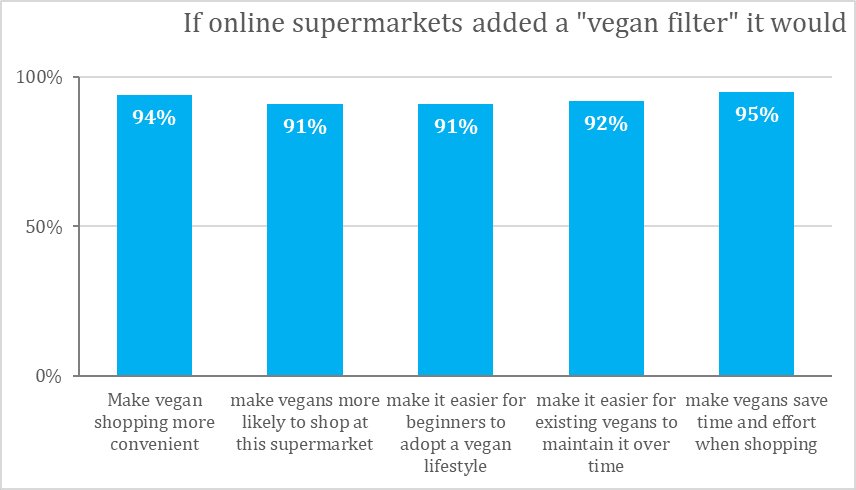
A vegan filter is strongly desired by consumers: Over 90% of respondents in the China Vegan Survey 2025 say it would improve convenience, vegan retention, and supermarket preference.
Imagine you have just turned vegan and are doing your first grocery shop. What used to take 10 minutes now takes half an hour. You read ingredient lists line by line, hesitate over unfamiliar additives, and still leave unsure whether you made mistakes. When you get home, you discover that one product contains eggs. Frustration sets in. The experience feels mentally exhausting rather than empowering.
This is not a niche story. For many people, veganism does not fail because of ethics or motivation. It fails because everyday tasks become cognitively demanding. Every shopping trip requires sustained vigilance. This constant friction quietly erodes motivation, until quitting feels like relief.
Behavioral science has a name for this: high friction environments suppress otherwise motivated behavior.
Convenience is the weak link
Large-scale data confirms this pattern.
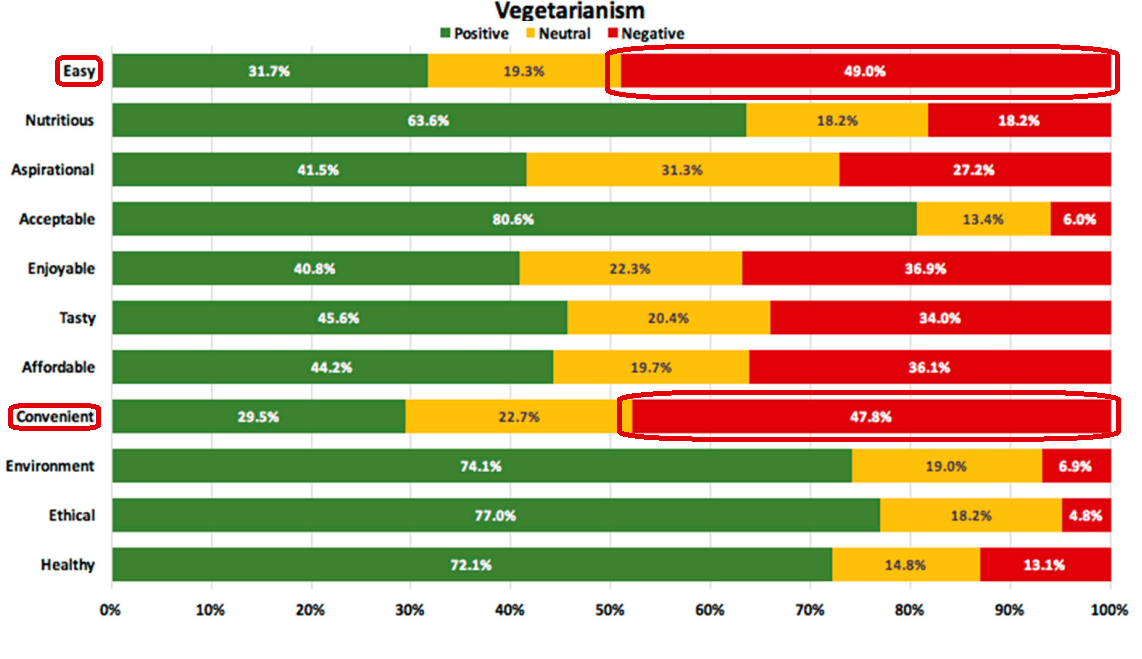
Faunalytics (2014, 2025) finds that 84% of people who attempt plant-based diets eventually quit, with inconvenience among the most commonly cited reasons. Cross-cultural consumer research shows the same result in both Western and Eastern contexts. Bryant (2019) identifies lack of convenience and ease as the most negatively perceived attributes of vegetarian diets.
Figure 1. Perceptions of vegetarianism across key attributes. Respondents rated vegetarianism as positive (green), neutral (yellow), or negative (red) across multiple dimensions. While ethical, environmental, and health attributes are perceived overwhelmingly positively, “Easy” and “Convenient” stand out as the most negatively perceived attributes, with nearly half of respondents rating them negatively. This highlights convenience as a primary bottleneck for adoption rather than values or attitudes. Reference: Bryant (2019)
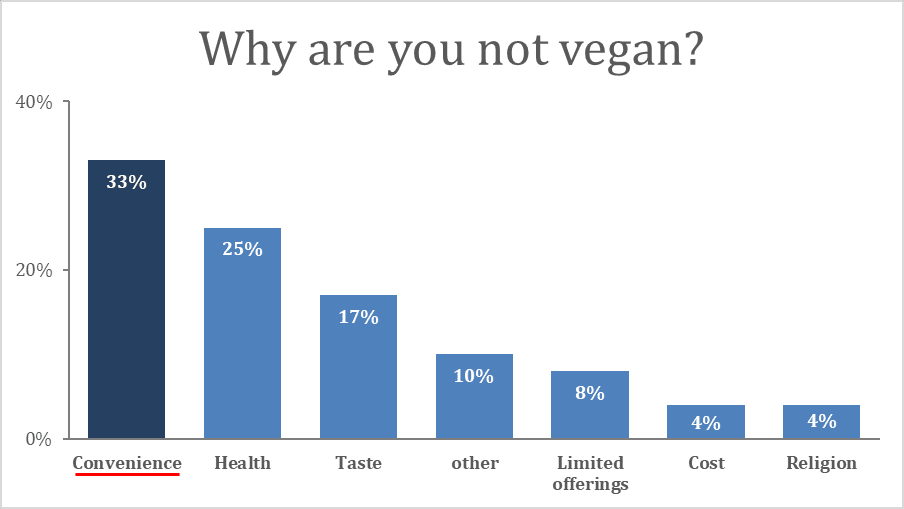
Recent data from the China Vegan Survey 2024 reinforces this conclusion: inconvenience is the leading barrier preventing flexitarians from adopting a vegan lifestyle.
Figure 2. Convenience is the leading barrier to vegan adoption in China. Results from the China Vegan Survey 2024 show that inconvenience is the most frequently cited reason preventing flexitarians from adopting a vegan lifestyle, exceeding health, taste, cost, and other factors. Reference: China Vegan Survey 2024
In short, veganism is often not a moral problem, but a usability problem.
The solution: Turn the supermarket vegan with a click of a button
Now imagine the same online supermarket, but with a simple toggle at the top of the page: Vegan Mode: ON.
With one click, all non-vegan products disappear. What remains is the full assortment of vegan options across every category: staples, snacks, sauces, frozen foods, household items.
Nothing about the user’s motivation has changed. The environment has.
This is a classic choice architecture intervention: instead of asking people to exert more willpower, we redesign the environment so the desired behavior becomes the default.
Strong consumer validation
Survey data from the China Vegan Survey 2025 shows overwhelming support for a vegan filter among Chinese vegans and flexitarians:
94% say it would make vegan shopping more convenient
95% say it would save time and effort
91–92% say it would support both adoption and long-term adherence
91% say it would make them more likely to shop at that supermarket
This suggests the Vegan Filter is not only theoretically helpful, but strongly desired by its target users.
Figure 3. Overwhelming consumer support for a vegan filter in online supermarkets. In the China Vegan Survey 2025, 91–95% of respondents agreed that adding a vegan filter would make vegan shopping more convenient, save time and effort, support both adoption and long-term adherence, and increase the likelihood of choosing that supermarket.
How the Vegan Filter could work
Core mechanism and partnership model
The Vegan Filter is designed as a collaborative intervention with online supermarkets, not a third-party workaround. The core idea is to work directly with the retailer and provide them with high-quality product classification data that enables a vegan filter within their existing platform.
Once integrated, the supermarket can offer an optional “Vegan Mode” that hides all non-vegan products, allowing users to browse the full store as if it were entirely vegan.
Importantly, this collaboration does not require changes to inventory, suppliers, pricing, or product availability. It only adds a product-tagging layer that plugs into existing filtering or category APIs already used by large e-commerce platforms.
Data creation: two complementary approaches
1. Paid expert review (best suited for pilots with retail partners) In collaboration with a partner supermarket, a small paid team reviews the full product catalog (around 10,000 items) to determine vegan status based on ingredient lists and manufacturer information. This curated dataset is then handed directly to the supermarket for integration and is periodically updated to account for reformulations and new products.
2. Community-powered aggregation (scalable with retailer oversight) To scale beyond pilots, vegan product data can be aggregated from the vegan community through a dedicated reporting platform. To ensure reliability for retail partners, classifications are assigned confidence scores based on user agreement, contributor reliability, and historical accuracy. Only high-confidence data is shared with supermarkets.
In practice, a hybrid model is likely most effective: paid review enables fast, high-accuracy deployment with a supermarket partner, while community aggregation supports long-term scaling across platforms and regions.
Why collaboration matters
Direct collaboration with supermarkets is what makes the Vegan Filter uniquely powerful:
It embeds the intervention at the point of purchase
It reaches all shoppers
It allows immediate, platform-wide impact at very low marginal cost
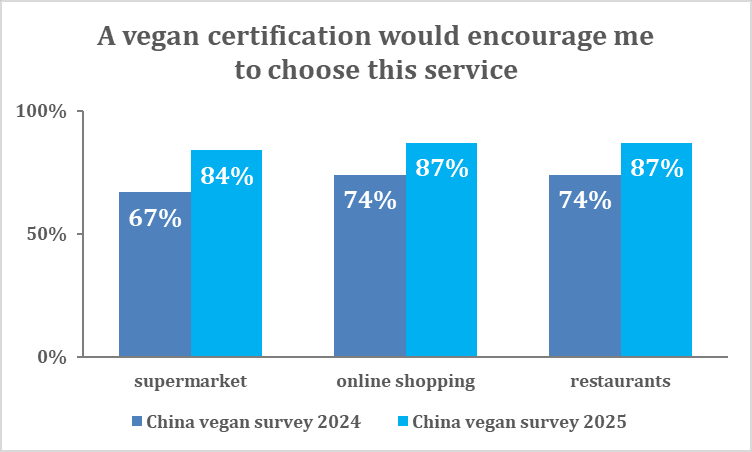
This is supported by consumer data. In both the China Vegan Survey 2024 and 2025, most respondents report that vegan certification would make them more likely to prefer supermarkets and online supermarkets over competitors.
Figure 4.Vegan certification increases preference for supermarkets and online supermarkets. Across both the China Vegan Survey 2024 and 2025, most respondents report that vegan certification would encourage them to prefer supermarkets, online supermarkets, and restaurants offering such certification.
This partnership-based approach turns a simple filter into a scalable behavioral intervention. For retailers, this reframes the Vegan Filter from a values-based feature to a customer acquisition and retention tool.
Why It Could Work
A 2024 randomized controlled trial published in PNAS, involving 2,359 shoppers, found that grouping vegan products into a separate category increased plant-based selection by 25%(Katare & Zhao, 2024).
A vegan filter goes even further. Instead of adding a category, it removes all non-vegan options with a single click, reducing search costs and decision fatigue across the entire shopping journey.
If modest categorization effects already produce large behavioral shifts, a full-store vegan mode is likely to have even stronger effects.
Importantly, grocery shopping in China is already highly digital. In the China Vegan Survey 2025, 69% of respondents report buying groceries online often or always.
Impact estimation
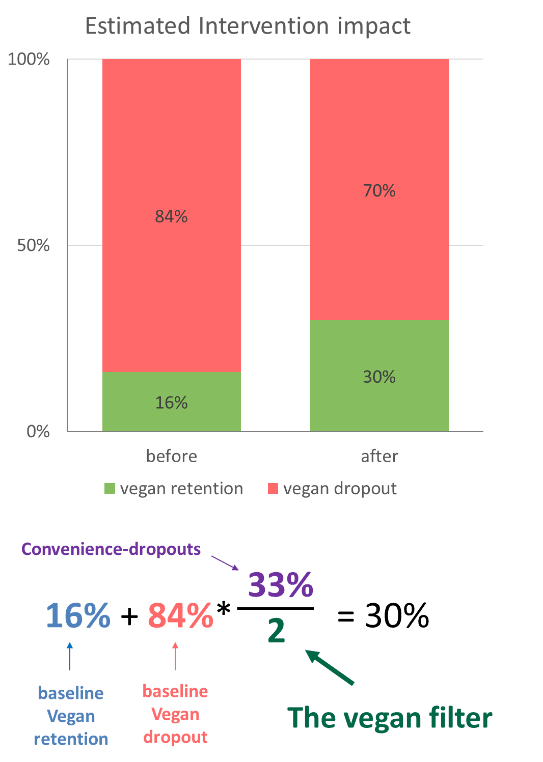
We estimate that The Vegan Filter could cut the convenience barrier roughly in half by addressing the “supermarket barrier,” one of the largest friction points for new vegans.
Assuming:
16% baseline vegan retention (Faunalytics, 2016)
33% of dropouts driven primarily by inconvenience (China Vegan Survey 2024)
This intervention could plausibly increase long-term vegan retention from 16% to 30%, effectively almost doubling the sustained vegan population in affected areas.
Even partial success would translate into very large downstream effects.
Why this matters for effective altruism
The vegan filter sits at the intersection of behavioral economics, tech infrastructure, and animal advocacy. It is:
1. Neglected
Although inconvenience is one of the main reasons people abandon vegan diets, very few online supermarkets offer a comprehensive vegan filter across the entire store. Most existing solutions are fragmented, leaving a clear and underexplored gap at the point of purchase.
2. Tractable
The Vegan Filter is technically simple to implement. It relies on product tagging and filtering infrastructure already used by large e-commerce platforms and does not require changes to inventory, pricing, or supply chains. Pilot implementations can be deployed incrementally with minimal engineering effort.
3. Large scale
Once integrated, a vegan filter can be rolled out across an entire platform with near-zero marginal cost per additional user. A single partnership with a large online supermarket can reach millions of shoppers repeatedly, making it easy to expand across regions and platforms without proportional increases in cost or complexity.
Even a modest increase in vegan retention (say, 10%) across large e-commerce platforms could translate to tens of millions fewer animals consumed annually - for a tiny marginal cost.
This could be one of the most cost-effective interventions to reduce animal suffering, especially if open-sourced and replicated globally.
104
More posts like this
45
Vegan Challenges Are An Underrated Lever For Diet Change





Couldn't this be automated? Perhaps with occasional human checks? Food products are required to list their ingredients so it should be pretty easy to classify. Or maybe I'm missing something.
Yes. But scraping data from the online shopping platform is probably against their policy and could have significant legal consequences.