Comments

Some thoughts from a product manager working in tech:
- AI increasing productivity allows startups to do more with less. I wouldn't necessarily expect it to significantly accelerate growth in general as coding speed is rarely the bottleneck for scaling products. You still need to grow your team, reach your target audience, find product-market fit, build your brand, convince customers to change habits, etc. This all takes time and effort. Coding is a surprisingly small part of it in most cases, especially for startups that aren't lacking funds for hiring engineers (which I'd expect to encompass ~all of the YC-backed ones).
- None of your metrics is actually measuring the rate of growth. You are measuring the absolute size (valuation) of a company after a certain amount of time passes. It's entirely possible that the startups are indeed growing faster but are smaller than before, sold off earlier or taking less investment (making the post-YC valuation less accurate).
A few effects that would incentivize this:
(1) AI enables doing the same work with a smaller team, decreasing the need for external investment and therefore founder dilution, lowering founder incentives for high valuation (for a founder 30% share in a $50M company is actually better than a 10% share in $150M one, as they maintain more steering power)
(2) AI makes copying a product easier, increasing the bargaining power of larger incumbents offering acquisition
(3) Advances in general-purpose AI are reshaping markets and societies faster than any technological change before, increasing the risk of a startup becoming irrelevant despite early success. - AI capable of significantly accelerating coding in non-trivial use cases has only been available since mid 2025 - early 2026, depending on who you ask. The benefits of AI for coding that we're discussing today would not be visible in your data yet anyway.
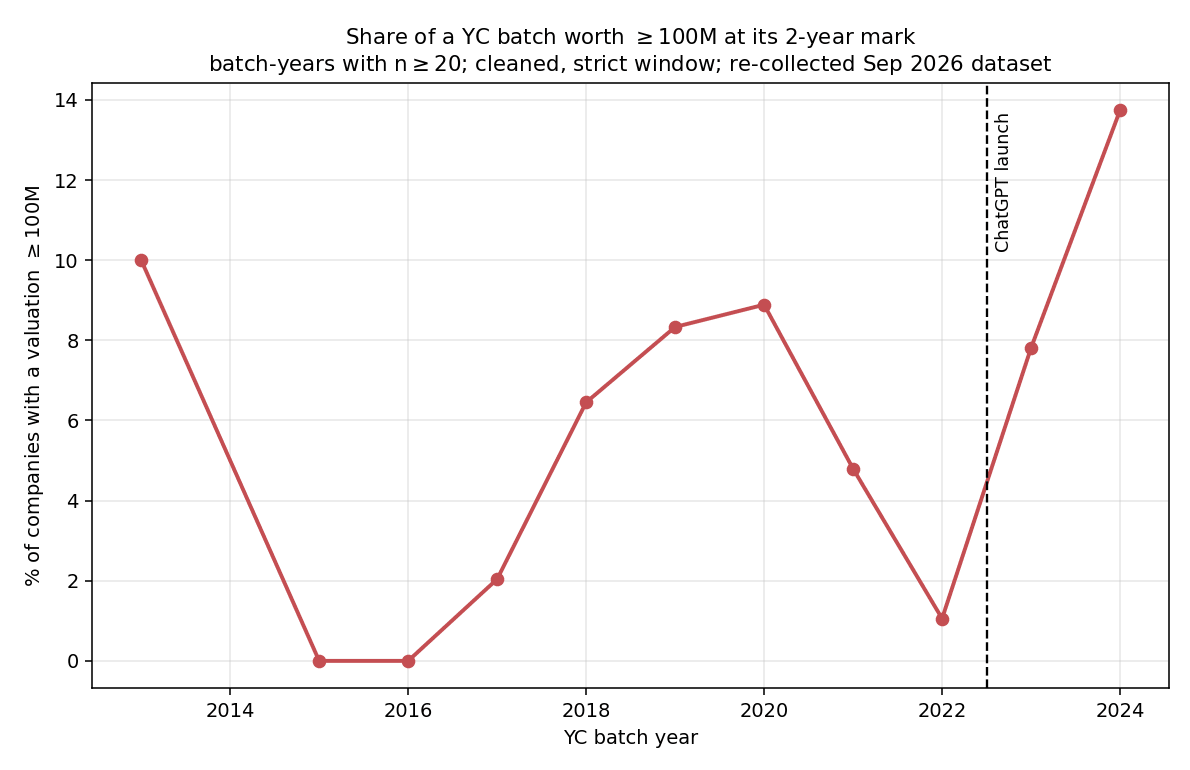
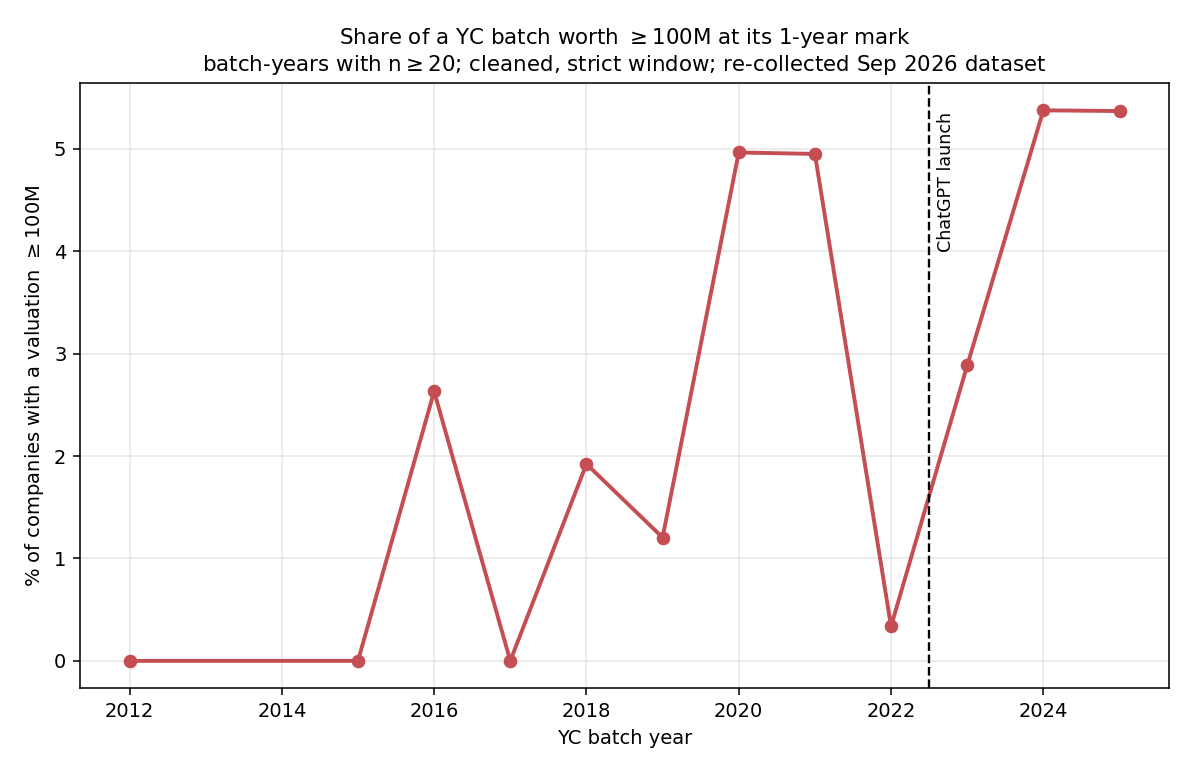
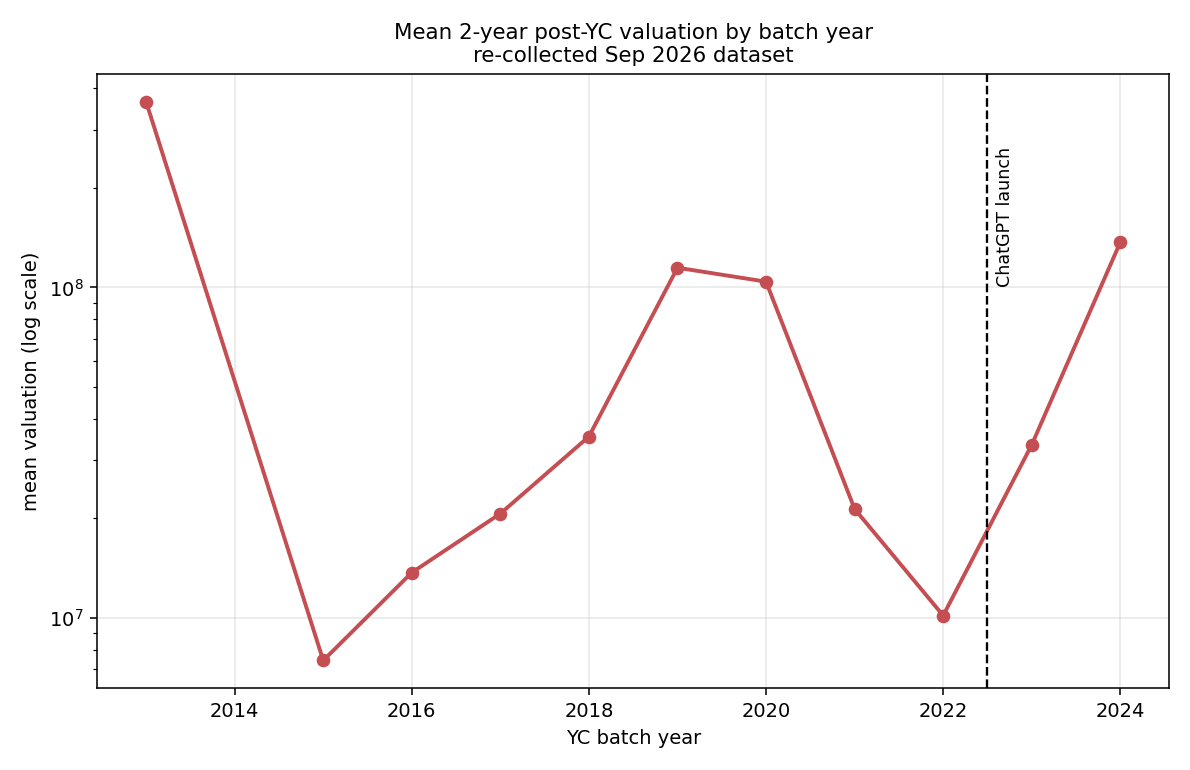
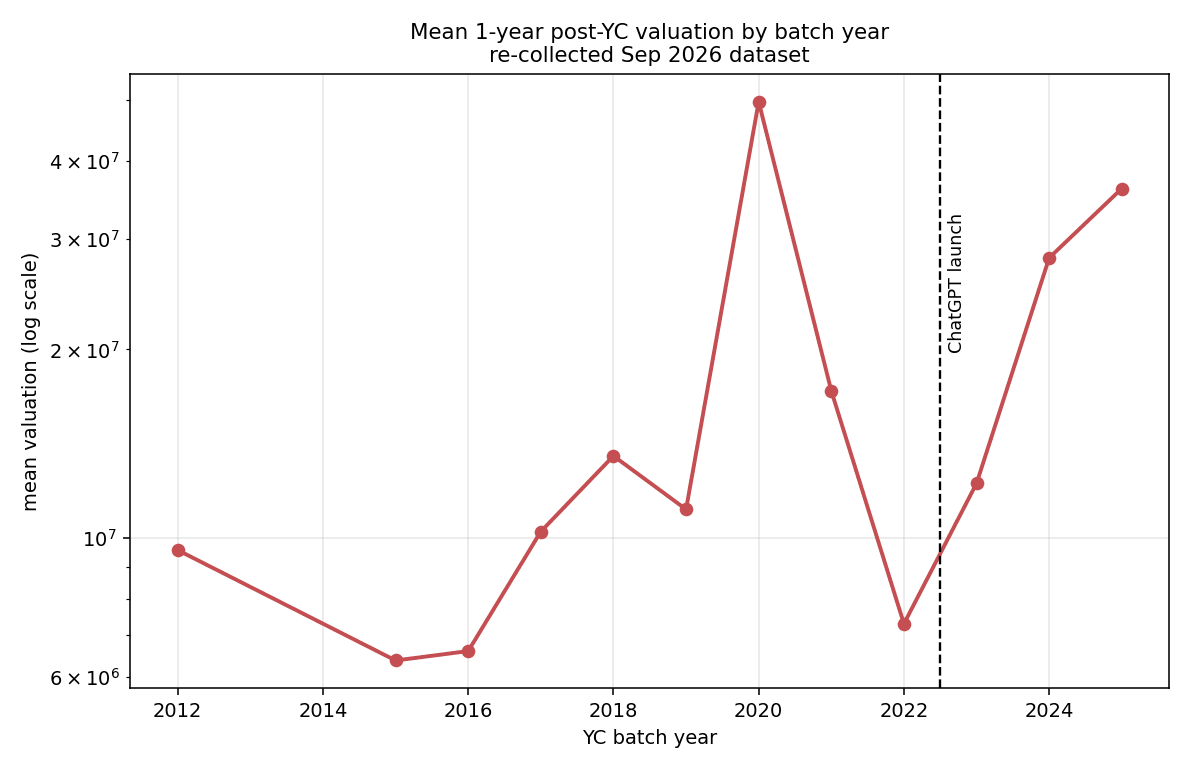

You already mentioned, but I think it's worth repeating -- in my view, the best startups do not take the YC deal anymore. I think partly it's because YC is a victim of its own success (the startup ecosystem is now much more developed, and other incubators and VCs bid at higher valuations); partly, the brand has fallen somewhat. Also, my guess is that a lot of the best people who would have used to start a startup, now join/start a lab, or sometimes, a nonprofit.
Some startups (and I presume, their incubators) do achieve extraordinary growth due to AI, though. One example is Cursor -- a VC recently asked "on a ROI basis, which would it have been better to seed invest into, Anthropic or Cursor?", and the answer was actually Cursor due to its rapidity of growth + fast acquisition. (And, the incubators such as https://aigrant.com/ are a inspiration for me when thinking about https://surplus.dev/)
YC never had any sort of monopoly on the best startups though, its own terms are much better than they used to be, and its still definitely the most prestigious. The question isn't "why didn't Anthropic join YC", it's "why, if AI truly makes most developers 10x more productive and transforms the unit economics of customers, are the valuations of a cohort of prestigious "AI-enabled" startups round about their non-AI enabled 2019 peers?". There really aren't enough people founding research labs for that to be the issue
Of course, any early stage valuations graph is as much a graph of investor sentiment as anything else, but if AI was really making these companies significantly more productive, investors would have to be very bearish on AI or YC selection effect to have gone down the toilet for that not to show in the data. I presume median data looks similar?
The best counterargument is that AI also makes it easier for competitors leading to less defensible business models even if AI actually enables them to grow faster, but if that was the case investor sentiment should be much more bearish on incumbents...
Is this true? In my previous post I noted that the YC data was out of step with other data sets like Stripe's, but I haven't found a great dataset to answer this conclusively.