“The Antichrist probably presents as a great humanitarian, it's redistributive, it's an extremely great philanthropist, as an effective altruist, all of those kinds of things.” - Peter Thiel
Effective altruism has more than its share of critics. But Peter Thiel, the billionaire cofounder of PayPal and Palantir, is unusual in that, when he describes us as the “Antichrist,” he does not mean this as a generic slur but rather as a specific claim that we oppose Jesus Christ in the Second Coming.
This document is intended just as an explication of his views, I neither endorse nor critique them. My attempted summary of his argument:
- The Antichrist will claim to bring peace and safety while actually creating a stagnant global state.
- The only promising technology for avoiding stagnation is AI.
- So the Antichrist will try to slow down and regulate AI in the name of peace and safety.
- EAs want to slow down and regulate AI in the name of peace and safety.
- Therefore, EAs are the Antichrist.
My attempted secular version of his argument:
- Totalitarian governments often rise to power by claiming that they need authority to protect society from some greater threat.
- A way to identify these proto-totalitarian governments is to look for instances where people are claiming that there is a great threat and therefore humanity needs to take some costly action, despite the threat not actually being that big.
- EA (and AI safety in particular) fulfills these requirements:
- The threat of AI isn’t that big because AI will not be that transformative and is likely to be regulated out of existence anyway.
- The regulation of AI will be costly because:
- Stagnation is bad and inevitably leads to conflict because humans will compete over a limited pool of resources.
- Artificial intelligence appears to be the only vector for technological growth in the near-term future.
- Therefore, on the margin, we should be more willing to accept risks from emerging technologies in exchange for greater growth.
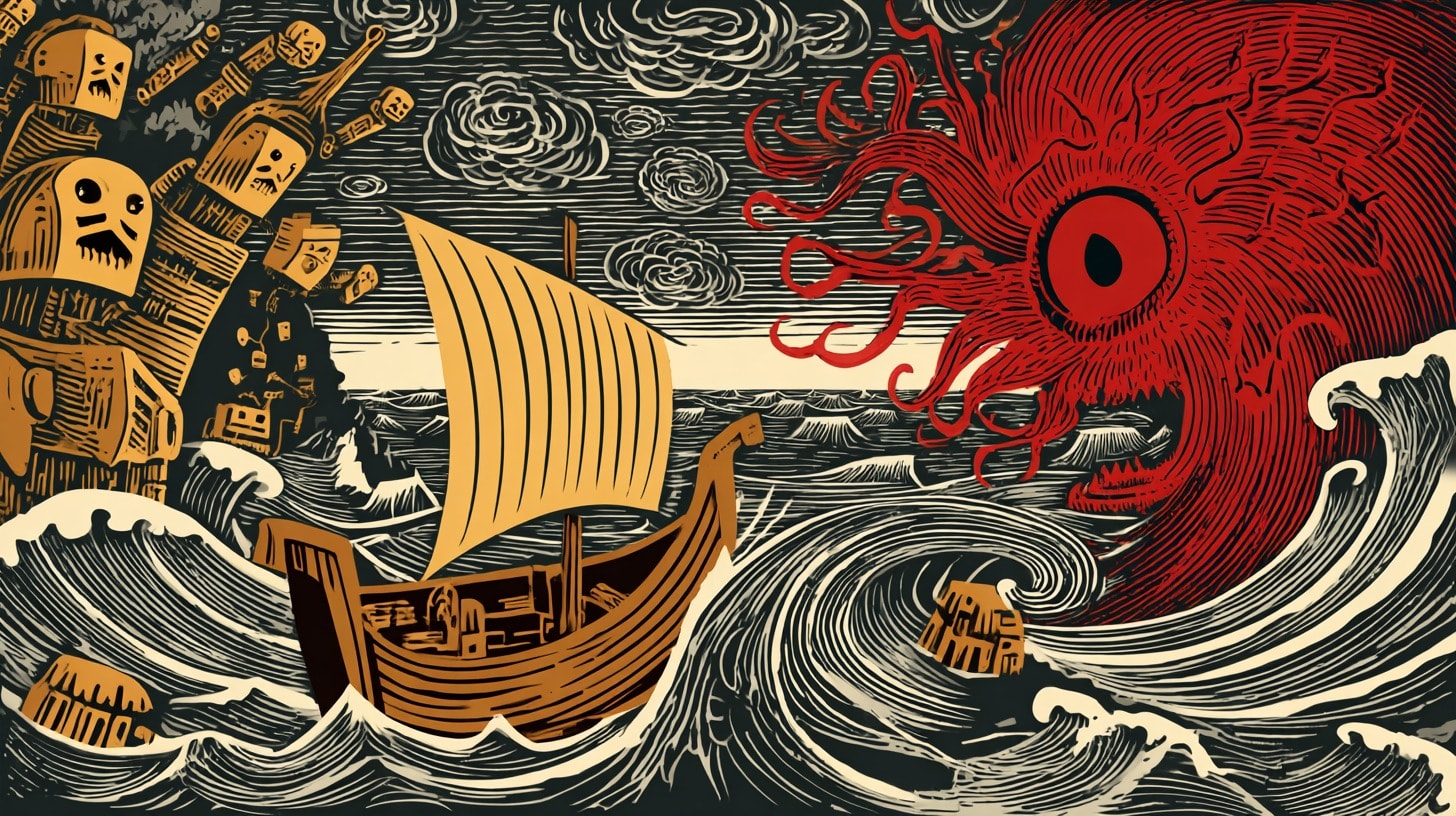
“Everyone is worried about the Scylla of Armageddon, nukes, pandemics, AI... We're not worried enough about the Charybdis of one world government, the Antichrist.” - Peter Robinson, summarizing Peter Thiel
Background: Girardian Mimetic Desires and Scapegoating
Peter Thiel is heavily influenced by the philosopher Rene Girard, including starting a foundation devoted to popularizing Girard’s work. Understanding at least the basics of Girard's views seems important for understanding Thiel's worldview.
Scott Alexander’s Summary
Scott Alexander gives the best short intro to Girard that I could find. The rest of this subsection is quoted from his article.
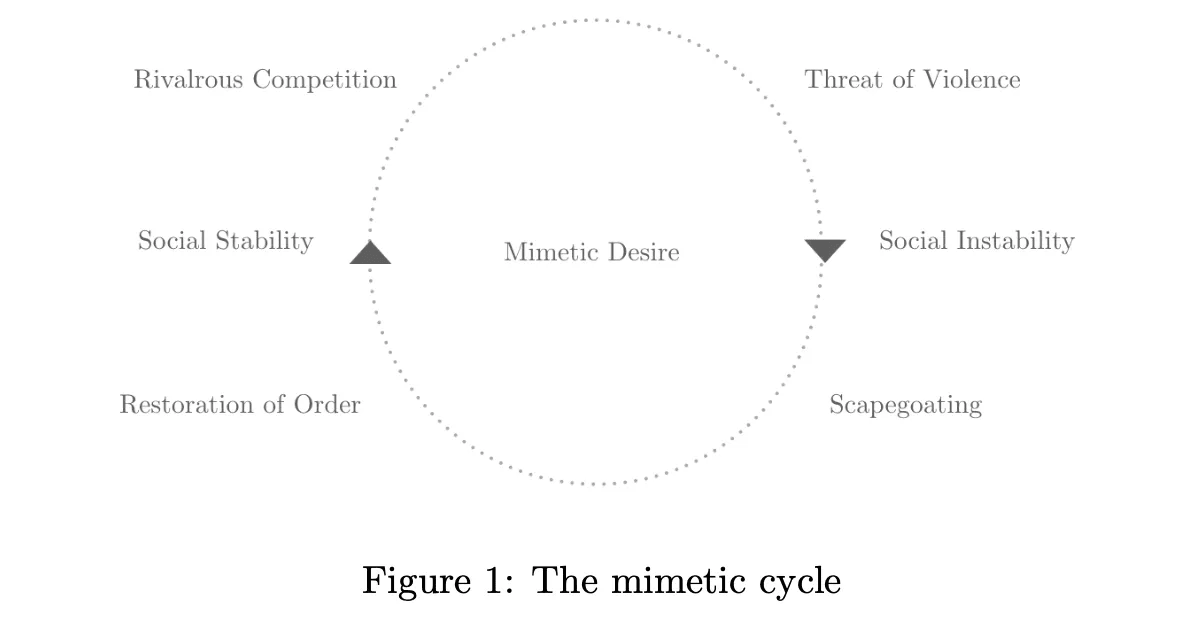
- Most (all?) human desire is mimetic, ie based on copying other people’s desires. The Bible warns against coveting your neighbor’s stuff, because it knows people’s natural tendencies run that direction. It’s not that your neighbor has particularly good stuff. It’s that you want it because it’s your neighbor’s. Think of two children playing in a room full of toys. One child picks up Toy #368 and starts playing with it. Then the other child tries to take it, ignoring all the hundreds of other toys available. It’s valuable because someone else wants it.
- As with the two children, conflict is inevitable. As the mimetic process intensifies, everyone goes from complicated individuals with individual wants, to copies of their neighbors (ie their desires copy their neighbors’ desires, and they become the sort of people who would have those desires). Alliances form and dissipate. There is a war of all against all. The social fabric starts to collapse.
- Instead of letting the social fabric collapse, everyone suddenly turns their ire on one person, the victim. Maybe this person is a foreigner, or a contrarian, or just ugly. The transition from individuals to a mob reaches a crescendo. The mob, with one will, murders the victim (or maybe just exiles them).
- Then everything is kind of okay! The murder relieves the built-up tension. People feel like they can have their own desires again, and stop coveting their neighbors’ stuff quite so hard, at least for a while. Society does not collapse. If there was no civilization before, maybe people take advantage of this period of relative peace to found civilization.
- (Optional step 5) Seems pretty impressive that killing one victim could cause all this peace and civilization! The former mob declares their victim to be a god. Killing the god was the necessary prerequisite to civilization. Now the god probably reigns in heaven or something. Maybe they die and resurrect every year. Whatever.
- Rinse and repeat.
Girard is against this process. Not just because it involves violent mobs lynching innocent people (although it does), but because that step perpetuates the whole cycle: people greedily desiring whatever their neighbors have, people hating their neighbors, internecine war of all against all. He dubs the process Satan, based partly on the original Hebrew meaning of Satan as “prosecutor”. Satan is the force that tells people that the victim is guilty and deserves to be lynched.
…
So, concludes Girard, the single-victim process is the basis of all ancient civilization. The pagan myths were written by people who had recently been in the mobs. It accurately reflects their understanding of events: there was some kind of looming crisis, we figured out that an ugly foreigner was responsible, we killed him, and that solved the problem (and optionally, he might be a god). Girard insists that this process is approximately infinitely powerful. You can’t just choose to be a good person who isn’t in the mob. Everyone joins in the mob. You can’t even regret being in the mob afterwards. This is some Julian Jaynes-level stuff. Your psyche is completely shaped by the single-victim process, you are caught up in it like a leaf in the wind, and all you can do is write some myths afterwards talking about how very right you were.
So how does the Hebrew Bible escape this failure mode? Girard says divine intervention. God (here meaning literal God, exactly as the average churchgoer understands Him) tried to break the reign of Satan (here meaning metaphorical Satan, the single-victim process) over the Jewish people, by constantly providing them with examples of the single-victim process being bad and ensuring those examples were written up accurately. He got the Israelites to obsess over these examples and worship them as a holy text, trying to hammer the whole thing into their heads. Finally, He sent His only begotten Son as the perfect victim, who would undergo the process in its entirety and have it be written up with unprecedented attention to detail. This extra-compelling example finally penetrated the Israelites’ thick skulls. Although Peter and the other disciples sort of joined the mob in denying Jesus at the beginning, after the Resurrection they started thinking previously barely-thinkable thoughts, like “what if our mob was in the wrong?” and “what if mob violence is bad?”
…
The Son of God brought from Heaven to Earth a single Word of the ineffable Divine speech, and that word was “VICTIM”. At first it was whispered only by a few disciples, so softly it could barely be heard at all. But as missionaries spread the faith, the word grew louder and louder until it became a roar, drowning out all merely-human metaphysics / psychology / ethics.
At some point it no longer needed the Church as a carrier vehicle. Like Oedipus, it killed its parent. The Church, it might seem, is not maximally designed to help victims. It has all these extraneous pieces, like prayers and cathedrals and Popes. And isn’t prayer offensive when we should be engaging in direct revolutionary action to free the oppressed? Aren’t cathedrals are a gaudy celebration of wealth, when that money should be used to feed the poor. Doesn’t a celibate clergy create conditions rife for child sexual abuse? As the single divine Word grew louder and louder, Christianity started to seem morally indefensible, and began to wither away like the pagan faiths it supplanted.
Rene Girard is against this. He shares the basic anti-woke fear that all of this ends in some kind of totalitarian communism, or in a bloody war of all against all where everyone accuses everyone else of being some kind of oppressor. But - at least in this book - he seems totally confused how to think about this or what can be done about it.
…
“I see Satan fall like lightning” doesn’t mean Satan dies. It means he falls from Heaven to Earth. He goes from being a semi-incomprehensible Jaynesian spiritual force, to lurking underneath all of our usual human squabbles. Girard does name wokeness as the Antichrist: not in the sense of “anti-Christian”, but in the older sense of anti-, the one that produced the word “antipope”. An antipope is a person who looks like he is the Pope, makes a superficially-credible claim to be the Pope, but is in fact not the Pope, and is opposed to everything that good Popes should stand for.
Key Points
[source]
- Conflict does not (solely) arise from poverty, poor education, or whatever else a bleeding heart liberal would blame. It arises from the fundamental zero-sum nature of mimetic desire, which causes a never-ending cycle of violence.
- The cycle of violence can be reset through the sacrifice of a scapegoat. Unfortunately (?), Christian society does not let us sacrifice random scapegoats, so we are trapped in an ever-escalating cycle, with only poor substitutes like “cancelling celebrities on Twitter” to release pressure. Girard doesn’t know what to do about this.
Background on the Antichrist
“I say this because many deceivers, who do not acknowledge Jesus Christ as coming in the flesh, have gone out into the world. Any such person is the deceiver and the Antichrist.” - 2 John 1:7
There are several common misconceptions (in Thiel’s view) about the standard view of the Antichrist that are worth addressing before continuing:
- The Antichrist isn’t a single person: “you can think of it as a system where maybe communism is a one world system. So it can be an ideology or a system.” [source] (Theil’s view is relatively mainstream within Christianity, although there is some disagreement. See below.)
- The Antichrist is not the opposite of Christ but rather one who stands in Christ’s place (the term “false Christ” is found in the gospels and may be more intuitive for modern readers)
- The Antichrist is commonly thought to be the “beast of the sea” from Revelation 13:1 but Revelation never explicitly says the word “Antichrist.” Some Christians believe that the Antichrist is not involved in Armageddon (I am unclear on Thiel’s opinion)
Thiel’s Views
Stagnation
“Then I saw that all toil and all skill in work come from a man’s envy of his neighbor. This also is vanity and a striving after wind.” - Ecclesiastes 4:4
If conflict came from, say, a lack of education, we might hope that by investing in schools we could reduce conflict. But if conflict comes from zero-sum rivalrous goods, then the only way to reduce conflict is to make more goods:
If we go full on with the club of Rome limits to growth, we have this fully Luddite program that again, my intuitions is that that will end very badly politically. It's gonna be a zero sum nasty Malthusian society and it will push towards something that's much more autocratic, much more totalitarian, because the pie won't grow. [source]
Unfortunately, progress has ground to a halt:
When tracked against the admittedly lofty hopes of the 1950s and 1960s, technological progress has fallen short in many domains. Consider the most literal instance of non-acceleration: We are no longer moving faster. The centuries-long acceleration of travel speeds — from ever-faster sailing ships in the 16th through 18th centuries, to the advent of ever-faster railroads in the 19th century, and ever-faster cars and airplanes in the 20th century — reversed with the decommissioning of the Concorde in 2003, to say nothing of the nightmarish delays caused by strikingly low-tech post-9/11 airport-security systems. Today’s advocates of space jets, lunar vacations, and the manned exploration of the solar system appear to hail from another planet. A faded 1964 Popular Science cover story — “Who’ll Fly You at 2,000 m.p.h.?” — barely recalls the dreams of a bygone age. [source]
There is one exception:
By default, computers have become the single great hope for the technological future. The speedup in information technology contrasts dramatically with the slowdown everywhere else. [source]
In particular:
If you don’t have A.I., wow, there’s just nothing going on. [source]
Totalitarianism
“Jesus said to them, ‘The kings of the Gentiles lord it over them; and those who exercise authority over them call themselves Benefactors. But you are not to be like that. Instead, the greatest among you should be like the youngest, and the one who rules like the one who serves.’” - Luke 22:25-26
Thiel is not a fan of governments:
People don’t understand that. They think governments are somehow divinely ordained. So, once you see how satanic the government is, how satanic taxes are, other things besides the governments do, it will have this unraveling effect. [source]
And particularly dislikes globalization:
At a minimum, you need to just always think, there are so many bad forms of globalization, our only chance of getting to a good one is to realize how tough it is. Maybe we should have trade treaties, we should negotiate them. They should always be negotiated by people who don't believe in free trade. [source]
Thiel’s view of the major tradeoff we face, as summarized by Peter Robinson:
Everyone is worried about the Scylla of Armageddon, nukes, pandemics, AI. Everyone is worried about the Scylla of Armageddon. We're not worried enough about the Charybdis of one world government, the Antichrist. [source]
The Antichrist
“What I hope to retrieve is a sense of the stakes, of the urgency of the question, the stakes are really, really high. It seems very dangerous that we're at a place where so few people are concerned about the Antichrist.” - Peter Thiel
We recall from Girard that the Antichrist acts like Christ but actually opposes him: “The Antichrist boasts of bringing to human beings the peace and tolerance that Christianity promised but has failed to deliver.” And Thiel believes that the greatest danger is the institution of a global government which causes stagnation.
What ideology claims to bring peace and safety while actually instigating stagnation and global regulation?
This is 1 Thessalonians 5:3 — the slogan of the Antichrist is ‘peace and safety.’ And we’ve submitted to the F.D.A. — it regulates not just drugs in the U.S. but de facto in the whole world, because the rest of the world defers to the F.D.A. The Nuclear Regulatory Commission effectively regulates nuclear power plants all over the world. You can’t design a modular nuclear reactor and just build it in Argentina. They won’t trust the Argentinian regulators. They’re going to defer to the U.S. [source]
And is there by chance an ideology or system who wishes to globally regulate and slow down AI, the one dim beacon of progress in an otherwise dismal future? (Narrator looks meaningfully into the camera.)
Summary
- The Antichrist will claim to bring peace and safety while actually creating a stagnant global state.
- The only promising technology for avoiding stagnation is AI.
- So the Antichrist will try to slow down and regulate AI in the name of peace and safety.
- EAs want to slow down and regulate AI in the name of peace and safety.
- Therefore, EAs are the Antichrist.
FAQs
“It is the glory of God to conceal a matter; to search out a matter is the glory of kings.” Proverbs 25:2
Is Thiel unaware of the dangers of AI?
Thiel says:
There are apocalyptic fears around AI that I think deserve to be taken seriously. [source]
He just thinks it’s worth the risk:
I think we have to find some way to talk about these technologies where the technologies are dangerous. But in some sense it's even more dangerous not to do them. It's even more dangerous to have a society where there's zero growth. [source]
That being said, he seems less impressed with the possibility of AI than I expect the median reader is:
Just how big a thing do I think A.I. is? And my stupid answer is: It’s more than a nothing burger, and it’s less than the total transformation of our society. My place holder is that it’s roughly on the scale of the internet in the late ’90s. I’m not sure it’s enough to really end the stagnation. [source]
And even these meagre impacts probably won’t arise:
It’s gonna be outlawed, it’s gonna be regulated, as we have outlawed so many other vectors of innovation.” [source]
How would his opinions change if he thought AI was more powerful?
AUDIENCE MEMBER: Thanks for coming. You’ve alluded to a lot of the forces between decentralization and centralization, particularly around AI with forces around the individual. I was wondering if you could talk a little bit more, describe what you think the forces could be that stop AI development, particularly as it relates to the state’s role, or how a politician or another entity could co-opt that force for their own benefit versus the benefit of many.
THIEL: Maybe the premise of your question is what I’d challenge. Why is AI going to be the only technology that matters? If we say there’s only this one big technology that’s going to be developed, and it is going to dominate everything else, that’s already, in a way, conceding a version of the centralization point. So, yes, if we say that it’s all around the next generation of large language models, nothing else matters, then you’ve probably collapsed it to a small number of players. And that’s a future that I find somewhat uncomfortably centralizing, probably. [source]
Because intelligence isn’t the gating factor:
I think we’ve had a lot of smart people and things have been stuck for other reasons. And so maybe the problems are unsolvable, which is the pessimistic view…
Or maybe it’s these cultural things. So it’s not the individually smart person, but it’s how this fits into our society. Do we tolerate heterodox smart people? Maybe you need heterodox smart people to do crazy experiments. And if the A.I. is just conventionally smart, if we define wokeness — again, wokeness is too ideological — but if you just define it as conformist, maybe that’s not the smartness that’s going to make a difference. [source]
I’m not sure what Thiel thinks about the standard counterarguments to the “culture not intelligence is the gating factor” view (e.g. these).
If Thiel is worried about totalitarianism, is he also worried that AI could enable totalitarianism?
Peter Robinson asks:
Peter Robinson: But you're not singling out AI as a game changer [for Chinese totalitarianism]. You tend to pooh-pooh the notion that AI will change things.
Peter Thiel: Well, I think it's unclear, I think there's always a lot of propaganda around all these buzzwords and so I think it's somewhat exaggerated, but yes of course, there's sort a continuation of the computer revolution where you'll have, you know, more powerful Leninist controls and you can have certain, you know, maybe the farmers can sell the cabbages in the market and you can still have face recognition software that tracks people at all times and all places, and so there's sort of a hybrid thing that might work for longer than we'd like. [source]
His lack of concern here seems related to his expectation that AI will not be that powerful.
I work in AI safety. What does Thiel think I should do?
My guess is that he probably thinks you should quit your job, but barring that you should look for ways to encourage economic progress as much as possible and minimize the extent to which government oversight, and in particular global government oversight, is needed.
I'm not Christian. Is there anything that I should be learning from Thiel's views?
Helen Toner’s In search of a dynamist vision for safe superhuman AI makes many of the same arguments from a secular frame. Lizka Vaintrob’s Notes on dynamism, power, & virtue also contains related excerpts and notes.
My attempted secular version of his argument:
- Totalitarian governments often rise to power by claiming that they need authority to protect society from some greater threat.
- A way to identify these proto-totalitarian governments is to look for instances where people are claiming that there is a great threat and therefore humanity needs to take some costly action, despite the threat not actually being that big.
- EA (and AI safety in particular) fulfills these requirements:
- The threat of AI isn’t that big because AI will not be that transformative and is likely to be regulated out of existence anyway.
- The regulation of AI will be costly because:
- Stagnation is bad and inevitably leads to conflict because humans will compete over a limited pool of resources.
- Artificial intelligence appears to be the only vector for technological growth in the near-term future.
- Therefore, on the margin, we should be more willing to accept risks from emerging technologies in exchange for greater growth.
How mainstream is Peter Thiel's interpretation of the Bible?
Girard’s theological work has been positively reviewed by respected theologians, but remains on the fringe. His theory of atonement as being related to ending the scapegoating cycle is unusual enough that it isn't even mentioned on the Wikipedia list of theories of atonement (although it should be noted that this doesn't necessarily make it incompatible with other theories of atonement).
Thiel’s anarchic views are unusual, though not unheard of. Notably, Leo Tolstoy’s The Kingdom of God Is Within You argued for what is now called “Christian Anarchism.” (Thiel specifically cites the fact that Satan tempted Jesus with the kingdoms of earth as evidence that governments are satanic, a common justification for Christian anarchism.) However, Romans 13:1-7, 1 Peter 2:13-14 and other passages are usually interpreted to the contrary; e.g. Cambridge Bible says of Romans 13:1: “In this passage it is stated, as a primary truth of human society, that civil authority is, as such, a Divine institution. Whatever may be the details of error or of wrong in its exercise, it is nevertheless, even at its worst, so vastly better than anarchy, that it forms a main instrument and ordinance of the will of God.”
Many theological traditions make a distinction between the capital-A Antichrist as a single figure and small-a antichrists. Those that don't make the distinction would deny the existence of a capital-A Antichrist and assume that there are just various degrees of small-a antichrists as anti-Christian individuals and institutions. Thiel’s views seem to fit within this spectrum.
As a relatively minor point, Thiel repeatedly cites 1 Thessalonians 5:3 as evidence that “the slogan of the Antichrist is ‘peace and safety’,” but the usual interpretation of this verse is just that most people will think that everything is stable and will be surprised by Jesus' return, not that the Antichrist in particular is the one promising peace and safety.
The ESV Study Bible suggests cross referencing 1 Thessalonians 5:3 with Jeremiah 6:14, which is summarized as “[the false prophets] met Jeremiah’s warnings of coming evil by the assurance that all was well, and that invasion and conquest were far-off dangers.” I expect many safety advocates feel like they are the ones warning of coming evil and the Thiel side is the one giving false assurance that all as well. (Thiel would maybe not be surprised: “There’s always a risk that the katechon becomes the Antichrist.”)
I would like to thank the following for contributions to this document: Vesa Hautala, Daniel Filan, JD Bauman, EA for Christians, Davis Kingsley. I sent a draft of this post to Thiel, who (reasonably) did not respond; probably some errors remain.



Nice post! I am a pretty close follower of the Thiel Cinematic Universe (ie his various interviews, essays, etc), so here are a ton of sprawling, rambly thoughts. I tried to put my best material first, so feel free to stop reading whenever!
As for my personal take on Thiel's views -- I'm often disappointed at the sloppiness (blunt-ness? or low-decoupling-ness?) of his criticisms, which attack the EA for having a problematic "vibe" and political alignment, but without digging into any specific technical points of disagreement. But I do think some of his higher-level, vibe-based critiques have a point.
Thanks! Do you know if there is anywhere he has engaged more seriously with the possibility that AI could actually be transformative? His "maybe heterodox thinking matters" statement I quoted above feels like relatively superficial engagement with the topic.
He certainly seems very familiar with the arguments involved, the idea of superintelligence, etc, even if he disagrees in some ways (hard to tell exactly which ways), and seems really averse to talking about AI the familiar rationalist style (scaling laws, AI timelines, p-dooms, etc), and kinda thinks about everything in his characteristic style: vague, vibes- and political-alignment- based, lots of jumping around and creative metaphors, not interested in detailed chains of technical arguments.
A couple more quotes on the subject of superintelligence from the recent Ross Douthat conversation (transcript, video):
Thiel claims to be one of those people who (very wrongly IMO) thinks that AI might indeed achieve 3000 IQ, but that it'll turn out being 3000 IQ doesn't actually help you do amazing things like design nanotech or take over the world:
PETER THIEL: It’s probably a Silicon Valley ideology and maybe, maybe in a weird way it’s more liberal than a conservative thing, but people are really fixated on IQ in Silicon Valley and that it’s all about smart people. And if you have more smart people, they’ll do great things. And then the economics anti IQ argument is that people actually do worse. The smarter they are, the worse they do. And they, you know, it’s just, they don’t know how to apply it, or our society doesn’t know what to do with them and they don’t fit in. And so that suggests that the gating factor isn’t IQ, but something, you know, that’s deeply wrong with our society.
ROSS DOUTHAT: So is that a limit on intelligence or a problem of the sort of personality types human superintelligence creates? I mean, I’m very sympathetic to the idea and I made this case when I did an episode of this, of this podcast with a sort of AI accelerationist that just throwing, that certain problems can just be solved if you ramp up intelligence. It’s like, we ramp up intelligence and boom, Alzheimer’s is solved. We ramp up intelligence and the AI can, you know, figure out the automation process that builds you a billion robots overnight. I, I’m an intelligent skeptic in the sense I don’t think, yeah, I think you probably have limits.
PETER THIEL: It’s, it’s, it’s hard to prove one way or it’s always hard to prove these things.
Thiel talks about transhumanism for a bit (albeit devolves into making fun of transgender people for being insufficiently ambitious) -- see here for the Dank EA Meme version of this exchange:
ROSS DOUTHAT: But the world of AI is clearly filled with people who at the very least seem to have a more utopian, transformative, whatever word you want to call it, view of the technology than you’re expressing here, and you were mentioned earlier the idea that the modern world used to promise radical life extension and doesn’t anymore. It seems very clear to me that a number of people deeply involved in artificial intelligence see it as a kind of mechanism for transhumanism, for transcendence of our mortal flesh and either some kind of creation of a successor species, or some kind of merger of mind and machine. Do you think that’s just all kind of irrelevant fantasy? Or do you think it’s just hype? Do you think people are trying to raise money by pretending that we’re going to build a machine god? Is it delusion? Is it something you worry about? I think you, you would prefer the human race to endure, right? You’re hesitating.
PETER THIEL: I don’t know. I, I would... I would...
ROSS DOUTHAT: This is a long hesitation.
PETER THIEL: There’s so many questions and pushes.
ROSS DOUTHAT: Should the human race survive?
PETER THIEL: Yes.
ROSS DOUTHAT: Okay.
PETER THIEL: But, but I, I also would. I, I also would like us to, to radically solve these problems. Transhumanism is this, you know, the ideal was this radical transformation where your human natural body gets transformed into an immortal body. And there’s a critique of, let’s say, the trans people in a sexual context or, I don’t know, transvestite is someone who changes their clothes and cross dresses, and a transsexual is someone where you change your, I don’t know, penis into a vagina. And we can then debate how well those surgeries work, but we want more transformation than that. The critique is not that it’s weird and unnatural. It’s man, it’s so pathetically little. And okay, we want more than cross dressing or changing your sex organs. We want you to be able to change your heart and change your mind and change your whole body.
PETER THIEL: A conversation I had with Elon a few weeks ago about this was, he said, “We’re going to have a billion humanoid robots in the US in 10 years.” And I said, “Well, if that’s true, you don’t need to worry about the budget deficits because we’re going to have so much growth. The growth will take care of this.” And then, well, he’s still worried about the budget deficits. And then this doesn’t prove that he doesn’t believe in the billion robots, but it suggests that maybe he hasn’t thought it through or that he doesn’t think it’s going to be as transformative economically, or that there are big error bars around it.
FTR: while Thiel has already claimed this version before, the more common version (e.g. here, here, here from Hassabis' mouth, and more obliquely here in his lawsuit against Altman) is that Hassabis was warning Musk about existential risk from unaligned AGI, not threatening him with his own personally aligned AGI. However, this interpretation is interestingly resonant with Elon Musk's creation of OpenAI being motivated by fear of Hassabis becoming an AGI dictator (a fear his co-founders apparently shared). It is certainly an interesting hypothesis that Thiel and Musk engineered together for a decade both the AGI race and global democratic backsliding wholly motivated by a same single one-sentence possible slight by Hassabis in 2012.
Thanks a lot for all your comments on this post, I found them very informative. (And the top-level post from Ben as well).
I think this picture of EA ignoring stable totalitarianism is missing the longtime focus on China.
Also, see this thread on Open Phil's ability to support right-of-center policy work.
This was really insightful but i'm curious if you assign much or any probability to the idea that he doesn't actually have any strong ethical view(s). Seems plausible that he likes talking and sounding smart, has some weakly held views, but when the chips hit the table will mainly just optimize for money and power?
I think Thiel really does have a variety of strongly held views. Whether these are "ethical" views, ie views that are ultimately motivated by moral considerations... idk, kinda depends on what you are willing to certify as "ethical".
I think you could build a decent simplified model of Thiel's motivations (although this would be crediting him with WAY more coherence and single-mindedness than he or anyone else really has IMO) by imagining he is totally selfishly focused on obtaining transhumanist benefits (immortality, etc) for himself, but realizes that even if he becomes one of the richest people on the planet, you obviously can't just go out and buy immortality, or even pay for a successful immortality research program -- it's too expensive, there are too many regulatory roadblocks to progress, etc. You need to create a whole society that is pro-freedom and pro-property-rights (so it's a pleasant, secure place for you to live) and radically pro-progress. Realistically it's not possible to just create an offshoot society, like a charter city in the ocean or a new country on Mars (the other countries will mess with you and shut you down). So this means that just to get a personal benefit to yourself, you actually have to influence the entire trajectory of civilization, avoiding various apocalyptic outcomes along the way (nuclear war, stable totalitarianism), etc. Is this an "ethical" view?
I also think that lots of big, world-spanning goals (including altruistic things like "minimize existential risk to civilization", or "minimimze animal suffering", or "make humanity an interplanetary species") often problematically route through the convergent instrumental goal of "optimize for money and power", while also being sincerely-held views. And none moreso than a personal quest for immortality! But he doesn't strike me as optimising for power-over-others as a sadistic goal for its own sake (as it may have been for, say, Stalin) -- he seems to have such a strong belief in the importance of individual human freedom and agency that it would be suprising if he's secretly dreaming of enslaving everyone and making them do his bidding. (Rather, he consistently sees himeself as trying to help the world throw off the shackles of a stultifying, controlling, anti-progress regime.)
But getting away from this big-picture philosophy, Thiel also seems to have lots of views which, although they technically fit nicely into the overall "perfect rational selfishness" model above, seem to at least in part be fueled by an ethical sense of anger at the injustice of the world. For example, sometime in the past few years Thiel started becoming a huge Georgist. (Disclaimer: I myself am a huge Georgist, and I think it always reflects well on people, both morally and in terms of the quality of their world-models / ability to discern truth.)
Thiel's georgism ties into some broader ideas about a broken "inter-generational compact", whereby the boomer generation has unjustly stolen from younger generations via housing scarcity pushing up rents, via ever-growing medicare / social-security spending and growing government debt, via shutting down technological progress in favor of safetyism, via a "corrupt" higher-education system that charges ever-higher tuition and not providing good enough value for money, and various other means.
The cynical interpretation of this is that this is just a piece of his overall project to "make the world safe for capitalism", which in turn is part of his overall selfish motivation: He realizes that young people are turning socialist because the capitalist system seems broken to them. It seems broken to them, not because ALL of capitalism is actually corrupt, but specifically because they are getting unjustly scammed by NIMBYism. So he figures that to save capitalism from being overthrown by angry millenials voting for Bernie, we need to make America YIMBY so that the system finally works for young people and they have a stake in the system. (This is broadly correct analysis IMO) Somewhere I remember Thiel explicitly explaining this (ie, saying "we need to repair the intergenerational compact so all these young people stop turning socialist"), but unfortunately I don't remember where he said this so I don't have a link.
So you could say, "Aha! It's really just selfishness all the way down, the guy is basically voldemort." But, idk... altruistically trying to save young people from the scourge of high housing prices seems like going pretty far out of your way if your motivations are entirely selfish. It seems much more straightforwardly motivated by caring about justice and about individual freedom, and wanting to create a utopian world of maximally meritocratic, dynamic capitalism rather than a world of stagnant rent-seeking that crushes individual human agency.
https://www.techemails.com/p/mark-zuckerberg-peter-thiel-millennials
I'm curious about the link that goes to AI-enabled coups and it isn't working, could you perhaps relink it?
Sorry about that! I think I just intended to link to the same place I did for my earlier use of the phrase "AI-enabled coups", namely this Forethought report by Tom Davidson and pals, subtitled "How a Small Group Could Use AI to Seize Power": https://www.forethought.org/research/ai-enabled-coups-how-a-small-group-could-use-ai-to-seize-power
But also relevant to the subject is this Astral Codex Ten post about who should control an LLM's "spec": https://www.astralcodexten.com/p/deliberative-alignment-and-the-spec
The "AI 2027" scenario is pretty aggressive on timelines, but also features a lot of detailed reasoning about potential power-struggles over control of transformative AI which feels relevant to thinking about coup scenarios. (Or classic AI takeover scenarios, for that matter. Or broader, coup-adjacent / non-coup-authoritarianism scenarios of the sort Thiel seems to be worried about, where instead of getting taken over unexpectedly by China, Trump, or etc, today's dominant western liberal institutions themselves slowly become more rigid and controlling.)
For some of the shenanigans that real-world AI companies are pulling today, see the 80,000 Hours podcast on OpenAI's clever ploys to do away with its non-profit structure, or Zvi Mowshowitz on xAI's embarrassingly blunt, totally not-thought-through attempts to manipulate Grok's behavior on various political issues (or a similar, earlier incident at Google).
I'm relieved to see someone bring up the coup in all of this - I think there is a lot of focus on this post about what Thiel believes or is "thinking " (which makes sense for a community founded on philosophy) versus what Thiel is "doing" (which is more entrepreneurship/silicon valley approach). We can dig into the 'what led him down this path' later imo but the more important objective is that he's rich, powerful and making moves. Stopping or slowing those moves is the first step at this point... I definitely think the 2027 hype is not about reaching AGI but about groups vying for control and OpenAI has been making not so subtle moves toward that positioning...
[redacted]