First of all, I want to thank you for your posts. Many of them have given me new perspectives and knowledge that I appreciate. I want to mention that the two-parameter ortega model probably is a better measurement for inequality, but it isn't used very much so it is hard to find any numbers.
I also want to mention that income inequality is problematic, since it correlates with almost allsocietal problems. Social mobility is greater in countries with low income inequality, since they have more robust welfare systems. It is easier to achieve the "American dream" in the Nordics for example. Many rich people use tax havens (but most don't) for avoiding taxes. Another problem is when rich people use their wealth for lobbying, changing public opinion, changing politics in ways that makes the poor poorer and the rich richer. An example below is a comparison between the United States and Sweden. A country with a high degree of inequality and a country with a low degree of income inequality. As you can see, Sweden has higher taxes, and also a higher union density, which might reduce the power of the rich. Which also makes those two things targets when rich people uses their power to increase their power and wealth. Sweden also has a more robust welfare system that helps people in poverty and also increases social mobility. I hope that my comment is helpful and that you appreciate it. I am happy to answer if you have any questions.
United States
Sweden
Income tax for people earning below 50 000 USD: 10-12 %.
Income tax for people earning over 50 000 USD: 22-37 %.
Value-added tax on goods and services: None.
Instead some states have sales tax on around 6 %.
Income tax for people earning below 50 000 USD: 31 %.
Income tax for people earning over 50 000 USD: 51 %.
Value-added tax on goods and services: 25 % and all purchasers pay value-added tax. It amounts for 47 % of the total budget for the Swedish state.
GINI-index: 0.395.
Federal spending 23 %.
Employed in public sector: 15 %.
Share of people belonged to unions: 10 %.
GINI-index: 0.281.
Federal spending: 48 %.
Employed in public sector: 29 %.
Share of people belonged to unions: 65 %.
Benefits in unemployment, share of previous income after five years: 9 %.
Benefits in unemployment, share of previous income after five years: 60 %.
Adequacy of minimum income benefits for a single person with no children: 6 % of median disposable income.
Adequacy of minimum income benefits for a single person with no children: 42 % of median disposable income.
Net childcare costs for a couple with average wage: 32 %.
Cost for one year in college: Over 9 000 USD / year. Health care: Mostly expensive.
Net childcare costs for a couple with average wage: 5 %.
Cost for one year in college: None, you get money for that. Health care: Practically free.
The social security contribution paid by the employer (caculated on top of the employee's salary): 7.65 %.
The social security contribution paid by the employer (caculated on top of the employee's salary): 31.4 %.
Epipen cost: 600-700 USD.
Epipen cost: 40 USD (if your medical expenses exceeeds 300 dollars a year, you get your medicine for free).
I do not know whether taxing people with higher income more heavily would increase human welfare. I agree it would nearterm, as 1 $ results in a greater increase in welfare for people with lower income. However, my sense is that economists tend to agree that income and capital taxes decrease the growth of real gross domestic product (real GDP) per capita, which is strongly correlated with median income across countries. At least in the US, there has also been a strong correlation between mean and median income. So I expect taxing people with higher income more heavily via income and capital taxes would lead to a slower growth of the median income, which may decrease welfare longterm.
An example below is a comparison between the United States and Sweden.
I would need a more comprehensive analysis to be persuaded. Singapore's tax revenue was 11.5 % of its GDP in 2022, less than US' 26.8 %, and much less than Sweden's 43 %, but Singapore is much closer to Sweden than the US in terms of social outcomes.
There is a good correlation between self-reported life satisfaction and real GDP per capita across countries. So, since I think taxing people with higher income more heavily via income and capital taxes would slow down the growth of real GDP per capita, I worry it may lead to less welfare longterm.
Zooming out, I also care about the effects on animals. So I would want to know how taxing people with higher income more heavily would affect the consumption of animal-based foods, and development of alternative proteins to come to an overall view about whether people with higher income should be taxed more or less. I believe the 3 animal-based foods which account for the most animal suffering, ordered from the least to the most expensive, are chicken meat, fish, and shrimp. In high income countries, where even people with low income eat lots of animal-based foods, I guess taxing people with higher income more heavily would tend to decrease the consumption of chicken, but increase that of fish and shrimp (and beef, but I am not worried about this one).
Given my large uncertainty about how taxes affect welfare, I am currently deferring to the libertarian intuitions described in another post from Michael Huemer, Tax Breaks for the Rich.
The current system is like this: Five friends go out for dinner. Say they have some expenses that are common to the group (e.g., a shared appetizer) plus some items ordered by and for specific individuals. At the end of the meal, someone suggests that one of the friends, the one with the most money, should be forced to pay for everyone, even though he doesn’t want to.
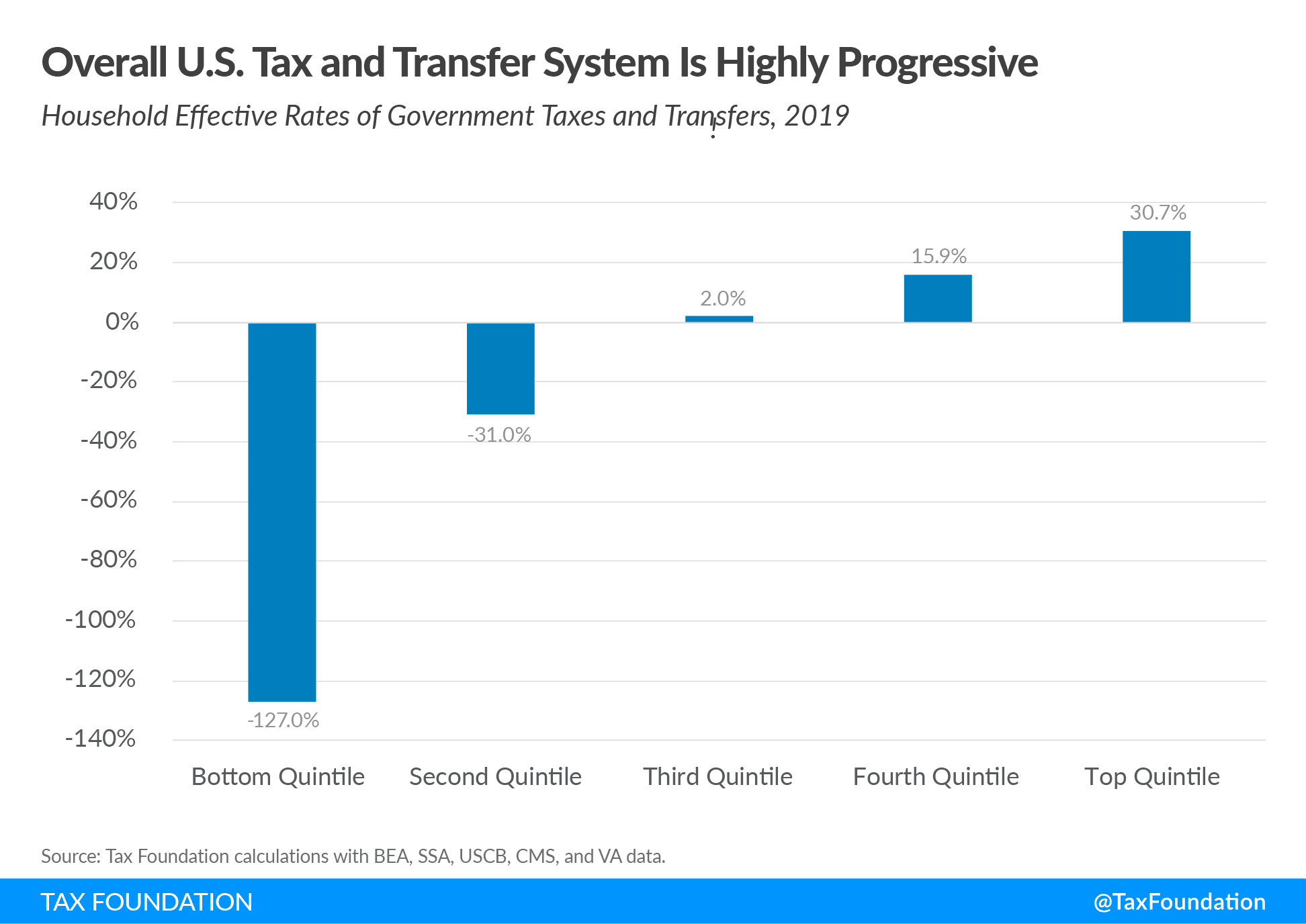
In the US, "The top quintile funded 90.1 percent, or $1.6 trillion, of all government transfers in 2019". So, if each of the 5 friends corresponded to one quintile, the richest one would pay for 90.1 % of the meal. I agree with Michael that:
Intuitively, a fair division would be like this: Everyone pays for the items that he himself ordered, plus 1/5 of the common items.
I am happy to answer if you have any questions.
Thanks for that! I think donations are the best way for people to increase their social impact. So, instead of discussing the effects of taxes, I would be curious to know your thoughts on my cause prioritisation. In particular, myviewthat the best animal welfare organisations are over 100 times as cost-effective as the best ones in human welfare. Have you considered donating to animal welfare?
Thank you very much, Vasco! I am glad that you liked my comment. I will try to answer all your questions as good as I can. I haven't replied to long post before so I don't know how to do the cool paragraphs that you do, so sorry if it gets a little confusing.
I updated the link, so it should work now. Thank you for mentioning this!
I didn't find any good data for how much the top quintile funded governement transfers in other countries, but it would have been very interesting to look at. Thank you for the interesting information.
I think one reason for Singapore being closer to Sweden when it comes to social outcomes might be annual working hours per employed person, where Singapore has 2 255 and Sweden has 1 609. I don't know much about the welfare system in Singapore, but I guess it might be less expenses in some areas. Their healthcare system is 5,5 % of GDP for example. The United States has a very ineffective healthcare system that costs much for both individuals and the state.
United States
Sweden
Per capita national health expenditures: 11,582 USD. 16.6 % of GDP.
Military expenditure: 14 % of GDP.
Per capita national health expenditures: 6438 USD. 10.7 % of GDP.
Military expenditure: 1.3 % of GDP.
There are studies that shows the correlation between income equality and life satisfaction as well.
Growth isn't always good, since growth also increases from bad things. According to the IPBES Nexus Assesment, there are 7 trillion in subsidies for the fossil fuel industry, and damages to nature for 10-25 trillion in unaccounted costs. There are 35 times more resources going to causes that destroy our planet than supports our nature. Instead of growth, it would be possible to use national income, by Thomas Piketty, would be a good global measurement instead of GDP. For example: “If you take 100 billion euros of oil from oil reserves underground or you take 100 billion euros in fish from the ocean, you have 100 billion euros of GDP, but you have zero euros of national income. And if in addition when you burn oil or gas you create global warming and you reduce the durability of life on earth, then if you put a price on the negative impact of these emissions you should have negative national income instead of positive GDP.” When it comes to growth, the World Bank Group has some projections about growth, inequality and poverty:
I think it is wonderful that you care for the animals as well. I only have numbers (from 2023, I think) for Sweden and United States when it comes to meat consumption and different types of meat consumption. So I think you might be right about less chicken= more seafood instead:
United States
Sweden
Meat consumption per capita: 102 kg.
Poultry 51 kg. Beef 26 kg. Pork 23 kg. ___________________________ Fish and shellfish consumption: 8,7 kg.
Meat consumption per capita: 77 kg.
Poultry: 23 kg. Beef: 23 kg. Pork 29 kg. _________________________________
Fish and shellfish consumption: 14 kg.
I think one reason for these numbers are that vegetables and vegetarian food are easily accessible in Sweden, and harder to find in the US.
Thank you for your good example about the dinner! I will try to come up with an example myself based on an Oxfam report: There is a dinner party with 100 people (where one person represents 1 % in the income ladder). One person has as much food as 95 of the other people. Nine of these people are going hungry (extreme poverty) and risk starving to death. Since these people already are in a bad situation, they will not be able to get food for themselves (an article about the mechanisms behind poverty). The people who have most of the food, can share their food so these people won't starve. 99 people at the table gets 16 new plates of food (trillion dollars of all new wealth), while the richest person gets 26 new plates of food. If the richest person is a billionaire, it gets 1.7 million plates of food for each plate of food that the 90 poorest people at the table gets.
Another example is that the 2 781 billionaires in the world owns $14.2 trillion. One million seconds is 11.57 days, one billion seconds is 31.71 years, one trillion seconds is 31,710 years, 14.2 trillion seconds is 450 282 years.
I think your thoughts about cause prioritisation are very interesting, and they have made me talk about animal suffering and effectiveness when I hold a lecture for my students in public health. I have considered donating to animal welfare. I donate money to Happier Lives Institute, since I am volunteering there and they have given me much joy. I donate money to Cool Earth because they address biodiversity, climate change and poverty. I am more of a "systems change" person and I think they address most areas so far, which was our input to the UN.
Thank you again for your interesting reply! I hope that I replied to everything! :)
I think your thoughts about cause prioritisation are very interesting, and they have made me talk about animal suffering and effectiveness when I hold a lecture for my students in public health.
I worry efforts to preserve biodiversity may be harmful due to encouraging wildnerness preservation, and therefore increasing wild animal suffering. I also think fighting climate change may be harmful due to increasing wild animal suffering. I would even say helping people in poverty may be harmful via increasing factory-farming. I believe the effects of Cool Earth on animals can easily dominate those on humans, and there is lots of uncertainty about whether the effects on animals are positive or negative, so I do not know whether Cool Earth is overall beneficial or harmful. Relatedly:
I believe the large uncertainty about the effects of human welfare interventions on wild (and farmed) animals should push one towards prioritising:
Animal welfare interventions improving the conditions of animals instead of decreasing the number of animals with negative lives, or increasing the number of animals with positive lives. I recommend donating to the Shrimp Welfare Project (SWP), which I estimate has been 64.3 k times as cost-effective as GW’s top charities (neglecting their effects on animals).
Learning more about helping invertebrates, whose total capacity for welfare vastly exceeds that of vertebrates. I recommend donating to (I ordered the organisations alphabetically):
The Arthropoda Foundation. Their research priorities are humane slaughter protocols, stocking densities and substrate research, and automated welfare assessment.
They intend “to use current and new funding” for, among other activities, “Conducting an analysis of agricultural pest control to better understand the best targets for welfare interventions — first identifying scientific gaps and then developing research plans to help fill them”.
I estimate paying farmers to use more humane pesticides to decrease the suffering of wild insects is 23.7 k times as cost-effective as GW’s top charities.
Thank you for another insightful and interesting comment as well, Vasco! It was really nice to discuss with you and want to say that I have great respect for you and your texts. You gave me a lot to think about. I am very curios about how you would like the world to look like, what would your utopia be? I understand that it might be much to write (if you haven't written about it already), so it is no rush, and you don't need to reply if you feel that you want to use your time in other ways instead. But thanks again for giving me new perspectives and knowledge, I hope that I was able to return the favor. :)
I am very curios about how you would like the world to look like, what would your utopia be?
Thanks for the question! I strongly endorse expectationaltotalhedonisticutilitarianism (maximising happiness, and minimising suffering), so my ideal world would have as much expected total hedonistic welfare as possible.
Nearterm, I would like people to consider digital sentience, factory-farming, and wild animal suffering the most pressing issues of our time (I have ordered them alphabetically). More importantly, I would like people to donate more to the Arthropoda Foundation, SWP or WAI. I think these are the organisations which more cost-effectively increase welfare. In addition, I believe increasing the donations to those organisations is the best strategy to maximise impact for the vast majority of people, even among people working in impact-focussed organisations.
Longterm, I would like the world to be filled with beings which have the most welfare per energy consumed. I estimate bees can experience 4.88 k times as much welfare per calorie consumption as humans. My estimates for the 5th and 95th percentile are 0 and 31.7 k, so I am not confident filling the universe with bees would be better than filling it with humans. Moreover, there may be other species or non-biological beings which experience even more welfare per energy consumed than bees. However, I would be surprised if humans were the beings experiencing the most welfare per energy consumption.
I believe the effects of Cool Earth on animals can easily dominate those on humans
I estimate the harm a random person caused to poultry birds and farmed aquatic animals in 2022 was 217 times the harm their GHG emissions caused to humans.
"The poor should be thanking the rich, not resenting them. The rich are the reason why the poor are getting by at all. Many of the poor are not pulling their own weight, while the wealthy are pulling much more than their weight."
Unfortunately this comment (rightly or wrongly) has made me somewhat doubt the integrity of some of your other arguments and comments. I feel like its important to say that I strongly disagree with this line of thinking and find it a horrble way to look at the world, and people who are far worse of than us.
I see no reason why my super poor friends here in the village in Uganda should be "thanking the rich". The world has developed around them, and their quality of life has not improved to the extent that it should have, given how many resources there are in this world. Their educational opportunities and healthcare remains unnecessarily terrible.
I was thinking of arguing against your points line by line, but I think that will do more harm than good.
Unfortunately this comment (rightly or wrongly) has made me think less of you and doubt the integrity of some of your other arguments and comments. I feel like its important for someone here to say publically that I strongly disagree with this line of thinking and find it abhorent and a horrible way to look at the world, and people who are far worse of than us.
I have published 2posts arguing for people to donate to people in extreme poverty, and I have donated to organisations helping them too. I only started worrying about the meat-eating problem much later.
Many of the poor are not pulling their own weight, while the wealthy are pulling much more than their weight.
This sentence of the post relates to the following earlier claims.
Wealthy people — say, the top 20% of income earners — are paying almost all of the net tax burden. The bottom 40% are consuming much more government resources than they are paying in, and that’s paid for by the top quintile.
These are accurate at least for the United States. "The top quintile funded 90.1 percent, or $1.6 trillion, of all government transfers in 2019".
The bottom quintile receives 1.27 $ from the government, 90.1 % of which come from the top quintile, for each 1 $ they spend. I am thankful to people who give me money regardness of their income. I do not know why this would not apply to people with low income.
I see no reason why my super poor friends here in the village in Uganda should be "thanking the rich". The world has developed around them, and their quality of life has not improved to the extent that it should have, given how many resource there are in this world.
I do not know about the situation in Uganda. It may not be analogous to that in the United States.
One of the shortcomings in this post is that it is not careful to distinguish leftism, which is a very broad umbrella term, from Marxism, which is a specific political philosophy or theory of economics which is not particularly popular in Western, developed liberal democracies today. This post seems to attempt to summarize Karl Marx's theory of surplus value, but then says most or all leftists think of the economy in these terms. There may be a grain of truth to this, but the way it's stated in this post is not really accurate.
The post's reply to the summarized version of Marx's theory of surplus value also has a problem. It doesn't make a clear enough distinction between labour and capital. White collar workers, managers, and owners/investors are all lumped into capital, and... physical labour is the only kind of labour considered? Very strange. Not only is this not accurate to the Marxist view, it's also not accurate to how mainstream orthodox capitalist economics sees the capital/labour distinction.
There are a number of problems of this kind in the post. I fear that if I tried to describe them all, I would end up with a comment longer than the post itself. I'll just quickly name one more.
The part about education is such a strange and inaccurate superficial gloss on the topic. First, who says education is the only relevant (non-genetic) factor in economic inequality or class mobility? If this is supposed to be a response to some real political faction's views, it should accurately represent those views. And, ideally, engage with economics research.
Second, there’s the idea that education can be reduced down to an "educational technique" that, I suppose, can be infinitely replicated by any competent adult anywhere just by following a simple set of instructions. To think education works this way would seem to imply that surely all schools, including all colleges and universities must give an equally good education, since any of them can just copy the best educational techniques. But that is a strange oversimplification and abstract reduction of what education is. By comparison, doing parenting well is not as simple as just reading a book or a pamphlet explaining the optimal parenting technique. Nor are many things in life, such as research, management, government, or art. So, why education?
The section that goes, "Btw, if you’re preparing an outraged denial at this point, it may be because you are more focused on how statements make people feel than on how statements relate to reality. ... If this upsets you, then reality upsets you," that section is borderline anti-intellectualist. Or maybe I'm saying "borderline anti-intellectualist" when I just mean intellectually dishonest, or all rhetorical bluster with no argumentative substance. It's certainly not a serious engagement with economics scholarship. When I read something that bad in a post, I feel assured I can safely discard the whole thing.
Overall, this post makes such an oversimplistic and inaccurate gloss of "leftist" views that they don't truthfully represent real people's views and it gives such a strange and unrealistic gloss of how the world works that its own account isn't true either. It's a fantasy of what leftists' views are and a fantasy about the world in response to that fantasy. There is no intellectual value here, and I'm kind of surprised to see such meagre fare even get posted on this forum.
For any topic discussed in this post, such as the capital/labour distinction, economic inequality and class mobility, or education, I recommend just looking up what the mainstream orthodox capitalist economics scholarship has to say about it. It would be exhausting to try to go over everything point by point and give a good retelling of what mainstream economics says. But that knowledge is available online and not hard to find, and there is a lot of explainer journalism and economics journalism that makes it accessible to a general audience.
Economics is a science — a social science — and we should treat it like one. We should view posts like this one as the equivalent of a layperson trying to reason based on first principles, intuition, and anecdote about which medicines can treat which diseases, while ignoring sources like medical journals, government health departments, the Mayo Clinic, WebMD, Encyclopedia Britannica, and so on. This simply isn't good enough, and it's so easy to do so much better.
Thanks for the perspective, Yarrow. Note the post is supposed to be about "The simplified stereotype leftist view", and "The simplified stereotype rightist view", not about the median, or strongest leftist and rightist views.
I would say it’s much worse than just a simplification or a stereotype, it’s just plain wrong.
If someone writes a post arguing that doctors are fools to prescribe anti-biotics to prevent novel coronavirus infections because of the respective properties of anti-biotics and viruses, that error in understanding what doctors are really recommending — mRNA vaccines — is more than a simplification or a stereotype. That person is just confused about what doctors are really saying. They are getting the details on which everything depends wrong, in such a way that their argument makes no sense as a result.
Saying that most or all leftists are Marxists (which is not close to true, it’s probably less than 1%) and then getting even the Marxist view wrong is a huge error. And also getting the mainstream orthodox capitalist economists’ view wrong too! And the post is filled with other huge errors of this kind.
It would be so time-intensive to explain everything wrong with this post, it’s better to just say people should start from scratch and learn about these kind of economic debates from reliable sources. And then you’ll see for yourself how wrong this post is.
While reading this post, I had a twinge of horror imagining what it would be like if civilization collapsed and, while we still had possession of books, knowledge transmission and intellectual traditions broke down so that all our views on economics, science, technology, history, politics, philosophy, ethics, medicine, and so on were as twisted and distorted as what you see in this post. A sort of broken telephone version of the original ideas.
Inequality has reached obscene limits in our time, considering the technological advances. A social system that allows such immorality cannot be stable. Moreover, history shows that labor productivity and technological progress can occur under all kinds of social conditions. And greed is not necessarily related to increased productivity.
Hi there. The Gini coefficient of gross income has decreased a little over the last few decades globally, which means decreased inequality, and I believe the Gini coefficient is one of the best indicators of inequality due to accounting for the whole income distribution.
Our World in Data did not have data on the global trend of the Gini coefficient of net income, which is more relevant than gross income. However, hapiness is even more relevant, and hapiness inequality has apparently been decreasing.
The reason for this global trend is because Global income inequality has decreased globally (mainly because of India and China's development), whereas within individual countries in general inequality has been increasing over the last 50 years - which is what matters most in people's perception. At the level of the nation state, which is what matter socially, inequality has drastically increased - especially right at the top end of wealth.
I agree with Pinker that inequality is not quite as bad as a lot of people think, but wanted to get the facts right here.
I read this cross-post with great interest. I wonder if I can buy a franchise from Michael Huemer—I’d like to write a whole series of articles using his brilliant line of reasoning.
The first installment would be provisionally titled: “Be Grateful to Your Lord, You Lowly Serf.” It would explain why the wealth gap between lords and serfs wasn’t a problem at all. After all, the lords protected their serfs from raiders, settled disputes, and maintained order. They trained for years to become warriors, risking their lives to preserve peace. Their horses and armor were expensive! True, the serfs did labor on the land, but the land was granted to the lords by God himself to own and protect - as any honest priest would be happy to confirm.
Besides, the lords carried superior genes and noble heritage, which they even generously shared with some serfs through the occasional exercise of droit du seigneur—not so much a “right,” really, as a touching act of feudal philanthropy.
Surely it’s only fair they received a larger share of the surplus!
Next in the series: “Ancient Rome—Slaves’ Paradise Lost.”
Here, I explain how leftists misunderstand the economy.
1. The Leftist Theory of Economics
Everyone can see the great inequality in capitalist societies between the rich and the poor. (Most people are actually in the middle class, but we often still think of society in terms of “rich and poor”.) But the left and the right have very different understandings of what is going on — where wealth is coming from, why some are so much richer than others, and what these two groups are like.
The following are simplified stereotypes, but they’re still interesting to contemplate. The simplified stereotype leftist view:
Where wealth comes from: It is created by “workers”. It is not created by capitalists or managers; those people are just shuffling papers around, not actually making anything.
How rich people get rich: Wealth is produced by poor workers, but our social system is designed to divert most of that wealth to a small number of unproductive people, the capitalists. The capitalists have lucked into having socially-recognized rights to control the stuff (capital) that other people need to use to produce things of value, so they get to collect rents on that stuff without contributing any value.
Poor people are poor because of bad luck. They happened to be born into the lower social class, and from there, it’s almost impossible to move up.
Descriptive Egalitarianism: Everyone is intrinsically more or less equal in ability. The reason the poor can’t move up is just that society won’t let them. Rich kids develop their abilities, while poor kids don’t, because the rich kids’ parents pay to give their kids a good education and upbringing.
What these groups are like: Rich people are by and large greedy bastards. So much so that if you hear about a CEO being murdered on the street, perhaps you should celebrate the murderer. Poor people are mainly virtuous victims of society.
There is a “fair pay rate” for any job. This has to do with how much work the job involves and how important that job is to society. For instance, teaching is really important to society, so teachers should get paid a lot. Our society is grossly unjust because actual pay rates diverge widely from the fair pay rates.
In sum, rich people are basically like parasites living off the backs of the poor.
Note that #1-5 are all descriptive, factual claims.
2. The Rightist View
The simplified stereotype rightist view:
Where wealth comes from: All or nearly all jobs are helping to create wealth. Workers, capitalists, company managers, etc., are all creating wealth.
How people get rich: They are paid roughly in proportion to how much value they each create, i.e., their marginal product. If you have a billion dollars, then (barring actual crime) you probably increased total productivity by about a billion dollars.
Poor people are mostly poor due to low productivity, which is usually due to either a shortage of useful talents, or a shortage of motivation and industriousness. With talent and hard work, almost anyone can succeed.
There are important differences between people that are not due to society. Some people are just innately more talented than others. Also, some people just make better free choices than others, for which they themselves (not society) are responsible.
Rich people are mostly normal people, only more talented and ambitious than average. Poor people tend to be less talented (at economically useful things) and/or less ambitious or industrious than average.
The fair pay for any job is the mutually agreed upon price, in a free market. Or the fair pay is determined your marginal productivity, or by supply and demand. For instance, there are a lot more people who can operate a machine in a clothing factory than there are people who can competently manage the company; also, a manager makes a bigger difference to total productivity than an individual worker. Hence, the manager would and should get paid more.
Rich people are carrying society on their shoulders like Atlas (see Atlas Shrugged); poor people are a drain on society, whom the rest of us have to carry along.
Note again that #1-5 are all descriptive theses. There’s an empirical fact about which version of #1-5 is more accurate, the leftist or the rightist.
3. Who’s Right?
Basically, the right is right and the left is wrong.
There is a lot more to productivity than physical labor. Take a company that produces cellphones. It is not only the people physically assembling the phones who are being productive. There are the engineers who design the phone, the people who create the company itself, the people who decide what the company should be trying to sell where, the people who save money and invest it in a startup so that the company can start operating, the people who evaluate loan applications from the company, and so on. All that “pushing paper around” has to be done, or no product appears, so that is all productive activity.
It’s not like the workers in the factory were just going to make phones on their own, and they just had to pay these paper pushers to let them. No, the workers, just on their own, were not going to make anything.
It’s totally plausible that the capitalists and other paper-pushers are vastly more productive than the workers — not as a class, but individually. I.e., subtracting one capitalist from the economy decreases total productivity by more than subtracting one worker, because the capitalist modifies the behavior of many other people in a beneficial way. If I can make 1000 workers be 1% more productive, then I am ten times more productive than a single worker.
Empirically, there is plenty of income mobility in America. Leftists have simply never bothered to check the empirical facts. E.g., one Treasury Dept report found that over 9 years, 58% of people who started in the bottom quintile of income had moved up to a higher quintile. Most millionaires got their money from consistent saving over time, not inheritance. For more data, see Progressive Myths, ch. 16.
Studies have found a correlation between parents’ income and childrens’ income in adulthood, but they have also found that this is nearly all due to genetics, not environment (it goes away for adopted children). (Again, see Progressive Myths.) The idea that everyone could be like the most productive people if only we gave them the right education is pure wishful thinking; there is zero evidence for it.
If there was such an amazing educational technique, don’t you think we’d be using it by now? Imagine the amount of money to be made by the private school that actually took poor people and made them just as talented and productive as rich people. Given the huge increase in expected income, students could get loans for the tuition, which the banks would know would easily be paid back even with a hefty interest rate.
There are plenty of rich leftists, yet none of them are willing to start up this business. Why not? Because all of them know that they would lose their shirts.
People in general are selfish, which includes being greedy. However, it is plausible that rich people are on average more greedy than non-rich people — i.e., they place greater value on money — since this could explain their motivation to do what it takes to become rich.
But there is also a personality dimension of industriousness versus laziness. Industrious people are willing to work hard to get what they want. Lazy people are willing to exert less effort overall. I don’t know any scientific studies of this; this is just based on personal observation of humans. But I bet almost everyone has noticed this.
Btw, if you’re preparing an outraged denial at this point, it may be because you are more focused on how statements make people feel than on how statements relate to reality. No doubt, the idea that poor people are on average “lazier” or “less talented” than rich people hurts people’s feelings. That, however, is completely irrelevant.
If you set aside feelings, the idea is completely natural and plausible. Of course the main reason why someone would have a low income would be that other people are only willing to pay that person a small amount, because that person is only producing a small amount of value for others. And of course the most natural explanation of that would be that the person is either unable or unwilling to produce more value. So it is really extremely commonsensical that low-income people tend to have less (economically valuable) talent or motivation. If this upsets you, then reality upsets you. In which case, you should blame God, not me.
Ex.: Elon Musk works 80-100 hours a week. How many of you would work 80 hours if you already had 400 billion dollars? (How many people would continue to work at all?)
It is possible for someone to be underpaid or overpaid in a market economy, because sometimes people make mistakes. Sometimes, a person’s productivity will go unrecognized; other times, a person will appear more productive than they are. Nevertheless, there is a systematic tendency in a free market economy for people to be paid roughly in proportion to their marginal product (how much they individually contribute to total production). It is in an employer’s interests to do that, since if you systematically underpay, then someone else can poach your best employees and profit from it. If you systematically overpay, you can be outcompeted by businesses that don’t do that.
Many people commit the diamond/water fallacy, the fallacy of thinking that water should be more expensive than diamonds, because water is a necessity of life while diamonds are not. The price of anything (including labor) is determined not by the value of that type of thing as a category, but by the marginal value of the thing, i.e., the value added by an extra bit of it. Given how much water there is on Earth, the value of an extra bit of water is minimal.
Similarly, given how many blue collar workers there are and how many capitalists there are, the marginal value of a capitalist is greater than the marginal value of a worker.
Wealthy people — say, the top 20% of income earners — are paying almost all of the net tax burden. The bottom 40% are consuming much more government resources than they are paying in, and that’s paid for by the top quintile. The poor also commit most of the crime (most poor people are not criminals, but most criminals are poor). It’s hard to avoid the conclusion that the rest of society would be better off without the current poor. On the other hand, the rest of society would be crippled without the rich. First, the government would be financially crippled and could not afford all the social services they’re giving to the poor. Second, so many companies would never have been started and so many products and services wouldn’t exist, and the people now working for those companies would be doing something less productive.
Perhaps you’re thinking, “No, without the poor, there would be no one to work in the factories, so productivity would stop!” I think this is not correct. Let’s say the bottom quintile (20%) of society left. In general, changes in the population have little effect on total productivity. If the population increases by 20% uniformly across all groups (over a long period, so we have time to adjust), this doesn’t mean there will be a big increase in per capita productivity. The new people will mostly just do more of the same, so they’ll have roughly the same average productivity. By the same token, a drop in population of 20% (over a long time period) would also have little impact on per capita productivity. But suppose we add that the drop will be a decline specifically in the least productive members of society, who are costing the state the most money and committing most of the crimes. In that case, the rest of society would plausibly be better off.
Conclusion
The poor should be thanking the rich, not resenting them. The rich are the reason why the poor are getting by at all. Many of the poor are not pulling their own weight, while the wealthy are pulling much more than their weight.
The left-wing view is motivated by sympathy for the worst-off members of society, which is understandable. But it is more important to describe reality accurately than to describe things in a way that seems sympathetic or makes people feel good.
Impressions from the 21st Annual U.S. Cluster Headache Patient Conference, organized by Clusterbusters.
On the morning of the last day of the conference, E. was hanging out with other “clusterheads” outside the conference hotel when he started having a cluster headache attack. Before he could go back to his hotel room, J. offered E. his DMT v...
TL;DR:
The movement has an evidence problem. To solve it, for each intervention we need to know:
* What types of evidence that intervention needs
* What types of evidence different sources can give us
In this post, we outline a framework for evidencing an intervention through five stages:
...




First of all, I want to thank you for your posts. Many of them have given me new perspectives and knowledge that I appreciate. I want to mention that the two-parameter ortega model probably is a better measurement for inequality, but it isn't used very much so it is hard to find any numbers.
I also want to mention that income inequality is problematic, since it correlates with almost all societal problems. Social mobility is greater in countries with low income inequality, since they have more robust welfare systems. It is easier to achieve the "American dream" in the Nordics for example. Many rich people use tax havens (but most don't) for avoiding taxes. Another problem is when rich people use their wealth for lobbying, changing public opinion, changing politics in ways that makes the poor poorer and the rich richer. An example below is a comparison between the United States and Sweden. A country with a high degree of inequality and a country with a low degree of income inequality. As you can see, Sweden has higher taxes, and also a higher union density, which might reduce the power of the rich. Which also makes those two things targets when rich people uses their power to increase their power and wealth. Sweden also has a more robust welfare system that helps people in poverty and also increases social mobility. I hope that my comment is helpful and that you appreciate it. I am happy to answer if you have any questions.
Income tax for people earning below 50 000 USD: 10-12 %.
Income tax for people earning over 50 000 USD: 22-37 %.
Value-added tax on goods and services: None.
Instead some states have sales tax on around 6 %.
Income tax for people earning below 50 000 USD: 31 %.
Income tax for people earning over 50 000 USD: 51 %.
Value-added tax on goods and services: 25 % and all purchasers pay value-added tax. It amounts for 47 % of the total budget for the Swedish state.
GINI-index: 0.395.
Federal spending 23 %.
Employed in public sector: 15 %.
Share of people belonged to unions: 10 %.
GINI-index: 0.281.
Federal spending: 48 %.
Employed in public sector: 29 %.
Share of people belonged to unions: 65 %.
Net childcare costs for a couple with average wage: 32 %.
Cost for one year in college: Over 9 000 USD / year.
Health care: Mostly expensive.
Net childcare costs for a couple with average wage: 5 %.
Cost for one year in college: None, you get money for that.
Health care: Practically free.
Thanks, Ulf! I appreciate you sharing relevant links too. I strongly upvoted your comment.
I cannot open the above link.
Even then, in the United States (US), "The top quintile funded 90.1 percent, or $1.6 trillion, of all government transfers in 2019".
I do not know whether taxing people with higher income more heavily would increase human welfare. I agree it would nearterm, as 1 $ results in a greater increase in welfare for people with lower income. However, my sense is that economists tend to agree that income and capital taxes decrease the growth of real gross domestic product (real GDP) per capita, which is strongly correlated with median income across countries. At least in the US, there has also been a strong correlation between mean and median income. So I expect taxing people with higher income more heavily via income and capital taxes would lead to a slower growth of the median income, which may decrease welfare longterm.
I would need a more comprehensive analysis to be persuaded. Singapore's tax revenue was 11.5 % of its GDP in 2022, less than US' 26.8 %, and much less than Sweden's 43 %, but Singapore is much closer to Sweden than the US in terms of social outcomes.
There is a good correlation between self-reported life satisfaction and real GDP per capita across countries. So, since I think taxing people with higher income more heavily via income and capital taxes would slow down the growth of real GDP per capita, I worry it may lead to less welfare longterm.
Zooming out, I also care about the effects on animals. So I would want to know how taxing people with higher income more heavily would affect the consumption of animal-based foods, and development of alternative proteins to come to an overall view about whether people with higher income should be taxed more or less. I believe the 3 animal-based foods which account for the most animal suffering, ordered from the least to the most expensive, are chicken meat, fish, and shrimp. In high income countries, where even people with low income eat lots of animal-based foods, I guess taxing people with higher income more heavily would tend to decrease the consumption of chicken, but increase that of fish and shrimp (and beef, but I am not worried about this one).
Given my large uncertainty about how taxes affect welfare, I am currently deferring to the libertarian intuitions described in another post from Michael Huemer, Tax Breaks for the Rich.
In the US, "The top quintile funded 90.1 percent, or $1.6 trillion, of all government transfers in 2019". So, if each of the 5 friends corresponded to one quintile, the richest one would pay for 90.1 % of the meal. I agree with Michael that:
Thanks for that! I think donations are the best way for people to increase their social impact. So, instead of discussing the effects of taxes, I would be curious to know your thoughts on my cause prioritisation. In particular, my view that the best animal welfare organisations are over 100 times as cost-effective as the best ones in human welfare. Have you considered donating to animal welfare?
Thank you very much, Vasco! I am glad that you liked my comment. I will try to answer all your questions as good as I can. I haven't replied to long post before so I don't know how to do the cool paragraphs that you do, so sorry if it gets a little confusing.
I updated the link, so it should work now. Thank you for mentioning this!
I didn't find any good data for how much the top quintile funded governement transfers in other countries, but it would have been very interesting to look at. Thank you for the interesting information.
I think one reason for Singapore being closer to Sweden when it comes to social outcomes might be annual working hours per employed person, where Singapore has 2 255 and Sweden has 1 609. I don't know much about the welfare system in Singapore, but I guess it might be less expenses in some areas. Their healthcare system is 5,5 % of GDP for example. The United States has a very ineffective healthcare system that costs much for both individuals and the state.
Per capita national health expenditures: 11,582 USD. 16.6 % of GDP.
Military expenditure: 14 % of GDP.
Per capita national health expenditures: 6438 USD. 10.7 % of GDP.
Military expenditure: 1.3 % of GDP.
There are studies that shows the correlation between income equality and life satisfaction as well.
Growth isn't always good, since growth also increases from bad things. According to the IPBES Nexus Assesment, there are 7 trillion in subsidies for the fossil fuel industry, and damages to nature for 10-25 trillion in unaccounted costs. There are 35 times more resources going to causes that destroy our planet than supports our nature. Instead of growth, it would be possible to use national income, by Thomas Piketty, would be a good global measurement instead of GDP. For example: “If you take 100 billion euros of oil from oil reserves underground or you take 100 billion euros in fish from the ocean, you have 100 billion euros of GDP, but you have zero euros of national income. And if in addition when you burn oil or gas you create global warming and you reduce the durability of life on earth, then if you put a price on the negative impact of these emissions you should have negative national income instead of positive GDP.”
When it comes to growth, the World Bank Group has some projections about growth, inequality and poverty:
I think it is wonderful that you care for the animals as well. I only have numbers (from 2023, I think) for Sweden and United States when it comes to meat consumption and different types of meat consumption. So I think you might be right about less chicken= more seafood instead:
Meat consumption per capita: 102 kg.
Poultry 51 kg. Beef 26 kg. Pork 23 kg.
___________________________
Fish and shellfish consumption: 8,7 kg.
Meat consumption per capita: 77 kg.
Poultry: 23 kg. Beef: 23 kg. Pork 29 kg.
_________________________________
Fish and shellfish consumption: 14 kg.
I think one reason for these numbers are that vegetables and vegetarian food are easily accessible in Sweden, and harder to find in the US.
Thank you for your good example about the dinner! I will try to come up with an example myself based on an Oxfam report: There is a dinner party with 100 people (where one person represents 1 % in the income ladder). One person has as much food as 95 of the other people. Nine of these people are going hungry (extreme poverty) and risk starving to death. Since these people already are in a bad situation, they will not be able to get food for themselves (an article about the mechanisms behind poverty). The people who have most of the food, can share their food so these people won't starve. 99 people at the table gets 16 new plates of food (trillion dollars of all new wealth), while the richest person gets 26 new plates of food. If the richest person is a billionaire, it gets 1.7 million plates of food for each plate of food that the 90 poorest people at the table gets.
Another example is that the 2 781 billionaires in the world owns $14.2 trillion. One million seconds is 11.57 days, one billion seconds is 31.71 years, one trillion seconds is 31,710 years, 14.2 trillion seconds is 450 282 years.
I think your thoughts about cause prioritisation are very interesting, and they have made me talk about animal suffering and effectiveness when I hold a lecture for my students in public health. I have considered donating to animal welfare. I donate money to Happier Lives Institute, since I am volunteering there and they have given me much joy. I donate money to Cool Earth because they address biodiversity, climate change and poverty. I am more of a "systems change" person and I think they address most areas so far, which was our input to the UN.
Thank you again for your interesting reply! I hope that I replied to everything! :)
Kind regards,
Ulf
Thanks for another insightful comment, Ulf!
Great to know!
I worry efforts to preserve biodiversity may be harmful due to encouraging wildnerness preservation, and therefore increasing wild animal suffering. I also think fighting climate change may be harmful due to increasing wild animal suffering. I would even say helping people in poverty may be harmful via increasing factory-farming. I believe the effects of Cool Earth on animals can easily dominate those on humans, and there is lots of uncertainty about whether the effects on animals are positive or negative, so I do not know whether Cool Earth is overall beneficial or harmful. Relatedly:
Thank you for another insightful and interesting comment as well, Vasco! It was really nice to discuss with you and want to say that I have great respect for you and your texts. You gave me a lot to think about. I am very curios about how you would like the world to look like, what would your utopia be? I understand that it might be much to write (if you haven't written about it already), so it is no rush, and you don't need to reply if you feel that you want to use your time in other ways instead. But thanks again for giving me new perspectives and knowledge, I hope that I was able to return the favor. :)
Thanks a lot, Ulf!
Thanks for the question! I strongly endorse expectational total hedonistic utilitarianism (maximising happiness, and minimising suffering), so my ideal world would have as much expected total hedonistic welfare as possible.
Nearterm, I would like people to consider digital sentience, factory-farming, and wild animal suffering the most pressing issues of our time (I have ordered them alphabetically). More importantly, I would like people to donate more to the Arthropoda Foundation, SWP or WAI. I think these are the organisations which more cost-effectively increase welfare. In addition, I believe increasing the donations to those organisations is the best strategy to maximise impact for the vast majority of people, even among people working in impact-focussed organisations.
Longterm, I would like the world to be filled with beings which have the most welfare per energy consumed. I estimate bees can experience 4.88 k times as much welfare per calorie consumption as humans. My estimates for the 5th and 95th percentile are 0 and 31.7 k, so I am not confident filling the universe with bees would be better than filling it with humans. Moreover, there may be other species or non-biological beings which experience even more welfare per energy consumed than bees. However, I would be surprised if humans were the beings experiencing the most welfare per energy consumption.
I estimate the harm a random person caused to poultry birds and farmed aquatic animals in 2022 was 217 times the harm their GHG emissions caused to humans.