Thanks for continuing to publish cost-effectiveness analyses (CEAs) of the charities you recommend (I linked them here). I am not aware of any other funder of animal welfare interventions doing this. I have made many comments on your posts announcing the charities you recommended in 2024, 2025, and 2026 suggesting improvements. However, all else equal, I trust funders publishing their analyses more. Funders not publishing their analysis are less accountable.
You are assuming excruciating pain is 45.6 (= 11.17/0.245) times as intense as hurtful pain. This implies 1 min of “severe burning in large areas of the body, dismemberment, or extreme torture” (excruciating pain) is as bad as 45.6 min of “awareness of Pain is likely to be present most of the time” (hurtful pain). I believe 1 min of excruciating pain is way worse.
Excruciating pain in humans would “mark the threshold of Pain under which many people choose to take their lives rather than endure the Pain”. I doubt people taking their lives to avoid 1 min of excruciating pain would do so to avoid 45.6 min of hurtful pain. In this pain, “Individuals can still conduct routine activities that are important in the short-term (e.g. eating, foraging) and perform cognitively demanding tasks, but an impairment in their ability or motivation to do so is likely to be observed”.
I made a similar comment in 2025, and this year privately. I know you have considered them. However, I do not understand why you believe the intensity of excruciating pain is so low relative to what I consider plausible.
Could you clarify why you recommended Greener by Default (GBD)?
Your best guess and upper bound estimates for the cost-effective of GBD are significantly lower than the same estimates for Sinergia Animal (SA) and Çiftlik Hayvanlarını Koruma Derneği (ÇHKD). Your best guess for the cost-effectiveness of GBD's work in 2025-mid-2026 is 37.3 % (= 2.14/5.73) of your best guess for the cost-effectivess of SA’s work targeting layers in 2024-mid-2026, and 6.97 % (= 2.14/30.7) of your best guess for the cost-effectiveness of ÇHKD's work targeting layers in 2024-2025. Your upper bound for the cost-effectiveness of GBD's work in 2025-mid-2026 is 12.3 % (= 13.0/106) of your upper bound for the cost-effectivess of SA’s work targeting layers in 2024-mid-2026, and 6.63 % (= 13.0/196) of your upper bound for the cost-effectiveness of ÇHKD's work targeting layers in 2024-2025.
I understand your cost-effectiveness analysis (CEA) of GBD only played a limited role in your recommendation. You note the following limitations.
Limitations: Our estimates have limited explanatory power and should be interpreted with caution because: - The range of results is wide and the real value lies somewhere between the lower and upper bound - The largest institution included in this program does not collect procurement data, which were instead assessed by proxy based on data from other institutions
As a result, we gave only limited weight to this cost-effectiveness analysis in our overall assessment of Greener by Default.
However, it looks like you think your best guess for the cost-effectiveness of GBD's work in 2025-mid-2026 is too high, and has little room to be higher. You say the following in the CEA.
Robustness (sensitivity): We tested how sensitive these estimates are to underlying assumptions. The largest engagement carries around 90% of modeled impact and the exact meal composition is unknown, so the estimate applies ACE's standard U.S. [United States] meal replacement estimate rather than anything observed at Sodexo. Depending on our assumptions of this engagement, the result [best guess for the cost-effectiveness?] ranges from 0.12 to 2.48 SADs per dollar [5.61 % to 116 % of the best guess you presented of 2.14; so it looks like you think your best guess has little room to be higher]. Shrimp contributes roughly 53% of ACE's standard estimate [for the impact of random diets in the US on farmed animals], however shrimp is not plausibly half the animal impact of a hospital patient entrée. Excluding shrimps from the estimate results in 1.19 SADs/$ [55.6 % of the best guess you presented; so it looks like you think your best guess is too high]. Our overall view of Greener by Default's cost effectiveness would change if there were measured data for the largest engagement, leading to a more accurate estimate.
Thanks for catching that, Vasco. We mention this in a footnote in the blog post announcement on our website but forgot to include that here. We did not complete ALI's evaluation due to concerns about governance which could affect their outcomes for animals. ALI has shown they are taking these issues seriously and are now in the midst of incorporating changes to improve their organizational health.
Hello Stien. Thanks for the context. I assume you are sufficiently concerned about ALI's governance to be confident they should not be recommended (for now), and that therefore there is no need to complete their evaluation. However, have you considered publishing an incomplete evaluation with some information about your concerns about ALI's governance?
Here are the estimates for the cost-effectiveness in suffering-adjusted days (SADs) averted per $ of the charities you assessed and recommended this year:
Çiftlik Hayvanlarını Koruma Derneği's (ÇHKD's) work targeting layers in 2024-2025: 30.7 (0.7 to 196).
Greener by Default’s work in 2025-mid-2026: 2.14 (0.33 to 13.0).
Sinergia Animal’s work targeting layers in 2024-mid-2026: 5.73 (0.01 to 106).
The ranges above are very wide, and they do not account for uncertainty in pain intensities and moral weights, which I think are the 2 largest sources of uncertainty. This illustrates why I think that decreasing uncertainty about the cost-effectiveness of supposedly top interventions is often more cost-effective than funding them.
You estimate the work targeting layers of Sinergia Animal in 2024-mid-2026 helped 0.32 layers per $, and that of Çiftlik Hayvanlarını Koruma Derneği (ÇHKD) in 2024-2025 helped 2.6 layers per $. These estimates are 2.91 % (= 0.32/11) and 23.6 % (= 2.6/11) of your estimate of 11 layers helped per $ for similar work from The Humane League (THL) in 2024. Do you think THL's work targeting layers is now much less cost-effective than in 2024? If not, have you considered not recommending Sinergia Animal, or neither Sinergia Anima nor ÇHKD given the large differences in cost-effectiveness suggested by your estimates, and that the interventions are very similar?
We update our list of recommendations annually. This year, we announced our recommendations on November 10.
Most people who care about animals arrive at the same impasse: the problem is enormous, there are thousands of animal advocacy organizations working on it, and there’s no obvious way to tell which of them are effective at turning donations into real-world change that helps animals at scale.
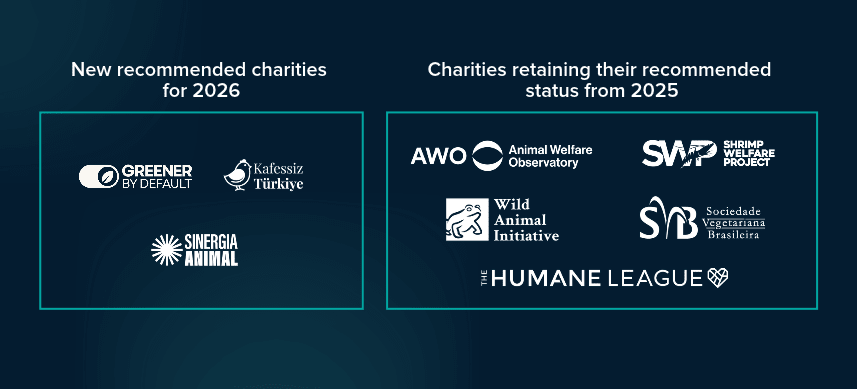
That’s where Animal Charity Evaluators comes in. We spend months evaluating a small cohort of the most promising animal charities so you don’t have to. We examine their programs, evidence, finances, organizational health, and what they’d do with more funding. After this year’s comprehensive evaluations, we’re delighted to announce our Recommended Charities for 2026.
Charities awarded the status in 2026
Charities retaining the status from 2025
Çiftlik Hayvanlarını Koruma Derneği
Greener by Default
Sinergia Animal
Animal Welfare Observatory
Shrimp Welfare Project
Sociedade Vegetariana Brasileira
The Humane League
Wild Animal Initiative
Çiftlik Hayvanlarını Koruma Derneği (in Türkiye) and Sinergia Animal (in Latin America and Southeast Asia) have continued to demonstrate impactful strategic prioritization and effective methods in their work on the most important issues for animals. After being thoroughly re-evaluated this year, their recommendation status has been renewed. And this year, a newly evaluated charity joins their ranks: U.S.-based Greener by Default.
Many worthy charities applied to be evaluated this year, and we’re grateful to them for the incredible work they’re doing for animals who need help. We believe the six we selected for in-depth evaluation[1] are doing some of the most meaningful work to reduce the suffering of farmed and wild animals, and it was a pleasure to get to know their programs in such detail.
If you’d like to support our Recommended Charities, we invite you to give to our Greatest Needs Fund. The fund lets us stay responsive to animals’ needs in a rapidly and radically changing world, so we can act on things that are hard to anticipate, like a Recommended Charity facing an unexpected funding gap or a time-sensitive opportunity we’d otherwise have to pass up. Your gift today is what makes that responsiveness possible.
Thanks to a generous legacy donor, we’ll launch a Matching Challenge for our Greatest Needs Fund to increase the impact of your donations starting 14th November.
Charities Recommended in 2026
Three charities were newly evaluated this year; five carry forward their recommendation status from 2025, having met our rigorous evaluation criteria.
Çiftlik Hayvanlarını Koruma Derneği
Çiftlik Hayvanlarını Koruma Derneği (ÇHKD) is working to improve the lives of the more than 110 million egg-laying hens and 1.8 billion farmed fishes (around 600,000 tonnes) that are suffering at any given time in Türkiye’s food production systems. They are the country's only farmed animal advocacy organization, running corporate cage-free campaigns through Kafessiz Türkiye (Türkiye Without Cages) alongside a newer program building the welfare science base for farmed fishes. They aim to make Türkiye a country where corporate welfare standards are expected rather than exceptional.
ÇHKD’s recent achievements include:
Securing 11 new cage-free commitments in 2024 and 2025, covering approximately 78,000 hens a year, including Big Chefs and Mado
Bringing five earlier commitments to full implementation, including Caffè Nero and Starbucks
Working with Migros, one of Türkiye's largest retailers, to accelerate its transition to cage-free eggs
Launching Future for Fish, a regranting program funding primary welfare research on seabass, seabream, and rainbow trout
With your support, ÇHKD can expand the Future for Fish program beyond its first pilot round, encourage the development of a Turkish egg certification scheme, and sustain the accountability work needed to hold companies to cage-free commitments already secured.
ACE proudly recommends Çiftlik Hayvanlarını Koruma Derneği (ÇHKD) as an excellent giving opportunity. To learn more, read our 2026 review of Çiftlik Hayvanlarını Koruma Derneği. If you would like to support the work of Çiftlik Hayvanlarını Koruma Derneği, you can donate here.
Greener by Default
Greener by Default (GBD) works in North America and Europe to reduce the number of animals raised and killed for food by changing how institutions serve meals. Institutional kitchens serve billions of meals a year, and the choices made in those kitchens shape what millions of people eat. Rather than asking individuals to change their habits, GBD works with hospitals, universities, corporate dining programs, stadiums, and city governments to make plant-based options the default on menus, with meat available on request.
Their approach is grounded in behavioral science, and because a single institutional contract can shift millions of meals, GBD's model reaches a scale that individual outreach cannot. The changes tend to persist because they’re built into procurement and menu design rather than depending on continued persuasion.
GBD’s recent achievements include:
Advising Sodexo Healthcare on the rollout of plant-based defaults and other menu nudges for one meal per day across roughly 400 U.S. hospitals
Shifting plant-to-animal ratios at one food station in each of three dining halls at a major East Coast university, with no increase in any animal-product category
Launching a centralized client portal they anticipate will reduce staff time per institution by 30% to 50%, and an international train-the-trainer program
With your support, GBD will be able to hire two healthcare managers to expand their coverage across U.S. regions and open up the senior living sector, an area which no other organization currently works in. They will also grow their train-the-trainer program, which they expect to equip at least 10 organizations by 2028, reaching institutions that serve over 9 million meals a year. Support will also help them add capacity to work with individual hospitals they currently turn down.
ACE proudly recommends Greener by Default as an excellent giving opportunity. To learn more, read our 2026 review of Greener by Default. If you would like to support Greener by Default’s work, you can donate here.
Sinergia Animal
Sinergia Animal works across Latin America and Southeast Asia to reduce the suffering of farmed animals in countries including Argentina, Brazil, Chile, Colombia, Indonesia, Peru, and Thailand — countries where farmed animals have few advocacy organizations working on their behalf. Sinergia drives meaningful welfare improvements through corporate outreach, institutional meat reduction, and programs for pigs’ welfare. Their campaigns are both locally tailored and globally strategic. With a strong track record and impressive plans for the future, Sinergia is well positioned to create lasting change for farmed animals worldwide.
Sinergia’s recent achievements include:
Securing 51 new cage-free commitments between January 2024 and June 2026, covering roughly 1.7 million hens a year, including Arcor, one of Latin America's largest food manufacturers
Pressuring 36 companies on existing commitments, with five reporting a completed transition and seven reporting significant progress
Extending accountability work to multinational targets, and engaging companies including Carrefour, Unilever, and Marriott
With your support, Sinergia Animal will be able to hire five new accountability campaigners in Argentina, Colombia, Chile, Indonesia, and Thailand, and senior campaign strategists to support national teams. They’ll also be able to run more pressure campaigns and develop a staff retention and succession plan.
ACE proudly recommends Sinergia Animal as an excellent giving opportunity. To learn more, read our 2026 review of Sinergia Animal. If you would like to support Sinergia Animal’s work, you can donate here.
Charities Recommended in 2025
Animal Welfare Observatory
Animal Welfare Observatory (AWO) works to improve the welfare of farmed animals through corporate campaigns, investigations, and legislative advocacy. Based in Spain, one of the EU’s largest producers of farmed animals and a strategically important yet neglected country for animal protection, AWO focuses on improving conditions for egg-laying hens, chickens raised for meat, and farmed aquatic animals, including fishes and shrimp. The organization works with companies and policymakers in Spain and at the EU level to advance stronger welfare standards and lasting institutional changes toward ending factory farming.
AWO’s recent achievements include:
Pushing three Spanish retailers to complete their cage-free fresh egg commitments through a corporate accountability campaign, affecting around 1.2 million laying hens
Bringing the overlooked suffering of farmed shrimp into mainstream debate with an international campaign challenging the shrimp industry in Spain (the EU’s largest shrimp importer)
Joining the European Commission’s Aquaculture Advisory Council, giving AWO a formal channel to influence EU aquaculture policy discussions, and launching an open letter calling for stronger EU legislation on farmed fish welfare
With your support, AWO will hold Spain’s largest retailers accountable for fulfilling their cage-free commitments, push chicken producers to adopt European Chicken Commitment standards, and secure corporate commitments to end eyestalk ablation and introduce effective stunning for shrimp. Additional funding will also support advocacy during the upcoming revision of EU animal welfare legislation, particularly to advance an EU-wide ban on cages and stronger legal protections for farmed fishes.
ACE proudly recommends Animal Welfare Observatory as an excellent giving opportunity. To learn more, read our 2025 review of Animal Welfare Observatory. If you would like to support Animal Welfare Observatory’s work, you can donate here.
Shrimp Welfare Project
Shrimp Welfare Project (SWP) is the first organization dedicated exclusively to improving the welfare of farmed shrimp. They secure commitments for electrical stunning, which minimizes suffering during slaughter, through two key approaches: supporting retailers’ shrimp welfare policies and providing producers with stunning equipment, ongoing technical support, and supply chain consulting. SWP also works to improve water quality on shrimp farms and researches shrimp welfare. In recent years, shrimp welfare advocacy has gained more traction and found opportunities to make meaningful change. SWP’s long-term goal is to transform industry standards toward higher welfare.
SWP’s recent achievements include:
Signing their 37th memorandum of understanding (MOU) to provide stunners to shrimp producers across nine countries in Asia, Latin America, and Africa, which is expected to help about 6.5 billion shrimp per year once all are delivered and operational
Celebrating 18 retailers’ shrimp welfare policies, including every major U.K. supermarket chain, plus global commitments from ALDI Nord and ALDI Süd
Partnering with Dutch retailer Albert Heijn, seafood supplier Klaas Puul, and Venezuelan producer Confremarca on a first-of-its-kind validation process to monitor electrical stunning in their supply chains, setting a new standard for industry traceability
With your support, SWP will be able to continue deploying stunners to accelerate industry-wide change, catalyze cheaper and fit-for-purpose models of electrical stunners, and bring in third-party verification for electrical stunning to improve implementation.
ACE proudly recommends Shrimp Welfare Project as an excellent giving opportunity. To learn more, read our 2025 review of Shrimp Welfare Project. If you would like to support Shrimp Welfare Project’s work, you can donate here.
Sociedade Vegetariana Brasileira
Sociedade Vegetariana Brasileira (SVB) is a nonprofit organization working to transform Brazil’s food systems by making plant-based eating more accessible, affordable, and widely adopted. SVB combines government relations, public policy advocacy, and grassroots mobilization to drive systemic change. Through engagement with policymakers, public institutions, and other stakeholders, they work to integrate plant-based nutrition into public policies and institutional food systems while building the political and social support needed to sustain these changes. By combining technical assistance, professional training, and policy engagement, SVB helps translate policy opportunities into practical improvements in food provision at scale.
SVB’s recent achievements include:
Being on track to reach an estimated 34 million plant-based meals in 2026 across public schools, hospitals, community kitchens, and universities.
Shaping school food policy by advancing discussions on dietary diversity, nutritional adequacy, and heme iron requirements in Brazil’s National School Feeding Program (PNAE)
Being the only civil society organization invited to participate in the National Fund for Education Development’s regional listening process on sustainable school menus
With your support, SVB can build on this momentum by strengthening their work in government relations and public policy advocacy, expanding their campaigns and capacity-building efforts, and broadening their nutrition education initiatives through courses and lectures at universities. The funding will also support SVB’s participation in health-related and international climate events, as well as their strategic engagement in fiscal policy through the hiring of a specialized consultant.
ACE proudly recommends Sociedade Vegetariana Brasileira as an excellent giving opportunity. To learn more, read our 2025 review of Sociedade Vegetariana Brasileira. If you would like to support Sociedade Vegetariana Brasileira, you can donate here.
The Humane League
The Humane League (THL) drives corporate and legislative change for farmed animals worldwide. Billions of chickens raised for eggs and meat suffer in intensive farming systems designed to maximize output at the expense of welfare. THL accelerates the adoption of cage-free and other welfare commitments, backed by their international Open Wing Alliance (OWA) network. Their tactics include direct company engagement and public pressure campaigns. They also establish lasting welfare reforms through their Animal Policy Alliance and direct political outreach.
THL’s recent achievements include:
Securing 234 new corporate commitments for chickens by Open Wing Alliance members in 2025, with more than 60 of those commitments established in Africa
Holding 131 companies accountable in 2025, and sparing 7.5 million hens from cages around the globe
Providing over $2 million in funding in 2025 to 36 Open Wing Alliance member groups across 30 countries and six continents
With your support, THL will be able to provide training and funding for Open Wing Alliance members around the world, expand their cage-free accountability work, drive forward progress in Asia, and support policy alignment to convert corporate norms into durable legislation.
ACE proudly recommends The Humane League as an excellent giving opportunity. To learn more, read our 2025 review of The Humane League. If you would like to support The Humane League’s work, you can donate here.
Wild Animal Initiative
Wild Animal Initiative (WAI) is a U.S.-based organization working to improve our understanding of wild animals’ lives by advancing the field of wild animal welfare science. The vast majority of animals live in the wild, many of whom live very short lives and experience painful deaths. Yet we know very little about most wild animals’ quality of life or how to improve it. WAI conducts their own research and supports other wild animal researchers to expand academic interest in wild animal welfare. Together, these efforts help uncover evidence-based solutions to improve the wellbeing of wild animals.
WAI’s recent achievements include:
Awarding 96 wild animal welfare research grants, totaling nearly $6 million in funding for the field
Publishing 15 papers about wild animal welfare in peer-reviewed scientific journals
Co-organizing the 2025 meeting of the UK’s Animal Welfare Research Network, one of the world’s premier animal welfare science conferences, resulting in approximately one-third of the conference focusing on wild animal welfare
With your support, WAI will be able to ensure their grants, research, and services programs remain high-impact. They will also be able to pursue new milestones for the field, such as an interdisciplinary conference dedicated to wild animal welfare science and the launch of formal wild animal welfare science programs at major universities.
ACE proudly recommends Wild Animal Initiative as an excellent giving opportunity. To learn more, read our 2025 review of Wild Animal Initiative. If you would like to support Wild Animal Initiative’s work, you can donate here.
While Aquatic Life Institute was listed in our blog post announcing the charities being evaluated in 2026, we did not complete their evaluation due to concerns about governance. Taking these issues seriously, ALI is now in the midst of incorporating changes that will reflect their growing professional needs and resources as an organization.
Note Edits made: link to Recommended Charities page added, mention this was cross-posted and added a linked footnote.
Crossposted to Less Wrong
‘Like most of life’s dangers, the dangers of artificial intelligence are not easily identified from the armchair.’
J Dmitri Gallow
Epistemic status
I’m not an expert in this field, and herein I make some sweeping generalisations educated guesses about the overall...
Note: This post was crossposted from Planned Obsolescence by the Forum team, with the author's permission. The author may not see or respond to comments on this post.
Subtitle: If acceleration compounds, the naive extrapolation implies superintelligence within a year
This post discusses a public METR report on AI R&D acceler...
TL;DR:
* When we started Rethink Priorities (RP) in 2018, our mission was, simply put, to close the knowledge gaps that stopped people from improving the world as much as they could. That hasn’t changed much, but the landscape we’re doing it in is shifting.
* In 2027, we plan to grow our core GHD, Animal Welfare, and Worldview Investigations teams to take on emerging priorities across causes, including those that the forthcoming transformative AI is creating.
...



Thanks for continuing to publish cost-effectiveness analyses (CEAs) of the charities you recommend (I linked them here). I am not aware of any other funder of animal welfare interventions doing this. I have made many comments on your posts announcing the charities you recommended in 2024, 2025, and 2026 suggesting improvements. However, all else equal, I trust funders publishing their analyses more. Funders not publishing their analysis are less accountable.