Comments
I think that you are asking the wrong question. The role of organizations such as ours is not to set the most ambitious standard, but rather to influence as many people as we can to give to the nonprofits we recommend.
Your article presents a critique of the go-to-market approach of The Life You Can Save, and then a comparison to the go-to-market approach of Giving What We Can, which you state you prefer as it is more ambitious. Let’s explore this a bit…
The Life You Can Save is actually 2 things:
1. A book in which Peter Singer presents an argument that in order to live an ethical life we have a moral obligation to help those suffering and dying unnecessarily from the effects of extreme poverty
2. An organization that has been working to influence as many people as possible to help those living in extreme poverty for the past 10+ years, and has raised more than $100M for effective nonprofits working to lift people out of poverty.
When it comes to recommendations for the level of giving, I would argue that Peter sets the most ambitious target of anyone when he argues that “in order to be good people, we must give until if we gave more, we would be sacrificing something nearly as important as the bad things our donations can prevent.” One important point here is that in the book The Life You Can Save he is arguing the case for giving to help those suffering from the effects of extreme poverty only, and not including giving to fight climate change, animal welfare or other causes that donors may hold dear. The book is a call to action written to raise awareness and compel everyone living with enough financial means to buy things that are not necessities, that not only do we have the ability but the obligation to end extreme poverty. Peter sets this moral ambition, but recognizes himself that this standard may not be attainable for many and may actually deter some to give, and thus he writes: “I propose a much easier target: roughly 5% of annual income for those who are financially comfortable, with less for those below that level, and significantly more for the very rich. My hope is that people will be convinced that they can and should give at these levels. I believe that doing so would be a first step toward restoring the ethical importance of giving as an essential component of a well-lived life. And if it is widely adopted, we’ll have more than enough money to end extreme poverty.”
Now, as an organization working to raise funding for our recommended nonprofits we need to decide how we ‘go-to-market’, meaning how we craft a strategy and business plan to achieve our objectives. Our mission is to lift people out of poverty by changing the way people think about and donate to charity. There are several considerations for why take the approach we do:
- We are focused solely on helping those in extreme poverty, and as such we need to work to overcome standard objections donors may have, the main one being why they should give offshore versus locally. As such we take the position that donors should take a portfolio approach to giving, meaning they should give with their head and their hearts and allocate their philanthropic budget across multiple causes that resonate with them. We are actively working to educate donors to the benefits they themselves would experience if we raised the minimum quality of life in the world, and thus inspire everyone to give some percent of their giving to lift people out of extreme poverty in an effective manner.
- We commend all giving and at all levels, and believe that donors are on an impact journey that will last a lifetime and as such, we need to meet donors where they are and support them to start, encourage their progress and continue to educate them as they expand their giving and thus their impact. Some donors may be deterred by calls to action with high thresholds, so we encourage people to start with any amount. Even a one-time $10 donation can go a long way, particularly when pooled with other resources and given to our Maximize Your Impact Fund, which is actively managed by our research team who determines where funds are deployed based on immediate funding needs of our recommended nonprofits in order to optimize the impact of donations on behalf of donors. In our view it’s important to encourage donors to just start, and then build from there.
- There is strong consensus among behavioral change experts that setting small, achievable goals is an effective way to change behavior. While not the only strategy, as the success of the Giving What We Can Pledge demonstrates, it is still considered highly effective in creating long lasting behavior change driven by: boosting self-efficacy when an individual achieves goals and believes in their ability to do so, creating habits as small changes are easier to incorporate into daily life, reducing the overwhelming nature of trying to achieve a highly ambitious goal, creating positive reinforcement when a person has consistent success in achieving goals and the power of incremental progress which creates a sense of momentum that can drive more significant change over time.
All of these factors have influenced our approach to messaging and donor engagement. We are working every day to continue to find the most successful tactics in influencing donors to join us on our mission and achieve our vision of a world with no global poverty.
Giving What We Can bases their ‘go-to-market’ approach around their 10% pledge, and we are so inspired by the work the team there does, and by the approximately 9,000 people who have taken the pledge. We do not disagree that their pledge is more ambitious than our recommendation at certain income thresholds, by design, and we hope that they continue to have success in not only inspiring people to sign the pledge, but to stick to it and move money to effective nonprofits. It would be worthwhile to note that they also have stated in their recommendation “if 10% doesn’t yet seem achievable, consider starting with a 
I hope this helps you better understand the reasoning behind our approach.
The problem(s) we are collectively working to resolve (The Life You Can Save with extreme poverty, and Giving What We Can across multiple cause areas) are massive, and include trying to influence everyone in the more affluent parts of the world, and as such we believe solving these problems will require many varied approaches across many organizations targeting different and diverse audiences. It’s best we find ways to work together, learn from each other and support each other, versus pushing a singular approach into the market.
Just a note: In a recent update we removed the The Life You Can Save pledge from our website for internal business reasons. Some of our supporters have specifically asked for the calculator to be available to them and so we have allowed access to the pledge through direct link only. It is no longer accessible through our website navigation.
Thank you,
Jessica, co-CEO The Life You Can Save
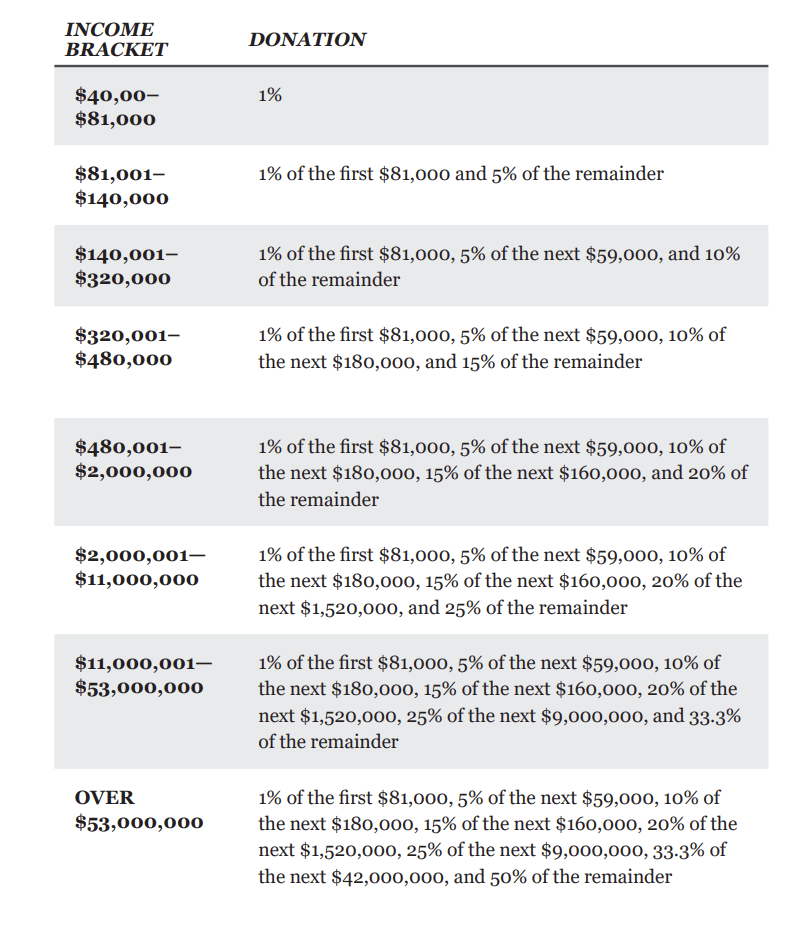



I've never lived in New York on $40,000/year, but I imagine that I would be constantly stressed and unable to think of other people's needs. That might be more than what 95% of the human population earns, but expenses are also higher for people in New York than for 99% (a guess) of the human population.
Assuming no sort of family/support network, that would be really hard. What sort of housing/medicine/food/clothing/lifestyle can a person afford in New York on 40k per year?[1] $40,000/year in Oklahoma City might be fairly comfortable, and in Chengdu or Chennai or Cairo it might be a very comfortable lifestyle, but in New York it would be... quite a bit less comfortable. It might not even be a living wage.[2]
I'm guessing that many of the people who are able to donate 10% (or more) while having good salaries would find it really hard to keep doing that if they lived at that standard (the standard of living that a 40,000 USD pre-tax income in New York City allows). Is it possible, and would some do it? Yes, there are some paragons of virtue who would be able to make that work. But for most of us, I think that would be too challenging.
In this scenario, if we aren't crashing on a friend's/relative's sofa, and we can't afford university education or similar training, and we don't know about the local networks (like Buy Nothing Facebook groups or Freecycle communities)
Although depending on the sacrifices you are willing to make, you would probably live on it. There are certainly people in New York City that survive on that amount or less per year.
New York might be too challenging on that salary, but I lived in Lyon (France's 2nd biggest city) on less than that (36k a year) and donated a third of my earnings to animal welfare charities.
Now I don't spend much, the situation would be different in the US (higher welfare expenses), and I dont have kids. But I expect most people in France with this salary to be able to give 10% of their income without sacrificing their wellbeing.
A somewhat meandering follow-up: I have an idea that isn't fully clear in my head, but I want to share the rough idea of it. I think that one of the difficulties is that when we use our own life examples there are often many hidden benefits that don't get calculated clearly/directly into the income. Some things can be roughly calculated if we put some effort (health insurance, the quality of housing, how stably is the job, the length of commute), and some things are really really hard to put a price on (having a family support network, local knowledge of which shops sell cheap vegetables that are still good quality, speaking the local language well-enough to make friends).
Maybe an economist would think of these as "investments in human capital." If a person has these things, it is really easy to forget how hard it is to exist without them. I think of the cliché of a millionaire pretending to slum around as a homeless person. But to be serious: if a person has a university education, and a strong professional network, healthy emotional relationships with family, and good physical health, and professional stability, and a well-funded retirement account, it can be really hard to imagine life without those things. If a person hasn't had all these "investments in human capital" then it is really really challenging to make a good life situation for yourself. When I think about a person living in an expensive city on $15,000 or $20,000 per year, I wonder how much has been invested in these people so that they are able to live so frugally. How different does it look if a person lacks that investment?
Could I live on 40k in NYC if I had all of the above-listed "investments?" Probably, yeah. Could I do it if I had none of them? I bet that I wouldn't be able to.