Comments
All views are my own rather than those of any organizations/groups that I’m affiliated with. Trying to share my current views relatively bluntly. Note that I am often cynical about things I’m involved in. Thanks to Adam Binks for feedback.
Edit: See also child comment for clarifications/updates.
Edit 2: I think the grantmaking program has different scope than I was expecting; see this comment by Benjamin for more.
Following some of the skeptical comments here, I figured it might be useful to quickly write up some personal takes on forecasting’s promise and what subareas I’m most excited about (where “forecasting” (edit: is defined as things in the vein of "Tetlockian superforecasting" or general prediction markets/platforms, in which questions are often answered by lots of people spending a little time on them, without much incentive to provide deep rationales) is defined as things I would expect to be in the scope of OpenPhil’s program to fund).
- Overall, most forecasting grants that OP has made seem much lower EV than the AI safety grants (I’m not counting grants that seem more AI-y than forecasting-y, e.g. Epoch, and I believe these wouldn’t be covered by the new grantmaking program). In part due to my ASI timelines (
10th(edit: ~15th) percentile ~2027, median ~late 2030s), I’m most excited about forecasting grants that are closely related to AI, though I’m not super confident that no non-AI related ones are above the bar. - I generally agree with the view that I’ve heard repeated a few times that EAs significantly overrate forecasting as a cause area, while the rest of the world significantly underrates it.
- I think EAs often overrate superforecasters’ opinions, they’re not magic. A lot of superforecasters aren’t great (at general reasoning, but even at geopolitical forecasting), there’s plenty of variation in quality.
- General quality: Becoming a superforecaster selects for some level of intelligence, open-mindedness, and intuitive forecasting sense among the small group of people who actually make 100 forecasts on GJOpen. There are tons of people (e.g. I’d guess very roughly 30-60% of AI safety full-time employees?) who would become superforecasters if they bothered to put in the time.
- Some background: as I’ve written previously I’m intuitively skeptical of the benefits of large amounts of forecasting practice (i.e. would guess strong diminishing returns).
- Specialties / domain expertise: Contra a caricturized “superforecasters are the best at any forecasting questions” view, consider a grantmaker deciding whether to fund an organization. They are, whether explicitly or implicitly, forecasting a distribution of outcomes for the grant. But I’d guess most would agree that superforecasters would do significantly worse than grantmakers at this “forecasting question”. A similar argument could be made for many intellectual jobs, which could be framed as forecasting. The question on whether superforecasters are relatively better isn’t “Is this task answering a forecasting question“ but rather “What are the specific attributes of this forecasting question”.
- Some people seem to think that the key difference between questions superforecasters are good at vs. smart domain experts are in questions that are *resolvable* or *short-term*. I tend to think that the main differences are along the axes of *domain-specificity* and *complexity*, though these are of course correlated with the other axes. Superforecasters are selected for being relatively good at short-term, often geopolitical questions.
- As I’ve written previously: It varies based on the question/domain how much domain expertise matters, but ultimately I expect reasonable domain experts to make better forecasts than reasonable generalists in many domains.
- There’s an extreme here where e.g. forecasting what the best chess move is obviously better done by chess experts rather than superforecasters.
- So if we think of a spectrum from geopolitics to chess, it’s very unclear to me where things like long-term AI forecasts land.
- This intuition seems to be consistent with the lack of quality existing evidence described in Arb’s report (which debunked the “superforecasters beat intelligence experts without classified information” claim!).
- General quality: Becoming a superforecaster selects for some level of intelligence, open-mindedness, and intuitive forecasting sense among the small group of people who actually make 100 forecasts on GJOpen. There are tons of people (e.g. I’d guess very roughly 30-60% of AI safety full-time employees?) who would become superforecasters if they bothered to put in the time.
- Similarly, I’m skeptical of the straw rationalist view that highly liquid well-run prediction markets would be an insane societal boon, rather than a more moderate-large one (hard to operationalize, hope you get the vibe). See here for related takes. This might change with superhuman AI forecasters though, whose “time” might be more plentiful.
- I think EAs often overrate superforecasters’ opinions, they’re not magic. A lot of superforecasters aren’t great (at general reasoning, but even at geopolitical forecasting), there’s plenty of variation in quality.
- Historically, OP-funded forecasting platforms (Metaculus, INFER) seem to be underwhelming on publicly observable impact per dollar (in terms of usefulness for important decision-makers, user activity, rationale quality, etc.). Maybe some private influence over decision-makers makes up for it, but I’m pretty skeptical.
- Tbh, it’s not clear that these and other platforms currently provide more value to the world than the opportunity cost of the people who spend time on them. e.g. I was somewhat addicted to Metaculus then later Manifold for a bit and spent more time on these than I would reflectively endorse (though it’s plausible that they were mostly replacing something worse like social media). I resonate with some of the comments on the EA Forum post mentioning that it’s a very nerd-sniping activity; forecasting to move up a leaderboard (esp. w/quick-resolving questions) is quite addicting to me compared to normal work activities.
- I’ve heard arguments that getting superforecasted probabilities on things is good because they’re more legible/credible because they’re “backed by science”. I don’t have an airtight argument against this, but it feels slimy to me due to my beliefs above about superforecaster quality.
- Regarding whether forecasting orgs should try to make money, I’m in favor of pushing in that direction as a signal of actually providing value, though it’s of course a balance re: the incentives there and will depend on the org strategy.
- The types of forecasting grants I’d feel most excited about atm are, roughly ordered, and without a claim that any are above OpenPhil’s GCR bar (and definitely not exhaustive, and biased toward things I’ve thought about recently):
- Making AI products for forecasting/epistemics in the vein of FutureSearch and Elicit. I’m also interested in more lightweight forecasting/epistemic assistants.
- FutureSearch and systems in recent papers are already pretty good at forecasting, and I expect substantial improvements soon with next-gen models.
- I’m excited about making AIs push toward what's true rather than what sounds right at first glance or is pushed by powerful actors.
- However, even if we have good forecasting/epistemics AIs, I’m worried that it won’t convince people of the truth since people are irrational and often variance in their beliefs is explained by gaining status/power, vibes, social circles, etc. It seems especially hard to change people’s minds on very tribal things, which seem correlated with the most important beliefs to change.
- AI friends might actually be more important than AI forecasters for epistemics, but that doesn’t mean AI forecasters are useless.
- I might think/write more about this soon. See also Lukas's Epistemics Project Ideas and ACX on AI for forecasting
- Judgmental forecasting of AI threat models, risks, etc. involving a mix of people who have AI / dangerous domain expertise and/or very strong forecasting track record (>90th percentile superforecaster), ideally as many people as possible who have both. Not sure how helpful it will be but it seems maybe worth more people trying.
- In particular, forecasting that can help inform risk assessment / RSPs seems like a great thing to try. See also discussion of the Delphi technique in the context of AGI risk assessment here. Malcolm Murray at GovAI is running a Delphi study to get estimates of likelihood and impact of various AI risks from experts.
- This is related to a broader class of interventions that might look somewhat like a “structured review process” in which one would take an in-depth threat modeling report and have various people review and contribute their own forecasts in addition to qualitative feedback. My sense is that when superforecasters reviewed Joe Carlsmith’s p(doom) forecast in a similar vein that the result wasn’t that useful, but the exercise could plausibly be more useful with better quality reviews/forecasts. It’s unclear whether this would be a good use of resources above the usual ad-hoc/non-forecasting review process, but might be worth trying more.
- Forecasting tournaments on AI questions with large prize pools: I think these historically have been meh (e.g. the Metaculus one attracted few forecasters, wasn’t fun to forecast on (for me at least), and I’d guess significantly improved ~no important decisions), but I think it’s plausible things could go better now as AIs are much more capable, there are many more interesting and maybe important things to predict, etc.
- Crafting forecasting questions that are cruxy on threat models / intervention prioritization between folks working on AI safety
- It’s kind of wild that there has been so little success on this front. See frustrations from Alex Turner “I think it's not a coincidence that many of the "canonical alignment ideas" somehow don't make any testable predictions until AI takeoff has begun.” I worry that this will take a bunch of effort and not get very far (see Paul/Eliezer finding only a somewhat related bet re: their takeoff speeds disagreement), but it seems worth giving a more thorough shot with different participants.
- I’m relatively excited about doing things within the AI safety group rather than between this group and others (e.g. superforecasters) because I expect the results might be more actionable for AI safety people. (edit: I got feedback that this bullet was too tribal and I think that might be right. I think that a better distinction might be preferring inclusion of people who've thought deeply about the future of AI, rather than e.g. superforecaster generalists)
- Making AI products for forecasting/epistemics in the vein of FutureSearch and Elicit. I’m also interested in more lightweight forecasting/epistemic assistants.
I incorporated some snippets of a reflections section from a previous forecasting retrospective above, but there’s a little that I didn’t include if you’re inclined to check it out.

I think forecasting is attractive to many people in EA like myself because EA skews towards curious people from STEM backgrounds who like games. However, I’m yet to see a robust case for it being an effective use of charitable funds (if there is, please point me to it). I’m worried we are not being objective enough and trying to find the facts that support the conclusion rather than the other way round.
I think the fact that forecasting is a popular hobby is probably pretty distorting of priorities.
There are now thousands of EAs whose experience of forecasting is participating in fun competitions which have been optimised for their enjoyment. This mass of opinion and consequent discourse has very little connection to what should be the ultimate end goal of forecasting: providing useful information to decision makers.
For example, I’d love to know how INFER is going. Are the forecasts relevant to decision makers? Who reads their reports? How well do people figuring out what to forecast understand the range of policy options available and prioritise forecasts to inform them? Is there regular contact and a trusting relationship at senior executive level? Would it help more if the forecasting were faster, or broader in scope?
These are all very important questions but are invisible to forecaster participants so end up not being talked about much.
Yeah, it seems similar to other areas where the discussion around the cause area and the cause area itself may be quite different. (see also the disparity in resources vs discussion around global health vs ai)
The interest within the EA community in forecasting long predates the existence of any gamified forecasting platforms, so it seems pretty unlikely that at a high level the EA community is primarily interested because it's a fun game (this doesn't prove more recent interest isn't driven by the gamified platforms, though my sense is that the current level of relative interest seems similar to where it was a decade ago, so it doesn't feel like it made a huge shift).
Also, AI timelines forecasting work has been highly decision-relevant to a large number of people within the EA community. My guess is it's the single research intervention that has caused the largest shift in altruistic capital allocation in the last few years. There also exists a large number of pretty simple arguments in favor of forecasting work being valuable, which have been made in many places (some links here, also a bunch of Robin Hanson's work on prediction markets).
At a higher level, there are also many instances of new types of derivatives markets increasing efficiency of some market, which would probably also apply to prediction markets.
FYI, just wrote a small piece on "Higher-order forecasts", which I see as the equivalent to derivatives. https://forum.effectivealtruism.org/posts/PB57prp5kEMDgwJsm/higher-order-forecasts
I agree they can help with efficiency.
I feel like the prediction-markets themselves are best modeled as derivative markets. And then you are talking about second-order derivative markets here. But IDK, mostly sounds like semantics.
Yea, that's a reasonable way of looking at it. Agreed it is just semantics.
As semantics though, my guess is that "nth-order forecasts" will be more intuitive to most people than something like "n-1th order derivatives".
I'm considering elaborating on this in a full post, but I will do so quickly here as well: It appears to me that there's potentially a misunderstanding here, leading to unnecessary disagreement.
I think that the nature of forecasting in the context of decision-making within governments and other large institutions is very different from what is typically seen on platforms like Manifold, PolyMarket, or even Metaculus. I agree that these platforms often treat forecasting more as a game or hobby, which is fine, but very different from the kind of questions policymakers want to see answered.
I (and I hope this aligns with OP's vision) would want to see a greater emphasis on advancing forecasting specifically tailored for decision-makers. This focus diverges significantly from the casual or hobbyist approach observed on these platforms. The questions you ask should probably not be public, and they are usually far more boring. In practice, it looks more like an advanced Delphi method than it looks like Manifold Markets. I'm somewhat surprised to see interpretations of this post suggesting a need for more funding in the type of forecasting that is more recreational, which, in my view, is and should not be a priority.
E: One obvious exemption to the dichotomy I describe above is that the more fun forecasting platforms can be a good way of identifying
Superforecastersgood forecasters.Personally, I think specifically forecasting for drug development could be very impactful: Both in the general sense of aligning fields around the probability of success of different approaches (at a range of scales -- very relevant both for scientists and funders) and the more specific regulatory use case (public predictions of safety/efficacy of medications as part of approvals by FDA/EMA etc.)
More broadly, predicting the future is hugely valuable. Insofar as effective altruism aims to achieve consequentialist goals, the greatest weakness of consequentialism is uncertainty about the effects of our actions. Forecasting targets that problem directly. The financial system creates a robust set of incentives to predict future financial outcomes -- trying to use forecasting to build a tool with broader purpose than finance seems like it could be extremely valuable.
I don't really do forecasting myself so I can't speak to the field's practical ability to achieve its goals (though as an outsider I feel optimistic), so perhaps there are practical reasons it might not be a good investment. But overall to me it definitely feels like the right thing to be aiming at.
Thanks for the comment, Grayden. For context, readers may want to check the question post Why is EA so enthusiastic about forecasting?.
Thanks for sharing, but nobody on that thread seems to be able to explain it! Most people there, like here, seem very sceptical
Would you count Holden's take here as a robust case for funding forecasting as an effective use of charitable funds?
This is my own (possibly very naive) interpretation of one motivation behind some of Open Phil's forecasting-related grants.
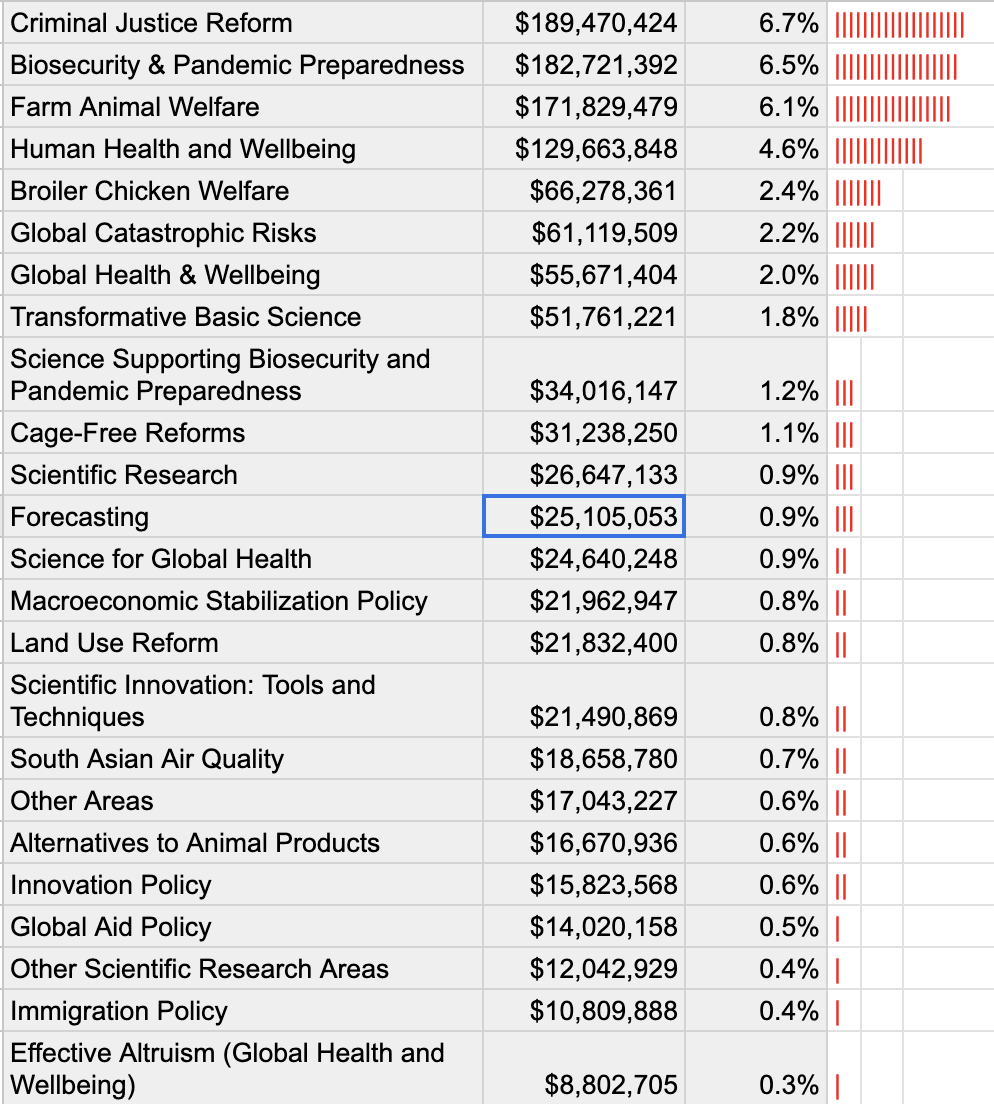
Actually, maybe it's also useful to just look at the biggest grants from that list:
Thanks for sharing. It’s a start, but it’s certainly not a proven Theory of Change. For example, Tetlock himself said that nebulous long-term forecasts are hard to do because there’s no feedback loop. Hence, a prediction market on an existential risk will be inherently flawed.
I don't think that really works. You can get feedback from 5 years in 5 years. Metaculus already has some suggestions as to people who are good 5 year forecasters.
None of the above are prediction markets.
COI - I work in forecasting.
Whether or not forecasting is a good use of funds, good decision-making is probably correlated with impact.
So I'm open to the idea that forecasting hasn't been a good use of funds, but it seems it should be a priori. Forecasting in one sense is predicting how decisions will go. How could that not be a good idea in theory.
More robust cases in practice: