Comments
Related post (which I don't think is mentioned here): Longtermism, risk, and extinction by Richard Pettigrew.
Related post (which I don't think is mentioned here): Longtermism, risk, and extinction by Richard Pettigrew.
Hi Sylvester, thanks for sharing that post, I hadn't seen it!
Hi Laura.
Spending on corporate cage-free campaigns for egg-laying hens is robustly[8] cost-effective under nearly all reasonable types and levels of risk aversion considered here.
[...]
I am only considering the first-order cost-effectiveness of the interventions, whereas it is likely there are externalities (potentially both positive and negative) to spending on each intervention [more].
Do you have any thoughts on how accounting for effects on soil animals on change your conclusions? I have very little idea about whether cage-free campaigns for egg-laying hens increases or decreases animal welfare accounting for effects on ants and termites.
Thanks for this, important work! I read the forum post but not the longer report or the accompanying code, so apologies if you have addressed these there. A few thoughts/questions:
There is some debate as to whether one must consider the “background” amount of utility in the world to implement WLU; that is, is WLU a state-of-the-world-based theory or a difference-making theory? I adopt the latter version, which is equivalent to a state-of-the-world-based theory that sets the “background” utility of the world at zero. I do so because finding the aggregate utility of the entire world seems currently intractable, fraught with even more ethical questions, and out of the scope of this project.
Couldn't you just use your utility assignments from the section Defining the Baseline Utility of Each State of the World for a state-of-the-world-based version, like I think you do for (state-of-the-world or non-difference-making) REU? If this is a problem for WLU, it would also be one for REU.
That being said, the possible states you consider in that section seem pretty limited, too, only "the human-equivalent DALY burden of each harm", with the harms of "Malaria, x-risk, hens, shrimp (ammonia + harvest/slaughter)", and so could limit the applicability of the results for (non-difference-making) risk and ambiguity aversion.
It seems the higher ranked options under risk neutral EV maximization are also ranked higher under (non-difference-making) REU here (ambiguity neutral). Including background utility might not change this, based on
Tarsney uses the broad conclusions from that paper in The epistemic challenge to longtermism, footnote 43.[1]
However, one major limitation of Tarsney's paper is that there doesn't seem to be enough statistically independent background value to which to apply the argument, because, for example, we have uncertainty across stances that apply to ~all sources of moral value, like how moral value scales with brain size (number of neurons, synapses, etc.), functions or states, e.g. each view considered for RP's moral weight estimates. We could also have correlated views about the sign of background value and the sign of the value of extinction risk reduction, e.g. a stance that's relatively more pessimistic about both vs one relatively more optimistic about both. In particular, if we expect the background utility to be negative, we should be more pessimistic about the difference-making value of extinction risk reduction, and, it, too, should be more likely to be negative. So, it would probably be better to do a simulation like you've done and directly check.[2]
The value of what you don't causally affect could also make a difference for your results for difference-making risk aversion, assuming acausal influence matters with non-tiny probability (e.g. Carlsmith, 2021, section II) or matters substantially in expectation (e.g. MacAskill et al., 2021[3]). See:
In Tarsney (2020), I try to develop a principled anti-fanatical view, based on stochastic dominance, that tells us when it’s permissible to deviate from expected value maximization and ignore small probabilities. The thresholds for ‘small’ probability that this view generates depend on various features of the choice situation, including in particular the agent’s degree of ‘background uncertainty’ about sources of value in the world unaffected by her choices. (Greater background uncertainty generates stronger stochastic dominance constraints that narrow the class of Pascalian choices in which deviations from expected value maximization are permitted.) §5.4 of the paper considers the implications for choices like our working example, between existential risk mitigation and interventions with more certain, near-term payoffs. My own conclusion is that our background uncertainty is probably great enough that even the anti-fanatic is required to prioritize existential risk mitigation when it maximizes expected value. But this conclusion is not particularly robust—other reasonable estimates of the relevant epistemic probabilities might lead to the opposite conclusion. So by the lights of my own preferred anti-fanatical view, cases like our working example are borderline; deciding whether expected value maximization is mandatory or optional in such cases will require more precise estimates of the relevant probabilities and stakes.
Or, maybe the argument can be saved by conditioning on each stance that jointly determines the moral value of our impacts and what we don't affect, and either checking if the recommendations agree or combining them some other way. However, I suspect they often won't agree or combine nicely, so I'm skeptical of this approach.
In general, I'm skeptical about applying expected value reasoning over normative uncertainty. Still, the case for intertheoretic comparisons between EDT and CDT over the same moral views is stronger (although I still have general reservations), by assigning the same moral value to each definite outcome:
Therefore, we will argue that the problem of intertheoretic value comparisons is solved by requiring that .
Where they disagree is how to assign probabilities to outcomes.
On the other hand, a similar argument could favour reweightings of probabilities or outcome values that lead to greater stakes over risk neutral expected value maximization.
Time ago, I took part in an exchange on risk aversion that can be useful.
"I remind you that "risk aversion" is a big deal in economics/finance because of the decreasing marginal utility of income. In fact, in economics and finance, risk aversion for rational agents is not a primitive parameter, but a consequence of the CRRA parameter of your consumption function. So I think risk aversion turns quite meaningless for non monetary types of loss."
See here the complete exchange:
https://forum.effectivealtruism.org/posts/mJwZ3pTgwyTon2xmw/?commentId=grW3y8JCmNK2rjFPA
The concept is slippery: you really need to clarify "why utility is non convex" in the relevant variable? Risk aversion in economics is not primitive: it is derived from decreasing marginal utility of consumption...
This post is part of Rethink Priorities’ Worldview Investigations Team’s CURVE Sequence: “Causes and Uncertainty: Rethinking Value in Expectation.” The aim of this sequence is twofold: first, to consider alternatives to expected value maximization for cause prioritization; second, to evaluate the claim that a commitment to expected value maximization robustly supports the conclusion that we ought to prioritize existential risk mitigation over all else.
As of November 6, 2023, the following changes have been made to the analysis and presentation of the report:
Imagine you’re faced with the following two choices, A and B, and you can push a button to select one or the other to occur. If you choose A, you will save 10 people’s lives with 99% certainty. If you choose B, you have a 1% chance of saving 1,200 people’s lives and a 99% chance of saving none. Which would you choose?
Using expected value (EV) maximization,[1] the answer is straightforward: you choose B, because when you multiply the 1% probability of saving the 1200 people, the expected value of the choice is 12 lives saved, compared to 9.9 for option A.
But maybe your intuitions say that EV maximization is missing something important. For example, you might be pulled towards A by this thought: “It’s nearly certain that if I choose B, I save nobody, letting 10 people die who I could almost certainly have saved.” And maybe if you’d still choose B for the stakes considered here (1200 lives with 1% probability), would you be comfortable choosing it if the gamble involved 1.2 trillion lives and had only a 10-11 probability of success?
You also might worry about expected value maximization from a different direction: a special concern about avoiding the worst outcomes. Imagine that option A stays the same but now option B involves saving 900 people with a 1% probability, making its expected value lower than that of A. You might think that you should still choose B because you think it’s especially important not to let 900 people die, even if you have a small chance of saving them.
Finally, you might worry about EV maximization because you might doubt the stipulated probabilities of the choice between A and B. What if you don’t know for certain that there’s a precisely 99% or 1% chance of saving 10 or 1200 lives, even if those are your best estimates? This problem is especially pressing when there could be additional downside risks. How should your decisions change if there’s a third option, C, where you could save 1200 people with an estimated 3% chance of success, but there’s also an estimated 1% chance of causing the deaths of 1800, and, on top of that, you’re not really sure of either probability? Yet again, our considered judgments may not match what EV maximization recommends.
Questions about how to navigate various types of risk and risk aversion permeate cause prioritization discussions. For example, many people are attracted to movements like effective altruism because they want to know with a high degree of confidence that they’re actually doing good rather than throwing their money away on ineffective philanthropic efforts. On the other hand, there are strong arguments for taking a hits-based giving approach in cause areas where the expected value is very high. If you favor spending on existential risk mitigation or insect welfare interventions, you might appeal to the thought that, even if the probabilities of an existential catastrophe or insect sentience are very small, we should err on the side of caution. That is, we should pay special attention to avoid the worst-case scenario where the possibility for flourishing is severely curtailed or large amounts of suffering are allowed to persist. Regardless of where you come down on these questions, it’s incredibly difficult to be confident in the probabilities and values we assign to countless important claims and parameters that affect our cause prioritization calculations. Should we still gamble with our resources when we know so little? If so, how much risk would be too much?
This report creates mathematical frameworks and tools to address the following question:
How can the relative cost-effectiveness of donating to different interventions within and between three cause areas (existential and non-existential catastrophic risk mitigation,[2] global health and development, and animal welfare) change when we consider risk aversion under decision-theoretic alternatives to expected value theory?
This question is explored in the four sections of this report, in which I:
Below is a summary of these four sections, which I expand upon in the rest of the report.
In investigating the motivating question above, I disambiguate three broad categories of risk aversion and build cross- and intra-cause comparison models that incorporate different degrees of aversion to each type of risk. These three types of risk aversion are
To address risk aversion that cautions us to “avoid the worst” states of the world, I built a model that implements Lara Buchak’s risk-weighted utility theory (REU), as discussed in Buchak’s 2014 paper “Risk and Tradeoffs.” The eight bad states of the world that I consider are combinations of the following events: egg-laying hens are/are not sentient and suffering immensely, shrimp are/are not sentient and suffering immensely, and the value of the future is/is not lost in an existential catastrophe.
Next, I built three decision theory models that incorporate risk aversion with respect to making a difference. For causes like global health and animal welfare, the definition of “difference-making” is straightforward: the number of human-equivalent DALYs averted by the intervention. However, for existential risk interventions, what counts as “making a difference” is a little more ambiguous: are our actions valuable only if they prevent an existential or non-existential catastrophe that would have otherwise occurred, or is it valuable to merely lower the probability of a catastrophe? [3]
Two of the three difference-making risk aversion models assume that value for existential risk projects is created only if the intervention averts a catastrophe that would have otherwise occurred. The first is a method my colleague, Hayley Clatterbuck,[4] and I created which I call “difference-making risk-weighted expected utility” (DMREU). Modeled on Lara Buchak’s risk-weighted expected utility model, the difference-making risk-weighted expected utility model changes what we mean by the “outcome” to be focused locally on the marginal cost-effectiveness of an intervention. DMREU gives extra weight to outcomes that come out at the beginning of a ranked list from worst to best change in the utility of the world from before to after the intervention. The second model that incorporates difference-making risk aversion is based on Bottomley and Williamson’s 2023 paper on weighted linear utility theory (WLU),[5] “Rational risk-aversion: Good things come to those who weight.” WLU differs from the rank-dependent DMREU model in that it is stakes-sensitive; rather than giving extra weight to the lowest-ranked outcomes, WLU gives extra weight to outcomes we cause in proportion to how bad they are in magnitude.
Now, suppose we value risk reductions themselves, rather than just existential catastrophes prevented. If we knew the amount by which our actions reduced existential risk, the expected value of the intervention would be clear: just multiply the change in the probability of an existential catastrophe by the amount of counterfactual value saved from preventing a catastrophe. Importantly, however, we are uncertain about our effects on existential risk levels, which creates massive variation in the expected amount of difference made by our actions. The third difference-making risk aversion model is called the “expected difference made” (EDM) risk aversion model. This model uses ambiguity aversion functions to aggregate the expected difference-made estimates of donating to existential risk projects while giving disproportionate weight to the worst of the set.
Like expected difference made risk aversion, implementing REU yields considerable variation in its expected utility estimates when I change the input parameters. As such, I also apply ambiguity aversion functions to aggregate the risk-weighted expected utility estimates created.
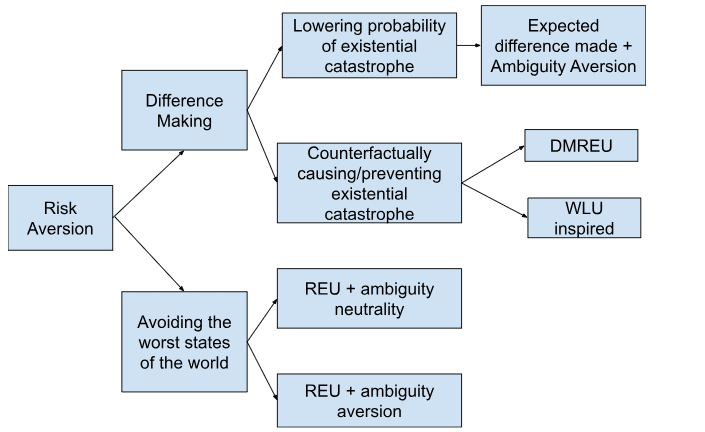
Figure 1 below shows a taxonomy of the risk aversion models developed. The first distinguishing factor is whether the risk aversion model focuses on making a difference or avoiding the worst states of the world. Difference-making models are further subdivided by whether you value lowering the probability of an existential risk occurring (expected difference made + ambiguity aversion) or counterfactually preventing existential catastrophes. Models for the latter (WLU and DMREU) differ in whether they’re stakes-sensitive. REU is the only “avoiding the worst” risk aversion model included. However, we can choose to apply a layer of ambiguity aversion in aggregating the REU results because of the substantial variation in probabilities related to background risk levels and whether and by how much our existential risk mitigation efforts succeed.
Figure 1: A taxonomy of risk-aversion models
For each of these risk and uncertainty aversion models, I see how the relative cost-effectiveness of several choice EA interventions changes or stays the same with different degrees of risk aversion. I describe these interventions in the results section.
Amongst the various cause areas popular among effective altruists, it might appear at first that existential risk mitigation interventions might be the most susceptible to risk aversion concerns, especially of the “difference-making” type, whereas global health and development interventions are safer. It is certainly true that the former interventions deal with great uncertainty: How likely is any intervention to have an impact on existential risk? How confident should we be that any impacts it has are beneficial, and how large are they? When does an intervention deserve counterfactual credit, and how much?
However, risks of failure are present within other cause areas, too. For instance, even though I’m pretty confident that donating to the Against Malaria Foundation has a positive impact, lobbying to get a new economic or health policy passed is a risky endeavor within global health. Moreover, leaving small probabilities of existential catastrophes unaddressed is also a risky choice if we’re averse to highly unfavorable states of the world coming about (e.g., human civilization being permanently wiped out).
Animal welfare advocacy faces similar questions: How much should we stick to tried-and-true interventions like cage-free corporate campaigns versus branching out into new areas like shrimp welfare? Here, two forms of risk prevail, mostly surrounding shrimps’ capacity for welfare. First, because shrimp could be sentient (here defined as having a non-zero capacity for welfare), there’s a risk that the level of shrimp suffering in the world is extremely high. However, we might think there’s less evidence for shrimp sentience than there is for hen sentience. So, spending on shrimp welfare has a higher chance of doing no good compared to spending on layer hen welfare.
With all these considerations in mind, I created at least two intervention profiles for each cause area. Each intervention considered differs based on 1) its expected cost-effectiveness and/or 2) the variance in its cost-effectiveness.
For global health and development, these include donating to:
For animal welfare, these include donating to organizations that:
The last intervention is a hypothetical shrimp welfare intervention. I included it as a model to get a more complete range of the possible cost-effectiveness of shrimp welfare interventions, beyond humane slaughter methods.
Finally, I considered two types of existential risk mitigation interventions:
Assessing the number of years of counterfactual credit involved in existential risk mitigation projects is both incredibly difficult and mightily consequential for the bottom-line cost-effectiveness estimates. To address this, I model both the risky and conservative interventions assuming two very different periods of counterfactual impact: between 100 and 1000 years (with 90% confidence) and between 10,000 and 100,000 years (with 90% confidence).[6] These are labeled “near-term” and “long-term” projects throughout the results section. The variation in the results underscores how, in addition to our uncertainty around how to treat risk, we’re radically uncertain about how to value existential risk mitigation efforts.[7]
As I describe in the limitations section, this paper cannot definitively answer: “What is the relative cost-effectiveness of each cause I could donate to?” However, it does provide a formal guide for addressing the question: “If I believe [this set of parameters] and assume this methodology for estimating cost-effectiveness, what is the approximate relative value of donating to each intervention under various types and degrees of risk aversion?”
Nevertheless, I’m optimistic that this report provides a good attempt at analyzing how risk aversion can impact intra- and cross-cause cost-effectiveness comparisons–one which can be improved upon as we uncover more empirical evidence and create better frameworks for doing cost-effectiveness analysis.
Given my modeling assumptions, here are some of the key takeaways from when I apply risk aversion models to analyze the cost-effectiveness of all of the animal welfare, global health, and existential risk interventions. The full results are in this spreadsheet and are explained in this section of this report. All calculations are made in this GitHub repository.
In Table 1 below, I summarize the cost-effectiveness results from each cause for all the risk aversion theories and at different levels of risk aversion. The interventions are scored by how many orders of magnitude the cost-effectiveness estimate was above zero, per $1000 spent. If an intervention had a negative value, then the score in the table equals the negative of the base-10 logarithm applied to the absolute value of the cost-effectiveness estimate. A score of 3.5, for example, means the intervention’s cost-effectiveness is 103.5=3162 risk-weighted units per $1000 spent. A score of -5 signifies that the intervention’s cost-effectiveness was -100,000 risk-weighted units per $1000 spent when risk aversion was applied (i.e., it’s worse than doing nothing).
The scores are best compared within columns because the units of cost-effectiveness can differ when different types of risk aversion are applied. However, high positive cost-effectiveness across many risk aversion types and levels is evidence of a cause’s robustness.
Table 1: Interventions ranked by cost-effectiveness, in orders of magnitude above zero, per $1000 spent.
| Cause | Risk-Neutral EV Maximixation | DMREU, moderate risk aversion (0.05) | WLU, moderate risk aversion (0.10) | EDM, lower ambiguity aversion | EDM, higher ambiguity aversion | REU, Moderate risk aversion, ambiguity - neutral | REU, Moderate risk aversion, higher ambiguity - aversion |
| Long-term risky x-risk project | 5.0 | -5.3 | -5.4 | 3.7 | -5.1 | 4.3 | -4.2 |
| Long-term conservative x-risk project | 4.6 | -3.8 | -3.8 | 4.6 | 4.4 | 3.9 | 3.6 |
| Shrimp - Ammonia | 3.2 | 2.1 | 2.2 | 2.9 | 1.8 | 2.7 | 1.9 |
| Near-term risky x-risk project | 3.2 | -3.3 | -3.3 | 1.7 | -3.1 | 2.3 | -2.2 |
| Chickens | 3.1 | 2.8 | 2.6 | 2.9 | 2.8 | 3.1 | 2.8 |
| Near-term conservative x-risk project | 2.8 | -1.8 | -1.6 | 2.6 | 2.5 | 1.9 | 1.6 |
| Shrimp - Stunning | 1.6 | 0.85 | 0.87 | 1.3 | 0.77 | 1.4 | 1.0 |
| Against Malaria Foundation | 1.3 | 1.2 | 1.1 | 1.3 | 1.2 | 1.3 | 1.2 |
| Road Safety | 1.3 | 0.87 | 0.58 | 1.1 | 0.89 |
The paper was written by Laura Duffy. Thanks to Aaron Boddy, Hayley Clatterbuck and the other members of WIT, Marcus A. Davis, Will McAuliffe, Hannah McKay, and Matt Romer for helpful discussions and feedback. The post is a project of Rethink Priorities, a global priority think-and-do tank, aiming to do good at scale. We research and implement pressing opportunities to make the world better. We act upon these opportunities by developing and implementing strategies, projects, and solutions to key issues. We do this work in close partnership with foundations and impact-focused non-profits or other entities. If you're interested in Rethink Priorities' work, please consider subscribing to our newsletter. You can explore our completed public work here.
In this report, I use the phrases “value” and “utility” interchangeably.
Often in this report, I use the short-hand term “existential risk,” but I also model the value of reducing non-existential catastrophic risks.
It’s entirely possible that the correct model of difference-making lies in between: spending can be valuable if it counterfactually averts an existential or non-existential catastrophe or if it provides a necessary but insufficient (alone) contribution to a series of projects that, collectively, avert a catastrophe. This third case is hard to model, and could be addressed in future research.
Clatterbuck explores how risk aversion interacts with animal and global health causes in this post, which uses stylized numbers. This paper attempts to provide more empirically based numbers that incorporate further uncertainty.
There is some debate as to whether one must consider the “background” amount of utility in the world to implement WLU; that is, is WLU a state-of-the-world-based theory or a difference-making theory? I adopt the latter version, which is equivalent to a state-of-the-world-based theory that sets the “background” utility of the world at zero. I do so because finding the aggregate utility of the entire world seems currently intractable, fraught with even more ethical questions, and out of the scope of this project.
The interpretation of “counterfactual credit” varies depending on what type of risk aversion we’re considering. For difference-making risk aversion, the counterfactual credit period represents the time until another exogenous nullifying event that undoes our counterfactually changing whether an x-risk event occurs. For ambiguity aversion and "avoiding the worst" risk aversion, the period of counterfactual credit represents the length of time over which our risk reduction efforts leave an effect on the probability of an x-risk event.
In the coming weeks, Rethink Priorities’ Worldview Investigations Team will publish work that more fully explores how uncertainty about the future affects how valuable existential risk mitigation is. But in this report, I take a simpler approach to modeling the value of existential risk for purposes of demonstrating the effects risk aversion can have on the relative value of causes. The methodology and results shouldn’t be considered my or Rethink Priorities’ final views about existential risk correct cost-effectiveness estimates.
Throughout this report, I use the term “robust” to mean that an intervention’s cost-effectiveness relative to others does not dramatically decline or become negative when risk aversion is applied.
For hens, I use sentience-conditioned welfare range estimates based on those from Rethink Priorities’ Moral Weight Project. Specifically, I assume that hens’ sentience-conditioned welfare range is distributed lognormally with a 90% confidence interval of 0.02 to 1. The mean sentience-conditioned welfare range is 0.29. I assume that the probability that hens are sentient is between 75% and 95% with a mean of approximately 90%. I also assume that the cost-effectiveness of corporate cage-free campaigns has decreased by between 20% and 60% from prior estimates conducted in 2019 (see the cage-free campaigns’ cost-effectiveness methodology section). In soon-to-be-published work, I will consider the cost-effectiveness of cage-free campaigns under substantially lower welfare ranges under risk aversion considerations. Roughly speaking, if you decrease the sentience-conditioned welfare ranges to be between 0.01 and 0.04, then cage-free campaigns are still probably more cost-effective than the Against Malaria Foundation’s work, but they’re safely within an order of magnitude of each other.
I assume that shrimps’ sentience-conditioned welfare ranges are lognormally distributed between 0.01 and 2 with 90% confidence. However, I also clip the welfare ranges from above at 5 times the human welfare range and at 0.000001 from below. This produces a mean sentience-conditioned welfare range that is roughly 0.44, which is the same as the mean estimate from the Rethink Priorities welfare range mixture model that includes neuron counts. I also assume the mean probability of sentience is 40% for shrimp (90% CI: 20% to 70%). As noted above, I’ll publish risk-aversion analyses that use lower welfare ranges for shrimp in the coming days.
I decided to not include the road safety intervention because it’s a global health intervention with nearly identical expected cost-effectiveness as donating to the Against Malaria Foundation. By contrast, both shrimp welfare interventions have extremely different cost-effectiveness estimates, as do the low and high-risk existential risk mitigation projects, so I included both project profiles for these cause areas.


This is a really impressive report! Looking at 5 different risk-aversion models and applying them to 7 different interventions is an extraordinarily ambitious task, but I think you really succeeded at it. Almost every question or potential objection I came up with as I was reading ended up getting answered within the text, and I'm very excited to try using some of these models in my own research.
I wanted to also highlight how helpful it was that you took the time to examine simplified cases and ground some of the results in easy-to-understand terminology. To give just a few examples:
I did also have a few minor comments:
"The estimate for the annual DALY burden of malaria used in the REU model comes from Our World in Data’s Burden of Disease dashboard, which places the estimate at 63 million DALYs per year for malaria and neglected tropical diseases. (I assume that this is equal to the DALY burden of just malaria, which is likely inaccurate but probably correct to within an order of magnitude). I add uncertainty to this estimate by modeling the DALY burden of malaria as a normally distributed variable with a mean of 63 million DALYs and a standard deviation of 5 million DALYs"
The raw data is available from the IHME website, with the point estimate being 46,437,811 DALYs due to malaria and the range being 23,506,933 to 80,116,072.
This is not to say that the pre-2010 DALY weights were good measures of utility, just that the post-2010 weights are explicitly not trying to measure it