Executive Summary
Contributions to the 2024 US election may be among the most impactful uses of our money and time over the next few months. A group of volunteers and I who have spent recent months investigating contributing to the election believe this election is much more tractable and important than what conventional wisdom within the EA community suggests.
This election is much more tractable than most expect:
- US presidential elections are now usually decided by slim margins in a few swing states (by 537 votes in 2000, 118,601 in 2004, 77,744 in 2016, and 42,918 in 2020).
- The best polling data we have as of August 2024 suggests that the 2024 election’s margins will be in a similar range, with Harris slightly favored to lose. (Public polls are likely still somewhat underestimating support for Trump, like they did in the last two presidential elections.)
- Given how small margins of victory have been, many organizations have arguably been responsible for flipping past presidential elections (and many more could have flipped them with modest investments).
- While a lot of good work is being done, poor incentives among organizations attempting to elect Democrats result in many inefficiencies. (These incentives include credit and funding for oneself sometimes conflicting with impact, lower wages and career instability, staff’s political views being further to the left than the American population, and more).
This election matters more than most give it credit for:
- Most importantly, willingness to stage a violent coup to undemocratically overturn an election ought to be disqualifying. Trump incited a fatal attack on the US capitol January 6th, 2021 as part of a broader coup attempt to discredit and overturn the 2020 election. He continues to push election denialism, entertain political violence if he doesn’t deem the election fair. Even more concerning, the Republican party has coalesced in support of MAGA’s anti-democratic behavior, with widespread plans to challenge election results if they don’t go the way of Republicans.
- Trump's violent rhetoric has also escalated recently, vowing to "be Dictator on Day 1", "root out" his political opponents who "live like vermin", and saying migrants “poison the blood of our country”.
- For most EA cause areas, there are strong reasons to believe a Trump presidency would cause much worse outcomes than a Harris win.
- Trump has cut billions in global health aid, cut pandemic preparedness programs, pledged to overturn the AI Safety Executive Order on Day One, and lacks Harris' positive track record on farm animal welfare.
- Trump also refuses to read briefings, makes unqualified family members his senior advisors, punishes or fires people who disagree with him, and has repeatedly suggested launching nukes — not what you want from someone who may be leading the world through international crises or new, powerful technologies.
- In his first term, Trump and allies were held back by sane civil servants who rejected their dangerous ideas, like launching nuclear weapons or using the military to overturn the election. Since then, Trump and his allies have been openly preparing a plan to eliminate these checks and balances if he is re-elected: firing up to 54,000 independent civil servants (Schedule F Executive Order) and replacing them with Project 2025's vetted loyalists.
- A second Trump administration would already enjoy more power due to a recent Supreme Court ruling on presidential immunity (backed unanimously by the six conservative Justices, and rejected by all three liberal justices).
There are donation and volunteer opportunities which could meaningfully reduce the chances of a second Trump presidency.
- Our modeling suggests donations to help Harris are at least 5x more impactful than top Givewell recommended charities.
- Oct 29 update: Donation options are shifting rapidly right now and we're less sure where is best. If you're interested in donating please email us at [email protected] and we can give recommendations.
- One thing you can do if you're in a safe blue state is sign up for www.swapyourvote.org/ - we think this is a highly effective option! Even more importantly, if you know swing state voters who don't like Trump but are likely to vote third party let them know about this option! If you have good connections with communities of people in swing states which lean third party please reach out!
- We're collecting useful volunteer opportunities (including some projects our team is planning) and would be happy to share them with you and have a call to discuss how you can help. You can sign up to hear more here.
We find it motivating to reflect on how we would feel if Trump becomes the next president, especially if he wins by a small margin (the most likely outcome at the moment), knowing we didn't do what we could to stop him.
Introduction
The US is the world’s most powerful state and the only superpower that is also a liberal democracy. If one of the presidential candidates is expected to be much worse in important cause areas (e.g., protecting liberal democracy, AI safety, biosecurity, climate change, global health, or animal welfare), and if the election is expected to be very close, then contributing to helping the better candidate win has extraordinary value.
We know of no lever, other than the US presidential election, that allows as many individuals to clearly influence such important trajectory changes. Several community members have dropped other EA work to stop Trump from winning this year.
If you’re already convinced and want to know what you can do to contribute now, feel free to skip to our recommendations section.
Influencing the US election is tractable
US presidential elections are often close
US presidential elections are often surprisingly close.
- Biden won the last election by 42,918 combined votes in three swing states. Trump won the election before that by 77,744 votes. In 2000, just 537 votes (and likely some Republican meddling) in Florida decided the election for Bush.
There’s a good chance the 2024 election will be very close too (i.e. likely decided by <300,000 votes)
- While Biden dropping out has improved our chance of victory massively, the race is still tight. In August 2020 Biden was up about 8 points nationally while today Harris is up just 2.4 points. Prediction markets & analysts favor Harris only slightly compared to Trump.
- The best polling data we have as of August 2024 is that this election’s margins will be tight, with Harris very slightly favored to lose.
- Tipping point states are highly likely to be Pennsylvania, Wisconsin, or Michigan where the candidates are neck-and-neck. Public polls show a slight Harris lead in these states but it’s still early in her candidacy and things can change quickly. It’s also worth remembering that, even with a consistent lead in swing states the entire cycle, Biden’s margin of victory in 2020 was razor thin.
Given how close US elections tend to be, many efforts can be counterfactually responsible for flipping the election.
- For example, most major donors or moderately-resourced Republican political organizations which operated in Florida in 2000 can reasonably claim counterfactual responsibility for Bush’s victory. We’ll never know for sure, but there are likely thousands of individuals who were counterfactually responsible for the election results. Tens of thousands of individuals likely could have done enough to flip the election to Gore had they put in the effort.
Having an impact on the election is relatively straightforward
Many other efforts by EAs that significant resources have gone into have little positive impact to show for them (though of course, ex-ante, a lot of these efforts seemed very reasonable to prioritize) – e.g., efforts around OpenAI, longtermist branding, certain AI safety research directions, and more.
The election is more tractable than a lot of other work.
- The general theory of change is fairly straightforward: Increase the share of votes to the candidate who is more likely to effectively govern the US & deal with major societal risks.
- The closeness of the election allows many individuals with non-extraordinary skills or power to have a shot at making a decisive difference in the outcome of the election.
- For most people, and given most assumptions, downside risks are minimal.
- Feedback loops are highly measurable and concrete. Whether someone voted in an election is publicly available information, and how they voted is highly predictable from demographic and other data. This has made US electoral politics much more RCT-able than most EA cause areas (see our recommendations below).
There is still low-hanging fruit
Estimates for how effectively top RCT-tested interventions generate net swing-state votes this election range from about a thousand to several thousand dollars per vote. Top non-RCT-able interventions could be even better.
Most political donations don't go to effective organizations.
- Because most political donors aren’t particularly evidence-focused or attempting to optimize their giving, most donations go to relatively ineffective groups. This means that many effective groups are often not funded to a point of saturation despite the money pouring into the presidential election.
Many promising strategies have not been sufficiently explored or are underfunded.
- Many cost-effective strategies can’t scale as much as they’d like because they’re underfunded. See here for more info on those organizations.
- Many top organizations in the space were created within the last 2-4 years. This suggests that there is little barrier to entry for creating an effective organization, that these groups have room to grow, and that more good ideas are likely out there.
- Anecdotally, people with little political background have been able to generate many ideas that haven’t been tried and were received positively by experts.
- One group we’re in touch with, started just a few years ago by people with almost no political background, has rocketed to being among the top organizations in Democratic politics. It contributes mainly by advising donors with sophisticated research on the effectiveness of election interventions and coordinating their giving. We believe their work has had crucial impacts.
- Though new to this field, the team I’ve been working with has managed to generate some ideas which highly experienced advisors think are promising and which are not being addressed by existing groups.
Even many top organizations aren’t operating very efficiently.
- Biden’s post-debate campaign was the pinnacle of ineffective operation. They spent tens of millions on ads long after it became clear Biden should drop out. The campaign team consistently rationalized away evidence against Biden, ignored polling, and lied to the public in ways which did little but damage trust.
Many of the most prominent Democratic organizations use messaging which we know to be ineffective. For example, when attempting to mobilize people to vote, most organizations use issue-focused language rather than best practice methods despite repeated evidence that using these methods would make their efforts far more effective.
According to an expert we’re in touch with, as much as ~$400M is expected to be spent on paid canvassing. While there are effective versions of paid canvassing, most of the money spent on this will likely go to organizations which don’t use best practices. Research shows these efforts often result in null or even negative results.
- We’ve been frustrated with the unwillingness of some top fundraising organizations to scale their outreach and operations. They are often using outdated technology and failing to find ways to automate simple tasks (e.g., managing email lists).
Electoral politics has poor incentives and talent retention
From an outside view it’s reasonable to believe that, given the amount of money spent each cycle, some kind of efficient market should exist within electoral politics. However, there are a number of characteristics of the sector which make it less efficient than one might think.
Incentives push talent away from political work.
- Jobs in political campaigns are cyclical/temporary, very demanding, poorly compensated, and offer uncertain career capital (i.e., low rewards for working on losing campaigns).
- Because of these poor incentives, politics often attracts politically motivated people who often have poor intuitions about how undecided voters and moderates think.
- There’s a common assumption that others are handling the election and that stepping forward to donate or volunteer can’t make a difference.
Incentives for those working in electoral politics often make optimizing for effectiveness difficult.
- Because elections are necessarily adversarial, much of the research about effective election interventions is considered risky to share. If the other side finds and uses the research, the potential upside is nullified. This means that information sharing is limited and the best information about effective interventions is not as widely known as one might hope.
Those working on campaigns are often doing so to get jobs with the administration after winning. Because of this, they’re often more interested in their reputation with the candidate relative to their peers than actually winning. This competition can lead to internal tension which is not conducive to effective decision-making.
- Similar to the international aid sector, election nonprofits are accountable to donors first and foremost. This means they’re incentivized to overvalue the effectiveness of their work and to operate in a way which appeals to donors rather than aiming to win the most votes (e.g., messaging which appeals to donors rather than undecided voters).
The 2024 election is much more important than other elections
A second Trump term would likely be far more damaging for liberal democracy than the last
Democracy is “the worst form of government except for all those other forms that have been tried,” as Churchill famously remarked. Democracy unusually welcomes free and open debate of ideas, and it challenges leaders to benefit constituents — or be quickly, peacefully booted. Authoritarianism, meanwhile, has more often let an insulated group of elites sit back as famines, genocides, and other catastrophes unfolded around them — sometimes at their command. We expect a second Trump presidency to be much worse for liberal democracy, both domestically and globally (see the section on US-China and international relations below), than a Harris presidency would be.
In his first term, Trump and allies were held back by sane civil servants who rejected their dangerous ideas, such as launching nuclear weapons or using the military to overturn the election. Trump’s failure to overturn the 2020 election has shaped his second term agenda, which is now aimed at destroying checks and balances through unprecedented power over the military, courts, and key agencies. His plans reflect these new priorities:
- Execute a massive purge of independent civil servants: Trump has mentioned several times his desire to pass the “Schedule F” executive order. This would give him the power to fire up to 50,000 civil servants who have traditionally checked the president’s power, including in legal, regulatory, and military contexts.
- Assemble vetted loyalists: Trump’s allies have spent tens of millions on “Project 2025”, one goal of which is to screen Trump loyalists to replace independent civil servants. In their own words, “Our goal is to assemble an army of aligned, vetted, trained, and prepared conservatives to go to work on Day One to deconstruct the Administrative State.”
- Expand presidential control: As reported, “Project 2025 proposes that the entire federal bureaucracy, including independent agencies such as the Department of Justice, be placed under direct presidential control.”
- Appoint more loyal judges: While this happened in his first term as well, it’s become apparent just how impactful the appointment of judges loyal to Trump has been, at the Supreme Court, appellate, and district levels. Both Trump’s immunity ruling & Cannon’s ruling to throw out Trump’s classified documents case have been highly unusual & appear politically motivated.
Another key change from Trump’s last term is the presence of an extremely Trump-friendly Supreme Court which has, among other things, granted the president unprecedented immunity from the law. It remains to be seen just how much immunity Trump would have, but in her dissenting opinion, Judge Sotomayor said, “[When the president] uses his official powers in any way, under the majority's reasoning, he now will be insulated from criminal prosecution… [if he] orders the Navy's Seal Team 6 to assassinate a political rival? Immune." It seems likely that Trump would be legally able to take or offer bribes and it’s possible he couldn’t be prosecuted even for organizing a military coup. While the full implications remain unclear, experts are near-universally concerned about this ruling and its implications for how Trump could behave in a second term.
It’s worth spelling out just how concerning and forceful Trump’s attempts to overturn the 2020 election (i.e., to become a de facto dictator) were. He pressured state officials not to certify the election, considered using the military to seize ballots in an effort to ‘prove fraud’, tried to replace official electors with loyalists, tried to use the DoJ to legitimize his fraud claims, pressured his VP to dispute the election results, and ultimately was responsible for a violent march on the capital.
Many of the checks on Trump’s power which prevented him from seizing power in 2020 are unlikely to be present in a second term. Given the Supreme Court ruling he’ll have far less concern about being prosecuted for election interference or threatening officials. His VP has implied he would obey Trump’s demands were a similar situation to happen again. The administrative state would be hollowed out and powerless to resist.
While each has been deniable, Trump has made allusions to attempting to stay in power beyond his second term, saying things like, “Four more years, you know what? It’ll be fixed, it’ll be fine, you won’t have to vote any more” or “I don’t know, are we going to be considered three-term? Or two-term?”. It appears highly likely that Trump will take actions to further degrade democracy in the United States. The possibility that he attempts to retain the presidency beyond 2028 should be taken seriously.
This is an especially critical period for AI
Many leaders and employees at frontier AI labs have discussed having TAI timelines before 2030 (Sam Altman: 4-5 years, Dario Amodei: Human level in 2 years, Shane Legg: 50% AGI by 2028). This means the next President has a good chance of presiding over a decisive period for addressing AI risk concerns.
Due to incompetence, anti-regulation influences in his camp, past corruption, and his anti-Democratic leanings, we believe Trump would have an outsized negative impact on AI policy concerns. For more on the likely implications of Trump and Harris on AI risk concerns, see the appendix.
Trump is unusually bad at governing
Trump’s own ghostwriter disclosed that Trump has an “absolute lack of interest in anything beyond power and money” and a “completely compulsive” need for attention. “Lying is second nature to him.” A statement signed by Republican national security experts, some of whom worked with Trump, claims that “other global leaders… view him as unreliable, unstable, and unworthy of respect” and that he “solicited foreign influence” from Xi and Putin.
The former head of Trump’s National Economic Council, Gary Cohn, purportedly said, “It’s worse than you can imagine. An idiot surrounded by clowns. Trump won’t read anything - not one-page memos, not the brief policy papers; nothing. He gets up halfway through meetings with world leaders because he is bored. And his staff is no better.”
We cannot trust Trump to act well in a crisis scenario or on crucial issues. Because of this, any large-scale risk of concern is amplified under a Trump presidency. More detail on this in the cause area section.
How you can help
Many people we’ve talked to (both inside and outside the community) think the election is a huge deal. Extremely few of them are actually making it a priority, let alone working on it. We believe finding ways to contribute is high value and worth seriously considering.
Urgency & irreversibility
The success of many EA efforts – e.g., a large portion of national AI policy or biosecurity legislation – will depend, at least in part, on the next US President & Congress (see our analysis of top cause areas below). This means improving Harris’ chance of being elected serves as a force-multiplier on a large portion of the most important work being done in key cause areas.
We have just under 3 months to have an impact on the Presidential election (election day is November 5th). The actual time that remains for many of the most effective opportunities is likely just a few weeks.
For a good portion of projects focused on EA causes, delaying work (or donations) for 3 months is unlikely to have a major impact on the project’s success. In contrast, once November 5th has passed, there will be nothing to be done about who is president. Depending on the outcome, it’s plausible that we won’t have another chance like this in 2028.
Get involved
We believe it could be worthwhile for many EAs to put serious time and effort into improving Harris’ odds. The upside of the election being so close is that, should you choose to work on this issue, the impact on your time is limited. Taking a 3 month hiatus, while certainly costly, is not going to make or break whether most EA projects succeed. At the very least, election work provides valuable experience in a new field with rapid feedback loops that make it easy to stay motivated and keep improving.
If you’re interested in getting involved (even for an hour or two a week), fill out this form to let us know your background, interests, and availability. Once you fill out this form we can share opportunities with you which we believe are likely to be particularly impactful. These will include opportunities with established organizations, but also options to get involved with projects run by our team (depending on funding there may be paid options). We’re especially interested in hearing from people who are open to working full-time and/or who have expertise in: social media, communications, messaging, law (esp. election law), student organizing, evaluation, data science, high-quality writing, and networking (esp. with high net worth individuals).
Appendix
The opportunity cost of a Trump presidency
As we detail below, Trump is likely to actively cause great harm (relative to the regulatory status quo) in key EA cause areas. But even if Trump did not actively cause harm – e.g., by repealing Biden’s executive order on AI, which he vowed to do on day one –, his presidency would still be extremely bad in opportunity cost terms. He would be the center of societal attention for at least four years and the entire political conversation would revolve around his agenda and rhetoric (e.g., attempts to grab power across the branches of government, “revenge” against his political opponents, the border/immigration, culture war topics, etc.). An enormous amount of progressive resources would be bound up resisting Trump’s agenda instead of improving public policy.
The candidates on some EA cause areas
The following are quick assessments, often based on limited information. Given how little we know of Harris’ current policy views and intentions, much of our assessment assumes she’ll behave similarly to Biden on key issues (which seems likely).
Artificial Intelligence
Candidates’ Strengths and AI
With how quickly AI is advancing, arguably what matters most is not the candidates' current stances on AI, but how the candidates will respond to new evidence of risks:
- Who will have the humility to, if needed, change their mind about AI's risks and pursue international cooperation?
- Which administration would have the expertise and culture to effectively track and govern AI?
- Who would govern with societal well-being most in mind, if given power over extremely powerful AI?
For the reasons in our sections on the candidates' personal character and international relations below, the answers strongly favor Harris.
Positions of the candidates on AI
There are similarities in how both candidates have discussed AI so far, with both candidates discussing global leadership and staying ahead of China as a priority when discussing AI, and pointing out its potential for causing harm. There are also important differences
Trump has expressed some concerns about AI but some of his top supporters seem to be vocal AI accelerationists with a strong interest in shaping AI policy in a second Trump administration.
- Trump has voiced some concerns about dangers from AI, especially around deepfakes and nuclear concerns.
- Trump plans to repeal Biden’s executive order on AI safety on day one.
- Prominent AI catastrophic risk deniers and accelerationists are backing Trump, including a16z leadership and Marc Andreessen, who are supporting the Trump campaign and angling to influence his administration’s AI policy.
- Elon Musk has given large, and very public, donations in an effort to help Trump win. He has voiced concern about AI risk in the past and may have some ability to influence Trump. While this does mitigate some fears that Trump will throw in his hat entirely with the accelerationist crowd, I have little trust in Musk’s judgment. I’ve been alarmed by what appear to be poorly thought-out statements on how to address AI safety from Musk and have found other recent statements of his concerning.
- One proposal from a group attached to Trump, the America First Policy Institute, has promoted messaging around limited regulation and reliance on corporate self-governance for AI companies. This proposal also brought up the idea of a ‘Manhattan Project for AI’. It’s unclear the extent to which Trump endorses these views.
Harris tends to focus on present harms, but has expressed some concern about existential risk.
- Harris has generally put more emphasis on current harms, highlighting that local/personal harms feel existential to individuals in a November 2023 speech. That said, in the same speech, she acknowledged that AI might “endanger the very existence of humanity”, citing “AI-formulated bioweapons” and “AI-enabled cyberattacks” as particular concerns.
- At a minimum, Harris seems highly unlikely to reverse the Biden-Harris administration’s previous actions on AI safety. The Biden administration has made impressive progress on AI safety policy, including the establishment of the US AI Safety Institute, securing voluntary commitments on AI safety from many companies, and the 2023 AI Executive Order.
Expected impact of the candidates on AI policy
Competence and integrity of the administration, relationships with other countries and labs, respecting science/strong arguments, not acting out of self-interest, corruption, and other intangibles strongly point in favor of transformative AI going better under a Harris administration than Trump.
Pandemic response and biosecurity
While we don’t know much about Harris’ opinions about biosecurity, the Biden administration has taken reasonable steps to address the risks from pandemics. Our best guess is that Harris would continue in a similar vein.
The Biden Administration has taken action on biosecurity which Trump has expressed plans to reverse if reelected.
- In 2023, the Biden White House launched the Office of Pandemic Preparedness and Response Policy. Trump said he would disband this office if reelected, arguing that “we can mobilize,” while with a preparedness office, “[a] lot of the things that you do and a lot of the equipment that you buy is obsolete when you get hit with something.”
- The Biden Administration is also creating standards and strong financial incentives for many DNA and RNA sequencing companies to screen requests, so they avoid handing hazardous sequences to bioterrorists. This is part of Biden’s Executive Order on AI safety, which Trump has said he would cancel “on day one.”
Trump presided over the beginning of the Covid pandemic and had, at best, a mixed record in terms of handling it. He may appoint known anti-vaccine activist RFK Jr. to a leading role in his administration.
- There's a reasonable chance that RFK Jr., an anti-vaccine extremist, will be put into a leading role in a Trump administration. It's hard to imagine a worse person to have in charge of managing a potential future pandemic or to give responsibility for ensuring countermeasures are in place for future pandemics.
- According to Wikipedia, “Trump was initially described as optimistic about the country's response to the pandemic and the threat level the coronavirus disease 2019 presented the public. As the pandemic's severity escalated in the U.S., Trump repeatedly made false or misleading statements. In contrast, officials within the Trump administration made numerous statements in support of physical distancing measures and business closures.”
- That said, under Trump, “The federal government managed the development of several vaccines for the virus through Operation Warp Speed in 2020. Distribution of the vaccines was overseen by the Biden administration during 2021, during which time many pandemic measures were ended.”
- According to a report from the non-partisan Federation of American Scientists, “Operation Warp Speed (OWS) [under Trump] was a public-private partnership that produced COVID-19 vaccines in the unprecedented timeline of less than one year. This unique success among typical government research and development (R&D) programs is attributed to OWS’s strong public-private partnerships, effective coordination, and command leadership structure.”
Global health
A proxy for the candidates’ track records on global health is how much money their administrations asked Congress to approve for global health programs. (How much money Congress actually approved probably depended less on the candidates and more on Congress.) The most recent budget request explains that these programs work “to combat infectious diseases, prevent child and maternal deaths, bolster nutrition, control the HIV/AIDS epidemic, and build the capacity of partner countries to prevent, detect, and respond to future infectious disease outbreaks to prevent them from becoming national or global emergencies.”
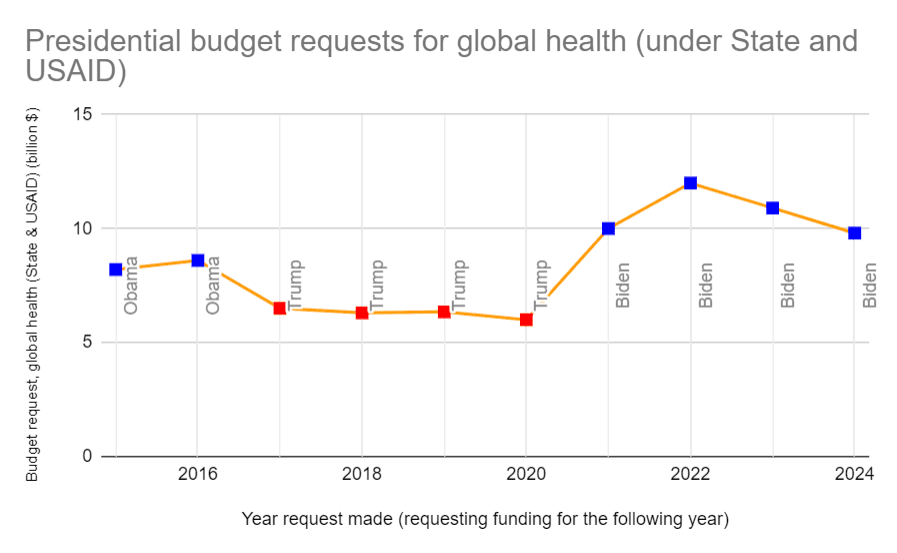
On average, the Biden Administration requested $4.4 billion more per year for global health than the Trump Administration. For reference, GiveWell moved about $1 billion (including funding from Open Philanthropy) in 2022. While it’s unclear how Harris will compare to Biden on international aid spending, it seems highly likely she’ll allocate billions more. If she spends at the same level as Biden (and Trump reverts to his prior spending), getting her into office would lead to ~$16 billion going to international aid that otherwise wouldn’t have.
Climate change
We don’t yet know the specifics of Harris’ climate platform, but she has long prioritized climate change.
- Her record includes co-sponsoring the Green New Deal, creating a unit to target polluters in poor neighborhoods as the San Francisco district attorney, and bringing charges against major California polluters as attorney general.
- Her campaign spokesperson said Harris will follow Biden’s lead. A key example of Biden’s climate efforts was the 2022 Inflation Reduction Act, which allocated hundreds of billions in funding and tax incentives to help both the public and private sector transition to renewable energy and otherwise reduce emissions.
Trump is clearly not going to take positive action on climate change and is likely to roll back much of the progress made under Biden
- Analysis from Carbon Brief shows that a second Trump administration could lead to an estimated extra 4 billion tonnes of CO2 emissions by 2030 than a second Biden term. This is comparable to the annual CO2 output of the European Union and Japan
- Put another way, the extra 4 gigatons of CO2 from a second Trump term would negate – twice over – all of the savings from deploying wind, solar and other clean technologies around the world over the past five years.
- Looking beyond 2030, and assuming no further policy changes, a Trump win could yield an extra 27 billion tonnes of CO2 emissions by 2050, compared with policies that would be implemented under a second Biden administration, the analysis shows.
- Trump has actively solicited money from oil executives, apparently in exchange for major actions to cut pollution regulations, reduce subsidies for electric cars, and expand offshore drilling permits.
Nuclear Risk
Trump probably exacerbated nuclear risk in his first term and would likely do so again in a second term.
- Kingston Reif, a missile expert at the Arms Control Association in Washington, D.C., summarized Trump’s nuclear initiatives: “The Trump administration's nuclear legacy is one of failure,” Reif said. “The administration inherited several nuclear challenges, to be sure, but it has made nearly all of them worse. Trump became the first president since the 1960s not to negotiate any new nuclear arms-control agreement. Instead, he did the very opposite—loosened controls, encouraged proliferation and, as a result, is “the first post-Cold War president not to reduce the size of the nuclear warhead stockpile.”
- Two years after Trump withdrew from the Iran nuclear deal, Tehran has cut in half the time it would need to produce enough weapons-grade fuel for a nuclear bomb.
- Trump is generally unstable and prone to making risky bets. He has not demonstrated a solid understanding of nuclear policy nor the serious risks of using nuclear weapons. In fact, his former Secretary of Homeland Security claims that Trump, “cavalierly discussed the idea of using a nuclear weapon against North Korea, saying that if he took such an action, the administration could blame someone else for it to absolve itself of responsibility”
Harris seems likely to continue with the status quo on US nuclear policy, perhaps making marginal progress on increasing safety.
- As for Harris, we again know fairly little about how she would differ from the Biden administration on nuclear policy. It seems likely she would essentially continue with the status quo but be far more likely to handle a crisis gracefully.
Farm animal welfare
Harris appears to be a strong advocate of animal welfare, even addressing some issues for farmed animal welfare.
- As California’s Attorney General Harris, “defended a series of pioneering animal protection laws approved in the state. She continuously defended California’s ban on foie gras sales after producers launched a series of challenges in the courts. She also took the right side—and the winning side—of multiple separate challenges to Prop 2 and AB 1437, California’s improved farm animal welfare laws.” She also, “defended a law which banned killing pigs for food if they were too sick or injured to move”.
- In her 2020 primary campaign she also mentioned she would support changing dietary guidelines to incentivize a reduction in the consumption of red meat, though she cites climate change rather than welfare concerns.
- On the other hand Walz, who has done some work on agriculture in the past, is less clearly favorable for animal welfare concerns.
We know little about Trump’s views on animal welfare but it seems unlikely we’ll see any positive developments on farm animal welfare from his administration.
- As president, Trump signed a bill making various forms of animal cruelty federal crimes, but the bill exempted customary agricultural practices. In 2024, Florida governor Ron DeSantis signed Senate Bill 1084 into law, making Florida the first U.S. state to ban the sale of cell-based meat (also known as “cultivated” or “lab-grown” meat). This is part of a broader MAGA anti-lab grown meat polarization, with efforts to reduce factory farmed production
US-China & international relations
The next administration will inherit a tense international situation which could easily get worse. AI has the potential to add further challenges.
Back in 2021, a panel of superforecasters estimated the likelihood of a China-Taiwan conflict over the next five years at 14% (8-23% CI). Metaculus (currently) assigns a 25% probability to a full-scale Chinese invasion of Taiwan by 2030.
In short timeline worlds, international coordination and diplomacy might be extremely important, especially with China.
Harris, assuming she acts similarly to Biden, is likely to perform well when it comes to international relations.
A Harris administration seems much more likely to successfully navigate important relationships with China, the EU, Taiwan, South Korea, Japan, the Netherlands, and top labs than a Trump administration. For instance, the Biden administration seems to have successfully navigated the complex issue of instituting semiconductor export controls on China.
“Harris, like Biden, has emphasized the need to reduce Western economic reliance on China without strangling trade between the two nations or potentially hurting the U.S. economy through steep tariffs of the sort former President Donald Trump espouses. Harris also echoes Biden’s stress on engaging in competition with China but not conflict.”
Biden and Harris have credibly committed to help Taiwan. Trump appears much more isolationist and less likely to intervene, which might make China more likely to invade.
Biden prepared military-military communication between China and the US that Republicans have criticized, as well as an APEC summit.
While Trump had some foreign policy successes, his second term would likely degrade US alliances and could open up new security problems for the US and its allies around the world.
- The Trump Administration showed near-universal disdain for international coordination, as evidenced by pulling out of the Iran Nuclear Deal, the Paris Climate Accords, and the TPP. He appears to have a poor understanding of the importance of stable liberal international order, and the role the US plays in maintaining it.
- On the other hand, Trump did manage to successfully pressure some NATO countries to raise their military spending closer to the 2% threshold suggested in the treaty. He has, however, discussed withdrawing the US from NATO if re-elected (though he seems unlikely to do so).
- Both Trump and Vance have threatened to stop all US military aid for Ukraine. (Vance said: "I gotta be honest with you, I don't really care what happens to Ukraine one way or another.") This would likely embolden the Russian dictator as well as undemocratic regimes all around the world.
Trump seems to have little regard for sending a consistent message around which countries the US is or isn't prepared to defend. Misunderstandings on this topic have caused wars in the past (e.g., Persian Gulf War). This seems especially important in the case of Taiwan, where he has seemingly backed away from traditional US positions.
Trump has proposed a 10% universal import tariff (including allies), and a 60% tariff on all Chinese goods. This would likely hurt international diplomacy and the American economy.
Trump deserves some credit for pivoting the US toward a more aggressive stance on China and paving the way for the first round of export controls on its semiconductor industry (though these were devised and implemented by the Biden administration, whose stance on China would likely have been similarly aggressive without Trump’s preparatory moves).
- Overall, we expect a Trump presidency to destabilize the global security environment. If the foremost military superpower withdraws from its global policing role or sends mixed signals about its willingness to protect allies, conflicts are likely to break out at significantly greater rate. Many undemocratic regimes are likely to pursue territorial and other ambitions if the US check on their power weakens. Along with direct harms, a single war relevant to US interests could absorb much of the nation’s political attention and vast material resources for months or years. This is particularly dangerous during times as technologically critical as ours (see the section on AI above).


This seems like a very generous interpretation of her speech to me. I feel like you are seeing what you want to see.
For context, this was a speech given when she came to the UK for the AI Safety Summit, which was explicitly about existential safety. She didn't really have a choice but to mention them unless she wanted to give a major snub to an important US ally, so she did:
... and that's it. That's all she said about existential risks. She then immediately derails the conversation by offering a series of non-sequiturs:
I think it's pretty clear that these are not the sorts of things you say if you are actually concerned about existential risks. No-one genuinely motivated by fear of the deaths of every human on earth, and all future generation, goes around saying "oh yeah and a single person's health insurance admin problems, that is basically the same thing".
I won't quote the speech in full, but I think it is worth looking at. She repeatedly returns to potential harms of AI, but never - once the bare necessities of diplomatic politeness have been met - does she bother to return to catastrophic risks. Instead we have:
and
and
and
and
My interpretation here, that she is basically rejecting AI safety, is not unusual. You can see for example Politico here calling it a 'rebuke' to Sunak and the focus on existential risks, and making clear that it was very deliberate.
Overall this actually makes me more pessimistic about Kamala. You clearly wrote this post in a soldier mind and looked for the best evidence you could find to show that Kamala cared about existential risks, so if this speech, which I think basically suggests the opposite, is the best you could find then that seems like a pretty big negative update. In particular it seems worse than Trump, who gave a fairly clear explanation of one casual risk pathway - deepfakes causing a war - and he did this without being explicitly asked about existential risks and without a teleprompter. Are there any examples of Kamala, unprompted, bringing up in an interview the risk of AI causing a nuclear war, or taking over the human race?
I agree with your point that the record of the Biden Administration seems fairly good here, and she might continue out of status quo bias, continuity of staff, and so on. But in terms of her specific views she seems significantly less well aligned than Biden or Rishi were, and maybe less than Trump.
(I previously wrote about this here)
I agree with the criticism. The quotes provided aren't good evidence that she is personally concerned about x-risk. We just don't have much information about her views on catastrophic risks. I've updated the text to reflect this and tried to encompass more of what Trump has said about AI as well. Also edited a few other parts of the piece.
I've pasted the new text for Harris below:
Harris tends to focus on present harms, but has expressed some concern about existential risk.
Harris has generally put more emphasis on current harms, highlighting that local/personal harms feel existential to individuals (and implicitly deprioritizing globally existential threats posed by AI) in a November 2023 speech. That said, in the same speech, she acknowledged that AI might “endanger the very existence of humanity”, citing “AI-formulated bioweapons” and “AI-enabled cyberattacks” as particular concerns. In general, it seems reasonable to expect that Harris will at least not reverse the Biden-Harris administration’s previous actions on AI safety. The Biden administration has made impressive progress on AI safety policy, including the establishment of the US AI Safety Institute, securing voluntary commitments on AI safety from many companies, and the 2023 AI Executive Order.
Harris was the one personally behind the voluntary AI safety commitments of July 2023. Here's a press release from the White House:
See also Foreign Policy's piece Kamala Harris's Record as the Biden Administration's AI Czar
You have a point, I think you're right that we cannot be sure what Harris's beliefs about AI and AI Safety truly are deep down. I myself am skeptical she deeply believes AI is a true existential risk. However, her personal views matter less than one might think. Politicians are constantly triangulating between their various political needs (their constituents, donors, domestic political allies, international allies, etc) and what they think is the best policy. Personal views often matter less than you might think, and typically only do so only on the margin.
When public officials issue statements on policy, this is the narrow window we get into their political views, and what we think they'll do. This is how the world of politics and policy works. For example, the US government listens when Chinese officials make diplomatic statements on various issues at the UN or elsewhere. Voters listen to the campaign's message. Politicians do lie and break promises, but they do so at some political cost. Actions speak much louder than words, but when it comes to the future, words are all we have.
Yes, she spoke at the AI Safety Summit, but she chose to speak there. She could have spoken at any number of events on other topics, whether it be trade, security, climate change, etc. The choice of venue demonstrates her (and the US's) commitment to that issue. Additionally, she could have not mentioned existential risk, and I agree it would've been weird, but hardly an international snub.
I agree with you that I think the quote is pretty weak evidence. And her focus on other AI issues outside of existence risk is sub-optimal, but ultimately I'm favor of regulating other issues like AI discrimination and AI bias, even if I think it's substantially less important. And is it really a negative? If she's really pro regulation on 'near-term' AI issues like AI bias, on the margin wouldn't that push her to be pro-regulation on AI? I do think it's mostly irrelevant.
I think the much stronger evidence to support Harris on the basis of AI policy is Biden's record on the issue. Unless explicitly stated otherwise, I think that most Dem presidencies will continue policy making in a similar direction as previous Dem admins. I also think that we can trust a Dem admin to defer to experts on policy making
I also think the fact that the RNC platform explicitly states to roll back Biden's EO as strong evidence. See below:
Am I worried that Harris will cease to continue Biden approach? Yes. But I think the evidence is pretty clear that Harris is better than Trump on AI policy.