Comments
I have checked out your post history. have you considered 80,000 hours?
I have checked out your post history. have you considered 80,000 hours?
Intuitively, I think 3 > 1 > 2. Mentor quality differs between institutions; as does learning speed; as does the network you leave with (i.e. your classmates and mentors).
If you are psychologically able to put in the work for a good GPA at the good school, that seems like an excellent thing to do. If you find out that it's not psychologically sustainable for you to do, you can adjust your plans accordingly. It's not obvious to me that you are currently able to assess your GPA correctly - maybe you significantly over- or underestimate what results you will end up with.
However, according to some EAs, chasing a high GPA is mostly for signaling rather than improving my research abilities, because some college courses are irrelevant to AI risks.(I'm uncretain about this view)
I'd personally strongly disagree with this. I think a core problem of some EA work is that it keeps reinventing the wheel; that it overlooks important existing literatures; and that it struggles to illustrate its relevance to existing fields (and thus is not picked up or well regarded by researchers). A decent university education in the field you wanna engage in will be helpful even if it includes courses that do not currently seem directly AI research related - it may help you gain the ability to understand and persuade future colleagues in the field, for example.
The part about "EA reinventing the wheel" is quite insipring, thanks for providing me this opinion.
comment rather than answer cuz its a different discussion: in some cases a high GPA is a red flag cuz it means a person could've taken harder classes and didn't[1]. In the US, high schools adjust for this by making an A in an AP worth 5 out of 4, but i haven't caught wind of solutions like that in college.
plus there's enough grade inflation out there that isn't normalized across institutions or even within institutions.
My hunch is it doesn't matter. Master programs, especially in policy, tend to be cash cows. That's not to say they're worthless. But you are paying money for the network, credential, and access to a cool career. So admission standards are lower. It wouldn't surprise me if some internationally recognized exam like GRE took outsized weight in admissions.
When it does matter, it's not obvious to me that (1) is worst. The more prestigious Master's programs (typically those with full funding) do try to train their admissions staff to recognize differences in preparation across schools. And I wouldn't discount peer effects or building general cognitive endurance through a challenging curriculum.
Finally, I really don't know what middle-tier and top-tier mean here. And I think you should try to find a few people who took some Taiwan -> US master's transition to get their sense of where the ranking falls / how much it matters. I'm familiar with "tiers" in a few contexts: (1) NYC high schools, (2) US college admissions, and (3) Econ PhD admissions. There's no portable rule that works for all cases. Sometimes, the quality difference drops really sharply at some rank. Other times, the quality difference is flat through the distribution. Other times, the real quality distinction is within-a-school rather than across schools (e.g. the prestige at a school comes from a specific program than only half the applicants get accepted into)
I'm not sure how similar or dissimilar the Taiwan case is, but in Brazil I've seen people discussing (and acting) on strategies like this, and in almost every case going to top-tier Brazilian schools with better launchpads (e.g. professors having stronger connections abroad; more like-minded peers; exchange programs) seems to have paid off better than going to mid-tier schools, even when accounting for the much more rigid grading at the top-tier ones or that's harder to get a top-tier class rank, or for how much harder it is to achieve a top class rank there
Please don’t assume you will get a job in reducing risks from AI. It is a very small niche, and it also doesn’t give you that many transferable skills. Opt for a path that will give you most opportunities, and then choose from those opportunities wisely.
As far as I know, American universities place particular emphasis on your project experience and research experience. At mid-ranked universities, it may be difficult to obtain sufficient research support, and the range of available research projects may also be quite limited.

Hello everyone,
My career goal is to reduce AI risks. If I major in CS, I could attend a top-tier college in Taiwan. In the future, I may pursue a master or PhD degree in US.
However, according to some EAs, chasing a high GPA is mostly for signaling rather than improving my research abilities, because some college courses are irrelevant to AI risks.(I'm uncretain about this view)
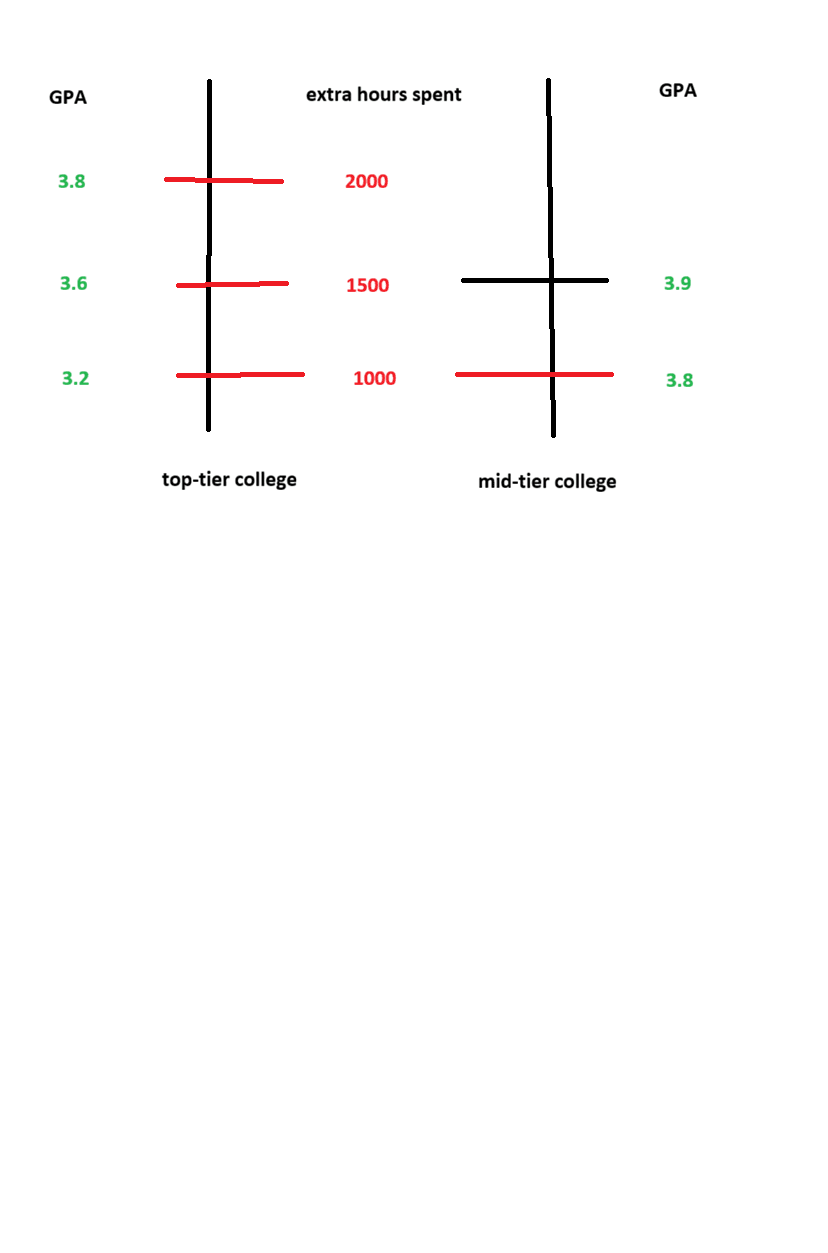
In Taiwan, a person who gets a 3.8 GPA at a mid-tier college might only get a 3.2 GPA at a top-tier college due to grade deflation.
When applying to master’s programs and internships in the U.S., GPA seems to matter much more than the college name in Taiwan, especially because U.S. evaluators may not know how large the difference in student ability is between top-tier and mid-tier Taiwanese schools.
So the choice may look like this:
It seems obvious that option 1 gives the weakest academic credential in the US. So the choice may be between options 2 and 3: whether it is worth investing around 1,000 extra hours to improve the “school name” on my resume.(Counterfactually, the 1000 hours would be spent on doing researches)
What do you think is the best choice for an EA? If uncertain, what are your main cruxes?
Of course, there are still other advantages to choosing a top-tier school, such as better peers and research environment. However, these advantages seem to come at the high cost of spending more time maintaining GPA.
Please don’t aim for a rigorous answer. A one-minute gut intuition would already be very helpful. Thanks a lot for answering
Option D: dont attend any university and just get to work. The value of university degrees, even purely for signalling, are at an all-time low and descending. For learning, you can do free online video courses.
There are highly valuable tasks AI researchers dont do because they are low status / boring / hard to fund. You could get started on them independently.
You'd need a mentor at some point to avoid wasting time on irrevelant things / to hold you accountable.
I think if you are highly self-motivated, independent, and creative, this could be the best option by an order of magnitude.
The ceiling and floor for outcomes of option D are extreme. Going to university is a good hedge by raising the floor of potential outcomes. Plus, there are some non-negotiable things like having an income above a certain level - something that uni will help with, albeit after some time and school fees.
Something else to consider is that you're based in Taiwan. This means you likely have strong command of Mandarin and could have access to Chinese universities. China is a big player in the AI space, and in terms of international relations, AI and the tech arms race is a frontier between the USA and China. I would reconsider whether the pursuit/signalling of post-grad studies in the USA is the most comparatively advantageous path for influencing AI risk.
For people who disagreed him: Just disagree, don't downvote. Every reply takes time and should be respected. I think downvote should only be used to posts/replies that are obvi usly not serious