Comments
If you’re interested in this work, then let me point out that RP is hiring.
If you’re interested in this work, then let me point out that RP is hiring.
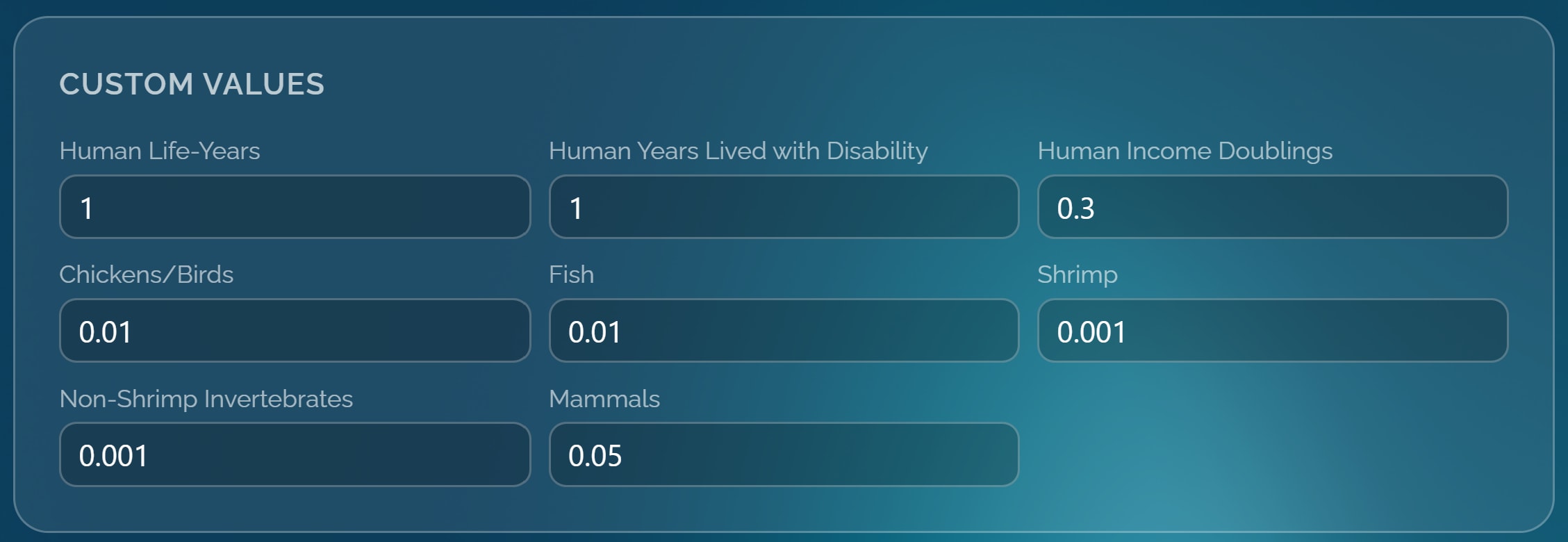
Hello. Have you considered adding answers to question 1 of the Donor Compass for which animals matter more than exactly 0, but have sufficiently small sentience-adjusted welfare ranges that interventions targeting humans are prioritised? This holds for the answer "Only humans matter", but this is not a reasonable view. It requires all animals having a probability of sentience of exactly 0.
The answer where animals matter the least, but more than exactly 0 is "Animals matter, but much less than humans". The sentience-adjusted welfare ranges of this answer are below. That of shrimps is 0.1 % that of humans. There are many reasonable values which are above exactly 0, but much smaller than 0.1 %? I would say one could reasonably believe that sentience-adjusted welfare ranges are proportional to "individiual number of neurons", and shrimps have 10^-6 times as many neurons as humans.
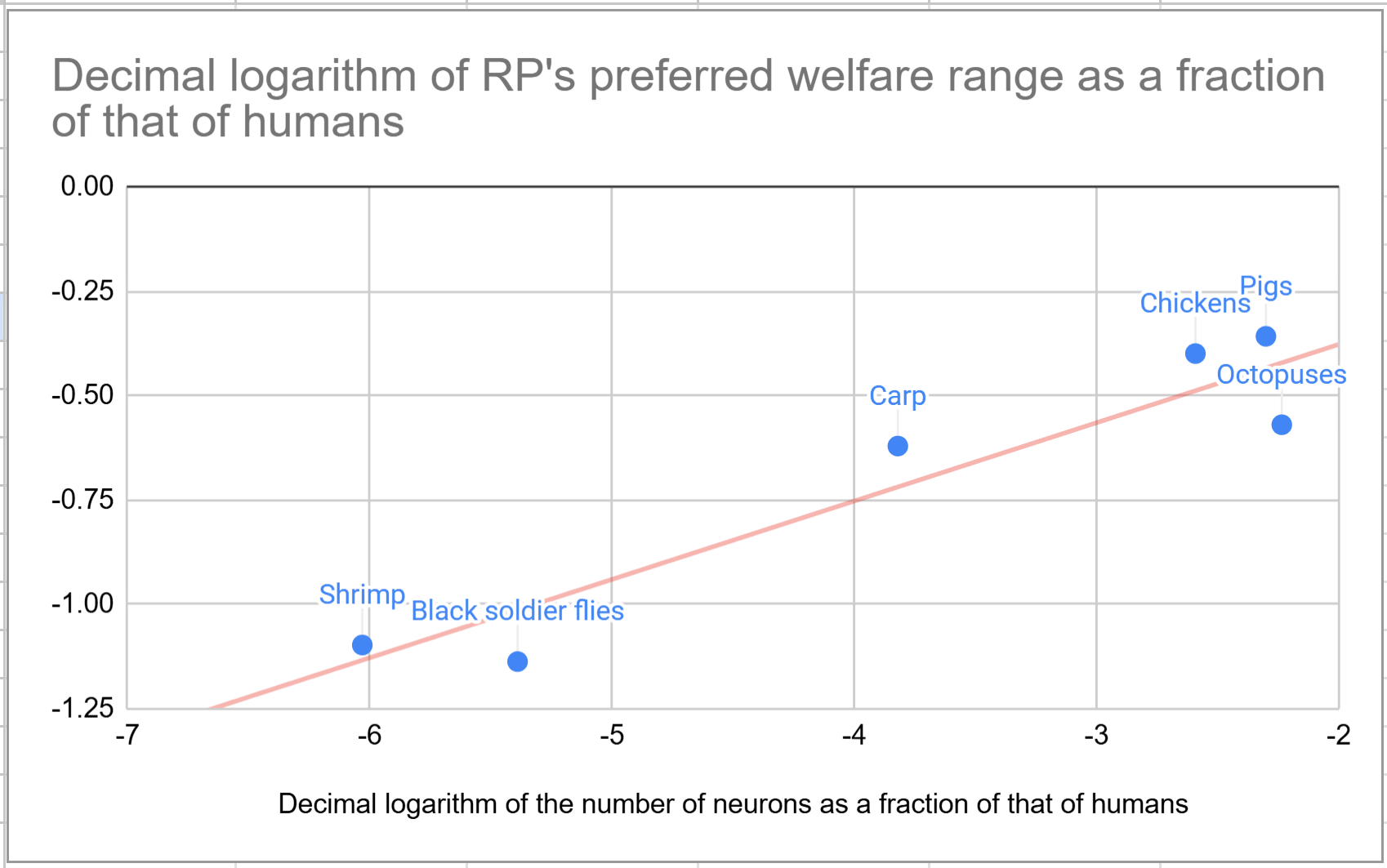
I would let users specify sentience-adjusted welfare ranges covering the values given by "individual number of neurons"^"exponent", and "exponent" from 0 to 2. An exponent of 0.188 explains pretty well the welfare ranges in Bob Fischer’s book about comparing welfare across species, as illustrated below.
Hey Vasco,
We agree having more low moral weight options for animals could be valuable but the Donor Compass is a simplification. We made some tradeoffs for simplification that reduced complexity given feedback from initial testers but may need to recalibrate if current users don't find this the right tradeoff. Generally, if you want to do something more complex on animal weights (or just given the fact you have detailed opinions about the moral weights of animals), the quiz version of the Donor Compass probably isn't the right tool and you should probably use the advanced mode.
Hi Marcus. Thanks for the reply.
I wonder whether the initial testers included people with views on welfare comparisons across species similar to those that I, @NickLaing, @trammell, and @William_MacAskill have. None of us believe that animals matter exactly 0. However, we also have best guesses that the sentience-adjusted welfare range of shrimps should be much smaller than 0.1 % of that of humans. So our views would be described by an option where animal welfare matters much more than in "Only humans matter" (where animals matter exactly 0), but still significantly less than in "Animals matter, but much less than humans" (where the sentience-adjusted welfare range of shrimps is 0.1 % of that of humans).
I think adding an option with sentience-adjusted welfare ranges proportional to the individual number of neurons would let people specify their views. I suspect users would not be much bothered by having 5 options instead of 4. However, if keeping 4 options is important, I would add the option I suggested, and then have a single option replace the current intermediate options ("Animals matter, but much less than humans", and "Animals matter, but somewhat less than humans").
I understand one could use the advanced mode to specify other ways of comparing welfare across species. However, I am thinking that it is also important for the default options to cover the range of reasonable disagreement, and I believe a large part of that range for welfare comparisons across species is not covered with the current default options.
I've known about this for a while. I really liked this write-up. I continue to be extremely impressed with Rethink Priorities.
Thanks so much, Marcus, on behalf of the Team :)
Exciting! Are you eligible for gift-aid in the UK? Seems like it is based around US donors so far (reasonable triage).
Hi Toby, the CCF is not eligible for UK gift aid, I'm afraid, as it's a US-held fund, so donations are tax-deductible in the US only.
We're actively looking into workarounds. Theoretically, one can give to a giving vehicle eligible for UK gift aid, and that entity could then re-grant to this fund. Anyone interested can contact us at [email protected] to discuss options.
I'm curious about how you model the time discounting more in detail:
As I read it right now, you pick six fixed multipliers for six fixed future time intervals. Am I understanding this correctly?
Under some assumptions that are common in EA that I don't share such as the time of perils hypothesis, this would mean that, at least for some ways of computing, most utility is in the 500+ bucket.
And then the model would be very sensitive to people putting 0 vs any nonzero number for the 500+ years bucket. Is this the case?
Hi Clara,
Thanks for the good question!
Short answer: yes, you're understanding this correctly. And, yes, the model's allocations can be sensitive to putting any non-zero weight in for the value of impacts 500+ years out (but worldview diversification can mitigate this factor's impact on the outcome).
The model computes a "score" for each fund based on the sum of: (impact in time period t)*(weight in time period t) over all time periods.
In our estimates of the impacts of GCR funds, we do take the approach of estimating the impact of avoiding an existential catastrophe over many generations in the future. As such, if you were to give full weight to further-out time periods, the vast majority of the expected impact of avoiding an existential catastrophe is in the long-run future. So any weight that is meaningfully above zero will make these projects have a large-in-magnitude score, all else equal, compared to putting a weight of zero. (We're preparing a more detailed sensitivity analysis that we'll release soon, and which will address your question in more detail.)
Nevertheless, it's important to note that our recommended allocations are influenced by 14 worldviews, some of which assign zero weight to the far future. As such, we're not forced to choose between putting zero weight on the 500+ year period vs. some non-trivial amount that swamps the calculations. This creates a meaningful amount of diversification within the model's results, allowing other factors like moral weights to be influential.
Additionally, there's an interaction between risk attitudes and the amount of weight that one puts on the far future, such that putting a non-zero amount on the 500+ year period doesn't automatically recommend you spend 100% of your budget on GCR funds. For instance, if you're highly risk-averse and put a weight of 1% on the 500+ year period, then you might avoid funding certain GCR funds that have a high enough chance of raising existential risk, because permanently harming the long-run future would have such a considerable impact.
If you're interested in reading more about the worldviews we've used in the model, please feel free to reference this link.
Thanks again for the question!
Hey, thanks for your reply, I found it very informative.
I'm excited to read your sensitivity analysis writeup when you publish it.
Of course! We're also happy to answer any additional methodological questions you may have in the future
I'm really excited about this project and think it arrives at a pivotal moment!
Thank you, Sarah!
Thanks for your work on this.
- We modeled key uncertainties that matter for cross-cause prioritization: moral weights, time discounting, risk attitudes, aggregation across ethical views, AI-related uncertainty, and empirical uncertainty within each giving opportunity.
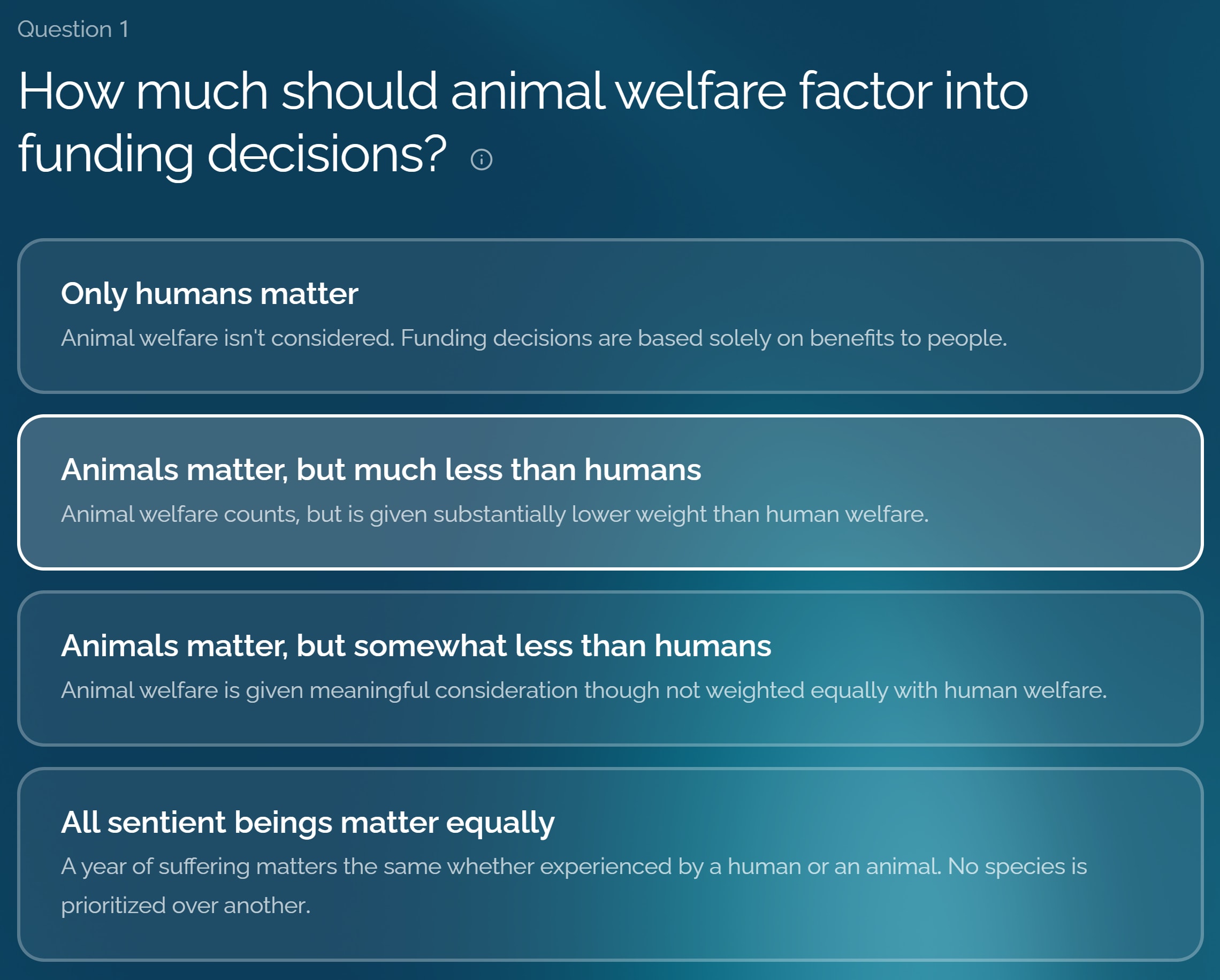
Have you considered making recommendations for people who do not have definitive views about the topics above? For example, question 1 of the Donor Compass asks about how much animal welfare whould factor into funding decisions, as illustrated below. I understand each option is represented by a set of point estimates describing welfare comparisons across species, but I do not undorse any particular set. I can see reasonable best guesses ranging from "Only humans matter [in practice]" to "Animals matter, but somewhat less than humans". So I think the priority should be decreasing uncertainty instead of acting based on a given set of best guesses.
Hi Vasco,
Thanks for the question! We've designed the Donor Compass to be more streamlined, but we certainly appreciate and share your moral uncertainty. Our recommendations for the Cross-Cause Fund take into consideration 14 distinct worldviews, which take into account a wide range of animal moral weights (among other variables). You can investigate the assumptions for each here, along with the credences placed on each. If the range of views you place credence on significantly differ, however, you can use the Advanced Mode of the Cross-Cause fund to tailor it to your specific needs. (The definitions of each term can be found in this spreadsheet)
Thanks for the links, Laura. To clarify, I meant to ask whether you have considered making recommendations that specifically target decreasing the key uncertainties that matter for cross-cause prioritisation. For example, decreasing uncertainty about welfare comparisons across species by supporting work like RP's moral weight project.
I think I see now, thanks for the clarification. We don’t currently include funds/interventions that specifically work on research (to reduce key uncertainties or otherwise). We do think this kind of work is important, and we aim to include more topics (which could include “meta” work and research) in future iterations of the model.
we aim to include more topics (which could include “meta” work and research) in future iterations of the model
Good to know.
It's an interesting one Vasco. I prefer the current questions to uncertainty questions which I think are more intuitive for most people. I think it's important to lean towards questions which are easier to understand, rather than the "best theoretical" questions to help differenciate. Not everyone thinks as deeply as you about these things, and I like the accessibility of the current questions.
Hi Nick. I agree it is important that the questions are easy to answer. However, I would say there are simple ways of letting users express their uncertainty. For the question about how much animal welfare should factor into funding decisions, there could be an option saying something like "I am very uncertain about which of the 4 views above I should pick", or users could be allowed to give weights to each of the 4 views (instead of giving a weight of 1 to a single view). Then these answers could be used to define distributions for the probability of sentience, and welfare range conditional on sentience. Wider distributions would tend to result in a higher expected value of perfect information.
I haven't dived into the figures/calculation, but I'm pretty skeptical about donating 46% to regular animal welfare projects given AI progress. Is the AI discount just based on x-risk or does it account for the possibility of AI radically transforming the world in such a way that the impact of current charities becomes moot?
Hi Chris,
The way it practically works is a blanket cut on the overall cost-effectiveness. That could be because there is an x-risk, or because the effect of non-AI work is reduced or eliminated. For the current inputs, a 40% discount is applied, which I think is large enough to account for all those possibilities.
But perhaps the phrase “regular animal welfare” is potentially another source of disagreement? The funds we’re donating to are aware of AI’s impact on the world and seem likely to take steps to use AI to improve their outcomes. The current allocation is based on what specific interventions the AW funds are funding but it’s also worth explicitly noting that giving money to AW funds or AW groups isn’t a commitment to pursue the same interventions that exist today indefinitely (this same reasoning also applies to GHD funds). Perhaps current interventions become moot (that’s why we are discounting them) but it’s also possible, for example, that AW work could be more effective in the future because AI makes monitoring welfare vastly cheaper or, say, boosts the efficiency of animal groups.
All that said, if you think there should be a higher discount, you can apply it, but that doesn’t substantially change the results regarding what goes to AW. Indeed, if you increase the discount to 90%, you don’t get much more to AI (and less overall to GCRs as a whole, likely because the discount also applies to biorisk and nuclear weapons). Generally, this is because there are interaction effects between risk preferences, diminishing returns, overall cost-effectiveness, and how the worldviews are aggregated. Making everything else less cost-effective doesn’t change, say, that you have to have a certain risk attitude to take longer-shot bets at success.
How was the 40% figure calculated?
The funds we’re donating to are aware of AI’s impact on the world and seem likely to take steps to use AI to improve their outcomes
There is definitely some correlation between current competence and ability to adapt to a changing world, though I suspect that there's also a huge amount of stickiness that undermines this.
All that said, if you think there should be a higher discount, you can apply it, but that doesn’t substantially change the results regarding what goes to AW. Indeed, if you increase the discount to 90%, you don’t get much more to AI (and less overall to GCRs as a whole, likely because the discount also applies to biorisk and nuclear weapons)
Fascinating. Is biorisk depreciating because some of those projects have a long payoff time?
My intuition is that biorisk talent will be more easily redeployable in a world undergoing an AI transition than a lot of the animal talent (more sticky).
How was the 40% figure calculated?
This is definitely an approximation, not based on a rigorous underlying model. I informally personally asked several people in the cause prio and AI spaces, including some at labs, to answer the question about what type of discount seemed appropriate and, along with my best judgment, settled on 40%.
I would very much like to improve this input in the future, perhaps through formal surveys or, perhaps, a Delphi panel-type process. Though I think my weakly held intuition here is a bigger possible change isn’t the precise value (which in the current model doesn’t change the result dramatically), but distinguishing between reduced effectiveness overall and probability of an effect going decreasing, with consideration of different time periods when those effects happen in each cause area.
Fascinating. Is biorisk depreciating because some of those projects have a long payoff time?
My intuition is that biorisk talent will be more easily redeployable in a world undergoing an AI transition than a lot of the animal talent (more sticky).
We included biorisk in the AI discount not just because of payoff times but because of the same type of uncertainty you raised about AW. That is, it seems possible the actions people are taking today could be mooted by changes in AI development.
It does seem possible that biorisk talent could potentially be more easily redeployable than AW. I would also add a couple more related additional considerations in what discount to use for biorisk: (i) some pathways to very negative outcomes for AI run through biorisk and (ii) it seems plausible to me that some civilizational hardening measures (i.e. more widely available PPE) seem perhaps more robust to AI uncertainty than some interventions in other cause areas because they act on AI risk itself given (i).
This is why in future versions of this model, I could imagine both nukes and biorisk having a different AI discount since there are clear interactions here between AI and these other GCRs.
Very cool, and will strongly be considering switching my donations if/where I can, potentially even at the cost of tax-effectiveness (in Australia)!
I wonder if it may be helpful to combine this with a moral parliament tool. Personally, my credence in consequentialism is far lower than 60% (which is the credence used on the linked spreadsheet), and my preferred normative theory is not even considered (Ross’ prima facie duties theory).
Hi Benton,
Thanks for the comment! To clarify, our model and recommendations do draw upon the same approaches to moral uncertainty as our moral parliament. Our Cross-Cause Fund draws upon 14 different worldviews (see here for the exact details) and uses a weighted average of recommendations across nine methods of aggregating across them.
Additionally, though our main Donor Compass tool is simplified, you can use a more Advanced Mode here to incorporate moral uncertainty across several combinations of worldviews. (I’m not familiar with Ross’ prima facie duties theory, but hopefully you could represent it adequately in the model.) Then, just like the Moral Parliament, you can specify which aggregation method you want to apply to resolve disagreements between worldviews.
Hi RP team. Thanks for being so open & explaining your methodology.
I've read a bit through your methodology, and I have a hard time shaking the feeling that animal welfare allocation shouldn't be 2.5x spend on human welfare. Instinctively that feels too high.
Similarly...with how effective GHD interventions are, I also have a hard time believing AI risk should command 2x the allocation of public health. There is extreme deep uncertainty with AI risk especially. It feels treacherous to even attempt to model something like that.
How do you respond to that objection? i.e. my intuition that more money shouldn't be spent on animal welfare than human welfare (much less 2.5x more). And feel free to speak on the modeling of AI risk too. That feels like a massive unknown to dedicate 1/3 of your fund to.
Have you considered accounting for effects on soil invertebrates? One of the "key takeaways" from your work on risk aversion was that "Spending on corporate cage-free campaigns for egg-laying hens is robustly[8] cost-effective under nearly all reasonable types and levels of risk aversion considered here". However, I suspect the vast majority of interventions perform worse than inaction accounting for effects on soil invertebrates under moderate levels of any type of risk aversion you considered (“avoiding the worst” risk aversion, difference-making risk aversion, and ambiguity aversion). I estimate cage-free campaigns for laying hens change the welfare of soil ants and termites much more than they increase the welfare of chickens for the sentience-adjusted welfare ranges presented in Bob Fischer's book about comparing welfare across species. I have little idea about whether those campaigns increase or decrease the welfare of soil ants and termites. So I do not know whether they increase or decrease animal welfare.
Of course, inaction is not the solution. I would like to see more research on comparing welfare across species. I can easily see effects on soil ants and termites being negligible, although I believe this would also imply a very low cost-effectiveness for interventions targeting invertebrates (like electrically stunning shrimps). In addition, I would prioritise building capacity to help soil invertebrates. They may well matter.
Hi Vasco,
Right now, we’re not including second-order effects of interventions, and in this case, we’re deeply uncertain about the magnitude or direction of effects like those you mention. I think you’re right to point out that more research is needed here to address questions concerning the welfare capacity, baseline welfare of, and effects of any interventions on invertebrates.
As mentioned above, we’ve for the time being chosen to focus on funds that already exist, have a strong track record, and can absorb a considerable amount of funding this year. In general, we’d like to expand the set to include individual interventions. Whether that will include more research on soil animals, I really can’t say right now, because we don’t yet know how granular we’re going to get with the included projects. Please look out for more updates in the coming months, as this is an evolving project.
Hi Laura. Thanks for the reply. I very much agree effects on soil invertebrates resulting from land use changes have very uncertain magnitude and direction. However, they should not be neglected under the types of risk aversion you studied?
- “Avoiding the worst” risk aversion: All else equal, we are averse to the worst states of the world arising and want to take actions that prevent them or lessen their badness.
- Difference-making risk aversion: All else equal, we are averse to our actions doing no tangible good in the world or, worse, causing harm.
- Ambiguity aversion: All else equal, we should be particularly cautious when taking actions for which the probabilities of the possible outcomes are unknown and quite uncertain.
"world" in 1 and 2, and "possible outcomes" in 3 should include effects soil invertebrates?
Do you agree that cage-free campaigns for laying hens may decrease the welfare of soil invertebrates much more than they increase the welfare of chickens, thus decreasing animal welfare a lot? I think this is very much on the table (although I can also see the effects on soil invertebrates being negligible). So I believe inaction is better than such campaigns for a sufficient level of difference-making risk aversion. In addition, I infer inaction is better for a sufficient level of ambiguity aversion because the effects on soil invertebrates are very uncertain.
Here is a related comment from @Michael St Jules 🔸.
If we give extra weight to net harm over net benefits compared to inaction, as in typical difference-making views, I think most animal interventions targeting vertebrates will look worse than doing nothing, considering only the effects on Earth or in the next 20 years, say. This is because:
- there are possibly far larger effects on wild invertebrates (even just wild insects and shrimp, but also of course also mites, springtails, nematodes and copepods) through land use change and effects on fishing, and huge net harm is possible through harming them, and
- there's usually at least around as much reason to expect large net harm to wild animals as there is to expect large net benefit to them, and difference-making gives more weight to the former, so it will dominate.
Hi Vasco,
Generally, I think that modeling is most useful in situations where we know enough about an issue to construct a solid framework for what effects to include, how to analyze it, and how to provide some evidence-based justification for key parameter values.
Given the enormous, many-layered uncertainties that surround second-order effects (like those on soil animals), and given that we don’t have yet a framework for analyzing such second-order effects comprehensively and equally across all interventions, I think it wouldn’t be responsible for me to speculate on either how various kinds of risk aversion can or should apply to them, or what the impact on our recommendations would be.
Because we have limited capacity, this is going to be my last comment about soil animals in particular. However, if you have questions about other aspects of the Cross Cause Fund, we would be happy to engage with them.
Because we have limited capacity, this is going to be my last comment about soil animals in particular.
I am replying in case anyone is interested, or you want to comeback to it later. Feel free not to reply, and thanks for the thoughts you have shared.
Generally, I think that modeling is most useful in situations where we know enough about an issue to construct a solid framework for what effects to include, how to analyze it, and how to provide some evidence-based justification for key parameter values.
Results are more certain in the situations you describe, but very uncertain results could still be informative. They may help identify the most important uncertainties. The results would not be useful even for this if they were sufficiently arbitrary. However, I do understand why you would believe this.
Based on the "More options" drop-down in question 1 of the Donor Compass, you are comparing the welfare of humans with that of chickens, shrimps, and "non-shrimp invertebrates", which I assume includes BSFs (as these were covered in Bob's book). So I would have expected you to be open to comparing the welfare of chickens with that of soil ants and termites, which are macroarthropods like shrimps and BSFs.
In addition, based on the "More options" drop-down in question 2 of the Donor Comass, you are modelling effects after 500 years, which I think are very uncertain. So I would have expected you to be open to modelling how changes in feed consumption resulting from improving the conditions of farmed animals impact the population of soil invertebrates.
Given the enormous, many-layered uncertainties that surround second-order effects (like those on soil animals), and given that we don’t have yet a framework for analyzing such second-order effects comprehensively and equally across all interventions, I think it wouldn’t be responsible for me to speculate on either how various kinds of risk aversion can or should apply to them, or what the impact on our recommendations would be.
Makes sense. I just meant to illustrate accounting for effects on soil invertebrates could change recommendations even if there is large uncertainty about their magnitude and direction.
"In addition, based on the "More options" drop-down in question 2 of the Donor Comass, you are modelling effects after 500 years, which I think are very uncertain."
That's not a bad point. I would be kind of on the opposite end of the scale though. We are so clueless about both 500 years in the future and soil arthropods I wouldn't be modeling either of those....
Hi Vasco and Nick,
On the future weights specifically, I think you raise a really interesting point. I tentatively think there are some differences between the GCR modeling and soil animal effects modeling, at least at this stage, but I understand if one wants to zero out their effects (and I suggest below ways to do so).
As a way of background, in the model for GCRs, we largely adopt the Time of Perils perspective, wherein we’re living in an unusually risky period of time, but if we survive past it, existential risk drops to some lower level. The expected value of the future is partially governed by the probability that we survive into the far future. Then, interventions that reduce/increase risk now–even if they only have temporary effects–raise/lower the probability of civilization surviving until a specific year and realizing the value of civilization in that year.
Based on this structure, I do think that the case of modeling the effects of GCR interventions in the far future is meaningfully different enough from modeling the effects of interventions on soil animals to justify including the former in the model but not the latter, at least at this point. For one, we do have some existing frameworks from within the GCR and cause-prioritization academic communities for modeling them (which we drew upon in doing the modeling, see here and here for example). Consistent with working on the terms of the fields themselves, it’s my understanding that at least people think it would be bad if human civilization ended, so that reducing x-risk is good (if we can figure out interventions that actually succeed at this). By contrast, it’s my understanding that how to incorporate effects on soil animals into our models is pretty uncertain, as we’re highly uncertain about all of the mechanisms that affect animal welfare that are involved. And, as you’ve pointed out, we’re also highly uncertain about the direction of the impact on soil animals.
There are many possible improvements that we could make to the modeling of GCR interventions’ long-term effects (see below). Yet, being able to draw upon existing frameworks within the time that we built the first version and having some consensus about the directional value of reducing x-risks made us more confident about including their effects on the longer-term than we feel about soil animals.
Nevertheless, I entirely understand being very skeptical of effects 500+ years out (or even 100-500 years out), as Nick is. I’d recommend using the Advanced User mode and setting the weights for effects 100-500 and 500+ years out to zero. In our baseline inputs, we do include five (out of 14) “clueless” worldviews that assign zero weight to impacts over 100 years out, taking up 30% of the overall credence. Of course, I think reasonable people can prefer to give more weight to clueless worldviews, which they can do with the tool linked above.
I hope that this answer is clear enough – again, it’s an area of significant uncertainty and there can be many different legitimate approaches.
Addendum: Improvements we could make to our modeling of GCR impacts in the far future
Going forward, I think there are many different improvements that we might want to make to our models of the effects of GCR interventions in the far future.
Though we adopt wide uncertainty levels for all of the parameters involved, which result in very different expected values of the future, one weakness of the model is that it’s entirely possible that the future does not follow a Time of Perils trajectory at all (i.e. that risk is flat, or that we go through many periods of high-then-low-risk). Part of the reason we did so is because it makes integrating into the far future tractable, and also because we wanted to represent GCRs as a field in a way that those working inside of it would agree is fair, and that we’re in a Time of Perils is a quite common point of view. But I think a real area of improvement for the model in the future would be to figure out how to incorporate different risk trajectories.
Additionally, I think we could consider implementing some kind of Bayesian discount (like that which David Bernard discussed here in RP’s CURVE sequence) to the expected value of the impact of the GCR interventions for each year in the future. I don’t think we have a very good intuition for what order of magnitude discount to apply to the 500+ year period overall (since our uncertainty could grow very rapidly). I also think that the discount we apply to the impact in the 501st year should be different from the discount in the 10^6th year. Finally, an upside of this approach would be that it separates out cluelessness from person-affecting worldviews, which the time discounts currently don't do very well.
Thanks for the context, Laura.
By contrast, it’s my understanding that how to incorporate effects on soil animals into our models is pretty uncertain, as we’re highly uncertain about all of the mechanisms that affect animal welfare that are involved. And, as you’ve pointed out, we’re also highly uncertain about the direction of the impact on soil animals.
There is strong evidence that chickens in different conditions need a different amount of feed, and that this affects land use, and therefore soil animals? There is uncertainty about the number of soil-animal-years affected, and their welfare per animal-year, but I do not understand why it cannot simply be modelled with wide distributions, at least in the case of soil ants and termites (as there are other macroarthropods covered in Bob's book about comparing welfare across species).
I don't think welfare interventions targeting vertebrates will necessarily look worse than doing nothing on "Avoiding the worst" views, because they don't specifically, AFAIK, increase the risks of worse cases than inaction. I think things that reduce land use for agriculture, including a lot of alt protein and veg advocacy work, plausibly do look bad in the near-term on "Avoiding the worst" views, because the near-term worst cases are where invertebrates have bad lives, modest/high moral weights and larger populations.
But I do think on many difference-making views that compare to some default option like inaction and weigh downsides at least linearly and more than upsides, most interventions will look worse than the default.
I also have a similar comment here and a piece critiquing and exploring different versions of difference-making more generally here. A version of difference-making that wouldn't let invertebrates dominate would be one that discounts both more extreme upsides and more extreme downsides (especially symmetrically) relative to a comparison option (more).
Hi Michael. Thanks for sharing your thoughts.
I don't think welfare interventions targeting vertebrates will necessarily look worse than doing nothing on "Avoiding the worst" views, because they don't specifically, AFAIK, increase the risks of worse cases than inaction.
Interventions which cost-effectively increase the welfare of vertebrates will change land use much more than inaction, and a greater change in land use increases the probability of causing lots of suffering? Are you assuming that i) such interventions would increase agricultural land, and that ii) this decreases suffering?
On i), such interventions may decrease agricultural land due to increasing the price of animal products, and therefore decreasing their consumption? I estimate that replacing Ross 308 (fast growth broiler breed) with Rebro (slower growth) decreases cropland by 0.102 m²-year/Ross-308-chicken-kg, and that replacing replacing eggs from battery cages with those from barns or aviaries decreases cropland by 0.529 m²-year/battery-cages-egg-kg. These estimates neglect increases in the consumption of other foods, but I believe accounting for this would increase uncertainty, and therefore further increase the risk of the worst outcomes.
On ii), increasing agricultural land may increase suffering by increasing the number of soil macroarthropods/nematodes? I think effects on these may dominate (given the large uncertainty about welfare comparisons across species), and they may have negative lives (although I can easily see them having positive lives too).
Interventions which cost-effectively increase the welfare of vertebrates will change land use much more than inaction, and a greater change in land use increases the probability of causing lots of suffering?
It might cause lots of suffering, but it could also prevent lots of suffering, too. I think you're thinking in terms of difference-making, but "Avoiding the worst" risk aversion is not difference-making. Rather than thinking about what you cause, you should just look at both (distributions of) outcomes and ask which has more suffering in it, without privileging the results of inaction.
Unless you believe the expected amount of wild animal suffering is higher all-things-considered than with inaction, you shouldn't really expect it to do worse according to "Avoiding the worst" risk aversion (as a heuristic; there could be exceptions).
It might cause lots of suffering, but it could also prevent lots of suffering, too.
I agree. So the worst case is that the campaigns cause lots of suffering (relative to inaction)?
[...] Rather than thinking about what you cause, you should just look at both (distributions of) outcomes and ask which has more suffering in it, without privileging the results of inaction.
Unless you believe the expected amount of wild animal suffering is higher all-things-considered than with inaction, you shouldn't really expect it to do worse according to "Avoiding the worst" risk aversion (as a heuristic; there could be exceptions).
I understand I should look into the distributions of global welfare with and without the campaigns, and then assess their negative tails. I have little idea about which distribution has the highest expected value. However, I believe the distribution with the campaigns has longer positive and negative tails, and therefore the risk of the worst outcomes is higher with the campaigns (although the probability of the best outcomes is also higher).
Stepping back, regardless of how accounting for risk aversion changes recommendations, I would like greater reasoning transparency about why effects on soil invertebrates have been neglected. Roughly for the reasons @Marcus_A_Davis mentioned replying to Nick's concerns about conflicts of interest.
I [Marcus] think there is not a single EA organization I would consider unbiased on this question [cross-cause recommendations], including ourselves (despite our ongoing efforts not to be). That is exactly why we publish so much of our methodology and our assumptions openly. One of the main motivations for this work is concern about the effect of bias when assumptions and models are implicit or hidden. We would welcome more experts with broader backgrounds being involved in drafting and improving these estimates, which is part of what we hope this kind of public methodology enables.
In particular, I would like greater transparency about why effects on soil macroarthropods were neglected. They are covered in Bob's book, unlike soil nematodes and microarthropods. Moreover, I estimate cage-free campaigns for laying hens change the welfare of soil ants and termites much more than they increase the welfare of chickens for the sentience-adjusted welfare ranges presented in Bob's book.
I agree. So the worst case is that the campaigns cause lots of suffering (relative to inaction)?
I don't think this is right. I think you're still treating "Avoiding the worst" like a difference-making view. You shouldn't be thinking in terms of "relative to inaction", which itself has a highly uncertain distribution of outcomes. Just evaluate the distribution of outcomes for each option, without fixing any as a comparison option.
The question is only whether worst-case outcomes are more or less likely with action or inaction.
FWIW, the actual worst cases are s-risks, and I'd expect "Avoiding the worst" views to prioritize their mitigation, as long as we're not clueless about that.
You shouldn't be thinking in terms of "relative to inaction", which itself has a highly uncertain distribution of outcomes. Just evaluate the distribution of outcomes for each option, without fixing any as a comparison option.
I had understood this. As I said, "I understand I should look into the distributions of global welfare with and without the campaigns, and then assess their negative tails". My phrasing "cause lots of suffering (relative to inaction)" was confusing. However, I meant "increase the probability of outcomes with lots of suffering (the worst) relative to the probability under inaction".
Ah, sorry, I was too quick and should have read more carefully.
However, I believe the distribution with the campaigns has longer positive and negative tails
Why do you believe this?
As chicken and egg prices increase from these welfare reforms, I would expect:
Why do you believe this?
Here is how I am thinking. Imagine the world has welfare 0.
With inaction, the final welfare will be 0 with probability 100 %.
With campaigns, there is lots of uncertainty, but here is a simplified set of outcomes:
The worst possible outcome across the 2 interventions is a final welfare of -1. With inaction, it has a probability of 0. With campaigns, it has a probability of 37.5 %. So the campaigns make the worst possible outcome more likely.
Unless you believe the expected amount of wild animal suffering is higher all-things-considered than with inaction, you shouldn't really expect it to do worse according to "Avoiding the worst" risk aversion (as a heuristic; there could be exceptions).
The intervention which can decrease welfare the most is the one leading to the lowest possible final welfare.
Imagine the world has welfare 0.
With inaction, the final welfare will be 0 with probability 100 %.
This is exactly a procedure you could follow for difference-making risk aversion; it's equivalent to taking the statewise difference with inaction. The welfare of the world with inaction isn't 0 with probability 100%.
RP has a model/procedure for avoiding the worst risk aversion here.
The welfare of the world with inaction isn't 0 with probability 100%.
Why? I was assuming a world with initial welfare 0 with probability 100 %. However, I think my point stands for any distribution describing the initial welfare.
RP has a model/procedure for avoiding the worst risk aversion here.
I have read the section Avoiding the Worst Risk Aversion: A Model, and I do not understand why you think it undermines my point.
If you instead set the campaign option to 0 welfare and defined the welfare of the world with inaction relative to the campaign option, you'd end up with the opposite conclusion, that only inaction reaches -1.
Avoiding the worst is meant to treat each option symmetrically. It doesn’t depend (in theory) on which option you single out to define things relative to.
(RP's practical procedure does start with inaction, but if you end up with the same probability distributions for each option in the end, the results will be the same as if you started with a different option to define all distributions relative to. I think their procedure helps ensure consistent probability assignments and is less work, compared to directly estimating each distribution independently.)
If you instead set the campaign option to 0
What exactly do you mean by this? The campaign has many potential effects. So it cannot result in a final welfare of X with probability 100 %, where X can be 0 or any other number.
Suppose the initial welfare is 0 with probability 100 %. Inaction would lead to a final welfare of 0 with probability 100 %. Imagine an intervention which decreases welfare by 1 with probability 50 %, and increases welfare by 1 with probability 50 %. The intervention leads to a final welfare of 0 in expectation. However, it leads to a final welfare of -1 with probability 50 %, and 1 with probability 50 %. The the lowest possible welfare of -1 is more likely with the intervention?
It was illustrative.
Inaction also does not in fact lead to welfare of 0 with probability 100%. There will be lots of animals suffering and many possible outcomes if we do nothing. So it's not correct to assume total welfare of 0.
I think my point stands for any distribution describing the initial welfare. Imagine the minimum initial welfare W_min has probability p. With inaction, the minimum final welfare would still be W_min, and have probability p. With an intervention which decreases welfare by 1 with probability 50 %, and increases welfare by 1 with probability 50 %, the minimum final welfare would be W_min - 1 with probability 0.5*p. So the lowest possible welfare of W_min - 1 would be lower and more likely with the intervention?
No, I don’t think this is the right way to model this. This looks a lot like the typical error people make for the original two envelopes problem.
This looks a lot like the typical error people make for the original two envelopes problem.
The moral two envelopes problem is not problematic if there is a common scale to compare the welfare per unit time (as there is to compare temperature)?
Initial welfare (what does that mean?) and final welfare after inaction can differ, because the world, e.g. land use, will change even if you do nothing, and campaigns take time for their effects to materialize.
Suppose that inaction leads to a distribution for the future welfare (integral of the welfare per unit time across all future time) whose minimum value W_min has probability p. With an intervention that decreases future welfare by 1 with probability 50 %, and increases it by 1 with probability 50 %, the minimum future welfare would be W_min - 1 with probability 0.5*p. So I think the lowest possible future welfare of W_min - 1 would be lower and more likely with the intervention (although the intervention would not change future welfare in expectation).
If you swapped the roles of campaign and inaction
What do you mean by this? By definition, inaction does not change the distribution of the future welfare?
In your model and your answers here, just replace inaction with campaign and campaign with inaction.
I see. Thanks for the patience. I could equally say that an intervention leads to a distribution for the future welfare whose minimum value W_min has probability p, and that inaction decreases it by 1 with probability 50 %, and increases it by 1 with probability 50 %, thus implying a minimum future welfare of W_min - 1 with probability 0.5*p. This is the exact opposite of what I concluded above, and suggests the lowest possible future welfare of W_min - 1 would be lower and more likely with inaction.
I agree both models are wrong. I cannot assume that the change in future welfare caused by the intervention is independent from the future welfare under inaction (as I did in my past comments), or that the change in future welfare caused by inaction is independent from the future welfare caused by the intervention (as I did just above).
Unless you believe the expected amount of wild animal suffering is higher all-things-considered than with inaction, you shouldn't really expect it to do worse according to "Avoiding the worst" risk aversion (as a heuristic; there could be exceptions).
I agree that increasing welfare in expectation is a good heuristic for better performance under "avoiding the worst" risk aversion. I have very little idea about whether cage-free campaigns for laying hens increase or decrease welfare in expectation. So I do not know whether they are favoured or not under "avoiding the worst" risk aversion. They are still disfavoured under difference-making and ambiguity risk aversion, and this could make them worse than inaction. In addition, they may be worse than inaction under no risk aversion of any type.
I think they've covered this a number of times and explained why they haven't considered soil invertebrates responding to previous comments you've made @Vasco Grilo🔸
Hi Nick. Do you know about any public explanations of why indirect effects on macroarthropods like soil ants and termites are not included? I suspect you have in mind the comments below. However, they apply to plants, microorganisms, nematodes, and microarthropods, not to macroarthropods like soil ants and termites.
Laura Duffy said on 17 July 2025:
We didn’t do the welfare range calculations for plants, protists, nematodes, etc, because we don’t think the methodology is appropriate for organisms that lack a complex brain and/or nervous system
Bob Fischer said on 28 July 2025:
1. It's true that we don't think you can take our methodology and extend it arbitrarily. We grant that it’s very difficult to draw a precise boundary. However, it's standard to develop a model for a purpose and be wary about its application in a novel context. Very roughly, we take those novel contexts to be ones where the probability of sentience is extremely low. We acknowledge that we don’t have a precise cutoff for “extremely low,” as establishing such a cutoff would be a difficult research project in its own right. There are unavoidable judgment calls in this work.
[...]
3. We don't think that the assumptions of our "mainline welfare ranges" imply anything about the welfare ranges of plants, nematodes, and microorganisms, as the models simply aren't intended to be used the way you are using them. That's why we aren’t replying to you about the welfare ranges of plants, nematodes, and microorganisms. We would need to do an independent project to form opinions on your questions. Right now, we don’t have the funding for that project.
Bob said on 21 November 2025:
On the macro-level issue of priorities, I've gathered some of my thoughts here.
From the doc linked above:
Second, I want to do good, not just good in expectation. So, as the probability of sentience drops, I become more wary. Insects are fairly close to my limit. Right now, we have some evidence for sentience in some insect orders, which I find reasonably compelling. However, it isn’t compelling primarily because it checks some number of boxes in Birch’s precautionary framework; instead, it’s compelling because of its breadth and richness. We have nothing like the evidence for sentience in Drosophila [small fruit fly] for mites, springtails, thrips, and the like. For that reason, we can respond to the stock objections to sentience in insects. We can’t do anything analogous for these smaller arthropods. (And recall that their brains are one or two orders of magnitude smaller than the brains of many insects. I doubt there’s a linear relationship between sentience and any such neurophysiological feature; at some point, I’m inclined to think that the probability falls off a cliff.)
As I commented above, I estimate the effects of chicken welfare campaigns on ants and termites are much larger than those on chickens for the sentience-adjusted welfare ranges presented in Bob's book. For this not to hold, I think the sentience-adjusted welfare ranges of ants and termites would have to be much lower than that of black soldier flies (BSFs). I would be surprised if this was the case under the methodology of Bob's book. Godfrey et al. (2021) estimated 90 k neurons for a desert ant, and 92.5 k for a fruit fly (“vinegar fly”), and “individual number of neurons”^0.188 explains pretty well the welfare ranges in Bob’s book, as illustrated below.
Thanks @Vasco Grilo🔸 . Yes I was thinking about all those comments I just forgot exactly which invertebrates they referred to. I suspect they will have a similar answer about any soil invertebrates but we will see!
@NickLaing, I am tagging you because I just updated this comment.
I suspect they will have a similar answer about soil invertebrates
Nitpick. I think you meant "about any soil invertebrates" or "about soil macroarthropods", as they have already commented on soil nematodes and microoarthropods (which are soil invertebrates).
we will see
I am not sure. I made a related comment 2 months on the post Introducing Rethink Priorities’ Cross-Cause Prioritization Series by @Marcus_A_Davis, and there has been no reply so far.
Where can I donate to the Naviation Fund? I've never heard of this and can't find them on the internet.
Hi, thanks for the question! You can find the Navigation Fund and all the others on the main page of our website, under the section header "The Rethink Priorities Cross-Cause Fund currently covers the following funds".
Today, based on our multi-year prioritization research, we launch the Rethink Priorities Cross-Cause Fund (CCF). The fund pools donors’ contributions and allocates them to high-impact giving funds across Global Health and Development, Animal Welfare, and Global Catastrophic Risks.
Key highlights from this post:
You can dive deep into our rationale and methodology for the CCF in the announcement below, or go straight to our dedicated website to engage.
GO TO THE CROSS-CAUSE FUND WEBSITE
To truly do the most good we can, we need to find a way to assess interventions that span vastly different areas of philanthropy.
In an ideal world, we'd do cross-cause prioritization, using a set of universal benchmarks to evaluate specific interventions across a wide range of cause areas. Cross-cause prioritization is extremely difficult, though, because of the many philosophical and empirical complexities involved. To understand why, consider what this kind of comparison actually requires.
When trying to truly ensure we’re doing the most good we can across dramatically different causes, we must — implicitly or explicitly — rely upon a host of moral (or, normative) assumptions regarding questions like:
Moreover, if we have competing intuitions about answers to any of the above questions, how can we navigate these tensions and determine how to act?
And once we've come to some conclusion about these normative and meta-normative questions, we run into many empirical difficulties, such as:
Every allocator faces these questions to some degree. But cross-cause prioritization is unique in demanding that they all be made explicit at once: you simultaneously need within-cause cost-effectiveness estimates and cross-cause conversion factors and a framework for handling moral uncertainty.
Yet EA has historically invested little in cross-cause prioritization. According to our analysis, only 2% of EA prioritization resources were allocated to cross-cause prioritization in 2025. Consequently, the community has lacked the research and advising infrastructure that cross-cause prioritization demands.
Given these difficulties with evaluating specific opportunities head-to-head across cause areas (cross-cause prioritization), EA has historically tended to take a two-step approach:
This two-step process accounts for the vast majority of EA prioritization effort (98% in 2025). This imbalance is partly historically contingent, as EA started by focusing heavily on global health interventions, then added Global Catastrophic Risks and Animal Welfare as cause areas. The process was largely driven by the availability of research and by the cities and academic communities where early EAs lived, rather than by systematic cross-cause comparison. The community has now largely reified these cause areas: funding bodies, research teams, and grantmaking processes are organized around them, and the dominant approach is to allocate funding by cause area first, then optimize within each.
Accordingly, much of the community debate focuses on cause prioritization or within-cause prioritization. But little effort actually goes to the question that arguably matters most for impact: how can we optimize among interventions across causes?
An often-heard claim in the EA/impact space is that one cause area is clearly superior, so we should concentrate all resources there. We are highly skeptical of this view and believe that concentrating all resources on a single cause requires an extremely high degree of confidence in our normative judgments about moral weights, the effects of our actions, and approaches to risk. We don't think this is warranted. Our models are inevitably imperfect, and diminishing returns and shifting risk profiles mean the relative value of additional funding in any area changes over time. Epistemic and normative humility both point toward diversification rather than concentration.
What gets funded is not "global health" or "animal welfare" in the abstract, but specific interventions: distributing bednets, lobbying for cage-free legislation, and funding biosecurity research. Yet much of the allocation to individual interventions within a cause area is determined by our rough picture of the cause area as a whole, even though interventions within cause areas differ dramatically in their cost-effectiveness, their risks of having no effect or causing harm, and their impact time horizons.
If these dimensions are important to donors, then the amount that's given to a specific intervention should depend on its own risk profile, cost-effectiveness, timing, and so on, independently of how others in the same category fare. As it stands, the merits of a specific intervention can be overshadowed by the characteristics of other interventions in that cause area, shaping the decision-maker's view of the cause area as a whole.
Diminishing returns also occur at the intervention level, and cause-level allocations based on average or historical cost-effectiveness can become stale as the marginal cost-effectiveness of interventions shifts relative to others — potentially necessitating a reallocation that the two-step process might not trigger quickly enough.
We believe that the problems above all point in the same direction: we need to compare and prioritize specific interventions across cause areas, rather than treating the cause-level allocation as fixed and optimizing only within each silo.
Without modeling, anyone trying to allocate effectively across causes must hold a bundle of moral weights, risk preferences, empirical estimates, and decision-making algorithms in their head at once, and somehow apply them consistently across every option. In practice, this is impossible. People fall back on heuristics, intuitions, and whichever considerations happen to be most salient. This produces allocations that are opaque (even to the person making them) and that can't be easily scrutinized, challenged, or improved.
By contrast, explicit modeling forces these assumptions into the open. When we specify our moral and empirical inputs in a model, we can see exactly how each one shapes the output. We can ask: what happens if I discount the far future more or less? How much does the allocation shift if I value animal welfare 2x more? How consequential are disagreements between two people about moral weights for their recommended portfolios? Being explicit makes it possible to productively and transparently disagree about important normative issues, quantify their impact on decision-making, and identify a clearer path forward for allocating scarce resources.
Of course, models don’t capture everything that matters. But we think they’re worth building because there's little reason to believe the implicit models running in someone’s head are doing any better. Putting our uncertainties on the table, naming our assumptions, and testing how the recommendation moves under different inputs is the most honest way we have found to prioritize across causes that don't share a common unit of measurement.
Though cross-cause prioritization is difficult, several recent developments have made the challenge much more approachable. RP’s cross-cause prioritization researchers have a track record of producing foundational, decision-relevant work when given resources:
All of the above underlie our Cross-Cause Fund and Donor Compass.
The space has also benefited from:
As such, the barriers to doing cross-cause research are substantially lower than they were even a few years ago.
Our Cross-Cause Prioritization model allows for:
In short, we can:
In practice, many donors give through funds rather than to individual interventions. Our model evaluates funds based on the marginal cost-effectiveness of the interventions they support, so the fund-level allocation reflects intervention-level analysis. We evaluate funds rather than specific interventions at this stage, both because funds themselves conduct intervention-level vetting and because we do not yet have the capacity to independently assess a wide range of individual interventions. And in contrast to the highly abstract cause areas, we often have information to evaluate the cost-effectiveness and diminishing returns rates of each particular fund. Finally, we believe these funds can absorb a large amount of money productively and divert it to the highest-priority interventions within their remit.
Nevertheless, we are actively working to broaden the range of opportunities covered by the model, including funds focusing on climate change mitigation and democracy preservation, as well as specific interventions.
The model currently allocates donations across the following funds:
Please note that this model is a perpetual work in progress, which we aim to regularly update as new cost-effectiveness data becomes available, as our research on cause priorities develops, and as we expand coverage to new funds and cause areas.
Powered by the cross-cause prioritization model described above, the Rethink Priorities Cross-Cause Fund pools donations from multiple donors and allocates them across a curated set of high-impact giving funds to get the most impact per dollar. You donate, our research and operations teams do the rest. (We do not charge any fees for managing the Cross-Cause Fund.)
The CCF is for donors who want their contribution to go where a marginal dollar is likely to do the most good, all things considered, and across cause areas, but who do not have the time to do the necessary research and ongoing monitoring themselves.
This fund might be a great fit for you if you:
The Cross-Cause Fund might not be a great fit for donors who:
When you donate to the RP Cross-Cause Fund, your contribution goes into a single pooled account held at CharityVest, which is managed by RP. We allocate pooled contributions across our recommended charitable funds on a regular basis, following our most current recommended split (see below). You can give once, on a recurring schedule, or at any time you choose. You'll be able to see the grants RP has made from the fund and receive regular impact reporting. For donations over $500,000, you can also submit a preferred allocation (generated via our Donor Compass tool) by emailing us.
CONTRIBUTEQuestions about contributing, or want to discuss your giving in more detail? Contact us at [email protected] to learn more or arrange a call.
Below is the current split (by fund and by traditional EA cause area) that we apply to any donations made to the RP Cross-Cause Fund. These splits are determined by running the cross-cause prioritization model based on:
The current split will always be available on the Cross-Cause Fund homepage.
It was last revised on May 18, 2026, and we’re tracking all updates and improvements to the model here. (This allocation will likely change over time as we adjust our inputs and refine the model.)
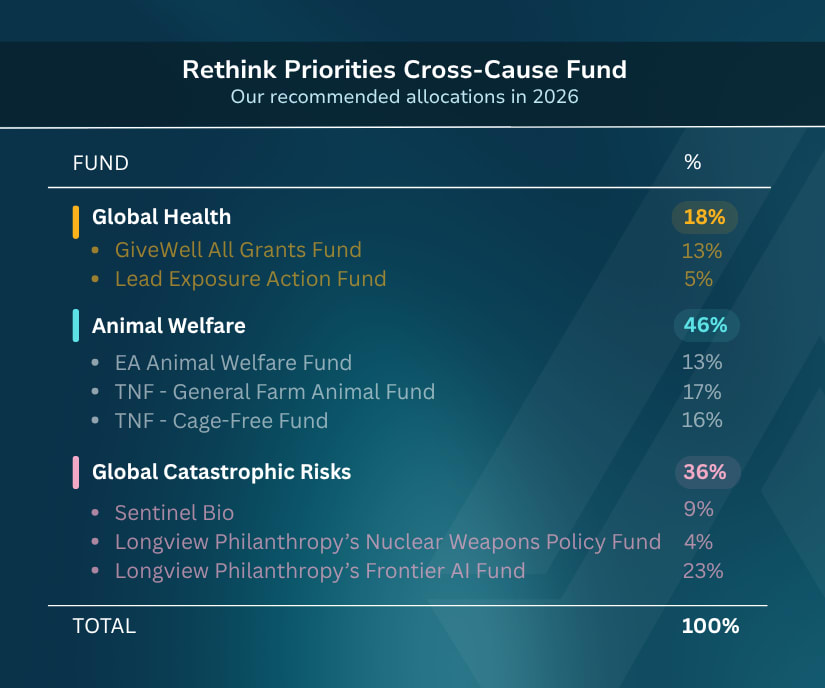
Our recommended allocation (based on an assumed budget of $200M) reflects our best all-things-considered judgment on where a marginal dollar does the most good among the funds we considered. As described above, the underlying model explicitly accounts for empirical uncertainty about interventions, moral uncertainty across ethical frameworks, and different attitudes to risk. It considers cost-effectiveness at different funding levels, welfare tradeoffs between humans and animals, and how uncertainty about AI should affect other cause areas.
We are also presenting the first version of the Donor Compass, a quiz-type tool powered by our cross-cause prioritization model that outputs a custom cross-cause allocation based on the user’s beliefs.
It is a tool for anyone looking to explore cross-cause giving, particularly those curious to see how their moral and empirical beliefs will shape downstream allocations.
You can use it to compare RP views and your own, resulting in a personalized allocation recommendation that reflects your moral and empirical commitments.
The Donor Compass has two modes:
Here is a walkthrough of how the tool works with real-world examples.
Our methodology has three components: (1) how we select funds for inclusion, (2) how we estimate each fund’s marginal cost-effectiveness and how it changes with funding influxes, and (3) how the cross-cause prioritization model combines those estimates into an allocation across funds. This section provides a brief overview; more details are available in the document linked here.
We aimed to include at least one fund per major cause area focused on by the EA community (Global Health and Development, Animal Welfare, and Global Catastrophic Risks), and applied four further criteria: fund quality (we included only funds we were confident would lead to high-impact grants, and excluded areas we lacked the experience to vet); data availability (we needed cost-effectiveness data we could obtain or model from public sources); decision relevance (we shaped the initial list around the giving decisions we expected to be most useful to early users); and our legal restrictions as a 501(c)(3), which require us to exclude political giving entirely.
For each fund, we estimate two things: how cost-effective it is at the margin today, and how quickly that cost-effectiveness declines as the fund receives more money. Our process is to build a cost-effectiveness framework for each fund, solicit data directly where possible, fall back on in-house estimates from existing research and expert views when data isn’t available, and simulate the fund's marginal impact and risk profile across each dimension. Separately, we construct diminishing returns curves informed by internal assessments, third-party experts, and fund managers.
Funds in the same cluster share outcome metrics. These metrics may be expanded in the future to cover more cross-cause impacts of each fund, but at the moment include:
All three cluster models then output a standardized 6-by-8 grid: six time periods (from 0–5 years out to 500+) by eight risk profiles (from risk-neutral expected value to discounting optimistic scenarios to giving significant extra weight to avoiding harms). Moral weights and cross-cause comparisons are applied downstream of this grid, which keeps the underlying impact estimates transparent and lets us swap in different moral views without rebuilding the fund-level models.
We built a Data Viewer, if you want to inspect the cost-effectiveness data that feeds into Donor Compass recommendations and Cross-Cause Fund allocations. To help you understand the data, we also created a brief overview explaining how to read it.
The model takes the fund grids and generates a scalar score for how well each fund performs under each of several worldviews. A worldview is a coherent bundle of moral and empirical commitments, along with an approach to acting in the face of risk and uncertainty. The components that define a worldview in the model include:
Time discounting. A discount factor (0–1) for each of six time periods (0–5, 5–10, 10–20, 20–100, 100–500, and 500+ years),[1] reflecting how much weight a worldview gives to future impacts relative to immediate ones.
Because we might be torn on one or more of the above questions, we can assign credences to represent our degree of belief in several competing worldviews. These credences are numbers between 0 and 1, and they collectively sum to 1 across all worldviews.
Once these worldviews are defined and our credences in them are set, the model runs in four steps.
The default inputs that we use can be found here. A more detailed description of the methodology behind assessing the funds and computing the allocations can be found here and here.
Our cross-cause prioritization model is a living tool. While it represents our best current methodology, we acknowledge that it does not yet capture every factor relevant to estimating impact. For example, we are not currently modeling certain interventions, such as alternative proteins, which we intend to add in the near future.
A detailed discussion of the model's current limitations is available in our methodology documentation and the Cross-Cause Fund’s FAQ section. We are committed to rigorously prioritizing these gaps and incorporating the factors most relevant to improving model accuracy.
The pace and depth of this refinement work will scale with the fund's size. As the volume of donations increases, the value of marginal improvements to our estimates grows correspondingly. We will invest in model development in proportion to the resources we steward.
The short-term improvements will likely include:
Longer-term opportunities could include:
We will communicate any additions to our fund coverage through our regular updates.
We do not charge any fees for managing the Cross-Cause Fund, and Donor Compass is free to use. We chose this because we want to enable impactful cross-cause giving with as few barriers as possible.
This also means our research, development, and maintenance work is completely reliant on donations. The Cross-Cause Fund and Donor Compass exist because individual donors believed cross-cause prioritization research was worth funding. If you also find this work valuable, consider donating here. You can also reach out to us at [email protected] to discuss options for supporting this work.
Rethink Priorities (RP) has received grants from Longview Philanthropy, EA Animal Welfare Fund, Navigation Fund, and Coefficient Giving. RP has also done commissioned research for GiveWell and Coefficient Giving. In addition, one RP staff member serves as an advisor to the EA Animal Welfare Fund but is recused from grantmaking decisions involving RP.
RP is not involved in any grant-making decisions for these organizations, and RP conducts independent cost-effectiveness analyses of any funds we decide to include in our Cross-Cause Fund.
The Cross-Cause Fund and Donor Compass are projects built by Rethink Priorities’ Worldview Investigations and Interdisciplinary Research Teams, with support from the Development Team and assistance from the Communications Team, which is responsible for final edits, copywriting, website content, and co-authoring this post. We want to thank all the team members behind this work, as well as the contractors and everyone who provided assistance and feedback at various stages of this project.
The time periods are inclusive of the lower bound and exclusive of the upper bound.



I think this is important work, but I want to flag my biggest concern about the process - the imbalance of the backgrounds of the research team and therefore potential for bias. I asked Claude to rank their areas of interest and prior work, and it shows a heavy bent towards Animal Welfare and Global Catastrophic risk.
Half of the research team have been strong advocates for Animal Welfare work in the past, while none of the team seems to have a special interest in GHD. Two of the team were deeply involved in the Animal Moral Weights project itself.
I think the work is impressive, and it's great there is a new fund, however I think a cross-cause research prioritisation team like this ideally would have been more balanced in makeup. Research team balance on prior opinions is especially important when the project relies on many assumptions and requires subjective assessments at many junctures. In addition potential conflicts of interest here should probably be stated on the website and in a post like this. Now that there is donation money directly involved, I feel the stakes are higher than when the situation was purely research (although the research alone is very influential).
A couple of other less important declarations perhaps could have been made as well. Given that Lead Exposure Action Fund was the only specific GHD intervention selected, they perhaps should have mentioned that they have been commissioned to do research on lead exposure before, and also that a previous RP researcher is now a program associate at LEAF. The RP CEO was also previously a fund manager on the EA animal Welfare fund which allocates 13% of this fund's money.
All think tanks will have bias to some extent (Political think tanks are even rated on a spectrum) and I think its important to consider this and state where there might be potential bias.
Hi Nick,
I think there is not a single EA organization I would consider unbiased on this question, including ourselves (despite our ongoing efforts not to be). That is exactly why we publish so much of our methodology and our assumptions openly. One of the main motivations for this work is concern about the effect of bias when assumptions and models are implicit or hidden. We would welcome more experts with broader backgrounds being involved in drafting and improving these estimates, which is part of what we hope this kind of public methodology enables.
On conflicts of interest: we aim to be transparent about potential or perceived conflicts of interest, and we state all present COIs in the post above and on the website (here and here), and we will update these when and if they change. RP is recommending these grants independently and no one outside of RP was involved in choosing the funds for inclusion.* You are welcome to review our methodology on how the funds were chosen and provide critique.
On team composition and priorities specifically, a few points: First, the researchers you list are not, in fact, the principal contributors to the project and it's harder to pin us down even if you stuck to that methodology. For example, Carmen van Schoubroeck was the project lead for all this work, and started her EA career as a global health and development researcher. Some of the specific inputs that in theory could be biased here (like the choice of aggregation methods) are mine and my background involves starting a global health charity, being an animal welfare fund manager, and incubating and providing operational support to a large number of AI projects. And obviously RP works across all of these areas because I, personally, think it's a good idea. Secondly, Claude does not have access to the work our researchers have done that’s not published, nor what they actually prioritize in their own giving. Third, our global health and development researchers gave feedback on the modeling assumptions, in the same way we involved researchers with other expertise on other cause areas. Having that option is one of the benefits of being a research organization with teams across causes.
More broadly, I would not consider Claude’s opinions about the priorities of our researchers to be a good method of gauging the quality of our work. I think all of the following:
Specifically with regard to (1), I can never tell you with certainty no one who worked on this was not subtly unconsciously biased, but one of the reasons people were chosen to work on this project at all is because of my perception of their lack of bias. This is a considerable filter to working on any cross cause work at RP and I stand behind the credibility of every person who worked on this was doing their best to be unbiased. I think this filtering combined with the process we had of having multiple people review work and getting input from funds and cause area experts should lead to less bias. I could be wrong, of course, but I think it would be more productive to make specific critiques of our work and choices because the specific choices are there to see. It's not costless in time to do this, so I don't begrudge anyone for not engaging, but you don't have to infer if you think our animal moral weights are too high, or the cost-effectiveness of an area is too low, you can see what we chose and say what you think is wrong and why.
I truly wish for myself and RP to do the impartial good but we only ever achieve doing so imperfectly. But, primarily, the way we find out is through specific things we get wrong. So, if you have specific issues with inputs or choices that you think privileged one area over others, please point them out. We’d be happy to revise them if they should be improved. The current model surely isn’t perfect (as we acknowledge) and can benefit from specific, thoughtful criticism about our methodology, which we’ve described and linked to on this site.
*Despite the complete lack of involvement of former staff in our decisionmaking, in general I favor more transparency in EA so ill note you are correct that RP has done research on lead exposure before, and in fact, two former RP staff now work on the Lead Exposure Action Fund. I think our ability to model lead was improved because we’d done work on it and this was a pro for us including it, as we felt more confident we could accurately do so by the time of launch. I was also a fund manager for the EA Animal Welfare Fund. We also have former staff at Longview, and some at other parts of Coefficient Giving unrelated to LEAF. We also have former staff or board members at a number of the funds we list that we plan to consider including Astralis, the AI Safety Tactical Opportunities Fund, Giving Green, and Macroscopic Ventures.
Thanks Marcus for the reply. First this criticism is specifically about potential preferences and bias of the researchers. With a project like this with perhaps hundreds of junctures which require subjective decisions, I think that's a reasonable discussion to have. I don't think it's fair to ask me shift the ground and ask to discuss the research methodology, I'm sure there'll be plenty of great discussion about that. My point was purely concerns about potential researcher bias.
I completely agree with your 3 points, and specifically that there are larger areas of concern than the cause area orientation of researchers - but I still think it's somewhat important .
This comment seems to twist the point I was trying to make "More broadly, I would not consider Claude’s opinions about the priorities of our researchers to be a good method of gauging the quality of our work" I was not questioning the quality of your work, I think your work is extremely high quality. Yet even the highest quality work can go in different directions, based on the assumptions and biases of the researchers who generate it. In many imprecise fields like development, economics and political science, the highest quality researchers can argue opposite sides. Stiglitz and Friedman both produced high quality work which often ended up at almost opposite conclusions. I would put cross-cause categorisation in a similar-ish category due to the wealth of assumptions required and uncertainties to be reckoned with. So in research like these yes, I think the make-up of the research team is important and open to scrutiny outside of objective criticism of the work itself. You might disagree with me on this one. Assuming people's backgrounds is open for discussion, I think a Claude analysis of people's previous work is reasonable if obviously very imprecise and yes potentially misleading.
I could be wrong here, but I feel like I may have been baited-and-switched a little on who are the major contributors here.. I went to your website and just searched the cross-cause prioritisation team, finding a page with photos and bios. You've said that the researchers I listed were not the principal researchers - then who were? That Carmen van Schoubroeck led the work isn't listed anywhere I don't think.
I agree with the direction but not the strength of this comment "I can never tell you with certainty no one who worked on this was not subtly unconsciously biased" and agree with your opening statement more "I think there is not a single EA organization I would consider unbiased on this question, including ourselves" We are all biased, often more than we think. Most of us (myself included) have a cess-pit of opinions and angles, despite our best efforts to the contrary. I think within EA we often overrate how objective we are, and we can only have so much objectivity based on our past experience and worldview built up over time. This is why I think for a cross-cause prioritisation exercise, it is helpful to start with a team with a wide range of prior opinions or perhaps very uncertain ones.
Hi Nick -- just regarding the team page issue, are you thinking of this page: https://rethinkpriorities.org/our-research-areas/worldview-investigations/ ? It has the people listed in your screenshot from Claude.
As a reference, I got to this from CCF page --> support our work --> under the "our team" section. Notably, the link is from this text:
"The Rethink Priorities Cross-Cause Fund sits on top of work done by our Worldview Investigations Team (WIT), and Interdisciplinary Research Team, groups established specifically to tackle the hard questions that most donors don't have time to engage with: how to compare welfare across species, how to reason under deep uncertainty, how to weigh present benefits against future ones, how to aggregate competing moral views into a single allocation.
The team brings together training in philosophy, economics, statistics, cognitive science, moral psychology, and decision theory . The fund's allocations also draw on the in-house expertise of RP's Global Health and Development, Animal Welfare, AI departments, so the cross-cause model is informed by researchers working directly in each area, not just secondary literature. "
So I'm interpreting that paragraph as saying that WIT work goes into the report, but not necessarily that the WIT team did all the work (in particular, the interdisciplinary research team clearly was also involved, and the second paragraph suggests other teams contributed as well).
Thanks so much @mal_graham🔸 that's the web page appreciate that! I understand that the WIT doesn't do all the work, but I think it was reasonable for me to assume that they were the major contributors given that they have been the team publishing the cross-cause work up to now, and were the team linked from the page.
Hey Nick, I don’t know if we are that far apart on the conceptual issue of potential bias but I think we are approaching this differently.
However, I really like the Stieglitz and Friedman analogy and think it is useful in many ways. Simply, there are lots of decision points here. And I really wish there were some other groups working on building such work so we could compare and contrast our work with theirs like you can in that context. If that were so, I think this type of meta-debate would be either less likely to occur, or more productive because we could point to more specific things.
At the same time, I think “count up the cause area backgrounds of the staff who worked on this” is misleading even if I agreed with the characterization of our staff, and I don’t. This is for a number of reasons and, if you’d permit, I’ll largely extend the economics and social science analogy to raise my points.
First, in some simple sense, I think looking at our staff’s background like this is like looking at the subfields GiveWell’s staff worked in prior to joining and if a disproportionate number worked on malaria using that to argue this is evidence of potential bias for why multiple of their top donation opportunities overall involve malaria. It’s not that this bias is not possible, it’s just a very blunt guide, at best, and the causal arrow may point the other way. That is, GiveWell may employ a lot of people who have backgrounds in malaria to help create their final estimates because they are particularly well suited to the task and/or malaria is an important area they have to cover.
Second, for this model many of the relevant choice points come from fields that have less ideological valence on the cause area lines (i.e. what do you think of risk attitudes) and potential bias in those areas is likely just as relevant to reaching conclusions as thinking at the level of cause area. Further, some inputs have effects difficult to pin down in the overall model, which limits the ability of people to even implicitly put their thumb on the scale because they don’t know what changing that input would change in the result. There are a few areas where it is obvious (i.e. make the animal moral weights higher or lower, reduce the cost-effectiveness of a given area) but those are the areas precisely where anyone looking at our model can see what we choose and object if they disagree.
But suppose you were convinced that Stiglitz tends to be biased in a liberal direction, and Friedman in a conservative one. What’s the best way to demonstrate that? I think it would often be to point to a specific assumption or choice they made that is questionable. This is why I asked you to point to something specific that you think is wrong. Not because I think it can’t be the case that we’re biased or that it’s inherently illegitimate to bring up the possibility, but because it’s the specifics that demonstrate that we are biased. I really do agree that too often some people in EA think everything they do is objective. I wrote this just last month and stand behind this as applying to basically everyone:
If someone doesn’t have the time to investigate an area, it can be at times reasonable to check for this kind of bias and discount appropriately (I think this is most useful as a guide when a group or individual has shown repeated bias in the past) but I also think this can at times serve as a shortcut to dismissing anything that doesn’t already ideologically align with yourself. Balancing these two competing forces can be a constant struggle, particularly in areas outside of your expertise and I know it’s something constantly in my mind when I read about politics.
Finally, to continue the analogy with economics, often the field of experts are debating a much more narrow range of opinions than exists in the public debate. For example, in immigration the economist debate about the impact of immigration on wages and employment is far more narrow than the general public discussion of the same topic. Stiglitz and Friedman (assuming you mean Milton Friedman) might have disagreed a lot but it was often within a largely shared framework. I’m pretty sure neither of them thought mass central planning would work, or that tariffs were largely paid by the exporting countries. I think many of the opinions people give about cause prioritization may fall into this category of something very few who think about the topic carefully dare to defend but, because those outside haven’t put in the time, they are unaware of this (in some sense through no fault of their own, not everyone can be an expert or very informed about every topic).
I think this type of distinction is likely to hold among serious efforts to build cross cause models.
Thanks there's some insightful stuff here. I really appreciated this. "If someone doesn’t have the time to investigate an area, it can be at times reasonable to check for this kind of bias and discount appropriately (I think this is most useful as a guide when a group or individual has shown repeated bias in the past) but I also think this can at times serve as a shortcut to dismissing anything that doesn’t already ideologically align with yourself. Balancing these two competing forces can be a constant struggle, particularly in areas outside of your expertise and I know it’s something constantly in my mind when I read about politics."
Despite my best efforts, I've really struggled to understand arguments around the nature of consciousness and valenced states. I'm still not entirely sure that any consciousness model is very meaningful but that's another discussion... This means my analysis has often stepped up the level to process. As a side note I still think far more EA funds should go to animal welfare than currently does, although the defensive nature of responses from RP and other animal welfare folk has updated me a bit against this over the last couple of years.
I think the GiveWell analogy is a great one, and it would be fair to look at the backgrounds of staff that were doing prioritisatoin. If most came from malaria backgrounds I would be quite concerned, I haven't looked into that. In a cross-cause prioritisation process I think there is more room for bias than in a CEA.
I think we'll probably have to agree to disagree on research team make-up being open to outside scrutiny. Like you say I don't think it's the most important thing but still important,. You've said that "personel is policy" carries weight, but haven't suggested how we should approach examining that? My Claude ranking method isn't the best for sure, what other way you would suggest? From an RP organisational perspective, I think there is a risk that the org's work could be undermined somewhat by people who might feel like a bunch of animal welfare/GCR folks might have disproportionate sway over a cross-cause prioritisation process like this.
I agree it would be great to have other groups working on this stuff, a poll a while ago was overwhelmingly in favour. The reality is though, you guys are it for now. There aren't other groups working on moral weights and cross-cause prioritisation. I think this means that there's perhaps more responsibility for balance within the organisation. The situation is more "Aristotle" dominating philosophy than Friedman and Stiglitz. I think with our current levels of information, thre is far more shared ground in economics than in cross-cause prioritisatoin. Perhaps within RP there's much agreement but I would argue there will be a heavy "groupthink" element built there over time. That there are 10+ moral theories in this model illustrates the extreme diversity. Between animal welfare and human welfare we have a bridge of one moral weights project? While GCR uncertainties are far bigger still, with moral and practical junctures going almost uncountable. On the GCR front even something as important and straightforward as as "have those who worked on AI risk done ill or good so far" is hotly debated.
As a final (if a bit sour) note, RP as I've experienced it on the forum has seemed pretty impervious to criticism and suggestion. Responses are always intelligent and very well reasoned, but l haven't seen openness to mind-changing, and not just in response to my comments. When criticism comes in, the response is polite well reasoned refutation - very good arguments for maintaining status-quo. I don't think I've seen a response along the lines of "hey you have a good point there, let's look into that" or even "yes that decision was tricky and we did X because...". As an example I put a big effort into understanding the moral weights project (for personal interest reasons). Then after writing a decent post about the MWP process, the response from RP members was excellent and well thought through, but never acknowledged that any of my process points might be reasonable. In contrast orgs like GiveWell in my experience are far more open to mind changing.
Hey Nick,
I'm headed off to two weeks of conferencing in in a few hours so very likely won't respond further after this but I do want to say a few things.
I take very seriously that you (or anyone else) believes we've come off as defensive or not open to changing our mind. I definitely think we haven't always lived up to our communication ideals and could stand do better. I'm really sorry if you don't think we aren't open-minded but I don't think this is true:
I don't have the time to do a throughout search and systematic weighing but I believe this comment section contains at least one example to the contrary. I think just a few comments down someone raises questions about what went into the AI discount and I stated why it's shaky, what changing it does to the output, and how I hope to see it improve.
I'm not really sure what the best method is as a I said I think doing this type of counting is a very blunt, limited tool. From my experience, the worry about our staff and outcome bias basically cuts all directions as some GCR people consider us too animal friendly, some animal people consider us too GCR and GHD friendly, and some GHD people (like yourself) consider us too animal and GCR friendly. I have personally heard all of these concerns over the past several months while working on this project. This doesn't invalidate any of the concerns (we really could be biased one of these ways, not all concerns are equally valid) but I think it can bring some perspective to it. I think one inherent limitation to this enterprise is we typically get staff who are willing to work on multiple areas and often have explicitly done so prior to joining RP. But that typically means few if any are perceived from the outside as a true "member" of any cause area.
But I think an additional reason it's not super useful to assess our staff this way and why I still lean away from the utility of type of exercise, is the actual projects RP does are reflective most of all of what projects we think are valuable. WIT in particular, has done roughly four large projects and those projects were about moral weight, risk and uncertainty in giving, quantitative tools for cross cause prioritization, and digital minds. But the reason we selected those projects--which I believe are then counted as part of what cause areas they've focused on in the Claude search--is because we thought there was a useful contribution to make that we could do well. To put it mildly, I think there's far less big intellectual gaps in the GHD space than in AW and GCR space, or in cause prioritization itself. So, that we filled in gaps outside of GHD that we think are needed to improve cause prioritization may be being used as evidence we don't care about GHD.
Outside of general competence, here's what I actually prioritize on staff working on cause prio projects (not necessarily in this order):
Of these I think (3) is partially visible from the outside, and under certain circumstances (2). (1) can be seen in what choices and arguments are actually advanced. But none of this maps very well onto "cause area" background, and largely I think different types of methodological background and experience have more to do with the output that area inclination. (I also don't think cause areas are the relevant level of crux, cause areas contain bundles of interventions that are extremely heterogenous but that's a story for another day).
I actually want more. I think we didn't capture everything I think is relevant about moral theories and hope to do better on this in the future. We had to start somewhere though.
I get that we are largely it for now and take this responsibility very seriously. Suffice it to say this project has dominated my thinking for months, and my desire to do the best we can with our initial offering has been my primary concern for several months. Hopefully despite your concerns, future editions of this project and others can do more to win your trust and live up to what we need to be be if we're going to be the only game in cause prioritization town.
Thanks that's a fantastic reply, really appreciate all the humility thought, time and effort put in. Looking forward to seeing future work :)
Hi Marcus. Thanks for the clarifications.
I very much agree. I would be curious to know your thoughts on these specific critiques.
Hey Vasco, I replied to the last link here and I don't have anything to add to Laura's responses for your first two links.
In brief, the Donor Compass is streamlined, if you want more subtlety you probably should be using the advanced version of the tool. And I while I think we should aim to have secondary effects of interventions, I want to do it in a way that doesn't unnecessarily penalize/reward areas where that data is/is not available, and to not have the effects of all interventions be dominated by deeply uncertain secondary impacts.
I replied there.
Great to know. Do you have any concrete plans or timelines? If not, how much funding would you need?
Nitpick. I would not call effects on non-target individuals "secondary". I think they may be much larger than those on the target individuals (in expectation), and "secundary" makes it sound like they are less important to consider.
Makes sense.
What if, given reasonable moral and empirical views, we should in fact be very uncertain about whether practically any intervention is better or worse than nothing accounting for effects on non-target individuals? I think this would be useful to know. The model should not force the conclusion that interventions which have historically been supported by the effective altruism community (like saving human lives, and cage-free egg campaigns) are better than nothing for all reasonable moral and empirical views?