Context: Effective Mental Health is a new group working to improve the field of global mental health along EA principles (and we're running another round of our Global Mental Health Fellowship, see info / apply here!).
Here, we outline the quick & basic case for why field-building work in effective global mental health seems especially cost-effective.
Huge Disease Burden and Neglect
Mental, neurological, and substance-use disorders account for 12% of the global burden of disease when measured in DALYs, yet mental healthcare accounted for just 2.4% of global healthcare spending in 2016. Treatment gaps are massive; most people with mental illness do not receive treatment (only 22% of people with mental illness in high-income countries, and as little as 4% of those in low-income countries, receive treatment).
Cost-Effectiveness
Promising mental health interventions are cost-effective in both low- and high-income countries. The Happier Lives Institute’s investigations into intervention cost-effectiveness find that some mental health interventions are over 5x more effective than GiveDirectly’s cash transfers:
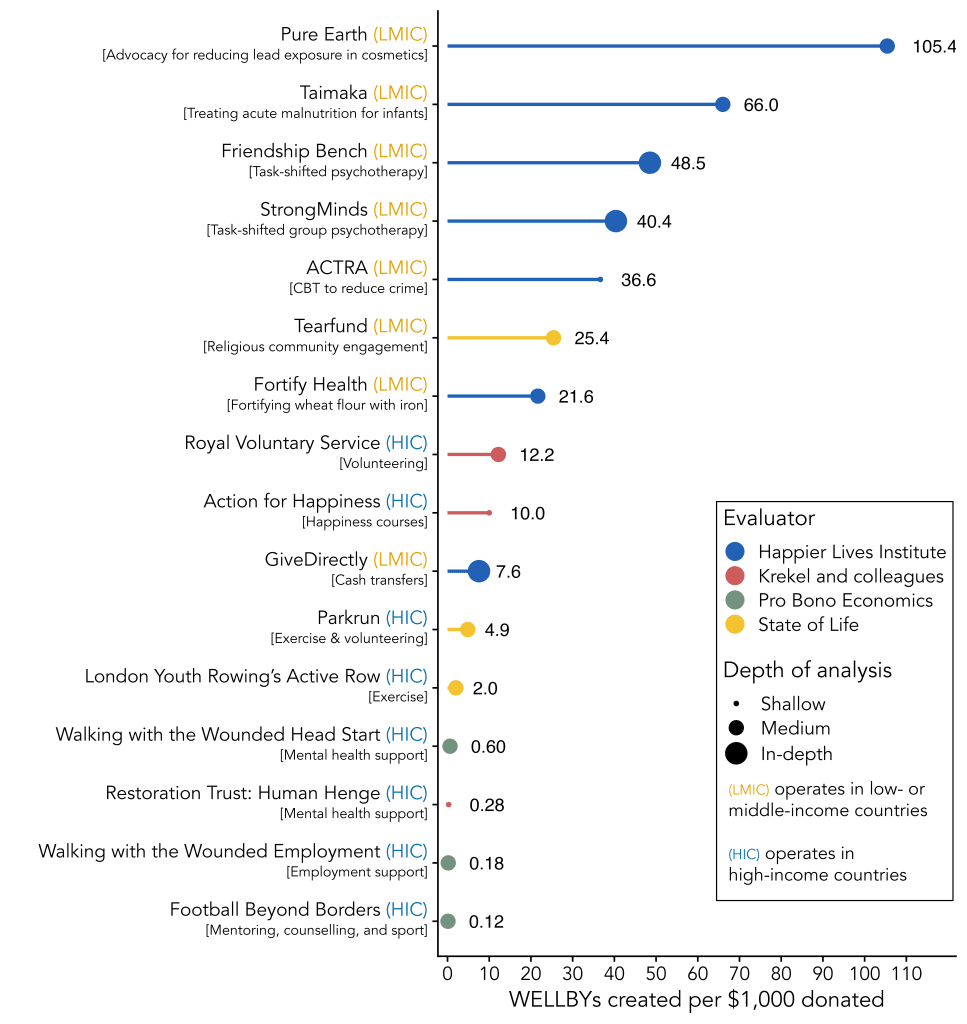
Many proven, evidence-based interventions already exist, but are bottlenecked by lack of prioritization, funding, and implementation.
We also expect that there will also be important “paradigm shifts” and approaches (e.g. new substance based treatments, AI assisted therapies, policy shifts, training lay therapists…) that could unlock radically improved quality and scalability in mental health interventions, yet much of the mental health world currently does not focus on outcome effectiveness nor innovation.
New Counterfactual Funding Pools
AIM (Charity Entrepreneurship) notes that since many foundations and funders are focused on a particular geography or cause area (e.g. mental health), “even if mental health interventions turn out not to be as cost-effective as the best global health program, there is still a substantial opportunity for impact”, since these interventions may have access to donors who wouldn’t otherwise fund traditional EA cause areas.
In other words, expanding work in effective mental health need not displace other effective programs, resulting in strong marginal and counterfactual value given existing funding ecosystems.
Moral and Epistemic Robustness
Improving mental health is ethically robust across moral systems, directly increasing wellbeing without ethical tradeoffs (e.g., no “meat-eater problem”). MH interventions target what matters most: how happy sentient beings actually feel, which may be robust both in the near-term and across many potential long-term scenarios. There may be important positive externalities to improving the effectiveness of global mental health as a cause area; e.g. improved measures and targeting of subjective wellbeing could help us set priorities or align AGI to genuinely positive human values. Some of the worst forms of human suffering stems from mental health problems, so understanding how to assess and avoid the worst subjective mental states may robustly increase our ability to reduce extreme suffering.
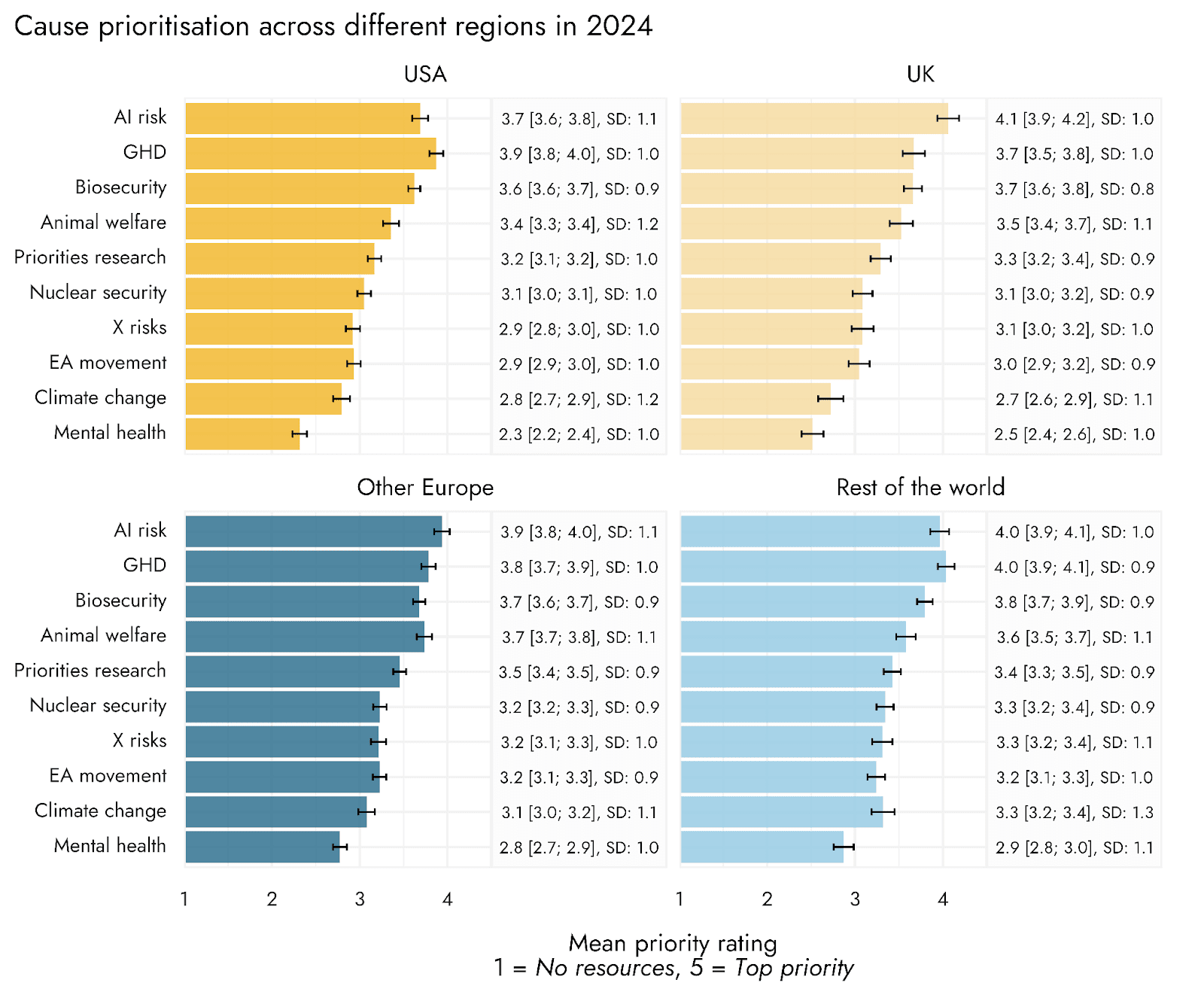
In 2020, AIM (Charity Entrepreneurship) noted that there is growing interest in the mental health space from the Effective Altruism community, with 4% of EAs ranking MH as their top cause area in 2018. However, as in previous years, the recent 2024 EA Survey found that mental health is consistently the lowest-ranked EA cause area overall across EA regions (participants are asked to rank cause areas on a 1-5 scale, where 1 = “I do not think any resources should be devoted to this cause”, and 5 = “This cause should be the top priority”).
Conclusion
Despite its vast scale and neglect, mental health remains an under-invested frontier for high-impact work. Proven, low-cost interventions already exist, yet they remain bottlenecked by insufficient funding, prioritization, and innovation. Moreover, mental health offers unusually strong moral and epistemic robustness: nearly all ethical frameworks (and many potential future scenarios) robustly value reducing suffering and increasing happiness, which are efficiently targeted by mental health interventions and meta-work. Better understanding and alleviating mental suffering may also provide broader benefits, from improving global wellbeing metrics to informing the genuine alignment of ASI. Work in this cause area could run on new funding streams that do not compete with traditional EA priorities. In short, improving the field of effective global mental health represents a neglected, tractable, and deeply humane opportunity to make the world better, with the potential for extraordinary returns. Expanding EA interest in mental health direct & meta-work seems potentially quite valuable.




Small note but this seems false: "directly increasing wellbeing without ethical tradeoffs (e.g., no “meat-eater problem”)"
If mental health interventions increase the number of DALYs in the world, then they definitely run into the meat eater problem (where each year of human life will cause X years of animal suffering).
Not making any particular comment on the meat eater problem here, just commenting to point out that you can't avoid trade-offs this easily :)
I'm not sure this is correct - a DALY weight is not a literal year of human life requiring sustenance. It's saying that a year with depression is like losing some proportion of healthy life. But the actual human years of life would remain the same (e.g., if the weight of depression is .5, then curing depression is not leading to twice as many human years actually lived and thus twice as much eating of meat)