I think it’s useful to ground these results by looking at another setting in which cultural and institutional norms put ambitious, intellectually selected young people into a similar context, which I think can be reasonable characterized as high-stakes, status-competitive, weak-boundary work environments.
Here are some comparisons GPT found to people in early-career academia:
Survey here
Early academia
Difficulty switching off from work
68%
78% ranked difficulty maintaining work–life balance among their top five concerns. 49% reported a long-hours culture at their university, explicitly including sometimes working through the night.[1]
Imposter syndrome
60%
42% experienced frequent imposter thoughts. More than 26% experiencing serious/intense imposter thoughts.[2]
39.3% reported anxiety-disorder symptoms.[4] A different study found 17% had clinically significant symptoms of anxiety.[5]
Hopelessness or depression
29%
26.5% depressive-disorder symptoms.[4] A different study found 24% had clinically significant symptoms of depression.[5]
Loneliness or isolation
32%
24% severely or very severely lonely (note this was collected during COVID).[6]
Considered cutting back or leaving
45%
51% considered leaving because of work-related mental health concerns.[4]
It seems worthwhile to me to question the premise that AI safety/x-risk work is unusually psychologically harmful. I’m not in the field, but I think there is a somewhat romantic story available here: that these problems arise because people are grappling with x-risk, carrying a moral burden, and working on something unusually consequential. That story is surely partly true, but it’s also flattering. Ingroup dynamics give us some reason to suspect that attributing distress to the exceptional significance of the work may be a motivated explanation, when a less glamorous one is that AI safety has reproduced a familiar high-pressure knowledge-work environment: long hours, poor boundaries, status competition, perfectionism, career uncertainty, people who are willing to sacrifice other parts of their lives to succeed.
The practical downside of viewing the problem as exceptional is that solutions become less available, need to be built bespoke. But if a large part of the variance is coming from more ordinary occupational dynamics, then a much larger institution (academia) has spent a long time running into the same failure modes and trying to intervene. There may be a helpful update here that upweights boring and well-established interventions.
It is great to get some comparison of these statistics to another field, however, comparing AI Safety mental health results with academia may not be so helpful. Academia, and even more so, early career academia, is notorious for low mental health and this also ties in with bad pay, oversupply of PhDs, and no job security. This is quite different for AI Safety with it being comparatively well-funded and without those same structural stressors, and yet still it produces similar or worse rates of anxiety, imposter syndrome, and loneliness for example. It is also worth noting that academia has not solved its own crisis despite knowing about it for decades, so certainly not a source of “well-established interventions”. In many ways, this comparison strengthens the case for building dedicated support. Besides when it comes to mental health, it should always be bespoke and tailored to the context. Also, being bespoke, doesn’t equate to being less available, and nor should it. I think too perhaps you underestimate the impact of working with x-risk and potential catastrophic risks and the accumulation of potential burnout, compassion fatigue, and effectively vicarious trauma. We should be prioritising tailored mental health support across all sectors, and I believe that AI Safety is just as deserving.
I agree that academia has generally done a poor job addressing its mental health crisis (I certainly had that experience, personally). At the least, though, their problem is older, well quantified, and their intervention outcomes are well studied, so, to the extent that we can exapt lessons from there, AI safety's approach to mental health can be (or begin) better informed.
I’d like to examine here how much the early career academia pattern is mirrored in the AIS workforce. Specifically, I think this premise is of large consequence to get wrong:
Academia, and even more so, early career academia, is notorious for low mental health and this also ties in with bad pay, oversupply of PhDs, and no job security. This is quite different for AI Safety with it being comparatively well-funded and without those same structural stressors
Scoping what constitutes the AIS workforce seems like a good first step, because arguably the workforce is much larger than those whose conditions can be characterized as “comparatively well-funded and without those same structural stressors.”
Surprisingly, there doesn't seem to be a real census of the AI safety workforce that distinguishes stable employment from fixed-term employment, fellowships, independent grant-funded research, PhDs, unemployment/job-search, etc. 80,000 Hours has been collecting something resembling a census since 2024, but as far as I can tell it hasn’t published aggregate employment-status results.[1] So I don't think we actually know what fraction of people seriously pursuing AI safety careers have stable jobs.
The evidence I can find suggests a fairly substantial AI safety gig economy. One 2025 estimate found about 1,100 FTEs at self-identified AI safety organizations[2] (likely a few thousand undercount given the qualifier, according to 80k). Meanwhile, a 2026 projection from people running AI safety talent programs expects 2,000-2,500 research-fellowship seats this year, plus ~300 non-research fellowship seats.[3] These aren't directly comparable since fellowship seats are annual flow rather than workforce size, and many are short or part-time, but they make it hard to regard temporary/soft-money work as a marginal feature of the field.
The outcome data too looks pretty similar to early career academia for these folks. A dataset of 647 alumni from nine relatively late-stage AI safety/governance fellowships found that 21.5% had done another such fellowship somewhere in their trajectory, and 11.1% did another one afterward.[4]
MATS acceptance rate was ~15% circa 2024 (more recently 4-7%), with its co-director saying many rejected applicants are proficient researchers without better options. 63% of all past scholars applied for independent-researcher funding immediately post-program to continue 4+ months on stipends he describes as LTFF-equivalent - "effectively self-employed."[5] Since then that funnel widened, with roughly 75% of fellows now continuing into a 6-12-month extension,[6] entry to which required (in 2024) securing an external grant, typically from LTFF or Open Phil.[7] In the one cohort MATS has tracked post-extension (n=18 though), five months out 33% were doing independent research, 22% were in PhDs, ~17% at established organizations, and 17% unemployed, a rate MATS attributes partly to a "gap between available safety positions and number of interested researchers".[7:1]
On the demand side, MATS's Q4 2025 interviews with hiring managers and funders describe organizations forced into hyper-selectivity, hiring only near-autonomous senior workers, while labs largely fill roles internally.[8] MATS also reports ~80% of alumni remain in AI safety[6:1], which, in light of the earlier numbers, suggests retention means circulation among temporary positions more than stable placement.
This is all really close to the postdoc pattern.
I'd qualify the bad pay part of the academic analogy since some AI safety fellowships pay pretty well. As I think is apparent above, the stronger parallel is with precarity, since a lot of the top-of-funnel positions are in 9-12 week or 3-5 month programs, followed by another application for an extension, grant, fellowship, job. In that respect the academia comparison might even understate the instability: postdocs are insecure, but generally operate on year-scale rather than month-scale funding timelines.
So I don't think the comparison lets us cleanly say that academia has bad mental health because it has oversupply, insecure employment and career competition, whereas AI safety lacks those stressors and therefore similar outcomes point toward the special psychological burden of x-risk. The first premise looks wrong if “AIS workforce” is interpreted honestly. AI safety appears to share quite a few of the same ordinary occupational stressors - scarce stable positions, repeated re-selection, soft-money research, status competition and uncertain career progression - even if the field as a whole is well-funded.
That doesn't imply x-risk contributes little, or that tailored support isn't useful. It just makes me less confident that the similarity in mental-health outcomes is evidence for something distinctive about confronting catastrophic risk rather than, at least in significant part, a familiar labor-market structure.
For what it's worth, I personally think stepping out of the mould of academia's interventions is high-value, which is why I'm focusing on understanding what the labour-market morphism looks like. To the degree there's a match, we have good information about what's been tried already.
Thank you so much for writing this Julian! I'm Cat, the operations lead at Rethink Wellbeing. Mental health does seem like a huge issue in the AI safety field right now, and we've been trying to tailor our CBT Lab program to fit with the most common things EAs/AIS report struggling with (burnout, work related stress, etc.). Our previous cohorts with a general EA/ambitious altruist audience have suggested that mental health support (via our program) can potentially increase productivity by 4-8 hours per week, which does seem to corroborate the claim that the AIS ecosystem could benefit from mental health support.
We're planning to make the broader AI Safety space one of our highest-priority targets for our next cohort (tentatively scheduled starting early/mid November) and we have been floating the possibility of officially partnering with organizations to provide mental health support as a employee benefit (and some plans for evidence-based team-building programs as well). Thankfully, since we're currently funded by the EAIF, we're able to offer this support for free. However, we're currently being bottlenecked by our reach. We primarily promote our programs on the forums, various Slack channels, and through organizations where we have warm connections. But it can be hard to reach organizations where we don't have warm connections, and from informal chats I've had with other EAs, it seems like there's a lot of dedicated EAs/AIS people who could benefit from the program but simply don't hear about it since they don't frequent the forums/slack channels! If anyone has ideas for how to reach AI Safety people/organizations better, we would love to hear them. Similarly, if you run an AIS/EA organization and would like free peer-support CBT programs as an employee benefit, please reach out to me or [email protected]!
It estimated a loss of roughly 6–7% of total workforce output
I think one issue with this claim is that I think stress and anxiety is downstream of something that also causes a huge amount of upside and that is people are persuaded by this being an incredibly high-impact opportunity. This is high impact because the stakes are high. Things could go catastrophically wrong. Not enough people are working on it. This causes people to make big career pivots and work hard, and also create stress and anxiety with the resulting psychological downsides.
Of course we should try to maintain motivation and interest in the cause area while reducing stress, anxiety, burnout, etc. But I think one of the reasons this is tough is that they are both downstream of a third factor.
Despite this, I do agree with most of your proposed solutions.
Also this is not me saying this is not a big problem. And of course there are other reasons why we should tackle this, not just for the instrumental value of lost productivity.
was just part of PDKU and now back in Philly for my "normal job". I think this is important!
The problems in the bay (and maybe dc) and elsewhere seem very different. I think in the bay, there is enough critical mass that you could do e.g. sports league teams for the AI safety people. Exercise + social is good. Not sure if like constellation is already doing stuff like this, but maybe just pre pay for some different sports leagues and then distribute out flyers with easy signup to the various orgs and email some people. might punt a few k but would probably very little effort and decent upside. I played soccer with some AIS folks at a park and that was fun. I know I would always appreciate someone coming up to me and asking if I wanted to play on a sport team with like minded people for the next 10 weeks.
Outside the bay, idk man. If you can help start an IRL group for people looking to inform the public/gov or help organize existing EA/Rat group to do the same, that seems like a good way to channel the energy. But otherwise it's a bit crazymaking to even think about AIS at all because you will find so little support or understanding from everyone around you. The best thing you can probably do without going nuts is to set a reminder to call your senator and congress person once a month or two and otherwise delete twitter and don't think about it too much (unless you are working an actual AIS remote job, then idk).
In general I suppose I should have always felt the sadness associated with how bad the world is at triaging resources, that is sort of what EA is all about after all, but trying to help with AIS has made me feel this in such a visceral way that doesn't make me feel good compared to the animal welfare/poverty stuff. Maybe I had already more successfully compartmentalized those.
As someone in the mental health space, this was an interesting read! I believe that more clinicians with niche specialties would be amazing, however current provider burnout rates and staff shortages would make that nearly impossible (right now). While we figure out that conundrum, utilizing trained lay people is an evidence-based, scalable solution. Community involvement also shows significant impact on mental health, isolation, and loneless, and I wonder if promoting and making space for some of these activities (during the workday) for employees would actually help bring anxiety levels down as well!
Jarred Filmer has experimented with starting peer support groups in EA, using the microsolidarity patterns. Worth learning from him if you want to dive into peer support structures yourself.
I have been in the EA space for a decade and have been more actively engaged since I started professional coaching nearly 5 years ago. I admit I'm more low-pressure and responsive in my coaching business. But outside of EAGs, I've fielded maybe a dozen inquiries from the EA community interested in coaching, and I formally coached less than half of them. I have also been involved in the EA Coaches and Therapists community. There are 122 members of the #role-coaches-and-therapists channel on EA Anywhere, and 80 providers listed on MentNav.
We have the therapist and coaching capacity. And—as elucidated in this article—we have a need. But for whatever reason, the people who need the services are not proactively engaging with the professionals providing the services, so… ¯\_ (ツ)_/¯
I rejoice in the goodness of those working on AI Safety. As it goes for big problems, they're basically out of control (for a particular agent) and some acceptance around that is needed. Making big tech slow down or put effective guardrails on AI is a difficult task, but those trying for it to be done must be happy about those intentions and efforts (if only they slow down to reflect on them), even if those intentions don't flourish completely.
If I may add, on a deeper level, a lot of stress around x-risk comes from the understanding that such a thing as non-existence is even possible. I think that some relfection on that is also helpful.
Thank you for outlining the opportunities to get funding for mental health projects for those involved, I would love to help with my meditation and mediation facilitation experience.
This is just my perspective coming from a different industry, albeit a safety-critical one. In my work, I've dealt with safety and operational issues that affected not just my organization but others across the industry. In those situations, the people responsible for similar issues at different orgs would come together in what we called industry working groups. We would meet on a set cadence to discuss what we were seeing, work through technical and operational questions, compare our experiences and interpretations, understand different approaches, etc. There were of course proprietary and competitive boundaries that we had to be mindful of.
BTW, these weren't peer-support groups. The groups were formed to work through the problems at hand. But now that I think back, I realize they had a supportive effect for me. I felt like I was no longer individually trying to carry or make sense of a difficult safety issue when there were peers elsewhere wrestling with the same thing.
So I'm curious whether AI safety has cross-organizational communities like this, where people doing similar work across different orgs can regularly compare experiences and work through issues together.
This is something that I've thought about as I look to get into AI Safety in the context of: How might I set good boundaries with peers and myself when entering an org? How do I strike the right balance of being engaged and committed to my team while protecting myself?
The backdrop is an environment where:
The stakes of getting it wrong feel incredibly high
There's not enough people
The backlog is already massive and growing as frontier labs race ahead
In basically every line of work, there's always going to be more to possibly do than you're going to have time for. The to-do list never ends.
Rutger Bregman touched on this some in his School for Moral Ambition book. He points out that many people work on efforts across their lifetime, and that you're least effective if you burn out and have to quit. (And probably more, paraphrasing from memory).
With that in mind, expanding on your ideas:
A good AI safety news newsletter - I'm subscribed to a couple of these, a general from Vox and one for climate change. The goal is to remind us that real progress is being made on real issues, and that its not all doom and gloom.
Building it into the culture of the work:
Create a documented plan - A template would be helpful. Identify what you care about and why. Identify the risks of burnout and other mental health challenges you face. How you might mitigate them (your work/life boundaries, hobbies outside of work, forcing time off, sabbaticals, etc). Ideally, this happens before you start a role as its a lot easier to do this when clear of the everyday grind.
Put it into action - Be up front with your manager or team. Ideally you could all share. This creates an upfront expectation so that your team isn't left wondering why you're pulling back, or you feel guilty and keep pushing instead of taking the break you need.
Of the survey data described by Spencer Greenberg (as well as the other surveys), do we know anything about the people who reported the fewest mental health challenges? What distinguishes them, and what are they doing differently?
In all my research, the single most important supportive factor is healthy, positive relationships with others. The Harvard Grant Study is a great resource. I even borrowed the name for a conjecture I crafted.
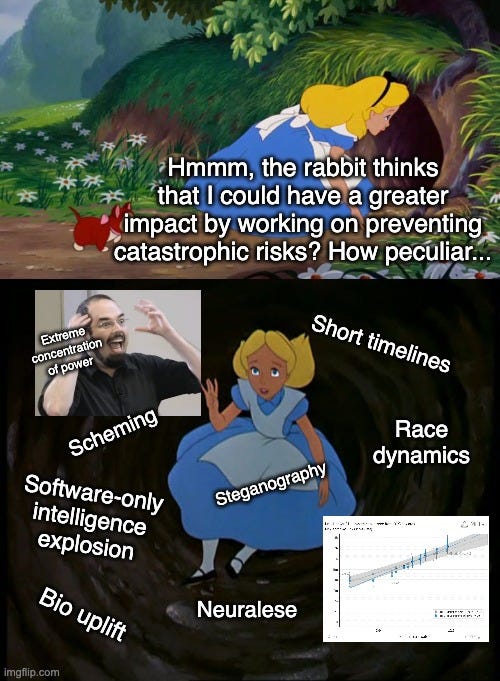
A tough lesson I learned over the past few years is that it’s pretty stressful to work in the “Please Don’t Build the Torment Nexus” ecosystem, especially as it increasingly seems like the world is hell-bent on building the Torment Nexus.
This is what it can feel like to be an impact-pursuing person who stumbles into the AI safety field.
It’s hard to be productive when you’re stressed and anxious. And setting aside productivity, it’s also just plain badif people working on AI safety — My peers! My people! — are feeling distraught.
Anxiety about AI risk really fucking sucks. If you feel this way, you aren’t alone. I’m right by your side, biting my nails, whitening my knuckles.
But even besides me, a lot of people seem to feel this way.
How big of a problem is this?
Survey data[1] described in Spencer Greenberg’s recent 80k episode implies that mental health challenges for people working on AI safety are fairly common:
Most respondents experienced psychological challenges — the median person reported six different problems.
More than half (52%) said these challenges at least moderately hurt their effectiveness, while 45% had considered cutting back or leaving.
The most common problems were:
Difficulty switching off from work: 68%
Imposter syndrome: 60%
Burnout: 59%
Guilt: 56%
Anxiety or worry: 54%
Less common — though still significant — were loneliness or isolation (32%), hopelessness or depression (29%), interpersonal difficulties (28%), and fear of death (22%).
Few appeared to be experiencing clinical anxiety or depressive disorders. The more typical problem was chronic strain: people remained functional, but struggled to rest, sustain motivation, and maintain boundaries.
Somewhat ironically, I asked Fable 5 to estimateBOTEC how much productivity is being lost due to mental health challenges in the AI safety ecosystem. It estimated a loss of roughly 6–7% of total workforce output, with an 80% confidence interval of ~3 to 13%. I only quickly skimmed the report it put together, but the conclusion seems fairly reasonable to me. If anything, my all-things-considered guess is that the real productivity hit is larger.
If I’m right, this seems like a big problem. And as a corollary, if tractable interventions exist here, even modest improvements would be worth a lot.[2]
What is being done about it?
There’s a bunch of existing stuff I’m aware of related to mental health and AI safety:
There’s a ton of writing about mental health challenges related to AI safety on the EA Forum and LessWrong (this post in particular seems like a useful snapshot, though note it’s from 2023; also, see this).
Spencer talks about his book. I haven’t (yet) read it, but maybe it’s good!
What else should be done about it on the margin?
Honestly, I don’t know. I’m not sure how tractable this is, and I don’t claim to have particularly great ideas. With this post, I’m mostly just trying to point at a problem, say “oh man, this seems like a big problem”, and hope that others have ideas for how to fix it.[3]
That said, here are a few things that might be good:
A vetted network of therapists who “get it”. I think it would be good if there was a curated, actively maintained, network of clinicians who have experience working with AI safety clients. As mentioned above, there’s the EA Mental Health Navigator — and ACX has the Psychiat-List — but maybe more can be done? When I was searching for a therapist, I didn’t find these existing resources super helpful.
Better norms in the community. The survey implies that chronic strain (e.g., issues with boundaries, rest, and motivation) is more common than clinical disorders like anxiety or depression. So maybe a lot of the fix has to do with improving the norms that shape the day-to-day experience of working on AI safety. For instance, not socially rewarding hardcoreness as a virtue so strongly.
Expand the group-program model. Rethink Wellbeing’s peer-guided CBT/IFS groups seem useful, at first glance. Maybe someone could do an AI-safety-specific version?
Generous mental health benefits at AI safety orgs. My sense is that many AI safety orgs are good at providing mental health benefits for their employees, but I might be wrong. If the org you run doesn’t offer this, you probably should fix that.
Peer support circles. Lightly facilitated, informal-ish groups of people working on AI safety who meet on some regular cadence to support each other emotionally.
Manager upskilling. Maybe someone (a high-AI-safety-context therapist?) could create resources or offer training sessions on how managers can provide better support to their direct reports.
If you’re interested in starting a project on something like this (or something else aimed at improving mental health in the AI safety space), this RFP from Coefficient Giving might be a good place to get funding. You also might want to check out the EA infrastructure fund.
If you’re applying for funding for some other project/org, consider requesting additional funding specifically to support yourself/your employees with mental health related challenges.
The survey is of 80 people working on existential risk, AI safety, animal welfare, and other high-impact causes. There’s obviously some self-selection bias here, but even after accounting for that, the rates of mental health challenges seem quite high to me. And while the survey population is broader than AI safety specifically, I'm assuming the AI safety subset looks similar (if anything, plausibly worse), but I haven't checked.
The AI safety ecosystem has a high willingness-to-pay for interventions that bring new people into the field. In theory, the willingness-to-pay for interventions that help AI safety people who are struggling with mental health challenges (and are thus less productive than they otherwise could be) should also be high.
After doing some fake math, I'd guess that the ecosystem should be willing to pay at least millions of dollars (maybe tens of millions?!) for something that reduces the productivity drag by a percentage point.
TLDR: Everyone’s talking about what the money could do, but few about how to decide where it goes.
This post is part of the new series of articles on cross-cause giving and the new wave of philanthropy. Stay tuned to the EA Forum and our Substack for the latest takes on topics such as giving now vs. later, common pitfalls in cause prioritization, and other crucial considerations from the Cross-Cause Fund (CCF) team...
I was born at the end of the cold war, unaware of the danger we were emerging from. Duck and cover drills (as if those could protect schoolchildren from a nuclear blast) were a curiosity of the past.
The farmer-poet Wendell Berry, who wrote about the dread of nuclear war, died recently. From his 1968 “The peace of wild things”:
When despair for the world grows in me
and I wake in the night at the least...



I think it’s useful to ground these results by looking at another setting in which cultural and institutional norms put ambitious, intellectually selected young people into a similar context, which I think can be reasonable characterized as high-stakes, status-competitive, weak-boundary work environments.
Here are some comparisons GPT found to people in early-career academia:
It seems worthwhile to me to question the premise that AI safety/x-risk work is unusually psychologically harmful. I’m not in the field, but I think there is a somewhat romantic story available here: that these problems arise because people are grappling with x-risk, carrying a moral burden, and working on something unusually consequential. That story is surely partly true, but it’s also flattering. Ingroup dynamics give us some reason to suspect that attributing distress to the exceptional significance of the work may be a motivated explanation, when a less glamorous one is that AI safety has reproduced a familiar high-pressure knowledge-work environment: long hours, poor boundaries, status competition, perfectionism, career uncertainty, people who are willing to sacrifice other parts of their lives to succeed.
The practical downside of viewing the problem as exceptional is that solutions become less available, need to be built bespoke. But if a large part of the variance is coming from more ordinary occupational dynamics, then a much larger institution (academia) has spent a long time running into the same failure modes and trying to intervene. There may be a helpful update here that upweights boring and well-established interventions.
Nature's 2019 global survey of 6,320 PhD students
A study of 302 Australian PhD students. Also in there, Imposter thoughts predicted symptoms of depression, anxiety and suicidality.
A study of 62 master's and doctoral psychology students at a Canadian university.
Nature's international survey of 7,600 postdocs.
A meta-analysis of nine studies, 15,626 PhD students.
A study of 222 doctoral researchers in the Berlin area.
It is great to get some comparison of these statistics to another field, however, comparing AI Safety mental health results with academia may not be so helpful. Academia, and even more so, early career academia, is notorious for low mental health and this also ties in with bad pay, oversupply of PhDs, and no job security. This is quite different for AI Safety with it being comparatively well-funded and without those same structural stressors, and yet still it produces similar or worse rates of anxiety, imposter syndrome, and loneliness for example. It is also worth noting that academia has not solved its own crisis despite knowing about it for decades, so certainly not a source of “well-established interventions”. In many ways, this comparison strengthens the case for building dedicated support. Besides when it comes to mental health, it should always be bespoke and tailored to the context. Also, being bespoke, doesn’t equate to being less available, and nor should it. I think too perhaps you underestimate the impact of working with x-risk and potential catastrophic risks and the accumulation of potential burnout, compassion fatigue, and effectively vicarious trauma. We should be prioritising tailored mental health support across all sectors, and I believe that AI Safety is just as deserving.
I agree that academia has generally done a poor job addressing its mental health crisis (I certainly had that experience, personally). At the least, though, their problem is older, well quantified, and their intervention outcomes are well studied, so, to the extent that we can exapt lessons from there, AI safety's approach to mental health can be (or begin) better informed.
I’d like to examine here how much the early career academia pattern is mirrored in the AIS workforce. Specifically, I think this premise is of large consequence to get wrong:
Scoping what constitutes the AIS workforce seems like a good first step, because arguably the workforce is much larger than those whose conditions can be characterized as “comparatively well-funded and without those same structural stressors.”
Surprisingly, there doesn't seem to be a real census of the AI safety workforce that distinguishes stable employment from fixed-term employment, fellowships, independent grant-funded research, PhDs, unemployment/job-search, etc. 80,000 Hours has been collecting something resembling a census since 2024, but as far as I can tell it hasn’t published aggregate employment-status results.[1] So I don't think we actually know what fraction of people seriously pursuing AI safety careers have stable jobs.
The evidence I can find suggests a fairly substantial AI safety gig economy. One 2025 estimate found about 1,100 FTEs at self-identified AI safety organizations[2] (likely a few thousand undercount given the qualifier, according to 80k). Meanwhile, a 2026 projection from people running AI safety talent programs expects 2,000-2,500 research-fellowship seats this year, plus ~300 non-research fellowship seats.[3] These aren't directly comparable since fellowship seats are annual flow rather than workforce size, and many are short or part-time, but they make it hard to regard temporary/soft-money work as a marginal feature of the field.
The outcome data too looks pretty similar to early career academia for these folks. A dataset of 647 alumni from nine relatively late-stage AI safety/governance fellowships found that 21.5% had done another such fellowship somewhere in their trajectory, and 11.1% did another one afterward.[4]
MATS acceptance rate was ~15% circa 2024 (more recently 4-7%), with its co-director saying many rejected applicants are proficient researchers without better options. 63% of all past scholars applied for independent-researcher funding immediately post-program to continue 4+ months on stipends he describes as LTFF-equivalent - "effectively self-employed."[5] Since then that funnel widened, with roughly 75% of fellows now continuing into a 6-12-month extension,[6] entry to which required (in 2024) securing an external grant, typically from LTFF or Open Phil.[7] In the one cohort MATS has tracked post-extension (n=18 though), five months out 33% were doing independent research, 22% were in PhDs, ~17% at established organizations, and 17% unemployed, a rate MATS attributes partly to a "gap between available safety positions and number of interested researchers".[7:1]
On the demand side, MATS's Q4 2025 interviews with hiring managers and funders describe organizations forced into hyper-selectivity, hiring only near-autonomous senior workers, while labs largely fill roles internally.[8] MATS also reports ~80% of alumni remain in AI safety[6:1], which, in light of the earlier numbers, suggests retention means circulation among temporary positions more than stable placement.
This is all really close to the postdoc pattern.
I'd qualify the bad pay part of the academic analogy since some AI safety fellowships pay pretty well. As I think is apparent above, the stronger parallel is with precarity, since a lot of the top-of-funnel positions are in 9-12 week or 3-5 month programs, followed by another application for an extension, grant, fellowship, job. In that respect the academia comparison might even understate the instability: postdocs are insecure, but generally operate on year-scale rather than month-scale funding timelines.
So I don't think the comparison lets us cleanly say that academia has bad mental health because it has oversupply, insecure employment and career competition, whereas AI safety lacks those stressors and therefore similar outcomes point toward the special psychological burden of x-risk. The first premise looks wrong if “AIS workforce” is interpreted honestly. AI safety appears to share quite a few of the same ordinary occupational stressors - scarce stable positions, repeated re-selection, soft-money research, status competition and uncertain career progression - even if the field as a whole is well-funded.
That doesn't imply x-risk contributes little, or that tailored support isn't useful. It just makes me less confident that the similarity in mental-health outcomes is evidence for something distinctive about confronting catastrophic risk rather than, at least in significant part, a familiar labor-market structure.
For what it's worth, I personally think stepping out of the mould of academia's interventions is high-value, which is why I'm focusing on understanding what the labour-market morphism looks like. To the degree there's a match, we have good information about what's been tried already.
80,000 Hours' AI-risk career census initiative. ↩︎
Bottom-up estimate of roughly 1,100 AI-safety FTEs. ↩︎
2026 estimate of AI-safety fellowship throughput. ↩︎
Career-path analysis of 647 fellowship alumni. ↩︎
Ryan Kidd’s comment on Arb Research’s Impact Assessment of AI Safety Camp post. ↩︎
MATS program overview with scale and retention figures. ↩︎ ↩︎
MATS follow-up data on employment outcomes and funding stability. ↩︎ ↩︎
2026 interview study of AI-safety hiring constraints. ↩︎