I kind of like the idea, but I must confess still don't entirely understand how an impact market would work exactly? Lets say someone independently assessed we at OneDay Health at achieving the equivalent of 1 life saved for every 2,500 patients that we treat. How would an impact market work from there?
a lot of the benefits of “impact markets” can be realized just by encouraging charitable founders to create C-Corps (or PBCs), which can take “investment” from nonprofit funders like AISTOF, or “revenue” from nonprofit buyers scoping out a prize or purchase commitment, like cG.
This seems like one of the key points, but I don’t completely get what you’re saying and the writing here is highly dense.
The hope of impact markets is that we can come up with a clever accounting system for 501c3 nonprofits, which allows them to fundraise for equity (like a standard C-Corp), and then later distribute its prizes/retro funding among its early funders (like a dividend).
What if, instead of coming up with a clever accounting system, we just asked impactful orgs to incorporate as a C-Corp in the first place? And then, the impact market's prospective funders (usually small funders, like AI Safety Tactical Opportunities Fund) just literally bought equity in the C-Corp. And then, the impact market's retro funders (large funders like cG) just paid out for good work as a prize to the C-Corp. (Or, invest at a higher valuation for a "Series B" with a tender offer, for earlier investors to cash out.)
Then we would get all the benefits of an impact market, but not need exotic new instruments to implement them.
Thanks. This alternative seems pretty close to what I had envisioned as an impact market anyways, just with a different legal framework. "Investors" rather than "funders" place the bets on impact, but otherwise it seems the same; as long as the "retro funders" make the rules for payouts fairly transparent, or at least there are reasonable expactations.
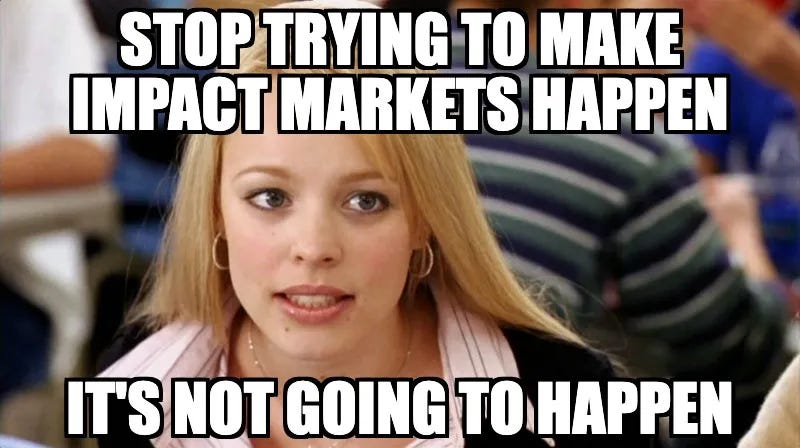
The beginning of this post and the image made me think this was going to say that impact markets won’t work and are dead. Yet later on you say “ Impact markets continue to be the best system we know of to coordinate philanthropy at scale” and discuss plans to continue/revive the efforts towards impact markets. Perhaps this could be retitled/respun, as a quick reader might get the wrong impression here.
Thanks. I think my writing here is intended to reflect both a felt pessimism (or lack of excitement, anyways) among people I know; and also our own optimism despite that; but also our current (eg 1mo roadmap) is not "full steam ahead on impact markets".
Maybe it should be more like "where are impact markets going"? To me "what happened to impact markets" made it sound like these are defunct and abandoned.
At a conference on post-AGI futures earlier this year, I proposed a session titled “What’s next for impact markets?” The conference speakers included the godfather of impact markets Paul Christiano himself, and noted supporters like Scott Alexander, Oli Habryka, and Andrew Critch — so I was hopeful that there would be some interest.
…
Zero people signed up for my session.
Before everyone writes these off as some EA fad of the early 2020s, or a pie-in-the-sky dream requiring impossible levels of funder buy-in: I’d like to give my account of what we’ve learned about impact markets, and where we can go next.
A brief oral history of Manifund
Our 501c3 entity “Manifold for Charity Inc.” was originally started with a narrow thesis: it’d be good to let Manifold prediction market traders donate winnings to a charity of their choice. See our original grant proposal to the FTX Future Fund, which they approved with a $500k grant around April 2022. But at the time, this was just a side project of Manifold.
Manifund proper was made with the explicit mandate of “make impact markets happen”. Scott Alexander was interested in trying out new mechanisms for funding projects, after the inaugural ACX Grants. I think he hated picking specific projects as winners himself, and wanted to absolve himself of this responsibility. (I’m pretty sympathetic to this btw.)
Scott and I were entranced by “impact markets” — Paul Christiano and Vitalik Buterin’s proposals for using retroactive funding and market-like equity mechanisms in nonprofit projects. Scott came up with the idea of an ACX “minigrants” round as an impact market, using forecasting as the specific subcategory that he and maybe Manifold had the ability to serve as retro funders for.
I convinced my then-girlfriend Rachel Weinberg to code up the v0 site with me, which we shipped in less than two weeks. (Trust me, this was impressive in the before-LLM-days.) Our idea was to operate like a scrappy tech startup; prove out the value of impact markets via small demonstrations; and have the best platform for hosting impact market rounds.
But after the initial launch and initial speculative funding round, we had nothing else to do for 6 months — while the grantees were working, before the all the projects were evaluated. It was then that Leopold Aschenbrenner, fresh off of FTX Future Fund, asked whether we would be interested in organizing FF-style regranting. He thought (and we agreed) that regranting was the best thing that Future Fund had invented. Mid 2023, he put us in touch with an aligned donor, and we were off to the races. With regranting, but also, with a more general-purpose “open call”, for any kind of grant application made in public — the Manifund that you see today.
In the years since, we’ve been busy with regranting, our general funding platform, and supporting a variety of grant programs — not to mention a festival series, community space, and software incubator. But impact markets remain part of Manifund’s founding motivation.
Wait, so, what do you think about impact markets now?
Impact markets continue to be the best system we know of to coordinate philanthropy at scale. Markets can solve allocation problems that central planning can’t. In tech, markets have scaled to coordinate trillions of $ and tens of thousands of people; we want AI safety to do the same. As AI money floods philanthropy, now is the perfect time to revisit impact markets.
However, Manifund’s original thesis of “small scale tests to prove out impact markets” didn’t pan out. At small scales, the whole endeavor isn’t really worth the complication. Angel-investor-like brainpower is scarce; coordination overhead is expensive. (I am optimistic that this could be somewhat mitigated today, since LLMs lowering the cost to price weird assets)
A lot of the benefits of “impact markets” can be realized just by encouraging charitable founders to create C-Corps (or PBCs), which can take “investment” from nonprofit funders like AISTOF, or “revenue” from nonprofit buyers scoping out a prize or purchase commitment, like cG. We think this is better than defaulting to a nonprofit.
C-Corps (and PBCs) offer case law and established norms for handling questions of compensation and allocation. Why futz around with impact markets if you can just start C-Corps?
However, we’re currently in an ecosystem where much great AI safety work is done inside of 501c3 nonprofits like METR, Resolution, MATS, Lightcone. (And, ourselves, I hope.) So, to be backwards-compatible, we’re starting with concrete demonstrations of impact markets, to explain the concept to others and ourselves.
If we can build trustworthy demonstrations via fake dollars, we expect to be able to convince donors that our calculations for “what is impactful” are better than anyone else’s. Call this the “early Givewell” approach towards impact markets: make lots of spreadsheets (ourselves, or with Claude); publish our work.
Unlike early Givewell, the initial focus of our analysis might be intermediate funds rather than final charities. Which is to say, we might be better placed to say “should you donate to AISTOF vs Longview vs Lightcone Commons vs cG vs Macroscopic”, rather than “MATS vs Tarbell vs FAR”. (This rhymes with GWWC’s agenda of “evaluating the evaluators”, though we don’t think they’re doing much of this for AI safety). Our AI safety funder bulletin is an early example of this; Trace is another.
Probably, the final retro buyer of impact will be God. And/or, the aligned future ASI.
In the short term, Manifund plans to continue improving philanthropy at the margins, eg by supporting regrantors and scaling up our core platform. But my ultimate goal for Manifund remains: to wholly align our society’s financial systems towards “doing good”. If you’d like to help, we’re hiring!
TL;DR
* GOAL 3 is a social enterprise that created IMPALA, a patient monitoring and digital platform system for low-resource settings. There is also a GOAL 3 foundation that raises funds to ensure underserved communities will be reached.
* A recently completed report from Rethink Priorities calculated IMPALA to have a cost per DALY averted of $7–17 in paediatr...
This month effective altruism has gotten lots of attention, including a cover story in The Economist. It feels pretty surreal to be on the receiving end of it. But I feel grateful these ideas have caught on, and even more grateful for the drive, earnestness, and compassion of so many people who took strange but well-argued ideas seriously and then actually acted on them....
Impressions from the 21st Annual U.S. Cluster Headache Patient Conference, organized by Clusterbusters.
On the morning of the last day of the conference, E. was hanging out with other “clusterheads” outside the conference hotel when he started having a cluster headache attack. Before he could go back to his hotel room, J. offered E. his DMT v...


I kind of like the idea, but I must confess still don't entirely understand how an impact market would work exactly? Lets say someone independently assessed we at OneDay Health at achieving the equivalent of 1 life saved for every 2,500 patients that we treat. How would an impact market work from there?