Comments
Good luck with your next chapter, Magnus. Your work at CRS completely changed my career/life trajectory. Thank you for all that you do.
Good luck with your next chapter, Magnus. Your work at CRS completely changed my career/life trajectory. Thank you for all that you do.
Sounds fun! Is CRS funding your independent research for now? Any idea who will/might fund you for this kind of work, otherwise?
Thank you, Jim. CRS has provided funding for this month out, and beyond that I'm planning to mostly rely on savings.

I have recently decided to leave the Center for Reducing Suffering (CRS) to pursue independent research on the possible implications of UAP and quiet expansionist hypotheses[1] for reducing suffering.
I have some history of writing about these topics (e.g. this essay collection), so this decision amounts to stepping more fully in that direction rather than keeping it perpetually in the background.[2]
I co-founded CRS with Tobias Baumann in 2020, and I greatly appreciate all the support I have received from donors and colleagues while working there. Below, I will briefly explain why I have decided to make this shift.
Two of the main reasons I prioritize these topics are theory and evidence. When it comes to theory, it seems that people tend to dismiss the possibility of quiet alien expansion based on very strong theoretical assumptions, but I don’t think those assumptions are nearly as solid as people generally assume.[3] In fact, most of the essays I’ve written about this topic (e.g. From AI to distant probes, Silent cosmic rulers, and The cooperative silence hypothesis) argue against the typical theoretical assumptions that supposedly rule out quiet expansion or nearby alien technology. (See also Robin Hanson’s On UFOs-As-Aliens Priors and Aliens Are Not Crazy Unlikely.)
Beyond theory, there is the UAP/UFO evidence, some of which I’ve collected in this post. Despite my strong initial skepticism, I think this evidence is much more notable than one would expect if one hasn’t looked into it. I encourage readers to look into this evidence if they want to better understand this topic, or if they want to better understand my decision.
Another reason for my decision is my sense that I’ve found meaningful insights when I’ve worked on these topics in the past, which suggests that investing further in this area may be fruitful. For example, considerations like those alluded to above arguably reduce the scale of our expected impact and give us reason to focus somewhat more on preventing local s-risks and moral catastrophes, and I think these considerations are worth exploring further. Immense suffering is at stake if we misjudge our situation and misallocate our efforts.[4]
Finally, the area seems highly neglected; it seems like virtually nobody is working on these topics from an altruistic perspective.
Given my decision to work on this, I think doing this research outside CRS is a win-win for my research and CRS.
In terms of how it benefits my research, I believe I can work more freely and independently on these topics if I can explore them without worrying about, for example, how my work will reflect on CRS and those who work there. One can see this as a risky research bet, and I think it’s fair that I take this risk chiefly on my own behalf.[5] I would not be comfortable with taking this risk on behalf of CRS, and it would weigh on me if I did.
In terms of how it benefits CRS, I believe my departure reduces the reputational risks associated with UAP-related work, along with the broader set of risks associated with such work. I worry that a strong association with UAP could negatively affect CRS.
I’m pleased to say that my co-founder and I agree that this is the best solution given my decision to work on these topics, and I want to sincerely thank Tobias for his support in my decision. I also want to emphasize that this has been my own decision and there has been no pressure from Tobias for me to leave, only support.
CRS will continue to fund research, publish essays, and run courses and internships. Hopefully, CRS will also be able to hire one or more researchers who can contribute to the mission of reducing suffering, with work in AI governance being a strong area of interest. If you think you might be a good fit for such a role, you can register your interest here.
Once again, I want to thank my colleagues and the CRS donors for all their support over the years, and I wish CRS all the best going forward.
Quiet expansionist hypotheses involve advanced civilizations expanding in ways that are not clearly visible on a cosmic scale.
This is not a topic I am personally eager to focus on, and I feel real reluctance about doing so given the social and reputational costs. But the potential implications for reducing suffering seem to me too large to ignore.
Just as we can underestimate the scope of our influence, we can also overestimate it, and thereby fail to prevent suffering that we could have prevented with a more accurate assessment of our influence.
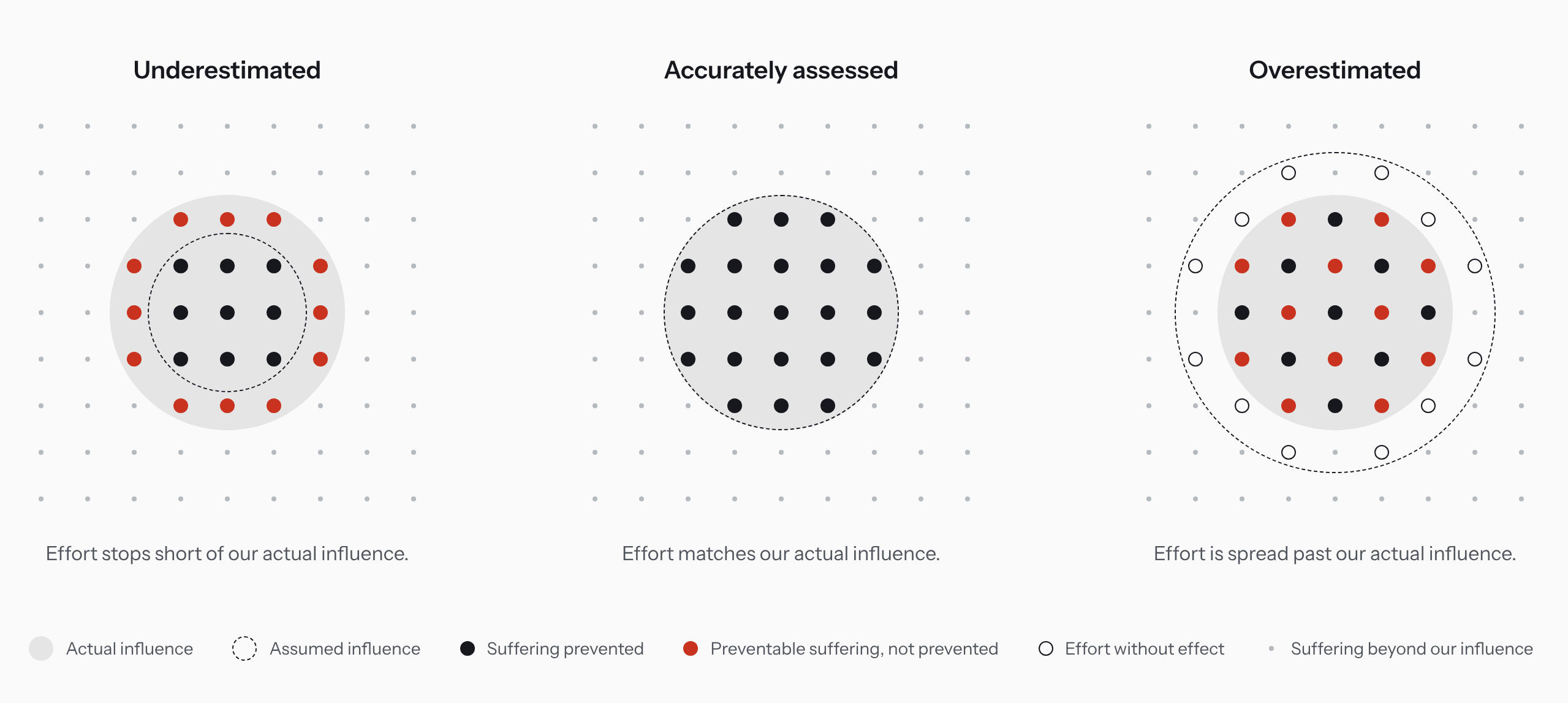
Some have argued for a leverage penalty against hypotheses that imply we have extremely outsized influence over the future, and quiet expansionist hypotheses provide yet another concrete way in which this leverage penalty could be vindicated (in addition to how it might be supported by the simulation hypothesis and by the common-sense idea that large futures will be shaped by many agents).
Concretely, this means giving up a stable salary and funding the work mostly from my own savings, at least for now.

Thanks for all your work Magnus, and wishing you the best beyond CRS.