Note: This post was crossposted from the Coefficient Giving Farm Animal Welfare Research Newsletter by the Forum team, with the author's permission. The author may not see or respond to comments on this post.
Subtitle: On vegan advocacy, effective altruism, and FIFA
I turn 40 today. Here are some hot takes.
On factory farming
1. Our biggest challenge is salience. If factory farming led the evening news, it wouldn’t last lo...
On October 22nd starting at 10:00am Pacific Time, Every.org is matching donations to select animal welfare organizations at a 2:1 rate, up to $2,000 per donor per nonprofit (so if you give up to $2,000, they will contribute up to $4,000 and the nonprofit will get up to $6,000). The first donation a donor makes to each eligible nonprofit will be matched, and donors can get the match for multiple $2,000 donations. So, you can get more than $2,000 matched by donating $2,000 one time to multiple...
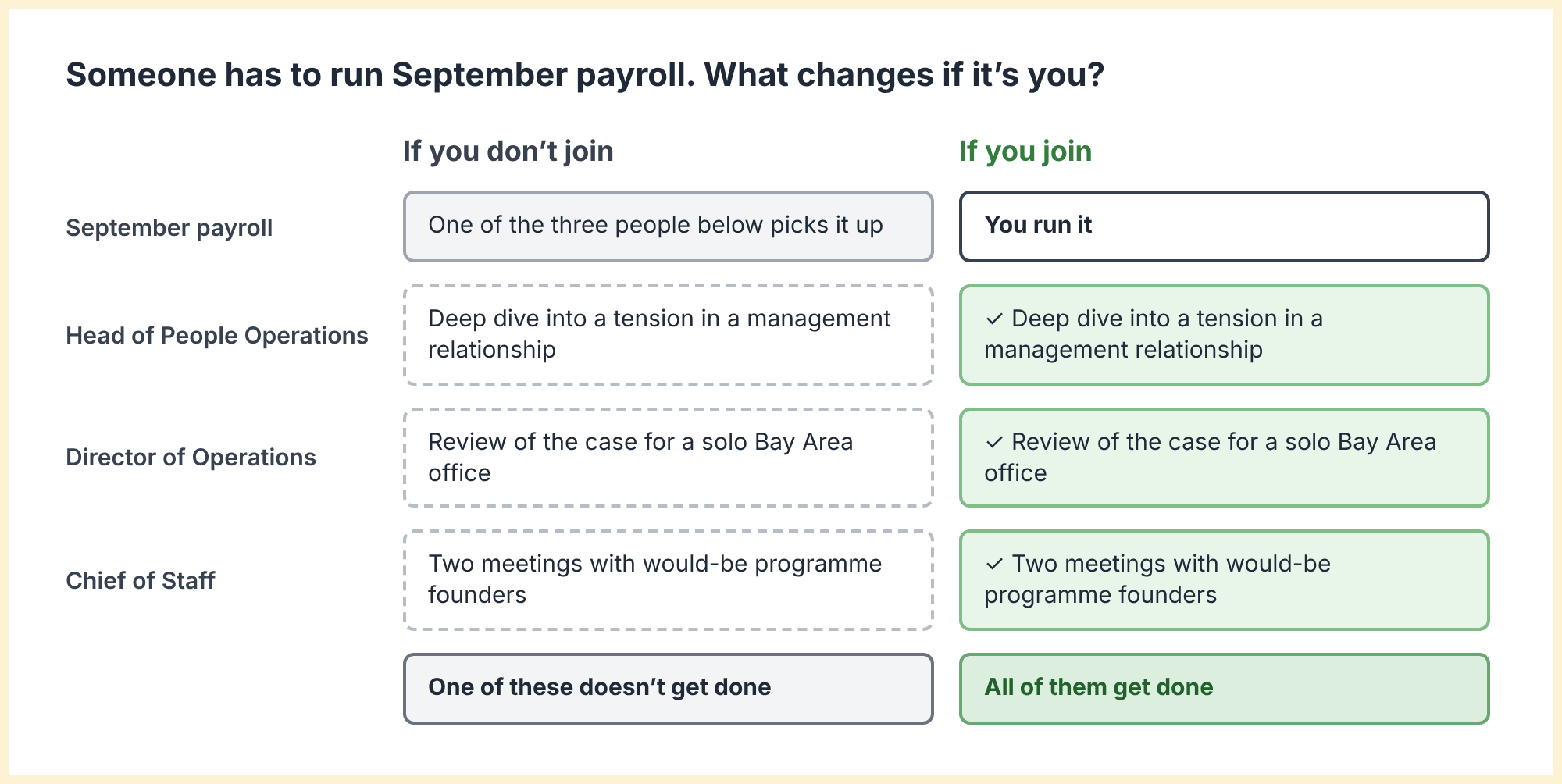
When speaking to candidates who are considering working with us at 80,000 Hours, I often hear people worry about replaceability.
The familiar version of the worry is about whether the organisation will hire someone else in your place. If it will, then the difference you make by taking the job is only the difference between you and them.
There are a couple of well-known answers to that. The person hired in your place probably cares about the world too, and would go on to do somethi...
In addition to retirement planning, if you're down with transhumanism, consider attempting to maximize your lifespan so you can personally enjoy the fruits of x-risk reduction (and get your selfish & altruistic selves on the same page). Here's a list of tips.
With regard to early retirement, an important question is how you'd spend your time if you were to retire early. I recently argued that more EAs should be working at relaxed jobs or saving up funds in order to work on "projects", to solve problems that are neither dollar-shaped nor career-shaped (note: this may be a self-serving argument since this is an idea that appeals to me personally).
I can't speak for other people, but I've been philosophically EA for something like 10 years now. I started from a position of extreme self-sacrifice and have basically been updating continuously away from that for the past 10 years. A handwavey argument for this: If we expect impact to have a Pareto distribution, a big concern should be maximizing the probability that you're able to have a 100x or more impact relative to baseline. In order to have that kind of impact, you will want to learn a way to operate at peak performance, probably for extended periods of time. Peak performance looks different for different people, but I'm skeptical of any lifestyle that feels like it's grinding you down rather than building you up. (This book has some interesting ideas.)
In principle, I don't think there needs to be a big tradeoff between selfish and altruistic motives. Selfishly, it's nice to have a purpose that gives your life meaning, and EA does that much better than anything else I've found. Altruistically, being miserable is not great for productivity.
One form of self-sacrifice I do endorse is severely limiting "superstimuli" like video games, dessert, etc. I find that after allowing my "hedonic treadmill" to adjust for a few weeks, this doesn't actually represent much of a sacrifice. Here are some thoughts on getting this to work.