Thanks for engaging, James! I agree with all these limitations: we flagged several of them from the start and have mentioned others elsewhere. The only points I'll add are:
The uncertainties cut in different directions. For instance, correcting for the "understudied species" problem would give us higher welfare range estimates for some animals, like fish and flies, whereas correcting for the "scalar not binary traits" problem would give us lower estimates. It's an open question how those corrections would net out. But almost certainly not at the precise numbers we gave! (That's one of many reasons why I've never taken the precise numbers all that seriously.)
One of many comms failures associated with the Moral Weight Project is that we didn't do enough to stress the background considerations that led us to set up the MWP the way we did. The models are toy models; no one should trust them on their own. They make sense, insofar as they do, in the context of (a) more general arguments for thinking that, given hedonism, we're likely to end up with small differences between species, and (b) a particular view about how best to navigate the uncertainties associated with making these estimates in the first place (basically, defaulting to an approach that minimizes differences we can't justify, which we discuss both in the original post and in the book). If you think that, conditional on hedonism, nonhuman animals probably aren't that different from human animals and that we shouldn't give our priors that much weight, so the burden of proof is on any postulated differences, then I think what we did makes some sense.
I agree: low confidence is the right orientation. That being said, we should have low confidence in the alternatives! We're all fumbling in the dark here. My hope is just that we can, as a community, do better over time.
Ties in with the more meta-level fact that numbers are used a lot in EA/rationalist spaces, even when there are kinds of uncertainty that don't go along with them.
I'm sure people have written about this many times but don't know who to cite.
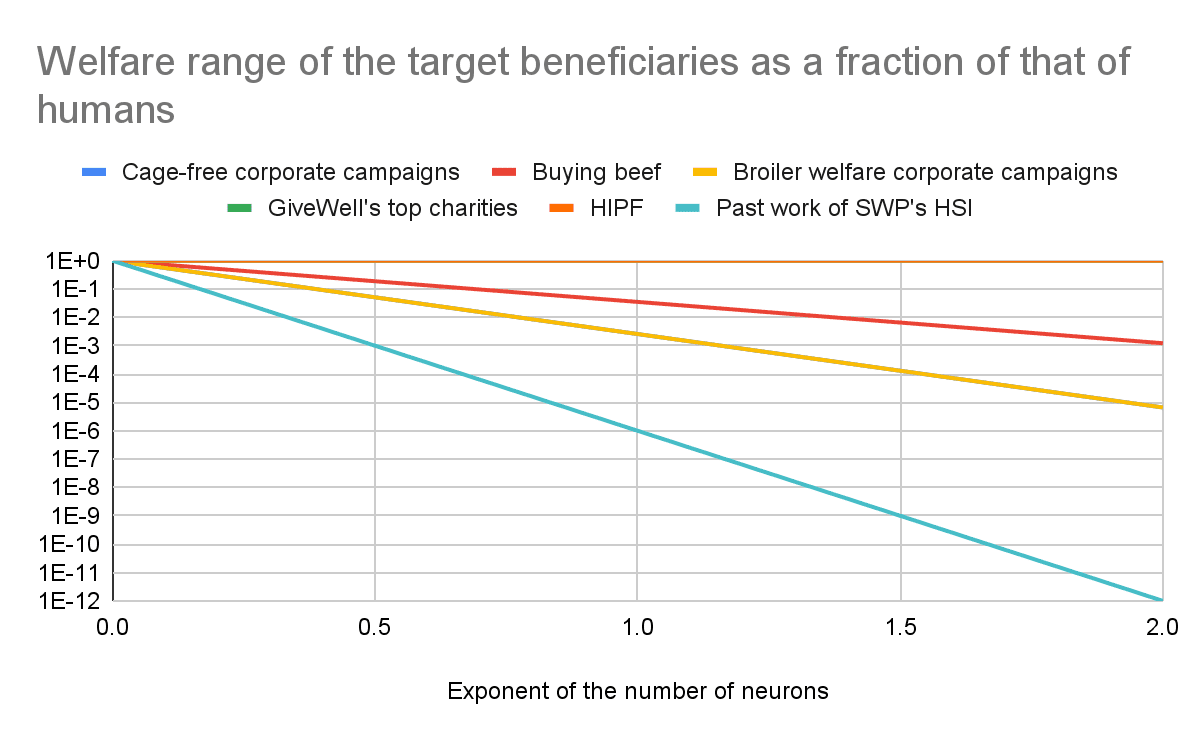
I agree there is huge uncertainty in the sentience-adjusted welfare rangesRethink Priorities (RP) initially presented, and the similar ones in Bob Fischer's related book. Below are the sentience-adjusted welfare ranges proportional to "individual number of neurons"^"exponent", and "exponent" from 0 to 2, which covers the best guesses that I consider reasonable.
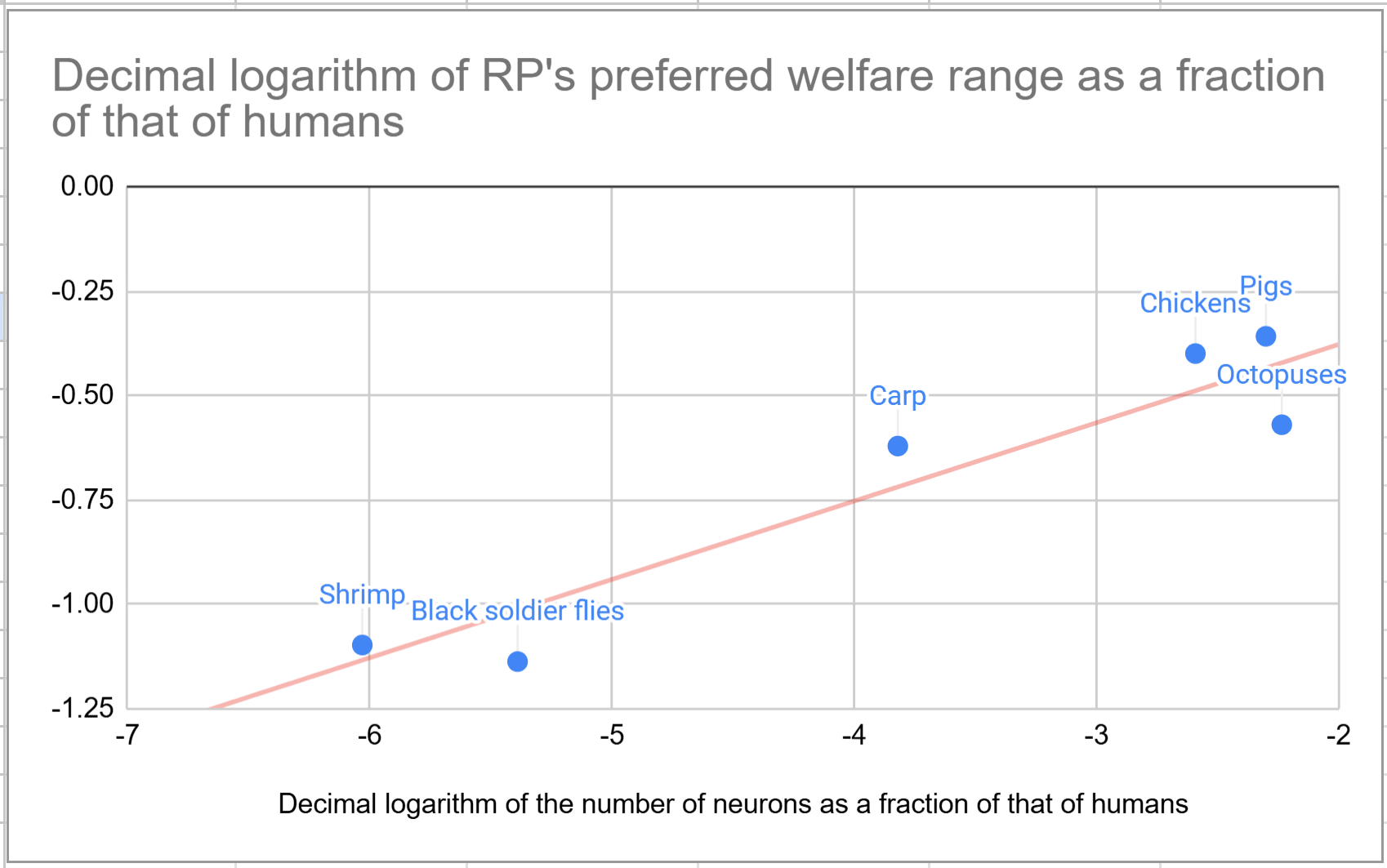
An exponent of 0.188 explains pretty well the sentience-adjusted welfare ranges in Bob’s book, as illustrated below. Here is some context about why sentience-adjusted welfare ranges might be a power law of the individual number of neurons.
Oh, wow, that's really interesting that you found that correlation.
One explanation of this correlation could be that the additive model focuses on the presence of different cognitive capacities, and animals may need higher neuron counts to have more cognitive capacities.
This would then center your worldview on how significant you think cognitive capacities are in determining welfare ranges.
Reasons To Be Skeptical Of Rethink Priorities's Moral Weights Project
In Rethink Priorities' (2021-2022) Moral Weights Project, they attempted to compare the welfare ranges of different farmed animals (which basically means comparing how many suffering shrimp are equal to one suffering chicken.) This project is the most comprehensive attempt at doing inter-species welfare comparisons to date, and it makes a very valuable contribution to the field.
That said, I think that many EAs have excessive confidence in these welfare ranges.[1] As such, in this post, I'm going to explain the project's basic methodology and some reasons to be skeptical of it.
Note: I am not a biologist. Others have written about this before, but I thought I would make this post since I've been thinking about the topic, and I think this view is worth re-iterating.
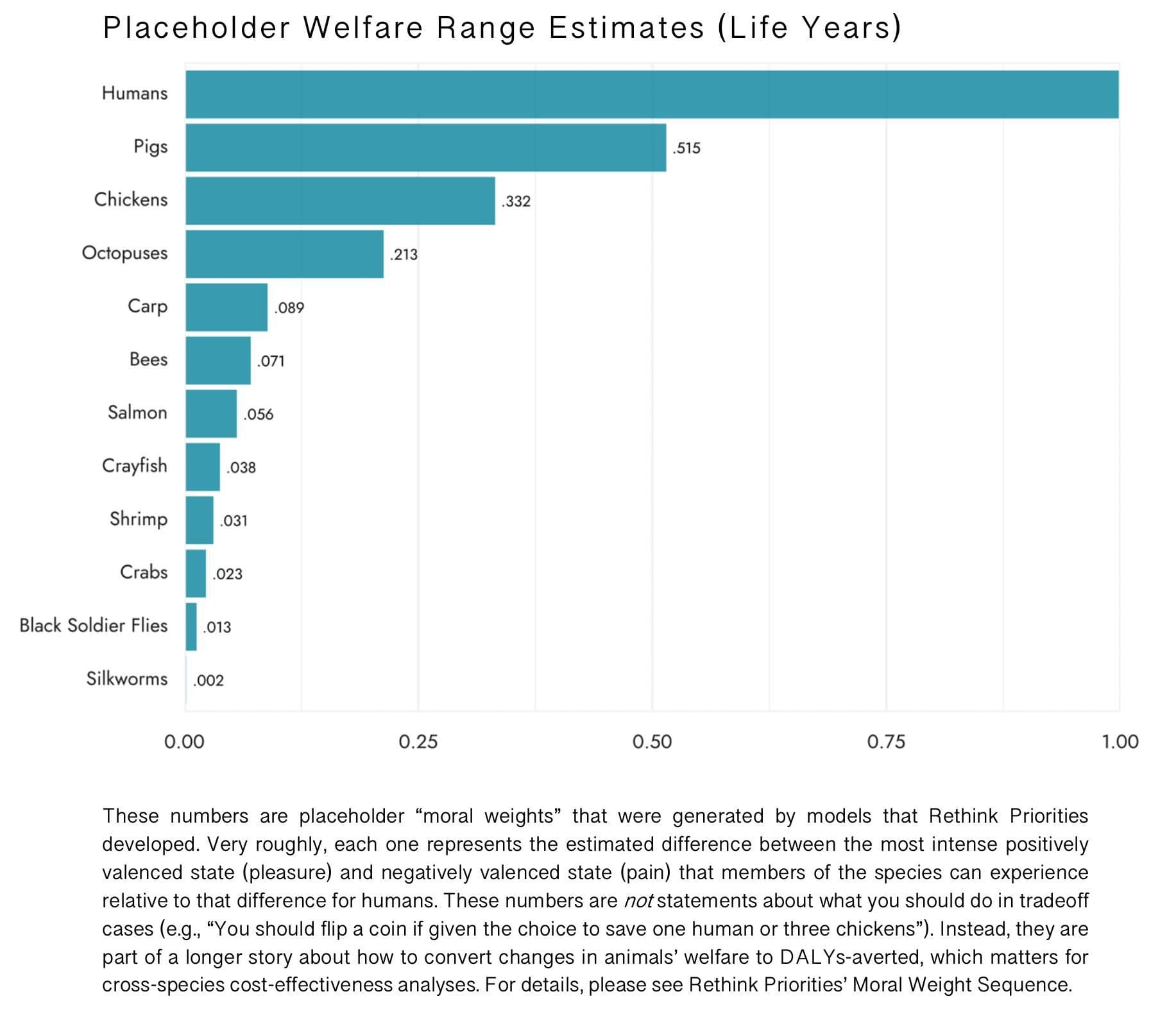
Welfare Range Estimates Chart
For reference, this chart is the welfare ranges being discussed:
The Basic Methodology
To create these moral weights, they calculated welfare ranges using three models:
The Equality Model
According to this model, all species have equal welfare ranges. (So, a chicken and a pig's most intense experiences would be equal in intensity.)
The Neurophysiological Model
According to this model, an animal's welfare range can be determined by weighting and adding together how many neurons it has, how many “sensory-associative structure” neurons it has, and its neuronal densities.
The Simple Additive Model
According to this model, the more proxies a species has, the higher its welfare range.
To determine this, the researchers made a list of behavioral 48 proxies for having a higher welfare range.
Then, they then looked through the academic literature to decide whether or not each species "likely" does, "lean" does, "likely" does not, or "lean" does not possess each proxy. If they couldn't find relevant information, they marked it as unknown.
Then, they aggregated these models together giving each model a different weight.
And, in the end, they adjusted these aggregations based on their own subjective guesses about each species' probability of sentience.
Reasons to Be Skeptical
This model has many merits since it takes into account a wide range of information and uncertainty to create relatively simple welfare ranges. That said, I think we should have very low confidence in its output for multiple reasons:
The Simple Additive model seems very flawed.
The Simple Additive model makes up for the bulk of the estimates, but it seems very flawed for many reasons. First, the academic literature lacks information on many of these proxies for many of these species. As a result, it is unclear whether these species have low welfare ranges because they are understudied or instead because they actually lack the proxies. Second, the welfare ranges are determined by whether or not a proxy is present when many of these proxies are likely scalar. For instance, to merely take into account the fact that both shrimp and bonobos are "social" would ignore the fact that bonobos likely have far more complex social lives than shrimp. Third, if we added vastly more proxies (say 5,000 proxies rather than 48), that would probably significantly change the results since more cognitively sophisticated animals likely possess many more narrow proxies than less sophisticated animals. Fourth, virtually all of the proxies are very controversial by the author's admission. For instance, does the experience of anxiety increase an animal's welfare range? It's unclear, since, if the anxiety blocks out other emotions, then the animal's most intense experiences might still have the same level of intensity.
2. Neuron counts seem questionable.
Although neuron counts are very popular, I think Adam Shriver makes a strong case against them. Some people like neuron counts because they assume that the more neurons an animal has, the more intensely it feels, or because they think it's the best proxy we currently have. Problematically though, many neurons may only have to do with cognitive tasks (such as doing math) rather than with feeling. As such, if most neurons have nothing to do with feeling, their neuron counts may be wildly off as a proxy. Additionally, neurons vary significantly in their size, in their rate of firing, and in how many synapses they possess. As such, an identical neuron count could likely result in vastly different welfare ranges.
3. The field of inter-species welfare comparisons is extremely nascent.
This field is so early in its development that it seems like there are many points of view that have not yet been considered or fleshed out into actual welfare range estimates. As such, I would guess that, if experts in this field were surveyed, they would have widely ranging views on what welfare range estimates we should currently be using.
4. The Moral Weights Project involves a lot of subjective components.
The creators of the Moral Weights project inserted their own subjective beliefs in deciding which models to use, which proxies to use, how to weight these models, how to weight these proxies, and what probability of sentience to assign to each species. Since the field is quite nascent, it seems to me that different experts would likely have had very different subjective beliefs that would have led to very different welfare ranges.
5. Applying a logarithm or an exponential to these numbers would vastly change the these ranges.
It seems to me that one could easily argue that we should apply a logarithm or an exponential to these estimates, which would vastly change them. For instance, one might say that each additional proxy in the additive model increases one's welfare range by more than a constant amount if they think that some proxies multiply together.
Conclusion
Some argue that, despite this model's flaws, it's the best stand-in we currently have for making inter-species welfare comparisons. While this may be true, I think it's very important that we still maintain a very low confidence in the project's output.
Note: This post was crossposted from the Coefficient Giving Farm Animal Welfare Research Newsletter by the Forum team, with the author's permission. The author may not see or respond to comments on this post.
Subtitle: On vegan advocacy, effective altruism, and FIFA
I turn 40 today. Here are some hot takes.
On factory farming
1. Our biggest challenge is salience. If factory farming led the evening news, it wouldn’t last lo...
On October 22nd starting at 10:00am Pacific Time, Every.org is matching donations to select animal welfare organizations at a 2:1 rate, up to $2,000 per donor per nonprofit (so if you give up to $2,000, they will contribute up to $4,000 and the nonprofit will get up to $6,000). The first donation a donor makes to each eligible nonprofit will be matched, and donors can get the match for multiple $2,000 donations. So, you can get more than $2,000 matched by donating $2,000 one time to multiple...


Thanks for engaging, James! I agree with all these limitations: we flagged several of them from the start and have mentioned others elsewhere. The only points I'll add are:
Thanks for the thoughtful response!