A conflict of interest to flag: I'm the founder of Settled, a relationship and matchmaking company with free and paid tiers. That may create bias in what I notice and what I recommend, so weigh these recommendations accordingly. I’d love for some of you to sign up to Settled, but my aim here is to share something useful whether or not you ever do.
What this post is and isn’t
- We’re writing this because we hope it provide helpful insights - people have also asked, so here it is!
- This post is based on:
- Hundreds of hours of interviews and coaching with 350+ singles
- Data from Settled: nearly 2K completed questionnaires & hundreds of feedback forms from dates we set up
- An ongoing literature review (with help from Claude) - 70+ papers reviewed
- Our insights are observational, there's no control group and we collected all data for the purpose of setting up good dates, not research or analysis. We're including it because operational data from inside a matchmaking service is rare, not because it's complete or correct.
Some observations and learnings from building Settled
1. Dating apps are problematic; you should probably still use them
There are a variety of known problematic dynamics associated with dating apps, ie:
- Apps waste a lot of time: we’ve talked to daters who spend tens of hours per week on the apps, and end up without quality dates
- App use is associated with worse mental health: two 2026 meta-analyses (Cela & Wood 2026; Sharabi et al. 2026) find small-to-moderate associations with worse depression, anxiety, loneliness, and behavioural dysregulation. Although it's important to note that these studies are cross-sectional and compare users to non-users, which is confounded by the users being single.
- Apps can increase unhelpful dating behavior: larger choice sets make daters more rejecting (acceptance falls ~27–29% across a session, Pronk & Denissen 2020), shift them onto cheap cues like height and weight (Lenton & Francesconi 2010), and produce less-satisfying, more reversible choices (D'Angelo & Toma 2017)
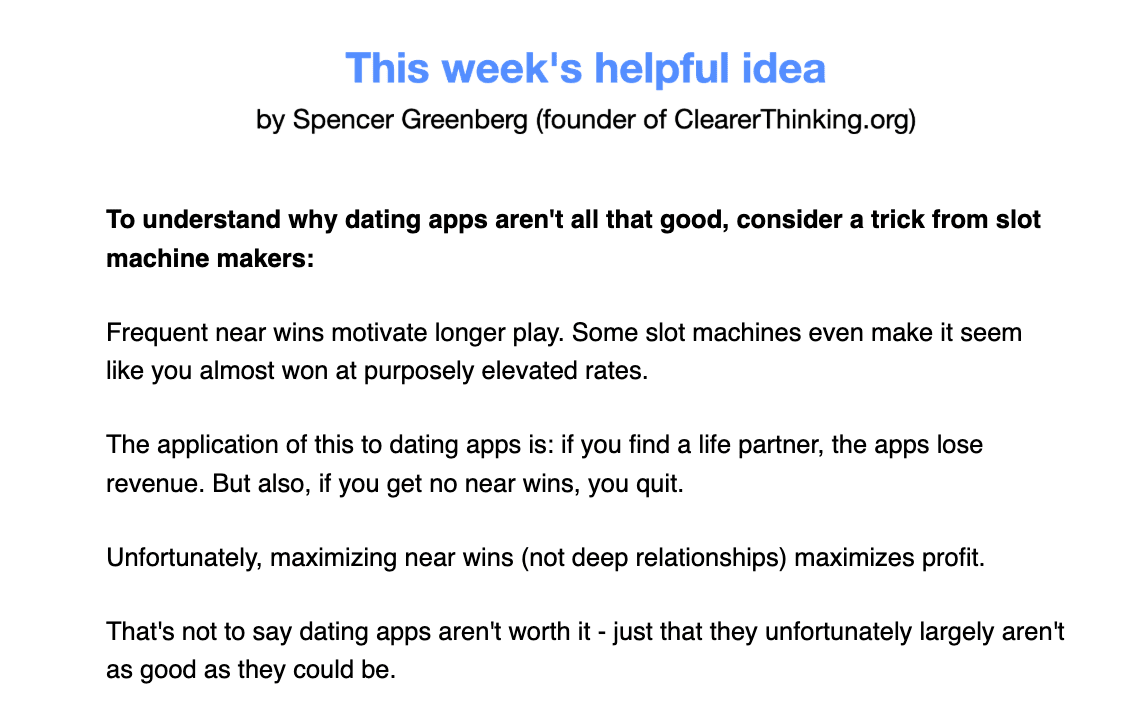
- Apps are incentivized to keep you single and on the app as noted on a recent post from Clearer Thinking:
And despite this, dating apps are still a common way that couples meet today.
A massive number of single people are on dating apps, so they're your biggest pool of potential matches. They are also good if you have broad preferences, or if a specialised app (ex. Feeld, Coffee Meets Bagel, ChristianMingle) narrows down your pool of preferences. If it does make sense for you to keep using the apps, here’s some tips:
- Use the apps alongside alternatives, ie: events, introductions through friends, communities you're in for their own sake, and matchmaking.
- Limit your use by limiting session frequency or length, and cap time when sending messages – just send it!
- Whilst Hinge and Bumble tend to have the biggest pools, some apps that are built to avoid some of the dynamics listed above, two examples we know of:
- https://breeze.social/ (also has an EA aligned founder!) but worth noting it’s not in every region
- https://www.compassmeet.com/
- Move to meeting quickly. Finkel et al. found that extended pre-meeting communication builds expectations that the actual person then has to survive. A long text rapport is not evidence of anything.
2. Just ask questions and be on time.
People overthink first dates enormously. Whether the joke landed. Whether the outfit was wrong. Whether they should have picked somewhere else. If they should have offered to pay instead of split, or criticizing why they fell short of producing the single best insight on planet earth.
We ask both people for feedback after every date we set up, including what the other person could have done differently, and here’s what it tells us:
- 54% of responses contained no improvement suggestion at all. The modal answer was some version of “no notes, they should just be themselves”
Among the responses that did suggest something, the most common themes we saw are:
- ~20% Ask more questions, show curiosity, balance the conversational airtime (often mentioned by women as their biggest complaint)
- ~11% Logistics: be on time, don’t end abruptly for because you take the date between engagements, etc
So, yeah: be yourself, ask questions, and be on time.
3. We’re bad at knowing how the first date went.
If you've ever set two friends up and then spoken to both of them afterwards, you'll know how this goes: they describe two different evenings. That's not unusual, it's the normal case. Reading a stranger accurately, while also managing your own nerves and performance, is genuinely hard.
We see this phenomena at scale: we ask both daters for feedback after every date. One question we ask is, “How interested did they seem in you?” on a 1-5 scale. Here’s how it pans out:
- Of the people who thought the other person was interested in them (rated 4-5), that person was not open to seeing them again 25% of the time.
- Of the people who thought the other person wasn't interested in them (rated 1-2), that person was open to seeing them again 73% of the time.
- Of the people who were unsure if the other person was interested in them (rated 3), that person was open to seeing them again 56% of the time.
So yeah, it’s sometimes hard to tell how the first date went.
And, we also learned that it’s hard to know how the date went even from your own perspective. When asked if they want to see the person again for a second date, 30% of daters choose our “middle” option of “"not sure yet.” Figuring out the answer to this question is one of the things we often work on together in coaching.
Our advice:
- Overthinking afterwards is usually a bad use of your evening. Distraction techniques can be helpful. We often recommend worrying techniques like Worry Time and Practical vs. Hypothetical Worries.
- When in doubt, give it some more time to develop. If you’re not sure whether to go on a second date, we always suggest giving it a go. First and second (and even third dates!) are high-pressure, usually with a limited amount of time to get to know the person, so there’s a lot of noise and not much signal. Just collect more data; old habits and thought patterns can get in the way of genuinely great matches if you quit early. We’ve seen people not be sure about whether to give it a second date and then end up married with two kids to the same person!
- Signal clearly, don’t play it cool. If you want to see someone again, say it simply and clearly. We recommend doing this after the date. It’s more about solving for confusion than a wildly romantic gesture. We’ve seen many potential relationships die because of lack of communication and both people guessing what the other thinks.
- Don’t expect it to be obvious to you how the date went. Debriefing with friends can be great, and journaling can soothe an active mind, but watch out for finding yourself in a bit of an echo chamber, and remember that people bring their own experiences, biases and frames into how they give advice, which is often very unreliable. Coaching, journaling, or talking to trusted friends can be good ways to think through this.
4. Physical attraction is just one ingredient amongst many
The topic of physical attractiveness comes up often and in many different ways in dating. We don’t want to undercut its importance: research shows that physical attraction is not a minor factor (Eastwick et al. 2014), and there are real population-level patterns in what people find attractive.
But mostly, we talk to people who care about physical attraction amongst many other things, have a rough ‘type’ that’s somewhat flexible, and are generally more worried about things like kindness, intelligence, and open mindedness. A few items we think are worth mentioning:
All of the dates we’ve set up are blind dates, meaning neither person sees a photo of the person before the date. So, there are 100s of smart, kind EAs who are happy to go on dates without seeing the other person in advance.
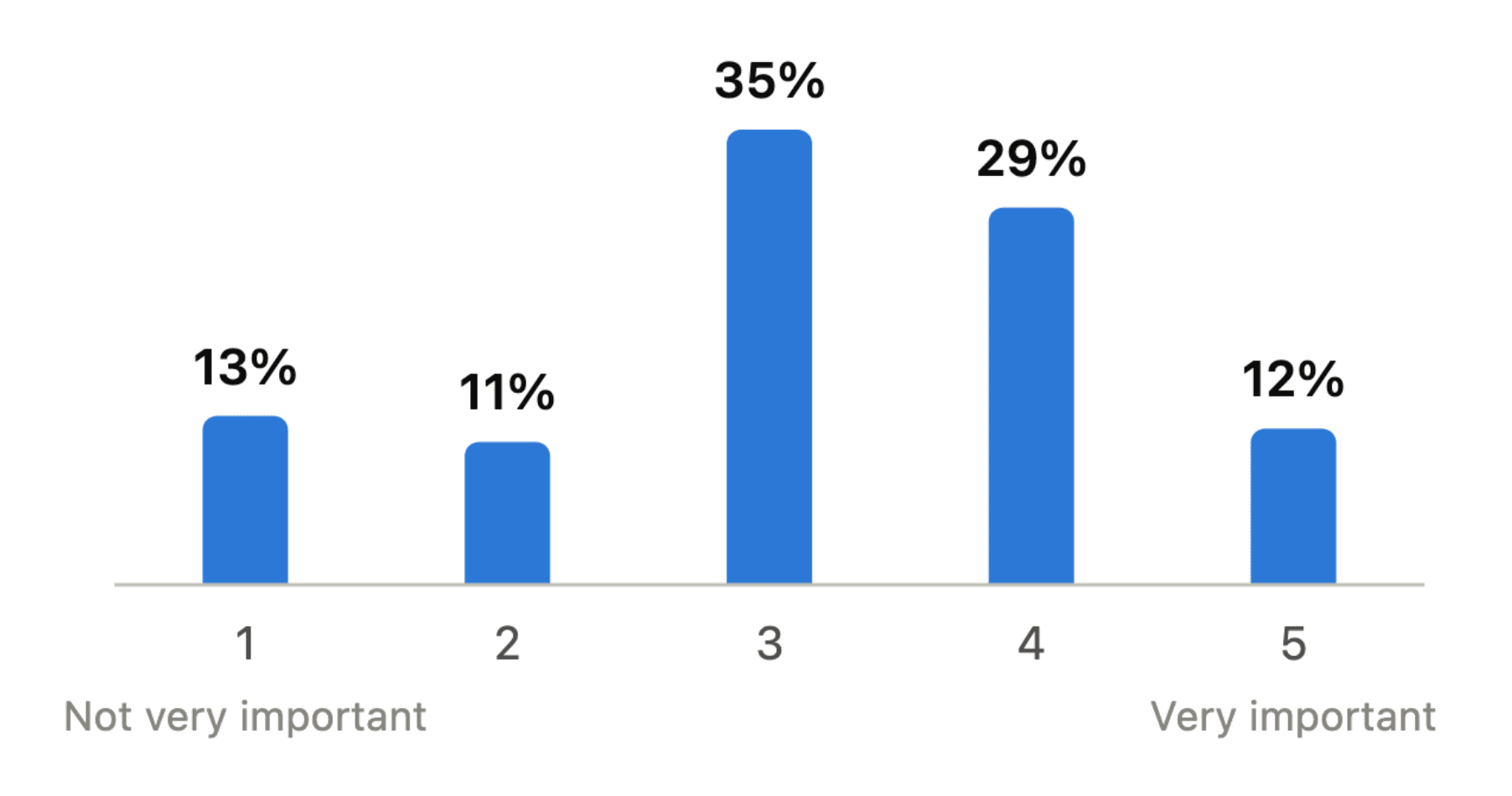
Here’s what 1K+ singles from the Settled community reported when we asked, "How important are looks when it comes to who you're attracted to?" As you can see below, 12% ranked it as very important, but also 13% say they have no type or that looks don't matter. Many say attraction builds once they know someone.
Note that this group is people who have self selected into dating via our service which does blind dates and are mostly EA/Rationalist, so we expect these numbers reflect those factors.
OkCupid “blind-date day” saw that blinding dates made almost no difference in whether people enjoyed the date.
In 2013 OkCupid ran a blind-date app, Crazy Blind Date, that paired about 10,000 people for in-person dates. Each person saw only a first name and a scrambled photo of the other. Afterwards, the app asked both people how the date went. When OkCupid matched those answers against the daters' attractiveness scores, the gap in looks between the two people made almost no difference to whether they enjoyed the date. About 75% of women and 85% of men had a good time.
Rudder's summary: people "appear to be heavily preselecting online for something that, once they sit down in person, doesn't seem important to them."
Note: this is company data reported in a book, not a peer-reviewed study.
5. Dating doesn’t have to suck.
When people tell us dating is miserable, they're usually describing a fairly specific set of things:
- Being ghosted, or having your time wasted (usually repeatedly)
- The hours spent on swiping, profiles, and texting that amount to nothing
- The uncertainty of having no idea why you're not getting first or second dates.
- And then concluding there's something badly wrong with you, losing hope, or feeling terrible about it.
Notice that most of these are not about the dates themselves. Most of the misery is in the overhead and the silence.
We think dating sucks less when a few conditions are true, and these are the conditions we try to create at Settled:
- Dates are set up for you, without all the faff
- You’re dating within a curated, screened pool of people who are intellectually curious and deeply kind
- You’re dating others with the same community affiliations (and we try to take into account sensitivities related to work in our matchmaking)
- You have someone in your court to debrief with before and after dates
- We help you break out of negative patterns, identify limiting beliefs and improve your confidence
- You get feedback on how you’re showing up and how it's being interpreted
Now, do these conditions mean that we will definitely find your person? We don't know, and per 70+ paper reviews, nobody knows.
But here’s our evidence that dating doesn’t have to suck: 85% of the time, daters say their Settled date was a good use of time. 78% said that they’re open to seeing their first date again and 72% end up in a serious relationship within 6 months.
If this resonates with you, join us
We hope this write up was helpful.
If this thinking resonated with you and interested in trying a different approach to dating, you can:
- Sign up to join Settled’s database here
- Follow us on X - we post anonymous profiles of EA singles, so you can browse for yourself or for a friend :)
- Come see us at an upcoming EAG singles events
- Reach out to me at [email protected]
A few things to know that may be unusual about how we work:
- Dates are blind dates, meaning they are set up without photos in advance
- Feedback after every date is mandatory. It’s how we improve at the individual and aggregate level.
- We have free and paid offerings
- We started in London, but have expanded across the EU and to hubs in the US including San Francisco, New York, and Washington DC - sign up to our EAG mixer NYC or Berlin
- Our database is gender balanced.
I really appreciate that someone is building something for this audience. Finding value-aligned, sharp, ambitious EA/vegan partners through mainstream apps feels close to impossible, and this deserves more attention. The critique below comes from wanting this to work.
First, the conflict-of-interest disclaimer is good practice, but the post still reads like an advert framed as a general-interest Forum post. The "observations" lead step by step to "this is what Settled offers," and the strongest numbers are about Settled's own outcomes.
I'd prefer a post that simply said: "We run an altruistic dating service, here's why we think it matters, here's how it works, here's our data." That would also be a stronger case. The real argument for a service like this isn't that dating is generally hard. It's that many people in this community work long hours on demanding problems. We don't have days to spend browsing a thousand misaligned profiles to find one person who shares our values, our diet, and an understanding of why we work the way we do. That's a compelling, EA-specific case, and the post undersells it.
Second, my first concern when I looked at Settled was incentives. The structure seems easy to exploit, deliberately or not:
a) Payment upfront. The service is paid for before outcomes are known, so the incentive is to produce something that looks like success quickly.
b) Contrast effects. If someone gets three dates and two are clearly weaker, the third will look better than it would alone. People may "settle" (the brand name doesn't help here) for someone who meets some important criteria because of the contrast, not because the match is strong. Relationships formed that way may not last.
I'm not claiming this is happening. My question is: how do you protect match quality against the pressure to show quick results and win more clients? For example, do you track relationship outcomes beyond six months? Is there internal review of match quality, or any separation between who makes the match and who gets credit for success metrics?
Third, the figures at the end (85% "good use of time," 78% open to a second date, 72% in a serious relationship within six months) carry most of the persuasive weight, but the post doesn't say how they were calculated.
72% in a serious relationship within six months is extraordinarily high for any matchmaking service. And it's a bit suspicious that this includes people who didn't meet anyone through your service but, e.g., "were more intentional about dating" afterward, which you take credit for. Answers given directly to the service you paid may skew positive.
As I said in another comment: if the claim is that the coaching helped, is that number really evidence of this? Or is it misleading marketing? It depends heavily on the survey design. People who paid may feel obliged, or may want to justify the spending by saying "this helped my future dating." Also, "intentionality in dating" is very broad. It would be worth explaining what you mean and how you measure it.
Fourth, it seems to me like your pool is still pretty small? I think it would be great to be very upfront about that. Someone I spoke to felt their matches seemed fairly random given what they'd asked for. One account is anecdotal, but it fits the arithmetic.
Fifth, I think pricing and structure don't fit the risk. The upfront cost is high for a small number of dates. A tiered system would make more sense. Three dates is too few for people whose attraction is selective. Maybe photos aren't the answer (although I completely disagree here, and think they should be attached; for many of my EA friends, looks do matter; they go to the gym, have a healthy lifestyle, and want similar things from their partner). With three dates, the odds of meeting someone you click with in person are low. Five to ten dates feels more realistic at this price, but I suspect you believe the mechanism of limited choice will work better for success — but this means, again, you're trying to gamify the system for a great result, which I suspect might not last. Also, people might want some visibility into the pool, as the dates might not work, but wouldn't it be more beneficial to just know who's single and open in the database to start with?
Sixth, I wonder how you address the problem of trusting one matchmaker's judgment. Some people have great experiences and others don't. The whole outcome rests on one person's view of who fits and why.
Seventh, I heard the London in-person mixer felt awkward because it was unstructured. A few people got lots of attention, and others risked getting very little. Was that representative? If structured events work better, that would be a useful lesson to share.
I also thought a little bit about improvements/alternative ideas on this; not sure if useful, but I asked Claude to quickly sum up my thoughts on this here:
1. Go all in on the altruistic niche, worldwide. Settle the positioning: dating for people who've made altruism central to their lives. Then grow the pool far beyond the UK. My dream would be to know about any EA or animal-impact person anywhere in the world, in my age range, who is open to dating. Right now, the only option is meeting someone at a conference. I'd never want to do that because it can feel unprofessional and can involve power imbalances.
2. A curated catalog (a "Raya for altruists"). Write rich, values-focused profiles that members approve. Then offer access in tiers, for example:
This requires less matchmaker time per person, so the price could drop significantly.
3. The Altruists dating app with clear eligibility. To join, members would either work at a nonprofit, be a pledger, donate above a set amount to high-impact charities each year, volunteer etc. Profiles would focus most of all on values — no algorithm, just filtering systems; likes on both sides = match. Members who behave badly could be removed, which would make it a trusted space with clear norms.
4. Structured online speed dating by age group. Run Zoom events grouped by age, with breakout rooms and topic-based small-group discussions so people can see how others think before choosing who to follow up with. This scales across countries and fixes the problems of unstructured mixers.
5. A tiered membership funnel. For example:
6. Tie revenue to giving. Commit a set share of revenue to effective charities, perhaps letting each member choose from a shortlist of high-impact organizations, and report the totals publicly. This would strengthen the service's identity with an altruistic audience, give members another reason to join, and answer some "is this just a business?" skepticism.
7. Publish more about the pool. This would be the most useful addition to the post, and it would build trust. For example:
People with narrow criteria could then judge for themselves whether signing up makes sense.