Comments
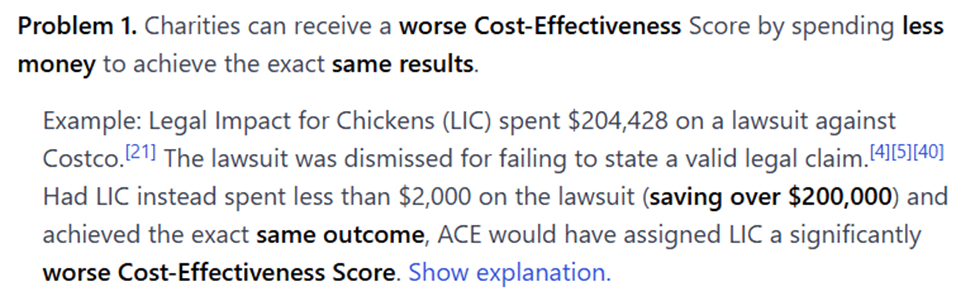
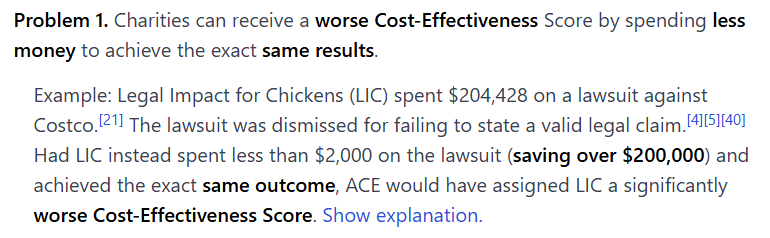
Did you ask ACE to review this before publishing? It seems like the kind of thing that would be worth getting feedback on before publishing. I didn't look at this for more than a couple minutes, but I saw immediately that there might be some conceptual disagreements between you and ACE - for example, I noticed that in your first example, you assume in your example (I believe), that if LIC didn't spend 200k on the lawsuit against Costco, they wouldn't spend it on anything else. It's unclear to me that this is the counterfactual, or how ACE is conceptualizing those funds. There might be reasoning behind their decisionmaking that would be useful to your critiques they could share.
I also felt like this felt pretty politically motivated. Not sure if that is your intention, but paragraphs like this:
ACE's recommendations determine which animal charities receive millions of dollars in donations.[1] Thus far, we have reviewed 5 of ACE's "Top 11 Animal Charities to Donate to in 2024" and only one of them (Shrimp Welfare Project) appears to be an effective charity for helping animals. ACE's poor evaluation process leads to ineffective charities receiving recommendations, and many animals are suffering as a result.
Without any evidence feels pretty intense. ACE is kind of low hanging fruit to pick on in the EA space, so this read to me like more of that, without necessarily the evidence base to back it. Reading your report, I felt kind of like "oh, there are interesting assumptions here, would be interested to learn more", and not "ACE is doing an extremely bad job."
E.g. I think the questions that would be good to ask in a critique of ACE might be:
- If ACE didn't exist, how would the funds the direct be spent otherwise? Would that be better or worse for animals?
- Is historical track record / cost-effectiveness the only lens on which to evaluate charities?
- If the answer is yes, seems very hard to start new things!
- I don't know if the LIC legal case is this, but celebrating the potential impact of promising bets that didn't pan out seems good to me.
I also think getting feedback on statements like this would be really helpful:
The correct formula for calculating cost-effectiveness is simply impact divided by cost. Rather than using this simple formula, ACE has elected to create a methodology that does not properly account for impact or cost.
I think ACE has wanted to do this at points in their history — my impression is just that it is incredibly difficult, so they've approached it from other angles instead. I also don't think it's clear to me that ACE's goal is to report cost-effectiveness. I think clarifying this with them, and getting a sense of why they don't do what you see as the simple approach would be useful for making this critique stronger. And, I don't think people should make giving decisions based only on historic cost-effectiveness - just because an opportunity was impactful doesn't mean the organization needs more funds to do that work, that it will scale, work in the future, etc.
I don't disagree that ACE might be directing funds to ineffective charities! I don't really think non-OpenPhil EA donors should give to farmed animal welfare, for example. But, I don't think it is obvious to me that ACE going away means money going to more effective charities - I expect it would mostly be worse - people giving to animal charities with basically no vetting.
That being said, critique of critical organizations is great in my opinion, so appreciate you putting this out there!
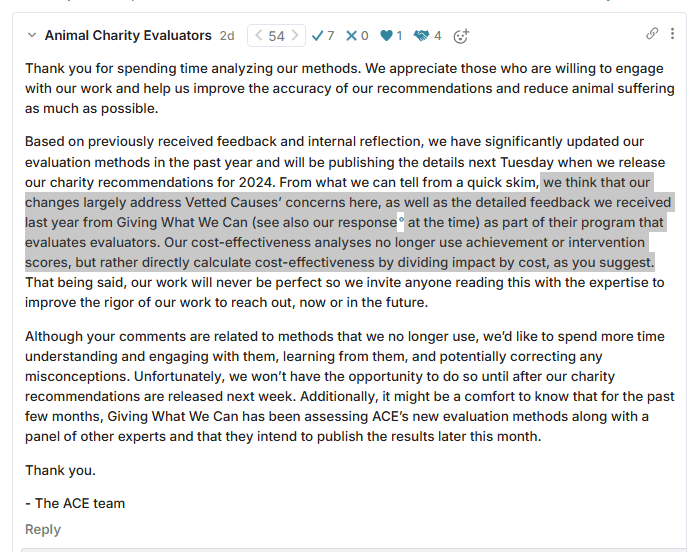

Thank you for spending time analyzing our methods. We appreciate those who are willing to engage with our work and help us improve the accuracy of our recommendations and reduce animal suffering as much as possible.
Based on previously received feedback and internal reflection, we have significantly updated our evaluation methods in the past year and will be publishing the details next Tuesday when we release our charity recommendations for 2024. From what we can tell from a quick skim, we think that our changes largely address Vetted Causes’ concerns here, as well as the detailed feedback we received last year from Giving What We Can (see also our response at the time) as part of their program that evaluates evaluators. Our cost-effectiveness analyses no longer use achievement or intervention scores, but rather directly calculate cost-effectiveness by dividing impact by cost, as you suggest. That being said, our work will never be perfect so we invite anyone reading this with the expertise to improve the rigor of our work to reach out, now or in the future.
Although your comments are related to methods that we no longer use, we’d like to spend more time understanding and engaging with them, learning from them, and potentially correcting any misconceptions. Unfortunately, we won’t have the opportunity to do so until after our charity recommendations are released next week. Additionally, it might be a comfort to know that for the past few months, Giving What We Can has been assessing ACE’s new evaluation methods along with a panel of other experts and that they intend to publish the results later this month.
Thank you.
- The ACE team
Hi,
Thank you for your response!
We are glad to hear that ACE has changed their evaluation methods, and we hope that the changes effectively address the concerns listed in our review.
We look forward to seeing ACE’s new charity recommendations when they are released next week.
Hi Isaac! Now that we’ve announced our 2024 Recommended Charities, we’ve had more time to process your feedback. Thanks again for engaging with our work.
As mentioned before, we’ve substantively updated our evaluation methods this year. This was informed in part by detailed feedback we received as part of Giving What We Can’s 2023 ‘Evaluating the Evaluators’ project, some of which aligns with your feedback.
One of these changes is that we now seek to conduct more direct cost-effectiveness analyses, rather than the 1-7 scoring method that we used last year. This more direct approach is possible in part thanks to Ambitious Impact’s recent work to allow quantification of animal suffering averted per dollar. Of course, these kinds of calculations are still extremely challenging, limited, and subject to significant uncertainties; we describe our methods and their limitations on our website. For example, while cost-effectiveness = impact divided by cost, it can be difficult to measure impact meaningfully in a way that is also quantifiable, so we rely on other criteria to help us make our assessments.
Another major change was introducing a formal Theory of Change assessment to understand the reasoning, evidence base, and limitations around each charity’s main programs. In our 2023 Evaluations, we discussed these considerations in our Recommendations Decisions meetings but did not systematically incorporate them into our public reviews. Together, we think these changes allow for a more nuanced assessment of charities’ work and (we hope) more informative and accessible reviews.
Regarding the impact of our recommendations, this year, we conducted an assessment of ACE’s programs and our counterfactual influence on funding. As part of this work, we surveyed donors to our Recommended Charity Fund (RCF) and asked them where they’d donate if ACE didn’t exist. This indicated that over 60% of our RCF donors would donate less to animal charities if ACE were not to exist, of whom around 12% would not donate to animal charities at all. We aim to publish these influenced-giving reports on November 29th. We hope this reassures you that animals are not worse off because of ACE’s charity recommendations.
In terms of your specific feedback on last year’s methodology:
Thanks again for your engagement with our evaluations. We hope you get in touch with us directly if you come across new evidence-based methods to meaningfully capture cost-effectiveness or to improve the evaluation of animal charities. We might also reach out to you via email in the coming weeks as we go through retrospectives and plan for next year’s evaluation. Because of the complexity of the animal welfare cause area, the many uncertainties and knowledge gaps in the field of charity evaluation, and the urgency and scope of suffering, we embrace productive collaboration.
Thank you.
- The ACE team
Hi,
Thank you for taking the time to read our review and for responding to each of our points. We really appreciate ACE’s willingness to engage with feedback and acknowledge problems.
Regarding your clarifications related to the calculation of Normalized Achievement Scores:
We are glad to hear that ACE was accounting for these factors behind the scenes.
Thank you for clarifying this. From the publicly available rubrics for calculating Achievement Quality Scores, it did not seem like breaking down an achievement into smaller steps would decrease the Achievement Quality Score at all. However, given that ACE was accounting for factors outside of the publicly available rubrics, it makes sense that this decrease could occur.
That being said, we believe it is important for ACE to fully disclose its methodology to the public and avoid relying on hidden evaluation criteria. This transparency would allow people from outside the organization to understand how ACE's charity evaluation metrics (i.e. Normalized Achievement Scores) were calculated.
We appreciate your openness to collaboration. Feel free to reach out to us at any time at [email protected]