I strongly recommend reading the book "Quiet: The Power of Introverts in a world that can't stop talking", by Susan Cain. It changed my whole view of introverted people, and think goes quite along with this post. =)
P.S. Planning to go to my first EA event soon. I really appreciate this set of advice you gave!
Thanks for writing this Sofia :) The "treat noise as your main enemy, not people" mindset has revolutionised the way I network (and just generally go about my day). People are not the problem, I love people — it's the sensory processing and constant, low-level cognitive effort required to sort words from noise that gets overwhelming pretty quickly. Your tip to skip the main networking sessions resonated: at EAGx Oxford I walked into one and walked right back out within a couple of minutes; I couldn't think straight!
The details don't matter so much as the key point, which is to be aware that you're an introvert and to intentionally plan.
Before knowing much about introversion, I'd been at many conferences (not EA) and always felt guilty when I would literally sneak out to have lunch at a local Subway rather than eat the delicious free food just so I could have some quiet time. Or how I would find an excuse to walk from Room 41 to room 43 via the outdoor car-park.
Also it's great that you highlight that introverts can have and enjoy fantastic conversations. I found (but I could be mis-representative here) that after a conference, I often had more actual follow-ups than most extraverts. They met 100 people, laughed, chatted, had fun, probably would meet up again and built their network, but I had maybe 5 people that would become partners on actual projects - in part because I did some of the things that you recommend like take time and prioritise and say no (which was always hard, I didn't have a good line like you had, I used to just invent other appointments that couldn't wait ...).
Hey Denis, thanks for reading! I can relate to leaving the venue, even if it means paying for food. I could have had a free dinner at the conference this time, but I still went home, as that meant I'd have had to spend an extra 2 hours at the venue while I was already tired.
Your point about talking to 5 people who you will actually collaborate with: very true! In the end, it's not really about how many meetings you had or how many people you spoke to, but what you got out of the conference that you couldn't have gotten elsewhere.
And yes, I think all this requires you knowing that you are an introvert and being attentive enough to your energy levels to actually implement all the tips that work for you.
Note: This post was crossposted from Planned Obsolescence by the Forum team, with the author's permission. The author may not see or respond to comments on this post.
Subtitle: If acceleration compounds, the naive extrapolation implies superintelligence within a year
This post discusses a public METR report on AI R&D acceler...
TL;DR:
* When we started Rethink Priorities (RP) in 2018, our mission was, simply put, to close the knowledge gaps that stopped people from improving the world as much as they could. That hasn’t changed much, but the landscape we’re doing it in is shifting.
* In 2027, we plan to grow our core GHD, Animal Welfare, and Worldview Investigations teams to take on emerging priorities across causes, including those that the forthcoming transformative AI is creating.
...
This post is part of the Rethink Priorities Cross-Cause Fund (CCF) series on how to allocate funding across causes when it is uncertain what matters most.
...
TL;DR: Treat noise as your main drain, not people. Have shorter days; book one meeting per hour. Stay within a 15-minute walk of the venue. Have scripts ready for saying no, and ignore the extrovert playbook.
You may be like me: enjoy meeting people, and love talking about EA, and still find conferences overwhelming. I'm a socially adapted introvert: 1:1s give me content ideas and some of my best meetings, but long days in loud rooms flatten me.
I've written before about how to enjoy a conference without burning out. That post covers pacing for everyone: limits, prime time, priorities, breaks. This one is for introverts and the noise-sensitive, based on what I changed at EAG New York this October, which I attended straight after a three-day retreat. It worked: my energy held through both, which rarely happens.
Disclaimer: all introverts are different, so take what works for you and leave what doesn't.
Treat noise as your main enemy, not people
For a long time, I assumed conversations were what drained me. For me, it's mostly sound. One good 1:1 in a quiet corner costs far less than ten minutes in a packed networking room. Once I separated the two, conferences got much easier. Some things that follow from this:
Skip the official networking sessions. At EAGs, these are often hosted in small rooms, which makes them extremely loud. I feel like a hypocrite writing this as I've hosted so many of them!
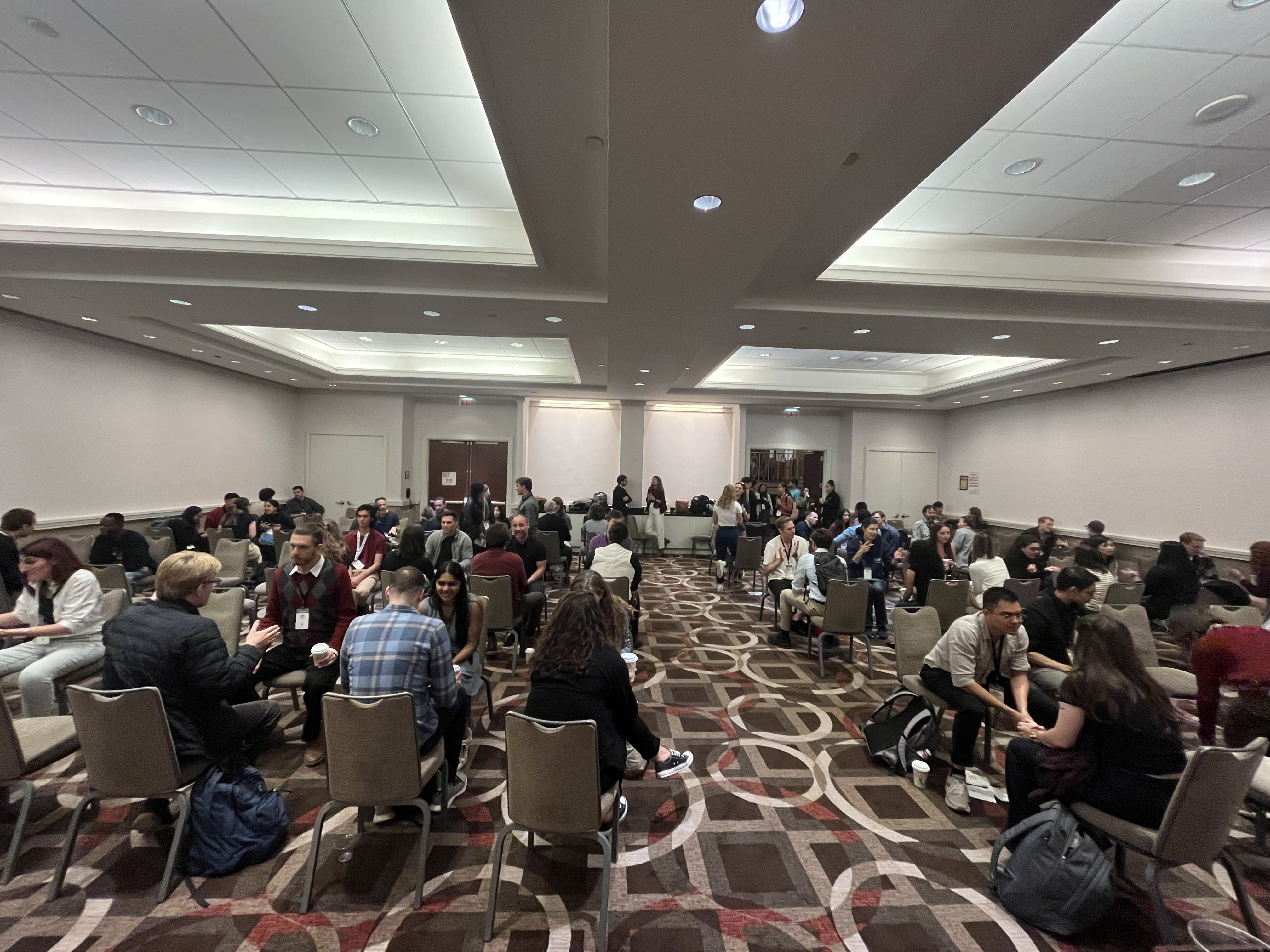
At the networking session I ran, you can imagine how loud this can get
Be wary of networking tables. They look great at first glance, but they're often the loudest rooms in the building. Grab your food and ask your companion to find a quieter spot instead. You can also grab lunch somewhere quiet by yourself in 30 minutes, then do your normal 1:1s later.
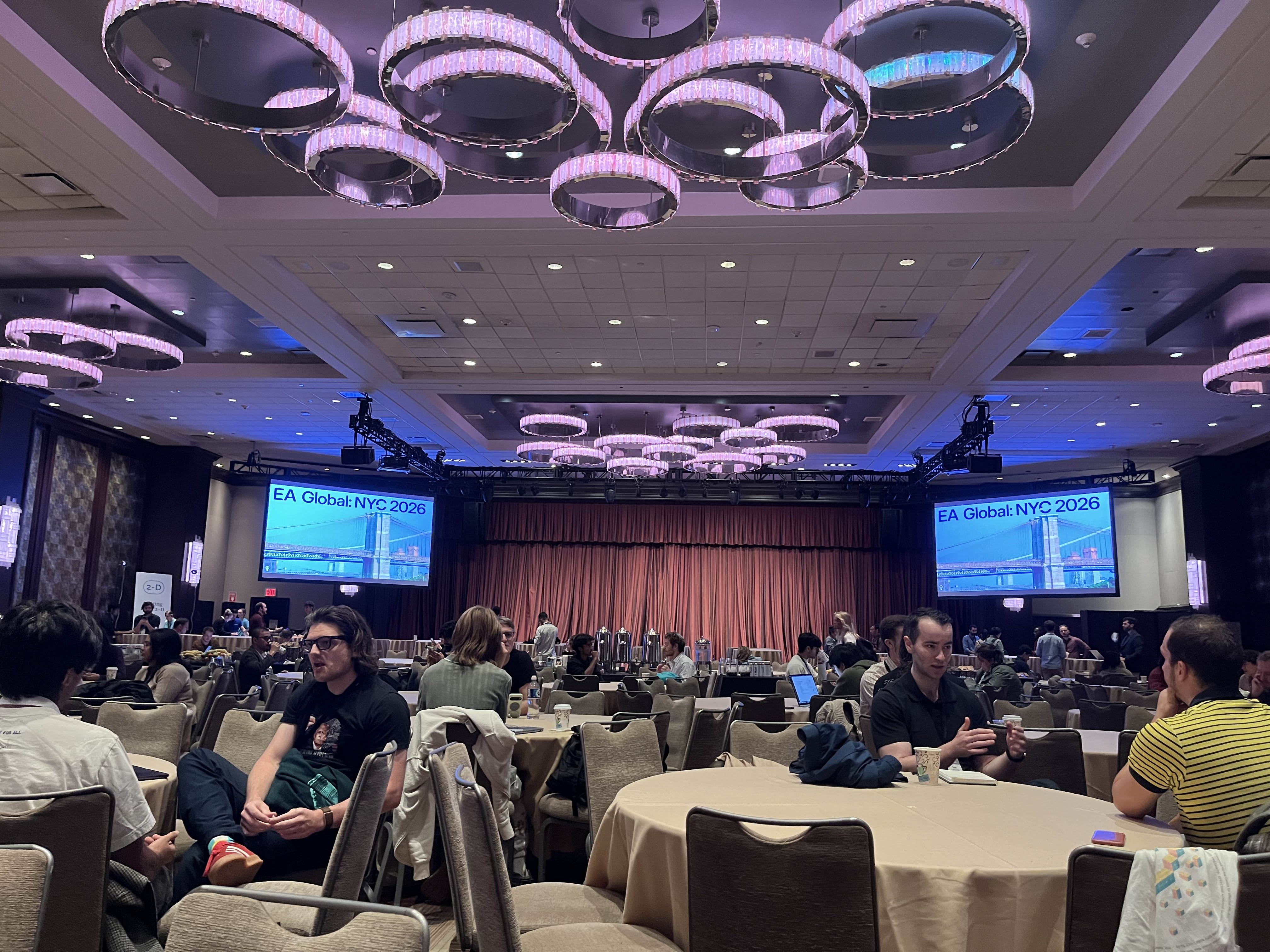
The ballrooms always have space, but I find them too loud to use
Scout the venue for nooks. Most venues have small clusters of chairs near stairwells or away from the main areas. I've found plenty, and they make 1:1s far less draining than the designated meeting points. Even a 5-minute walk to a quieter space is worth it.
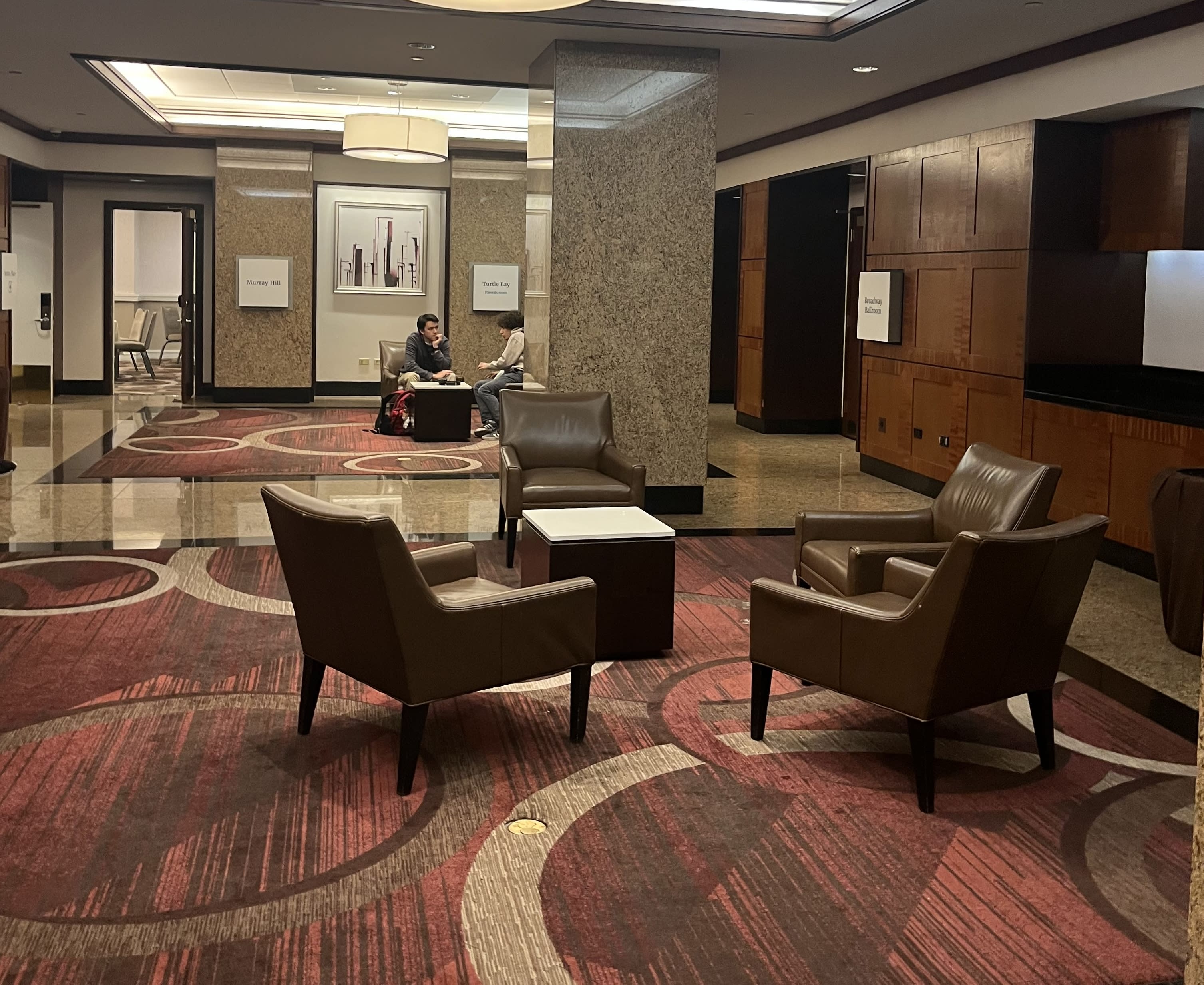
Some quiet spaces I've found at EAG NYC
Don't be afraid to relocate a meeting. "Do you mind if we grab a drink and go talk somewhere quieter?" has never been taken badly.
Bring noise-cancelling headphones. For the rooms you can't avoid, they buy you a quick reset without leaving the building.
Design your schedule around recovery, not capacity
My burnout post covers general pacing, so here I'll only add what I've changed since:
One meeting per hour. This was the single biggest improvement at my last conference. The built-in half-hour gap meant I could walk calmly between meetings, do my follow-ups straight away while they were fresh, make a drink, and not worry about being late. Rushing between meetings is its own source of stress, and this removes it.
If you're recognisable, take fewer, longer breaks. If you wear branded clothing or people know your face, short breaks don't work: you bump into too many people, and the break evaporates. A 2-hour block in the quiet room, where nobody will approach you, protects your rest far better than four 30-minute attempts.
Shorter days can be a good strategy. I used to feel guilty about leaving early. Now I know that coming for 6-8 focused hours with breaks is how I show up consistently across a multi-day conference. Six strategic meetings done well beat ten done depleted.
Stay close to the venue
If your budget allows, book accommodation within a 15-minute walk of the venue. My instinct is to always save money, so I stayed within a 20-minute subway ride (and I know plenty of people who stayed in Brooklyn and further). Another leader gave me this tip to stay within walking distance, which was more expensive than my room, but for her it was worth it. When you stay further away, you tend to arrive early, leave late, and have limited spaces to retreat to solitude in between. Being able to pop back to your room between meetings or take a longer break in bed can change the whole day and, in turn, influence how many consecutive days you can do and how you show up for work after the conference.
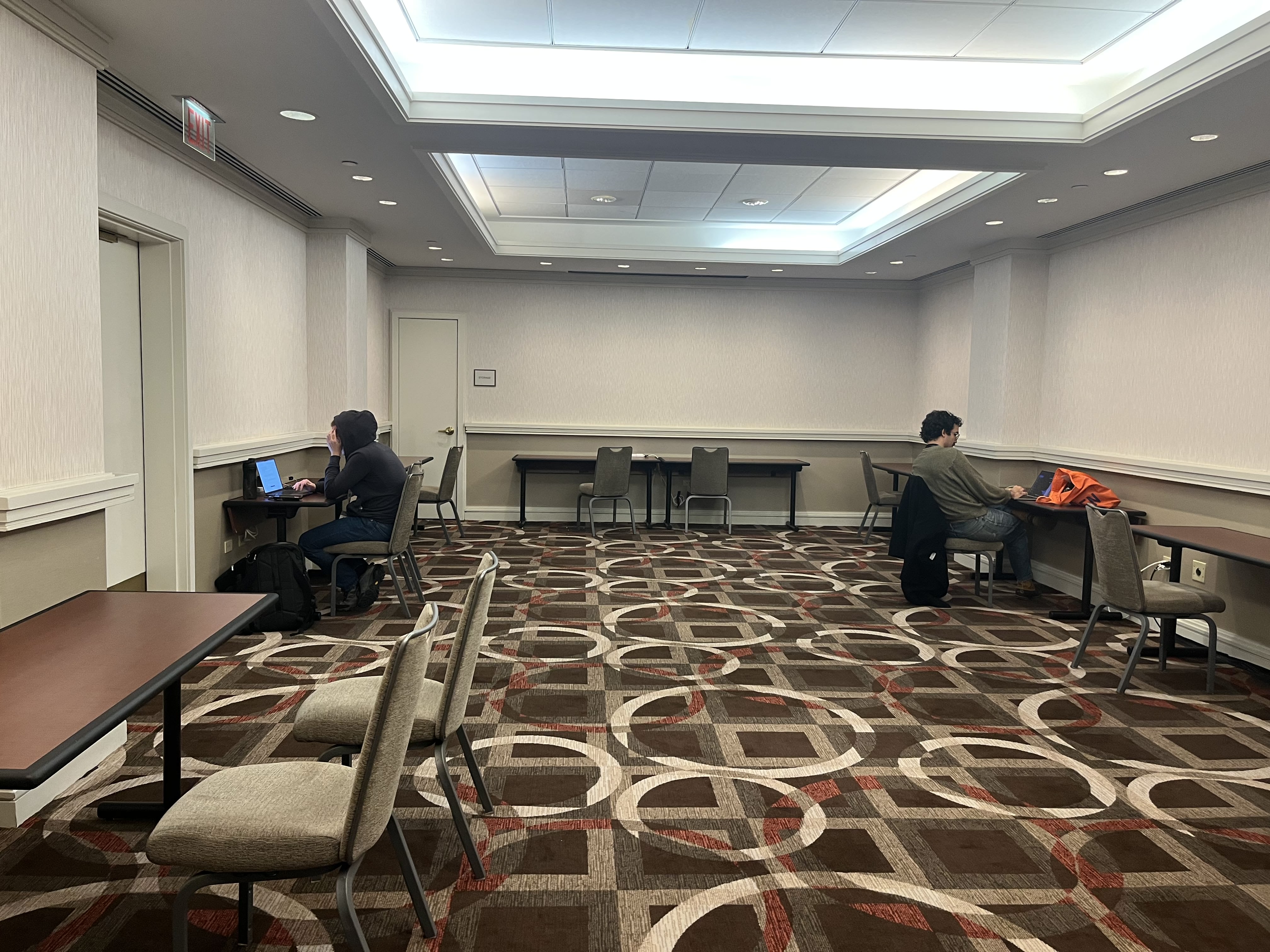
If that's out of budget, the quiet room and quiet coworking room do a lot of the same job for free. I've used both heavily, and they're the main reason my energy held up.
The quiet co-working room always had space available when I visited.
Have scripts ready for saying no
Declining is hardest in the moment, when someone has just bumped into you, and your break is slipping away. Having a few lines pre-prepared removes the decision fatigue. The ones I use:
"Lovely to see you, I'm on my way to a break; let's catch up online."
"Thanks so much for reaching out. I've unfortunately run out of slots, but please feel free to add me on Swapcard"
"I'm having lunch quietly on my own today as I'm resting my voice; let's connect later"
None of these is impolite, and online follow-ups are a legitimate alternative. Yes, some of them fall through, but that's not a reason to take more in-person meetings than you can handle. Agreeing to a meeting you don't have the energy for does neither of you any favours.
Ignore the extrovert playbook
Some people will tell you the real value is in the parties and late-night events. For some people, they are. But if the music means you can't hear anyone and have to shout to get two words in, you're paying a high energy cost for low-quality conversations. I've stopped going, and I've stopped apologising for it.
The same goes for meeting volume. Someone told me they only did six 1:1s across a whole conference, plus a few talks, and my reaction was: good for you. If you're strategic about who you meet, that can be plenty. Showing up well for six meetings beats showing up drained for twenty.
Run the conference on your terms, and don't be afraid to ask for what you need. The pressure to squeeze everything in just because you travelled there is real, but it optimises for the wrong thing. I know introverts who stopped attending conferences altogether because they found them too overwhelming. I still think attending can be impactful, and doing it in your own way can make a big difference.
Closing thought
A conference on your terms is more productive for you than a packed but stressful one. By the end of the conference, I was surprised to feel like I could keep going, and I got the follow-ups done because I had the gaps to do them in. For the general pacing advice that applies to everyone, see my earlier post on how to enjoy a conference without burning out.
If you're an introvert who's found other things that work, I'd love to hear them in the comments.
34
More posts like this
72
Conferences are great for scientific entrepreneurs


I strongly recommend reading the book "Quiet: The Power of Introverts in a world that can't stop talking", by Susan Cain. It changed my whole view of introverted people, and think goes quite along with this post. =)
P.S. Planning to go to my first EA event soon. I really appreciate this set of advice you gave!
I love this book, I actually realised I was an introvert after reading it!
Nice, glad you found it useful and enjoy your first EAG!