If the phenomena you are highlighting is that Animal Welfare gets a smaller share of funding than people would prefer, it seems very strange to 'blame' AI messaging, since AI risk also gets a smaller share of funding that the surveys suggest would be preferred. Based on your methodology, the phenomena to explain is why does global welfare get so much more.
Thanks for posting this! My thoughts on "what's going on here?":
The simplest high-level explanation is that the surveys capture 'thought leaders', which is distinct from the set of people who control the money, and these groups disagree on allocation. I guess my prior expectation would not have been that these numbers match, but perhaps I'm in the minority there?
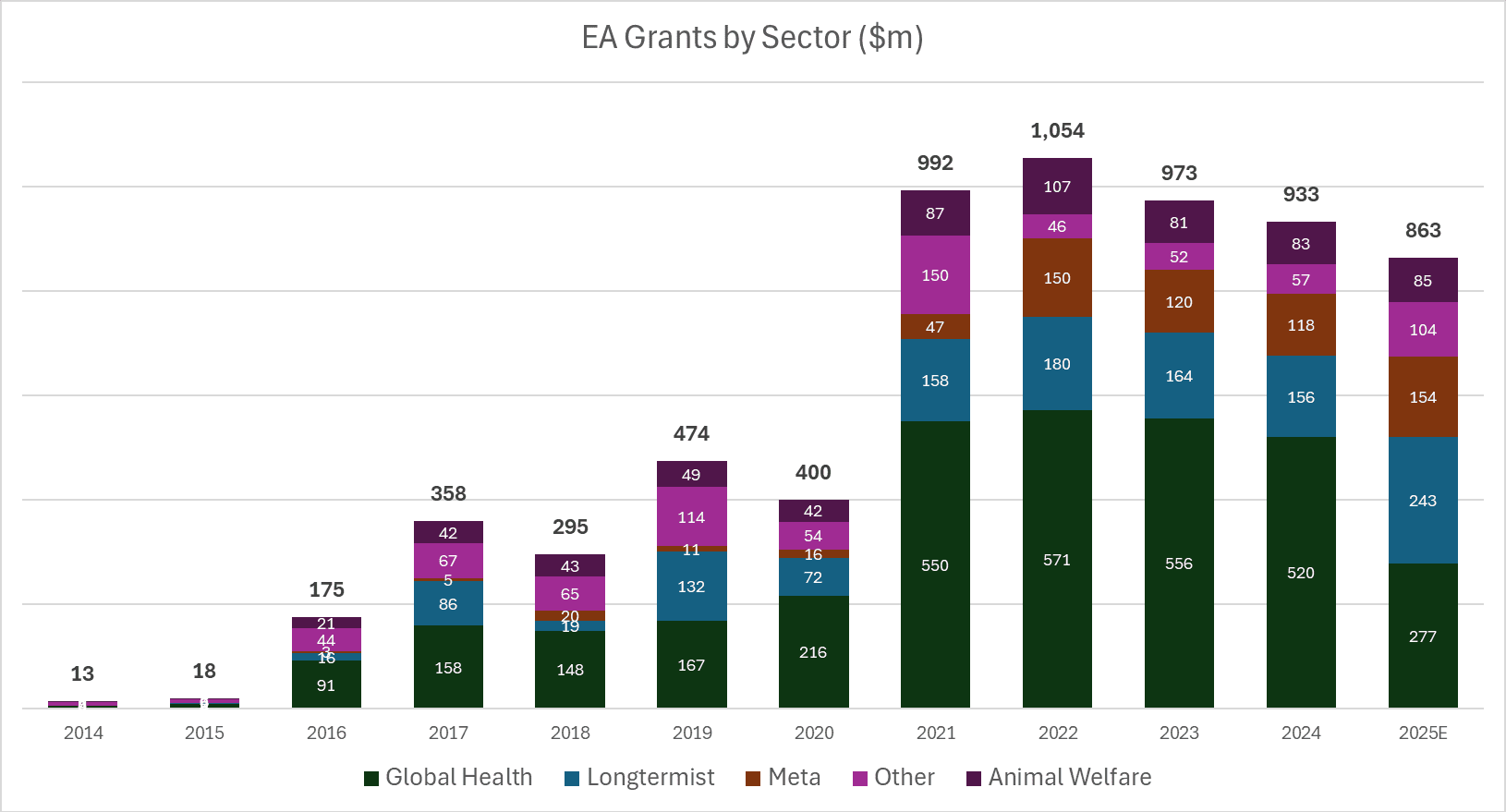
More specifically, as you mentioned, Coefficient Giving is responsible for ~2/3 of the grant dollars in this data set, so to a significant extent this reduces to comparing Dustin and Cari's preferred allocation to that of the surveyed EA population.
It's notable that Global Health is the only category to receive more funding than the survey mean (and more than double at that). Here it's both true that CG consistently gives a larger fraction, and that GiveWell top charities are the only 'EA orgs' to achieve any significant 'mainstream appeal' to date; e.g. the amount that GiveWell directs from non-CG sources per year is 3-4x the entire Animal Advocacy budget in this data set (and likely very little of that is coming from EA survey respondents).
Perhaps there is room for more EAs to shift their giving to Animal Advocacy in response to the above, and/or more optimistically to find animal-centric messaging with as much mainstream appeal as GiveWell.
Thanks for sharing your thoughts Tyler. I tend to think that 2 & 3 tends to account for funding discrepancies.
I do think at the same time there might be a discrepancy in ideal and actual allocation of talent, with so many EAs focused on working in AI safety/x-risk reduction. To be clear I think these are incredibly important and think every, but that maybe a few EAs who are on the fence should work in animal advocacy.
Hot take: the fact that we kill more animals per year than the total number of humans who've ever lived, and ~99% of them are factory farmed, I think animal agriculture is a moral atrocity that dwarfs all human problems (including throughout history).
That 12 people agreed with such a clearly false statement concerns me on what is usually a pretty rational forum. If we include sea fishing plus (maybe) all the insects we kill through spraying, not even close to 99 percent of animals we kill are factory farmed. It might even be under half.
Also this line... "Dwarfs all human problems (including throughout history)"might be true, but it's extremely uncertain and a great way to turn people off the cause and make people less likely to donate.
over 99 percent of the world doesn't work on factory farming, and this at least appears to make it sound like you think their work is unimportant.
I think the animal welfare movement still has a big a motivation/messaging problem which doesn't help on the donation front. I think there's a lot to learn from examples like the masterful Lewis Bollard TED talk here which still claims factory farming is the biggest moral problem of our time, while not alienating and showing a lot of empathy for regular people.
Good point, the way I worded that is wrong since we kill more animals than we farm and looking into it more now it looks like the 99% figure applies to the US, but according to our world in data (link later in this comment), the global estimate including farmed fish is more likely 94%. It's also not more animals per year than all humans, apparently it's likely about on par
According to our world in data and sentience institute, we factory farm 111 billion per year, but "this has wide uncertainty, ranging from 39 to 216 billion" (https://ourworldindata.org/how-many-animals-are-factory-farmed) (i.e. on the low end my point is it happens every three years and it still dwarfs human issues but not by as much, and on the high end it happens almost twice per year and is an even worse problem.)
Once you factor in wild fishing, then it's even more clear. And the method of slaughter for sea fish (suffocating or crushed to death in a pile) does not seem meaningfully better to me than a factory farm slaughterhouse, so the connotation still applies imo.
I agree that my perspective is likely to turn away people, I don't lead with it in conversations with the general public, but I do still think it's true. The problem is multiplied by every year we let it continue, it's not just a one-time <torture as many animals as all humans ever> event. Effective messaging to the public is super important, but it's not what I was trying to do with my comment. I was trying to highlight a reality so that people who really care about reality can use it to help orient and decide what to focus resources on.
"Once you factor in wild fishing, then it's even more clear. And the method of slaughter for sea fish (suffocating or crushed to death in a pile) does not seem meaningfully better to me than a factory farm slaughterhouse, so the connotation still applies imo."
First seacaught fish are not farmed. The simple fact that some fish are farmed illustrates the difference. Estimates I can find are between 1 and 2 trillion fish killed while fishing, about 10x the number of total farmed animals. This means excluding invertebrates using your farmed animal numbers maybe 10% of the animals we kill are factory farmed (excluding wild animal stuff), which is quite different from 99%
I also disagree that "the method of slaughter for sea fish (suffocating or crushed to death in a pile) does not seem meaningfully better to me than a factory farm slaughterhouse, so the connotation still applies imo." Yes the death might be bad or worse, but most suffering at a factory farm comes from a badly lived life, not a bad death. Many might disagree and I'm very uncertain, but its very possible that many fish that we kill after catching (yes with a bad death) have net positive lives. I find it hard to believe their suffering is on the same scale as a factory farmed chicken or pig.
I'll have to think about a better way to phrase my point, since I still think that the sheer amount of suffering and death far outweighs human issues. Almost all animals we kill at the very least have a bad death, and ~94% of the ones we farm (~10% of the ones we kill) also have a bad life. We factory farm about as many animals per year as the total number of humans who have ever lived, maybe about a third as many, maybe almost twice as many. Multiply that out by the number of years we've been doing those things and I still don't think any human problem even comes close to as bad.
but its very possible that many fish that we kill after catching (yes with a bad death) have net positive lives.
Doesn't this imply that even a theoretical painless death of a fish is really really bad because your taking away all the good moments trillions of fish could have experienced? You could argue that the utility experienced by those who consume the fish is higher, but it probably doesn't compare to the utility those unimaginably large amount of creatures could have experienced had they continued their natural lives.
(I agree with the more important point that non-adversarial messaging matters and these sorts of comparisons are practically useless.)
You may be interested in my estimates for the total welfare of animal populations which I calculated assuming individual welfare per fully-healthy-animal-year is proportional to "number of neurons"^"exponent". For exponents from 0.5 to 1.5, which I believe are reasonable best guesses, I got an absolute value of the total welfare of cattle, hens, broilers, and farmed black soldier fly (BSF) larvae and mealworms, finfishes, and shrimps ranging from 7.65*10^-4 to 2.48 times the total welfare of humans. So I believe the total welfare of humans may easily be much larger than that of farmed animals.
Nitpick. I think you meant "kill more farmed animals", not just "kill more animals". Abraham Rowe estimated agricultural pesticides kill "100 trillion to 10 quadrillion" insects per year, around 1 quadrillion (10^15). Hannah McKay and Sagar Shah estimated humans kill 1.12 trillion (= (76.2 + 134 + 440 + 472)*10^9) farmed broilers, finfishes, shrimps, BSF larvae, and silkworms per year, only 0.112 % (= 1.12*10^12/10^15) of the insects killed by agricultural pesticides.
Yep, I think farmed animal advocates sometimes miss that even if you only care about human-impacted animals (and not naturogenic suffering), the vast majority are wild animals, not farmed animals. The classic ACE graph could be replicated again with wild animals as the large boxes, and farmed animals as the small ones, and that's putting aside climate change (which impacts way more wild animals).
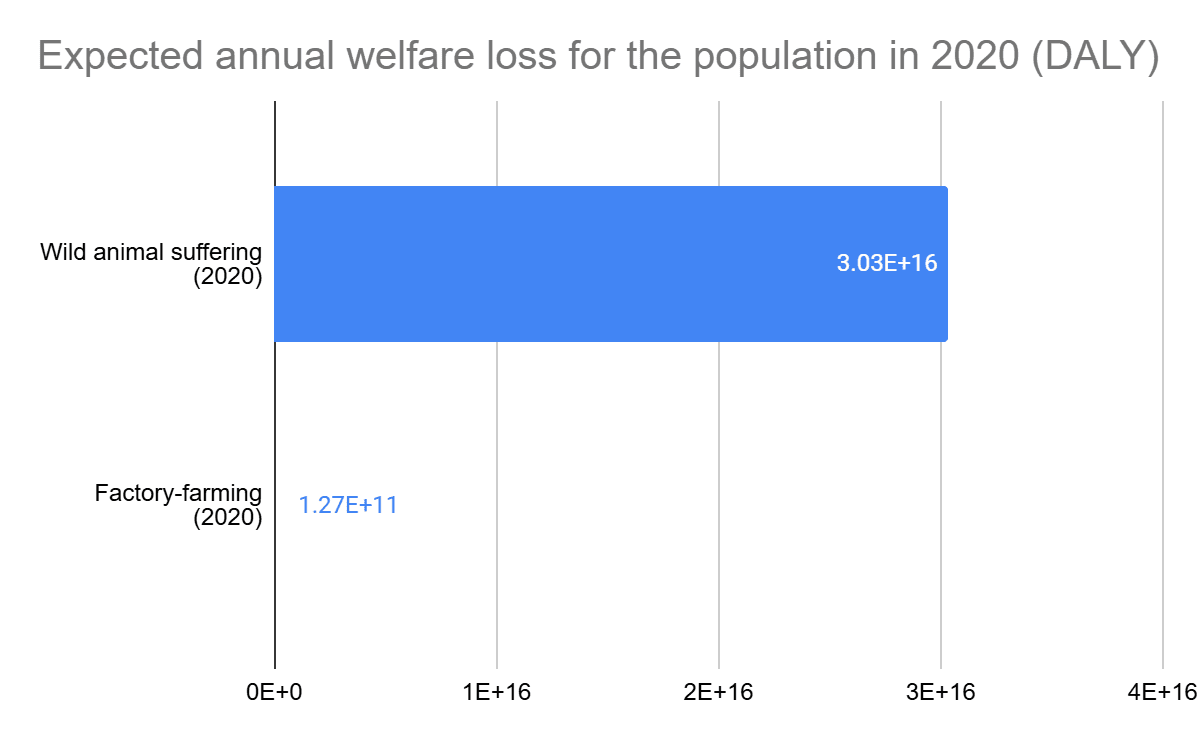
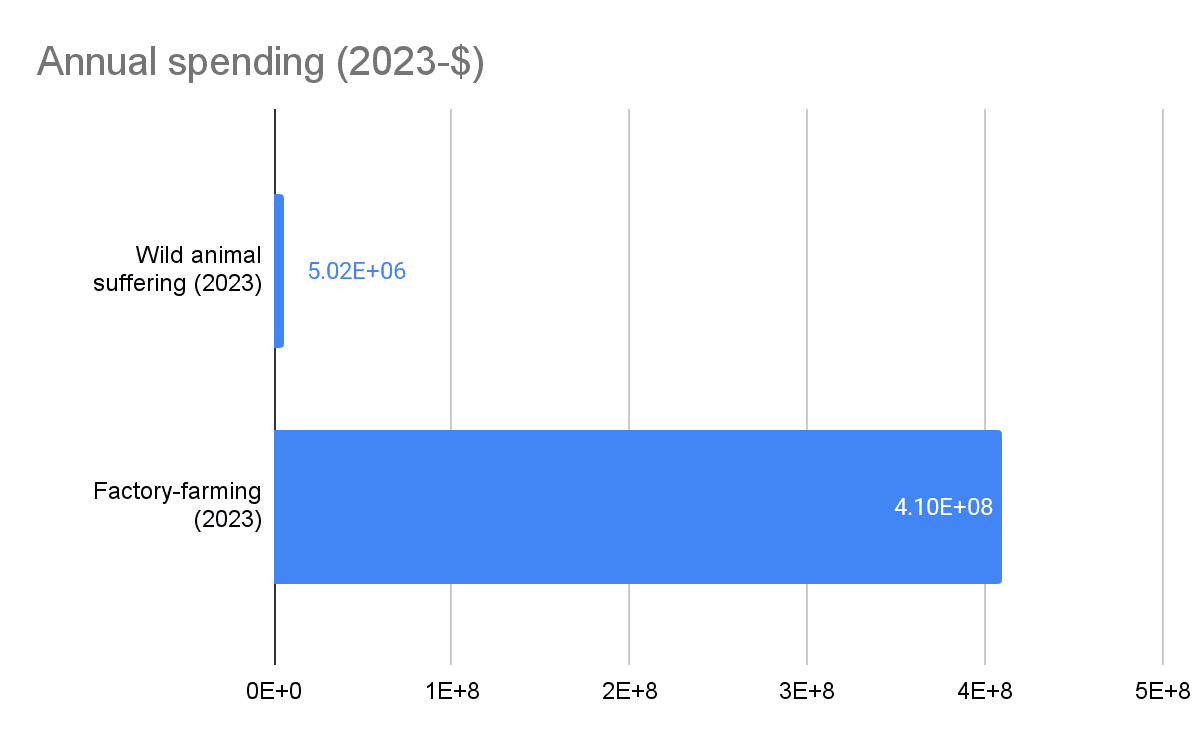
That makes sense, Abraham. Here are some graphs I made illustrating that wild animals are neglected compared with farmed animals.
On the other hand, I think people advocating for a greater focus on helping wild animals, including myself in the past, often overestimate the robustness of their best guess that the absolute value of the total welfare of wild animals is much larger than that of humans. For individual welfare per fully-healthy-animal-year proportional to "number of neurons"^"exponent", and exponents from 0.5 to 1.5, I got an absolute value of the total welfare of:
Wild birds, mammals, and finfishes ranging from 0.0412 to 376 times the total welfare of humans.
Yep, I agree that the case is complicated by total welfare potentially being dominated by invertebrates. That being said, I think many people in the community who might not be motivated by helping insects or nematodes or mites might still care about shrimp, and humans still kill 25 trillion wild shrimp (!) annually.
I agree the absolute value of the total welfare of wild invertebrates may well be much larger than that of wild vertebrates. For exponents from 0.5 to 1.5, I get an absolute value of the total welfare of soil ants, termites, springtails, mites, and nematodes ranging from 0.459 (= 0.0189/0.0412) to 2.60 k (= 977*10^3/376) times that of wild birds, mammals, and finfishes. However, my point was that the total welfare of humans may easily be much larger than the absolute value of the total welfare of wild animals including vertebrates and invertebrates.
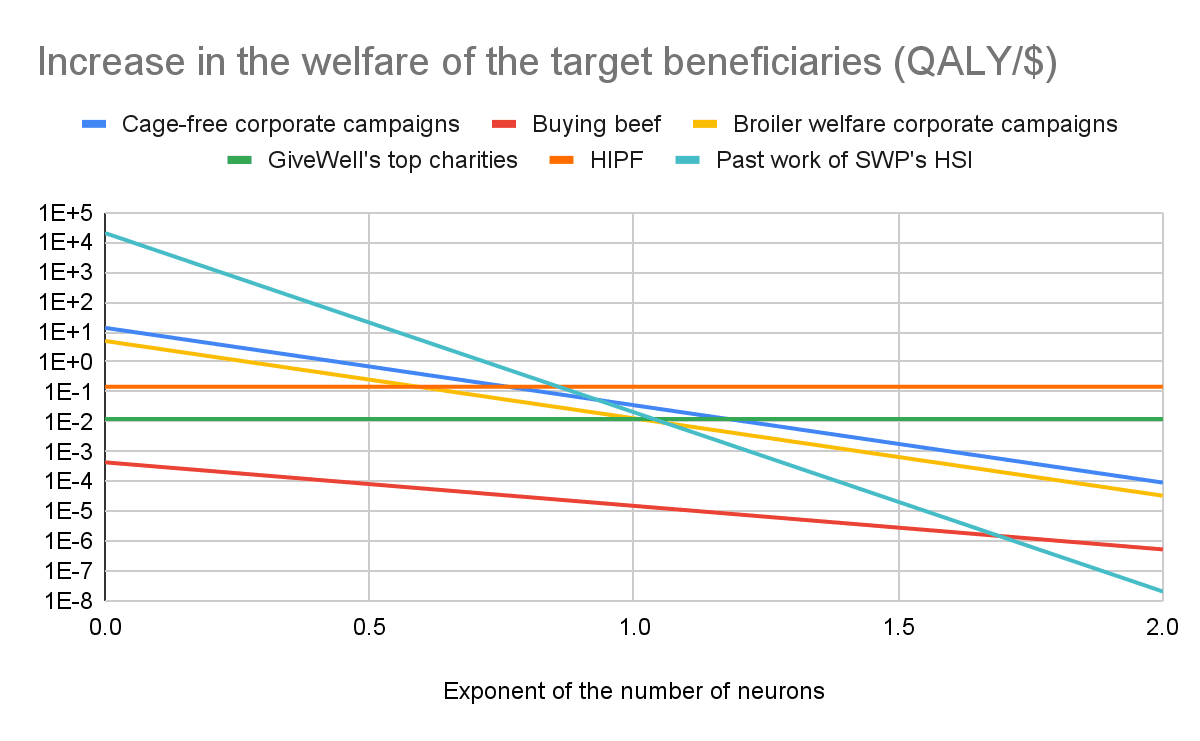
I think the focus should be on cost-effectiveness, and the absolute value of the total welfare. These will be lower than suggested by animals killed because a higher number of these tends to be associated with animals with fewer neurons and welfare proxies. For exponents from 0.5 to 1.5, and only accounting for effects on target beneficiaries, I estimate the cost-effectiveness of the Shrimp Welfare Project's (SWP's) Humane Slaughter Initiative (HSI) has been 0.0114 (= 2.06*10^-5/0.00180) to 29.4 (= 20.6/0.701) times that of cage-free corporate campaigns (the graph below has my results for more interventions and exponents). So I do not know whether the interventions which most cost-effectively increase the welfare of wild shrimps are more or less cost-effective than the ones which most cost-effectively increase the welfare of chickens
Accounting for effects on soil animals and microorganisms, I have very little idea about whether any intervention, including SWP's HSI which gets more farmed shrimps to be electrically stunned, increases or decreases welfare (in expectation).
Nice idea. We do have one WAW version of the classic graph, which I like in its simplicity, but it lacks the funding angle and if you do not see it next to the FAW classic, it's not as meaningful. I'll add this idea to our wish list of comms graphs.
One hypothesis: animal advocacy is a frequent "second favorite" cause area. Many longtermists prefer animal work to global health, but when it comes to their own donations and career choices, they choose longtermism. This resembles voting dynamics where some candidates do well in ranked-choice but poorly in first-past-the-post.
Larks makes a good point - AI risk is also underfunded relative to survey preferences. The bigger anomaly is global health's overallocation.
My very quick guess is that's largely founder effects. I.E. GiveWell's decade-long head start in building donor pipelines and mainstream legibility, while focusing on global health.
I'm curating this because it strikes me as an important piece of collective knowledge, and I'd like to further incentivise people to share takes like this.
Animal advocacy uniquely prompts people to align moral belief with personal behaviour. It’s not necessary to do this in order to be effective at reducing animal suffering, but if you don’t, then the incoherency is always lurking within. That creates a level of psychological friction that other cause areas don’t have - we aren’t directly contributing to malaria or x-risk in the same way most of us are implicated in factory farming. It’s plausible that this shows up as a gap between what people endorse in surveys and how resources get allocated.
I’m not sure we should expect stated preferences and real-world allocations to line up neatly. Large funders may be counterbalancing where the rest of the community drifts in its actions, and in that sense divergence isn’t obviously a bad thing.
If we do think the gap is a problem, I think fixing careers is an under-explored avenue. Animal advocacy still seems like a hard place to build a stable, respected long-term career. Retention, senior leadership depth, and longevity all seem thinner than in other cause areas. My hunch is that this cause area ends up being a ‘seasonal’ phase, with talent drifting toward better-resourced areas that can better place senior talent.
I agree re the career problem. I wonder how much additional money would fix the problem vs other issues like the cultures of the two movements/ecosystems, status of working in the spaces, etc.
Agreed, I'm always surprised by these low donations numbers.
I keep in mind that EA is one of the movements that helps animals the most in the world, especially farmed and wild animals, which are so important. This is great and much, much more better than the average.
But given that animals are so numerous and often live in terrible conditions, there still is be an important imbalance.
I see no rational reason to spend only 7% of donations on the vast majority of individuals in the world.
Late to this, but something I didn’t catch in the comments—Global Health looks overfunded in your calculations, but my sense is that Global Health is quite efficient at spending money. Much of the money in global health goes directly to programmes and beneficiaries, or working-class talent that often gets excluded as ‘not what we mean’ in these kinds of surveys. I would argue, too, that the other cause areas here are often quite talent-dense. Under these terms, it’s probably still valid to argue that Animal Welfare is under-resourced relative to Existential Risks though :)
Agreed completely! As a fundraiser myself, and working on raising funds for animal welfare for the past 12 years, I have seen and experienced this "decline" of the animal welfare topic within the EA movement in the recent years.
Five years ago, when you attended an EA Conference, you would see entire floors, panels, discussions and speakers from the Animal Welfare movement, divided into the different interventions, type of advocacy, activities. Today, you're lucky if you see one topic on animal welfare, one panel (usually on hot things for the EA community such as Insect farming), but no longer playing a protagonist role in the gatherings. I understand also how many people in the movement would want to mix things. Have AI in the same conference where you have AW, and global catastrophe and future pandemics. But what happens when you do this, is that inevitably you prioritize one in detriment of the other. And now AI has taken the room completely because its just the hot thing to be discussed at the moment.
I don't want to say one is more important than the other. I'm not here for that and who am I to judge on this. But there's enough space to have dedicated discussions on all, and to incentivize funding on it all.
Perhaps is also up to us, the users and individuals within the EA movement, to point that out and to start promoting, requesting and claiming that we want animal welfare to have a more prominent role again.
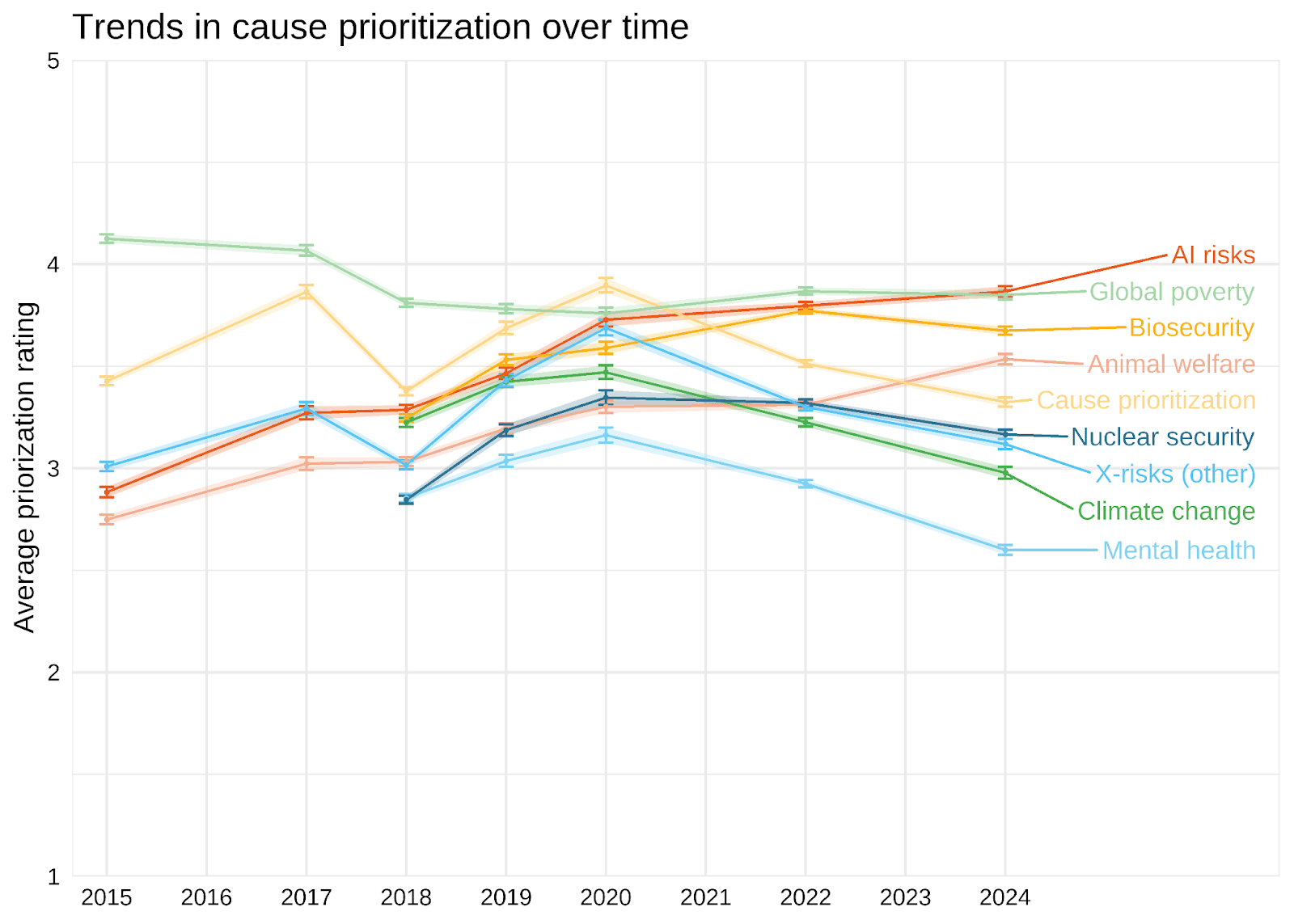
Interestingly, community members' prioritisation of animal welfare appears to have been increasing in recent years. (https://forum.effectivealtruism.org/posts/CKwDgZGLipchAoxtN/ea-survey-2024-cause-prioritization#Trends_in_cause_prioritization_over_time)
This is neither to agree or disagree with the observation about representation of animal welfare at EA conferences and such.
Thanks David! This is puzzling, but it might be what Elliot is pointing out. That AW is still a priority, but somehow this is not reflected on fundraising unfortunately.
One take is that what is happening is that the movement cares more about animal welfare as a cause area over time, but that the care and concern for AI safety/x-risk reduction has increased even more, and so people are shifting their limited time and resources towards those cause areas. This leads to the dynamic of the movement wanting animal advocacy efforts to win, but not being the ones to dedicate their donations or career to the effort.
One difference worth highlighting: animal welfare is probably the only thing on this list you can contribute to without working or donating. I suspect that if you tried to come up with a more general "How much have you changed you life for this cause?" question AW would get a boost from the large amount of vegans.
Hmm this is interesting because I'm actually not sure whether to treat the survey numbers or the funding numbers as the better signal of what the community actually believes! Surveys capture what people say when asked in the abstract.Funding decisions capture what people do when they have to make tradeoffs with real stakes. To me, neither is obviously more "true" When I answer a survey about ideal resource allocation, I'm not doing the same kind of thinking as when I'm actually deciding where my money goes. surveys feels more like "what do I want the world to look like" whereas the donation feels more like "given my uncertainty about sentience, tractability and what others are funding, where's my/our marginal money best spent." These can reasonably diverge as you can see. That said, I do think your lost in translation hypothesis is true in a way. The discourse is more AI-dominated than the MCF survey would predict or at least feels so. And if the community's stated preferences are roughly right but people are deferring to a perceived consensus that doesn't actually exist, that's a coordination failure worth pointing out! Also resonate with @SiobhanBall's point about psychological friction. Animal advocacy is the one cause area where most of us are personally implicated and that creates a kind of discomfort that's easy to avoid by just... focusing elsewhere. A kind of moral responsibility offsetting. I'd be curious whether the stated/revealed gap is smaller for vegans in the community!
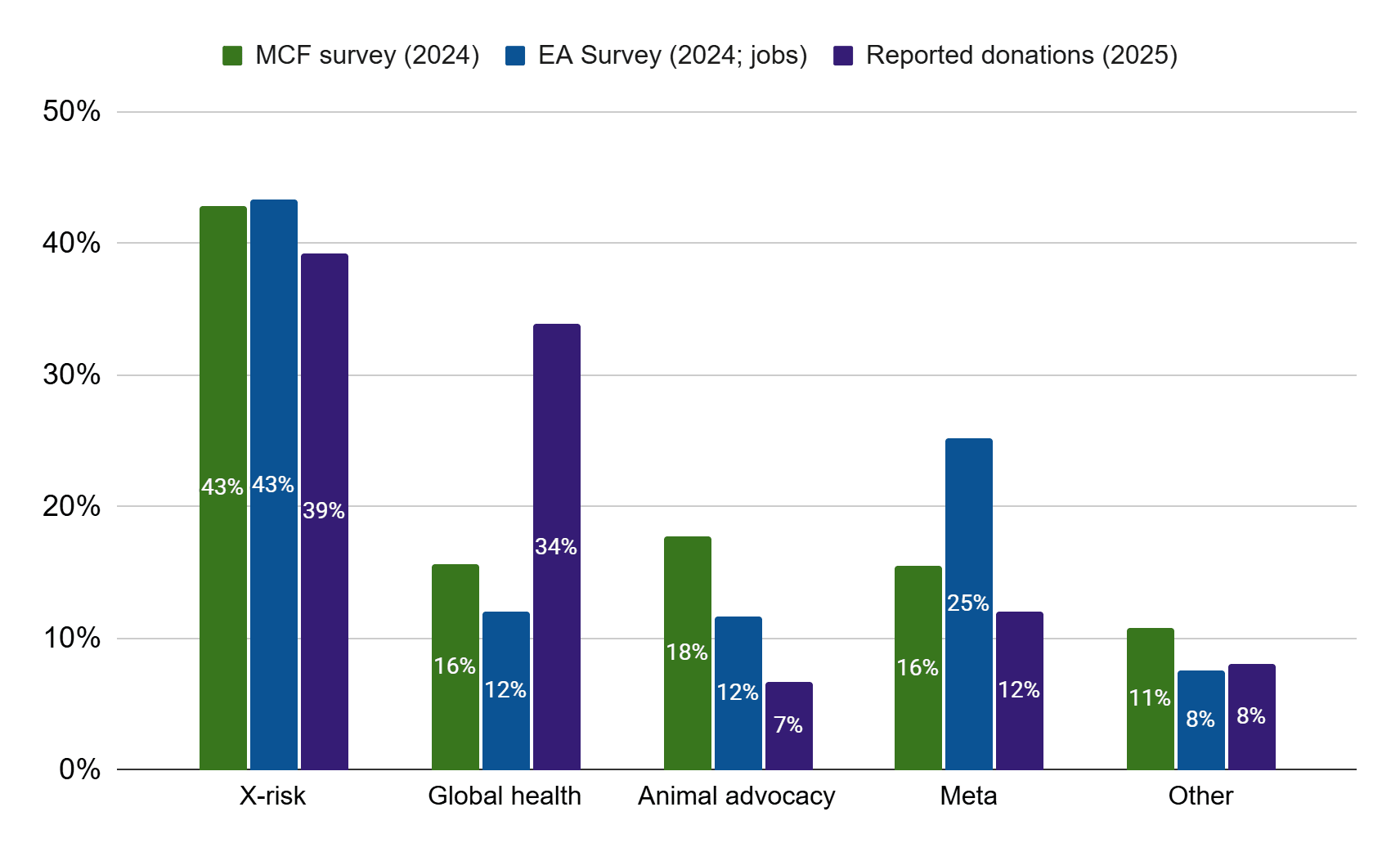
One small note: the MCF survey results in your first chart appear to sum to ~104% rather than 100%. It looks like the other two sources in the comparison do sum to 100%, which might make direct comparison a bit tricky.
This could just be a rounding artefact, or perhaps the survey methodology allowed responses that didn’t need to sum to 100% - but given some of the percentage differences between sources are fairly small, it might be worth a quick note explaining the discrepancy (or normalising the MCF data if appropriate).
Flagging mainly because I found myself a bit distracted by this when trying to interpret the comparison, and I imagine other readers might have the same reaction.
This seems to assume that EA funds ought to be distributed “democratically” by people who identify as EAs or EA leaders. I don’t buy that.
If the goal is good resource allocation, we want funding decisions to track competence about cause prioritization, not representativeness. Randomly sampled EAs—many of whom haven’t spent much time thinking seriously about cause prioritization—don’t seem like the right decision-makers.
And it’s also not obvious that “EA leaders,” as such, are the right allocators either. The relevant property isn’t status or identity, but judgment, track record, and depth of thinking about cause prioritization.
I agree that EA funds shouldn't be distributed democratically, nor that "EA leaders" or survey participants are necessarily the right allocators. Do you think that the current resource allocation is being made by experts with "judgment, track record, and depth of thinking about cause prioritization"?
If I had to guess, I would say it is a combination of this, but also EA UHNW donor preferences, a cause's ability to attract funding from other sources, etc.
Ideally we would survey some of the best grantmaking experts on cause prio, but I still found the EA survey and MCF survey to be a useful proxy, albeit flawed.
Despite being the one who wrote the original post I did think in writing it that trying to figure out if one cause is being underfunded compared another cause is a really difficult question to answer. Part of my motivation to write this was to see if anyone had any insights as to whether my claims were right or not.
Maybe people donate to animal welfare outside of the EA charity intermediaries. For example, I donate to charities such as PETA and Direct Action Everywhere directly, not through an EA intermediary.
This app takes the top EA forum post from each day and has an LLM generate a discussion question based on it. Let me know if you have any questions about the tool!
[This comment is no longer endorsed by its author]
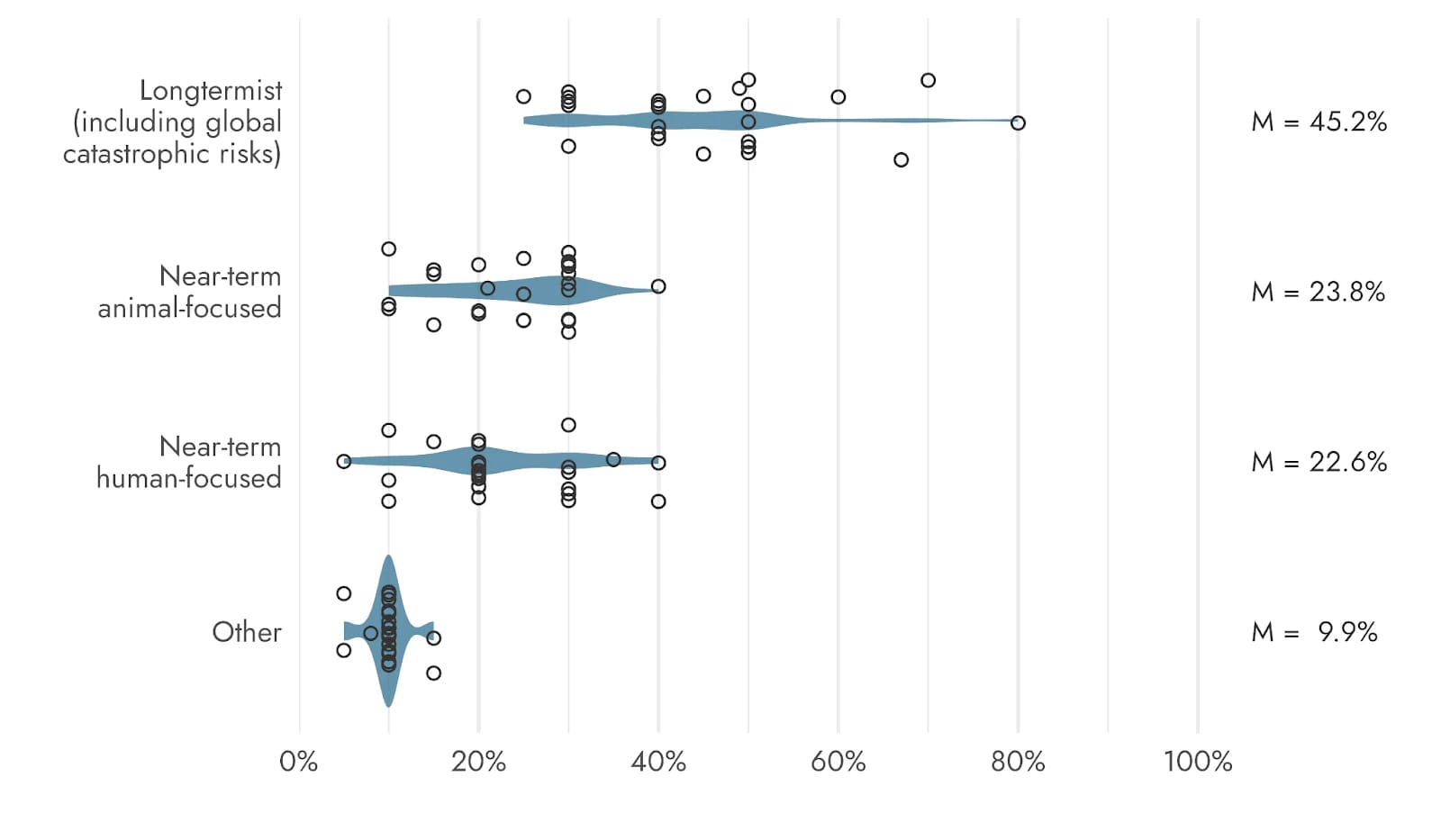
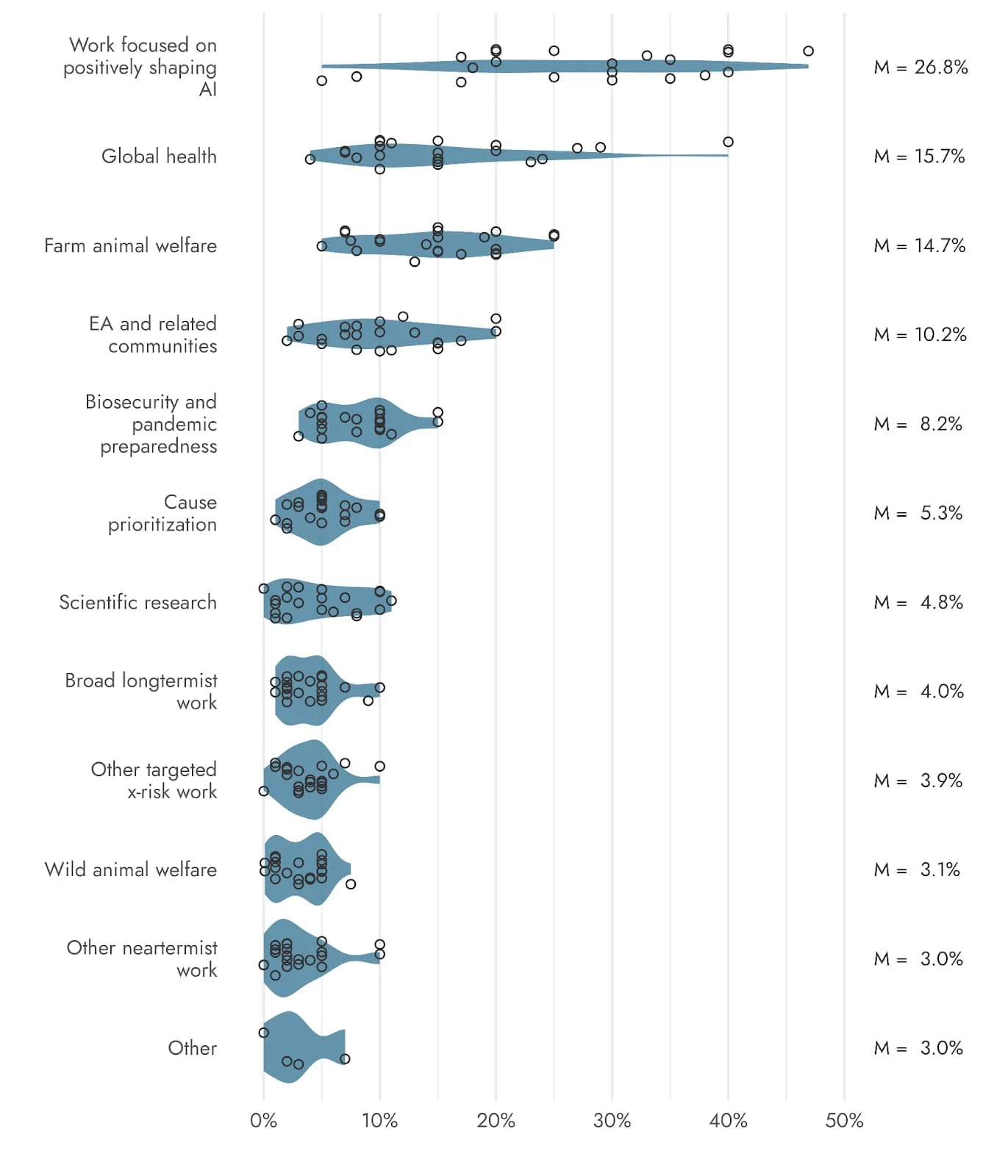
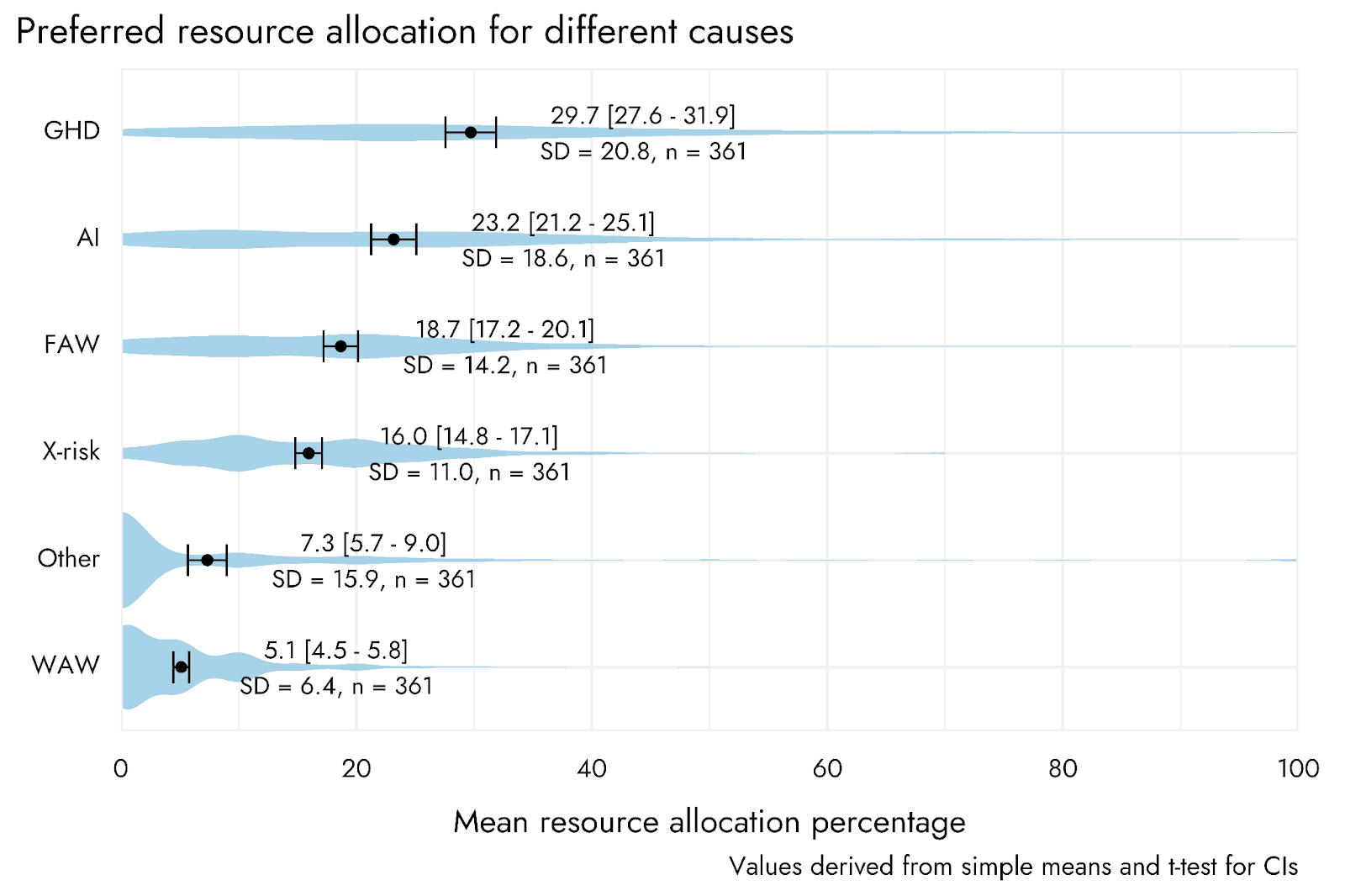
When surveyed, the EA community and leaders think ~18-24% of resources should go towards animal advocacy. The actual figure is about 7%.
We as the EA ecosystem are putting less resources (money and time) into animal advocacy than the movement thinks we should when surveyed.
This disparity could be because of loss of message fidelity, it's a harder cause area to pitch donors, or the role of large funders, but I'm honestly not too sure.
My job at Senterra Funders (formerly Farmed Animal Funders) involves making the case to EA/EA adjacent prospective donors that they can do a tonne of good by donating to animal advocacy charities. As part of this work I’ve noticed a certain level of inconsistency in the EA ecosystem: I encounter a lot more people who want the animal advocacy movement to 'win' than people working in or donating to the space.
The numbers
It turns out this intuition is backed up by survey data.
Note: I didn’t include the 2023 supplementary materials for the EA Community Survey Cause Prioritization because there wasn’t a category on ‘meta’ which made it too confusing to include without extra work. Having said that, at a glance the numbers look fairly similar to the meta coordination forum survey.
Looking at this chart, it’s quite striking that about 2.5 times less money goes towards animal advocacy than both the community (here), and ‘EA leaders’ think should go towards this cause area.
There’s also a similar issue with where people are working. Compared to animal advocacy, there are almost 4x as many people working in x-risk, 2x in ‘meta’.
Accounting for the disparity
What’s going on here? Either these numbers are wrong, the optimal allocation of resources has changed since this post went out, or this is a big failing of allocation of resources?
Here are some speculative reasons why this might be the case:
The funding split is dominated by Coefficient Giving. Coefficient Giving/Good Ventures makes up the majority of EA donations in 2025, so this will dominate the funding allocation. Although, the data shows 9% of CG’s funding going to farm animals in 2025, which is higher than the 7% average, so CG is actually bringing up the average substantially.
Helping farm animals is a tougher pitch than helping humans. To the extent that a lot of EA funders are working with other funders in the broader ecosystem, it’s much easier to bring in new funders to helping the world’s poorest people than helping chickens or fish.
The message from ‘EA leaders’ has been lost in translation. It’s safe to say that for quite a while now the vibe in EA has been that x-risk and AI are the most important problem to tackle. I respect the people who have been saying this quite a lot and don’t disagree with their assessment. I do worry that the message from some EA leaders might have looked like “AI Safety looks to be more pressing on the margin but with wide error margins and factory farming seems really important too”, and came out as “AI safety is the most pressing problem”. My evidence for this is the MCF survey, and the fact that CG is spending a far higher % on farm animal welfare than the wider movement.
I’m writing this with a genuine curiosity of what others think of the claims made. Is there a misallocation of resources here? And if so, why?
Mandatory caveats to end on:
Different data is sliced in different ways across cause area divides. If you look at the original sources it should be clear how I combined sources.
It’s also unclear how we should define the border of EA money and non-EA money. In order for this to not balloon out I accepted these numbers as presented.
This is a rougher version of this post than I’d like due to time constraints, but the main information is all there.
I am almost certainly biased because my job is fundraising for the animal advocacy ecosystem, so feel free to tell me why I’m wrong (or right).
Note: my data has updated numbers from Coefficient giving and Longview Philanthropy based on this section. I didn’t include Founders Pledge as I wasn’t sure about their allocation across cause areas.
EA Survey - work by cause area
This data is from the EA Survey 2024m shared by David Moss in a private correspondence
Cause area
Frequency
% selections
% respondents
AI risks
266
27.1%
42.16%
EA movement
198
20.2%
31.38%
Global health
119
12.1%
18.86%
Animal welfare
115
11.7%
18.23%
Biosecurity
87
8.9%
13.79%
Other
74
7.6%
11.73%
X-risk (other)
72
7.3%
11.41%
Cause prioritization
49
5.0%
7.77%
Caveat from David: “respondents who indicated that they worked for an EA org or do EA direct work could indicated that their work involved multiple cause areas (which I think makes sense, as one might work on GCRs, including both AI and other GCRs). As such I've included both the percentage of total selections and the percentage of total respondents”
TL;DR
* GOAL 3 is a social enterprise that created IMPALA, a patient monitoring and digital platform system for low-resource settings. There is also a GOAL 3 foundation that raises funds to ensure underserved communities will be reached.
* A recently completed report from Rethink Priorities calculated IMPALA to have a cost per DALY averted of $7–17 in paediatr...
This month effective altruism has gotten lots of attention, including a cover story in The Economist. It feels pretty surreal to be on the receiving end of it. But I feel grateful these ideas have caught on, and even more grateful for the drive, earnestness, and compassion of so many people who took strange but well-argued ideas seriously and then actually acted on them....
Note: This post was crossposted from the Coefficient Giving Farm Animal Welfare Research Newsletter by the Forum team, with the author's permission. The author may not see or respond to comments on this post.
Subtitle: On vegan advocacy, effective altruism, and FIFA
I turn 40 today. Here are some hot takes.
On factory farming
1. Our biggest challenge is salience. If factory farming led the evening news, it wouldn’t last lo...

If the phenomena you are highlighting is that Animal Welfare gets a smaller share of funding than people would prefer, it seems very strange to 'blame' AI messaging, since AI risk also gets a smaller share of funding that the surveys suggest would be preferred. Based on your methodology, the phenomena to explain is why does global welfare get so much more.