Comments
I agree with Scott Alexander that when talking with most non-EA people, an X risk framework is more attention-grabbing, emotionally vivid, and urgency-inducing, partly due to negativity bias, and partly due to the familiarity of major anthropogenic X risks as portrayed in popular science fiction movies & TV series.
However, for people who already understand the huge importance of minimizing X risk, there's a risk of burnout, pessimism, fatalism, and paralysis, which can be alleviated by longtermism and more positive visions of desirable futures. This is especially important when current events seem all doom'n'gloom, when we might ask ourselves 'what about humanity is really worth saving?' or 'why should we really care about the long-term future, it it'll just be a bunch of self-replicating galaxy-colonizing AI drones that are no more similar to us than we are to late Permian proto-mammal cynodonts?'
In other words, we in EA need long-termism to stay cheerful, hopeful, and inspired about why we're so keen to minimize X risks and global catastrophic risks.
But we also need longtermism to broaden our appeal to the full range of personality types, political views, and religious views out there in the public. My hunch as a psych professor is that there are lots of people who might respond better to longtermist positive visions than to X risk alarmism. It's an empirical question how common that is, but I think it's worth investigating.
Also, a significant % of humanity is already tacitly longtermist in the sense of believing in an infinite religious afterlife, and trying to act accordingly. Every Christian who takes their theology seriously & literally (i.e. believes in heaven and hell), and who prioritizes Christian righteousness over the 'temptations of this transient life', is doing longtermist thinking about the fate of their soul, and the souls of their loved ones. They take Pascal's wager seriously; they live it every day. To such people, X risks aren't necessarily that frightening personally, because they already believe that 99.9999+% of sentient experience will come in the afterlife. Reaching the afterlife sooner rather than later might not matter much, given their way of thinking.
However, even the most fundamentalist Christians might be responsive to arguments that the total number of people we could create in the future -- who would all have save-able souls -- could vastly exceed the current number of Christians. So, more souls for heaven; the more the merrier. Anybody who takes a longtermist view of their individual soul might find it easier to take a longtermist view of the collective human future.
I understand that most EAs are atheists or agnostics, and will find such arguments bizarre. But if we don't take the views of religious people seriously, as part of the cultural landscape we're living in, we're not going to succeed in our public outreach, and we're going to alienate a lot of potential donors, politicians, and media influencers.
There's a particular danger in overemphasizing the more exotic transhumanist visions of the future, in alienating religious or political traditionalists. For many Christians, Muslims, and conservatives, a post-human, post-singularity, AI-dominated future would not sound worth saving. Without any humane connection to their human social world as it is, they might prefer a swift nuclear Armageddon followed by heavenly bliss, to a godless, soulless machine world stretching ahead for billions of years.
EAs tend to score very highly on Openness to Experience. We love science fiction. We like to think about post-human futures being potentially much better than human futures. But it that becomes our dominant narrative, we will alienate the vast majority of current living humans, who score much lower on Openness.
If we push the longtermist narrative to the general public, we better make the long-term future sound familiar enough to be worth fighting for.


Hey Scott - thanks for writing this, and sorry for being so slow to the party on this one!
I think you’ve raised an important question, and it’s certainly something that keeps me up at night. That said, I want to push back on the thrust of the post. Here are some responses and comments! :)
The main view I’m putting forward in this comment is “we should promote a diversity of memes that we believe, see which ones catch on, and mould the ones that are catching on so that they are vibrant and compelling (in ways we endorse).” These memes include both “existential risk” and “longtermism”.
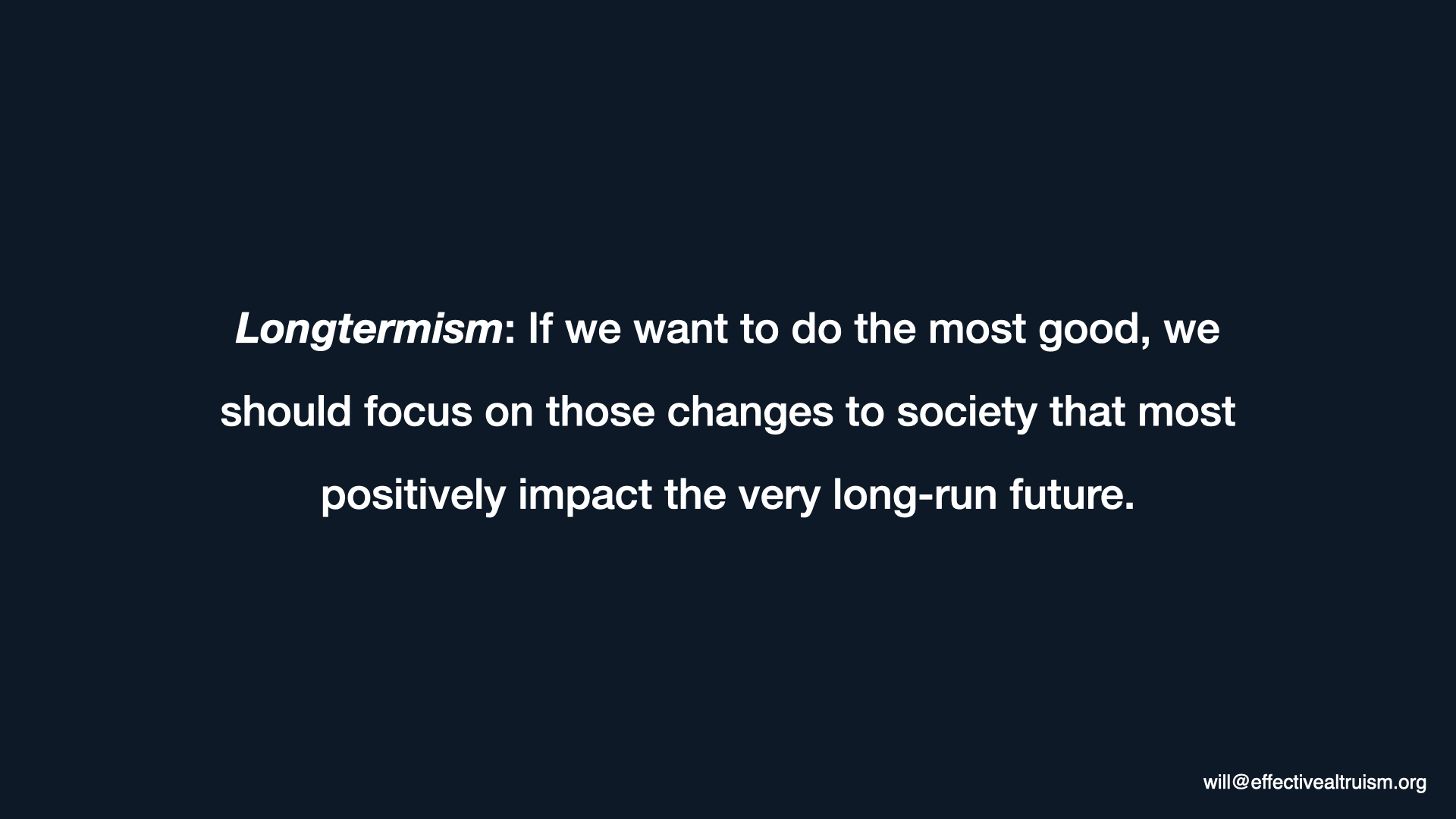
What is longtermism?
The quote of mine you give above comes from Spring 2020. Since then, I’ve distinguished between longtermism and strong longtermism.
My current preferred slogan definitions of each:
In WWOTF, I promote the weaker claim. In recent podcasts, I’ve described it something like the the following (depending on how flowery I’m feeling at the time):
I prefer to promote longtermism rather than strong longtermism. It's a weaker claim and so I have a higher credence in it, and I feel much more robustly confident in it; at the same time, it gets almost all the value because in the actual world strong longtermism recommends the same actions most of the time, on the current margin.
Is existential risk a more compelling intro meme than longtermism?
My main take is: What meme is good for which people is highly dependent on the person and the context (e.g., the best framing to use in a back-and-forth conversation may be different from one in a viral tweet). This favours diversity; having a toolkit of memes that we can use depending on what’s best in context.
I think it’s very hard to reason about which memes to promote, and easy to get it wrong from the armchair, for a bunch of reasons:
Then, at least when we’re comparing (weak) longtermism with existential risk, it’s not obvious which resonates better in general. (If anything, it seems to me that (weak) longtermism does better.) A few reasons:
First, message testing from Rethink suggests that longtermism and existential risk have similarly-good reactions from the educated general public, and AI risk doesn’t do great. The three best-performing messages they tested were:
So people actually pretty like messages that are about unspecified, and not necessarily high-probability threats, to the (albeit nearer-term) future.
As terms to describe risk, “global catastrophic risk” and “long-term risk” did the best, coming out a fair amount better than “existential risk”.
They didn’t test a message about AI risk specifically. The related thing was how much the government should prepare for different risks (pandemics, nuclear, etc), and AI came out worst among about 10 (but I don’t think that tells us very much).
Second, most media reception of WWOTF has been pretty positive so far. This is based mainly on early reviews (esp trade reviews), podcast and journalistic interviews, and the recent profiles (although the New Yorker profile was mixed). Though there definitely has been some pushback (especially on Twitter), I think it’s overall been dwarfed by positive articles. And the pushback I have gotten is on the Elon endorsement, association between EA and billionaires, and on standard objections to utilitarianism — less so to the idea of longtemism itself.
Third, anecdotally at least, a lot of people just hate the idea of AI risk (cf Twitter), thinking of it as a tech bro issue, or doomsday cultism. This has been coming up in the twitter response to WWOTF, too, even though existential risk from AI takeover is only a small part of the book. And this is important, because I’d think that the median view among people working on x-risk (including me) is that the large majority of the risk comes from AI rather than bio or other sources. So “holy shit, x-risk” is mainly, “holy shit, AI risk”.
Do neartermists and longtermists agree on what’s best to do?
Here I want to say: maybe. (I personally don’t think so, but YMMV.) But even if you do believe that, I think that’s a very fragile state of affairs, which could easily change as more money and attention flows into x-risk work, or if our evidence changes, and I don’t want to place a lot of weight on it. (I do strongly believe that global catastrophic risk is enormously important even in the near term, and a sane world would be doing far, far better on it, even if everyone only cared about the next 20 years.)
More generally, I get nervous about any plan that isn’t about promoting what we fundamentally believe or care about (or a weaker version of what we fundamentally believe or care about, which is “on track” to the things we do fundamentally believe or care about).
What I mean by “promoting what we fundamentally believe or care about”:
Examples of people promoting means rather than goals, and this going wrong:
Examples of how this could go wrong by promoting “holy shit x-risk”:
So, overall my take is:
Thanks for writing this! That overall seems pretty reasonable, and from a marketing perspective I am much more excited about promoting "weak" longtermism than strong longtermism.
A few points of pushback:
On this particular point
I can't find info on Rethink's site, is there anything you can link to?
Of the three best-performing messages you've linked, I think the first two emphasise risk much more heavily than longtermism. The third does sound more longtermist, but I still suspect the risk-ish phrase 'ensure a good future' is a large part of what resonates.
All that said, more info on the tests they ran would obviously update my position.
This seems correct to me, and I would be excited to see more of them. However, I wouldn't interpret this as meaning 'longtermism and existential risk have similarly-good reactions from the educated general public', I would read this as risk messaging performing better.
Also, messages 'about unspecified, and not necessarily high-probability threats' is not how I would characterize most of the EA-related press I've seen recently (NYTimes, BBC, Time, Vox).
(More generally, I mostly see journalists trying to convince their readers that an issue is important using negative emphasis. Questioning existing practices is important: they might be ineffective; they might be unsuitable to EA aims (e.g. manipulative, insufficiently truth-seeking, geared to persuade as many people as possible which isn't EA's objective, etc.). But I think the amount of buy-in this strategy has in high-stakes, high-interest situations (e.g. US presidential elections) is enough that it would be valuable to be clear on when EA deviates from it and why).
tl;dr: I suspect risk-ish messaging works better. Journalists seem to have a strong preference for it. Most of the EA messaging I've seen recently departs from this. I think it would be great to be very clear on why. I'm aware I'm missing a lot of data. It would be great to see the data from rethink that you referenced. Thanks!
Thanks for explaining, really interesting and glad so much careful thinking is going into communication issues!
FWIW I find the "meme" framing you use here offputting. The framing feels kinda uncooperative, as if we're trying to trick people into believing in something, instead of making arguments to convince people who want to understand the merits of an idea. I associate memes with ideas that are selected for being easy and fun to spread, that likely affirm our biases, and that mostly without the constraint whether the ideas are convincing upon reflection, true or helpful for the brain that gets "infected" by the meme.
Some support for this interpretation from the Wikipedia introduction: