Epistemic status: I wrote this up hoping people can poke holes in it because I am quite worried.
Here's what we've heard so far:
- Local media is reporting that an employee of a BSL-3 lab in Irkutsk, Russia, died of pneumonic plague on Oct 1st.
- The initial quarantine covered 200 people who were in contact with the employee before she died.
- The FSB (Russian FBI) was seen assisting in the quarantine, which means it was not voluntary.
- Soviet-era whistleblowers like Ken Alibek claim Irkutsk was a major bioweapon development facility.
As of Oct 4th:
- The quarantine has expanded to 5 hospitals in the area.
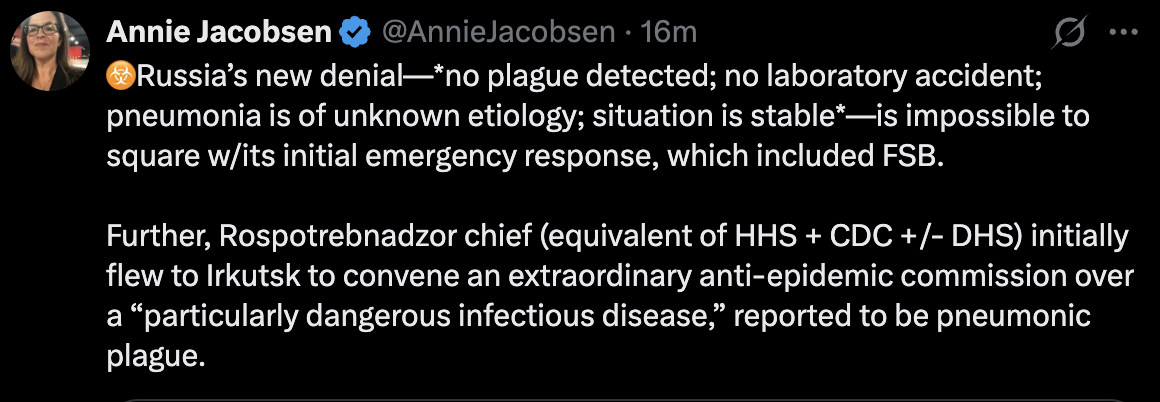
- The Russian government has switched to denial/coverup. Local news sources have deleted mentions of "pneumonic plague."
- Local universities and schools have canceled some classes and extended mask mandates.
- On the lab's website, they mention gain-of-function research for making bacteria more virulent.
- The White House is monitoring the suspected outbreak.
Why this might be a big deal
- Regular pneumonic plague is maybe not that hard to deal with (?) but if it is a bioweapon that was leaked, it could be significantly more virulent than, say, COVID. Pneumonic plague has an R0 of ~1.3-3.5, whereas genetically engineered variants could have an R0 of 5-12.
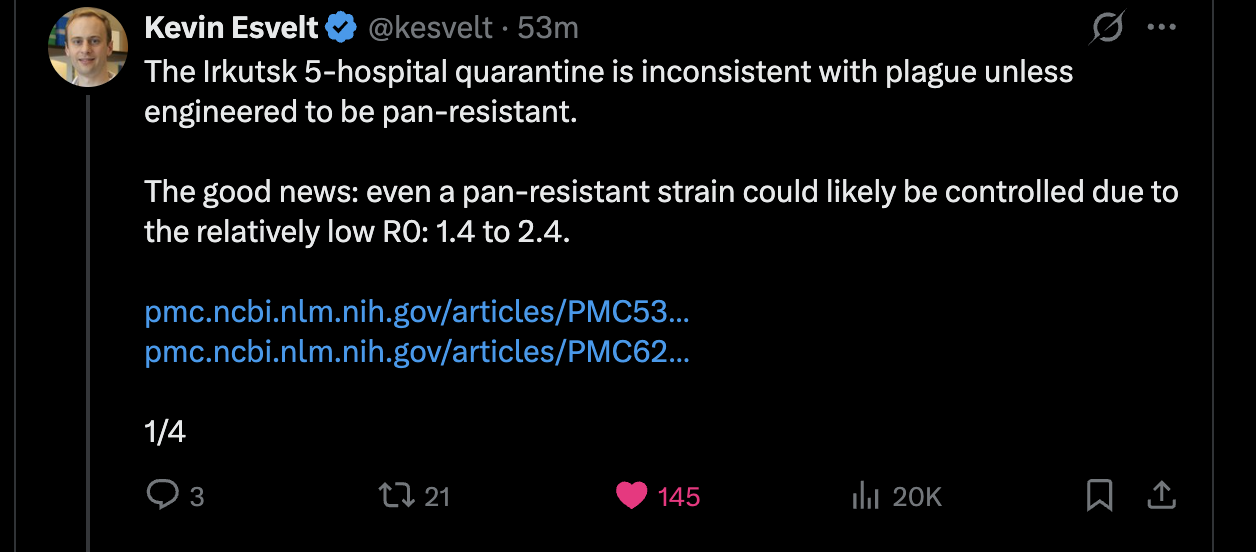
- If there is only one infection, then why quarantine 5 hospitals?
- If it wasn't a big deal, the Russian government wouldn't put much effort into covering it up. This is something I'll monitor over the coming few days.
- If this is a bioweapon, this could be quite bad. In Annie Jacobson's latest book, Biological War: A Scenario, much of the world is dead within the first few weeks after the first infection. I found it to be realistic, and it is a big reason I'm so worried. The scenario started basically identically to what's happening here.
- I asked the AIs if pneumonic plague is treatable with antibiotics, and they quoted me that the death rate with treatment is still between 8-30%.
- Soviet whistleblowers say they have successfully created recombinant plague with antibacterial resistance and much higher virulence, so we know it's possibly a bioweapon.
Why this might not be a big deal
- Some OSINT researchers looked at a bunch of street cams in Irkutsk and didn't find anything really out of the ordinary. Life is continuing basically as normal there.
- Nothing ever happens.
- We don't really have much info on the whole thing. There are no reported second cases from officials, but with historical evidence, we should assume a cover-up- e.g., the Sverdlovsk anthrax leak in 1979 and COVID-19 in China. So evidence that there are no secondary cases is not really (much) evidence.
- If it's not a bioweapon, it's most likely fine.
- Some smart bio people I know think this is not a big deal, but I don't really understand their reasons why.
- Superforecasters at Sentinel think that the odds of pandemic are <1%. Their reasoning is that there is no official reporting of any further cases, and that the Russian government is implementing strict quarantine measures.
- But I think this is actually the opposite of good news. The fact that the Russian FSB is implementing a strict quarantine AND the fact that the government is in full information control mode, denying that it is even pneumonic plague anymore, pushes me in the direction of this being a big deal, and they are covering it up.
- I would be persuaded this isn't a big deal if the Russian government wasn't covering it up AND was implementing a strict quarantine, but because they are doing both, it makes me think it is, in fact, a big deal.
10/5 update:
- Kazakhstan, Kyrgyzstan, Tajikistan, and Uzbekistan are now doing screening health checks at the Russian border to contain the spread of pneumonic plague.
- Russian equivalent of HHS is now denying there was any accident at the lab at all.
- Unconfirmed: reports of antibiotics running out in the city of Irkutsk
- Kevin Esvelt is saying that it's either a bioweapon or it's not plague.
- Another thread by Esvelt here.
10/6 update:
- According to an OSINT researcher, the patient zero who died, Daria Shipilova, coauthored a paper that tested antibiotic resistance from plague.
- I updated a lot on Esvelt thinking this was likely a bioweapon, but because not much news came out today, I think it's much less likely to become an epidemic.
Please let me know anything else I'm missing here.

I don’t think you can have it both ways—don’t we want people to freak out and quarantine a bunch of places if a bio facility has an issue like this? Why would this be a sign that the plague is more likely to be really bad, rather than just a sign that we learned the lesson from COVID? (Similarly, border measures are pretty regularly just a political cudgel; see Italy tightening border controls with Spain (??) after the Ceuta breach)
Yep I actually think the current response is close to the best case scenario
1. Russia freaks out properly and do all they can
2. Russia denies everything.
Given geopolitics seems among the best possible outcomes.