Comments

59
Good afternoon Carmen, Elisa, and Ula.
The model’s current limitations that we want to tackle
The model does not cover effects on non-target individuals. Have you considered mentioning this as a limitation? You said 5 days ago "we're still developing our [Rethink Priorities' (RP's)] plans for when and how to incorporate indirect effects in the model". However, there is no mention of "indirect", "soil", or "-target" in the post or methodology page.
I do not think it would make sense for you to list all limitations, but I would list not covering effects on non-target individuals. I am not aware of any intervention supported by impact-focussed funders which increases animal welfare accounting for effects on soil invertebrates.
Have you considered replying to comments using just personal accounts instead of RP's? I think transparency is usually good.
Hey Vasco. I wasn't one of the post's authors, but chiming in on RP's general tentative take on modeling off-target effects. (I'll let the others comment on why this was not mentioned in the post, if they want to. But, fwiw, excluding "flow-through effects" is listed as a limitation of our model on the CCF website.)
I agree this is a limitation, and I am tentatively in charge of thinking more about how we could model off-target effects in a non-arbitrary way (which you know I am pessimistic about). This is however low on my/our list of priorities, since I doubt that whatever way of modeling them we might eventually opt for would substantially update the CCF's allocation. We'd most likely remain neutral on whether a given off-target effect is positive or negative, overall, in a way that leaves the precise allocation unchanged.
While this remains a limitation of the model behind the CCF, I think it is a much broader problem that the EA community may want to grapple with. I don't think off-target effects are a reason for anyone to distrust the CCF's current allocation, more than they are a reason to doubt any precise allocation---given the immense imprecision/ambiguity surrounding the scale and (especially) the sign of these off-target effects. And while you know I am myself sympathetic to such doubt, I still see a lot of value in thinking about where money should be allocated, conditionalizing on worlds in which off-target effects and other sources of deep uncertainty are not paralyzing.
I am not aware of any intervention supported by impact-focussed funders which increases animal welfare accounting for effects on soil invertebrates.
RP's work on moral weights and animal welfare might happen to address parts of this concern of yours in the future (and inform our CCF allocation), fwiw. (Macroscopic Ventures' AW team might also do related work.) But you will not find the answers you're looking for from our CCF team on this point.
Hi Jim. Thanks for sharing your thoughts.
We'd most likely remain neutral on whether a given off-target effect is positive or negative, overall [i)], in a way that leaves the precise allocation unchanged [ii)].
I agree with i) assuming "neutral" means "not far from neutral". However, why would ii) follow from i)? If it is very unclear whether the interventions currently funded by CFF increase or decrease welfare, you could allocate more resources towards decreasing the relevant uncertainties instead of funding such interventions. Even if you are not open to this, you could still disclaim you do not know whether the interventions being funded increase or decrease welfare such that other funders update towards funding research decreasing the relevant uncertainties.
While this remains a limitation of the model behind the CCF, I think it is a much broader problem that the EA community may want to grapple with.
I agree.
RP's work on moral weights and animal welfare might happen to address parts of this concern of yours in the future (and inform our CCF allocation), fwiw. (Macroscopic Ventures' AW team might also do related work.) But you will not find the answers you're looking for from our CCF team on this point.
For work on moral weights to inform CCF's allocation, you would have to combine it with research on the effects on non-target individual (for example, estimating the soil-arthropod-years affected per electrically stunned shrimp)?
I did mean actually neutral. I assume that our position would be to tentatively assign a value of 0 to effects where any precise number within a range spanning over 0 seems arbitrary, which approximates bracketing out effects we are clueless about. (I know that you are skeptical of bracketing and might say that 0 is just as arbitrary as any other number.)
you could still disclaim you do not know whether the interventions being funded increase or decrease welfare such that other funders update towards funding research decreasing the relevant uncertainties.
I think we overall would disagree with the first part, due to being sympathetic to bracketing out effects we are clueless about, or maybe believing these are not that large to begin with. (I am probably the person on the team most sympathetic to deep uncertainty about this, though.) But fwiw, we are planning on considering including "meta" funds/projects in the allocation, including those that reduce our key uncertainties. (Our key uncertainties may very well differ from yours, though.)
For work on moral weights to inform CCF's allocation, you would have to combine it with research on the effects on non-target individual (for example, estimating the soil-arthropod-years affected per electrically stunned shrimp)?
Well, this depends on what the moral weight research concludes, but in many scenarios, yes, we would need to if we wanted off-target effects to influence the CCF allocation (which, again, we might not want). Fwiw, I don't expect "estimating the soil-arthropod-years affected per electrically stunned shrimp" to be the hardest part, relative to figuring out the sign of this + other potential off-target effects of shrimp stunning (and how to weight all this). And I don't expect the CCF team to figure this out any time soon. The AW team might be more likely to make some progress, but I also don't expect it to figure this out.
I see. Have you considered using CCF's funds to support research outside RP aiming to decrease uncertainty about moral weights? In the section "The model’s current limitations that we want to tackle", you mention "A limited set of funds and cause areas currently included".
I did mean actually neutral. I assume that our position would be to tentatively assign a value of 0 to effects where any precise number within a range spanning over 0 seems arbitrary, which approximates bracketing out effects we are clueless about. (I know that you are skeptical of bracketing and might say that 0 is just as arbitrary as any other number.)
Say you want to increase expected human welfare, and there is an action i) which has a probability of 100 % of saving 1 human, a probability p of around 50 % of killing 1 billion people, and a probability 1 - p of saving 1 billion people. Would you evaluate this action as an action ii) which has a probability of 100 % of saving 1 human, and no more effects? I would evaluate i) and ii) very differently. I would say i) could easily increase or decrease human welfare a lot, whereas ii) increases it just a little with certainty (a little compared with how much i) can change human welfare). I would focus on decreasing the uncertainty about probability p instead of brackecting out the uncertain effects of i), and decide between i) and nothing as if I was deciding between ii) and nothing.
Moreover, many people care not only about increasing welfare in expectation, but also about not decreasing welfare. For those people, the uncertain effects can matter a lot. They may well prefer i) over nothing, but much prefer nothing over ii). From the point of view of decreasing the chance of causing large harm, funding CCF is much worse than doing nothing? This could be an uncomfortable conclusion, but it seems worth communicating if you want to empower donors to act in agreement with their values.
I think we overall would disagree with the first part, due to being sympathetic to bracketing out effects we are clueless about, or maybe believing these are not that large to begin with. (I am probably the person on the team most sympathetic to deep uncertainty about this, though.)
What do you mean by clueless? "Being clueless about X" is not a mathematical proposition which is either true or false. So I would think one can be more or less clueless about any effects, and I do not understand why some effects would be 100 % neglected. I also do not know why such effects would be effectd on non-target individuals. There are other factors that affect the level of clueless. It generally makes sense to be more clueless about effects happening further into the future. Based on the "More options" drop-down in question 2 of your Donor Compass, you are modelling effects after 500 years. Are you less clueless about these effects than the effects on the population of soil arthropods next year caused by chicken welfare reforms increasing the production of chicken feed? There are academic studies on the effects of chicken welfare reforms on agricultural land use, and on the density of soil arthropods by biome. You can combine these with your research on the moral weight of shrimps and black soldier flies (BSFs) to get a sense of the importance of the effects on soil ants and termites. I think you already agree that we have little idea about whether chicken welfare reforms increase or decrease animal welfare due to effects on non-target individuals, but many people believe these effects are negligible.
But fwiw, we are planning on considering including "meta" funds/projects in the allocation, including those that reduce our key uncertainties. (Our key uncertainties may very well differ from yours, though.)
Good to know.
Fwiw, I don't expect "estimating the soil-arthropod-years affected per electrically stunned shrimp" to be the hardest part, relative to figuring out the sign of this + other potential off-target effects of shrimp stunning (and how to weight all this). And I don't expect the CCF team to figure this out any time soon. The AW team might be more likely to make some progress, but I also don't expect it to figure this out.
I agree decreasing i) uncertainty about the direction of the effects on non-target individuals is harder than decreasing ii) uncertainty about their magnitude. However, I think ii) is valuable even without i). If the effects on non-target individuals are much smaller than those on the target individuals, the effects on non-target individuals can be neglected. If the effects on non-target individuals are much larger than those on the target individuals, there would be other interventions targeting the non-target individuals which would be more cost-effective (for example, interventions targeting soil ants and termites instead of chickens). In either case, there would be no need to decrease the uncertainty about the direction of the effects on the non-target individuals.
I think we would need to unpack too many things for addressing your first and third paragraphs to be worth it. (And I think you already know what I personally think about the first one.) I'll just note that, tentatively ~bracketing out some effects is not incompatible with valuing further research on them.
many people care not only about increasing welfare in expectation, but also about not decreasing welfare. For those people, the uncertain effects can matter a lot.
I tentatively agree and think this should be the strongest argument against our "indeterminate effects = 0" move, from RP's perspective. (Although I do not understand the most plausible versions of risk/ambiguity aversion well enough to be confident here, and remain sympathetic to this response Laura gave you when you raised the same point elsewhere. Defo still something I'd like to revisit at some point, though!)
From the point of view of decreasing the chance of causing large harm, funding CCF is much worse than doing nothing? This could be an uncomfortable conclusion, but it seems worth communicating if you want to empower donors to act in agreement with their values.
I don't think this part is fair, though. If donating to the CCF is bad because of risk aversion + substantial off-target effects, donating to pretty much anything is bad, then. Again, here, you're raising a potential problem that goes well beyond the CCF. (I understand very well that your views imply prioritizing research, though. And we might come closer to this ourselves if/once we estimate VOI for different projects and account for off-target effects.)
If donating to the CCF is bad because of risk aversion + substantial off-target effects, donating to pretty much anything is bad, then. Again, here, you're raising a potential problem that goes well beyond the CCF.
I agree. However, to the extent you want to help donors act in agreement with their values, you could recommend they do not donate to anything at all (CCF or other options) if this is the best option given their values. Some could then realise they have different values, and use your tools to clarify what they should donate to given their updated values. Some others could actually endorse not donating, or donating less than they would have donated if they had not learned their donations could cause a lot of harm.
- It accounts for key variables at play in determining and comparing the cost-effectiveness of different interventions, including:
- How to weigh the welfare of humans against that of non-human animals and that of different non-human animals between themselves (moral weights)
- How to weigh different time periods, like the near future (0-5 years) versus the very distant future (over 500 years), e.g., in light of deep uncertainty about far future effects (Discount factors across time periods)
- Attitudes towards risk
- Diminishing returns
- The first attempt to include the possibility of AI transforming the world so radically that any interventions not aimed at altering the trajectory of AI would be rendered ineffective (under improvement)
@Laura Muresianu and @Jim Buhler, on diminishing returns, why do you set the (marginal) cost-effectiveness of funding GiveWell's All Grants Fund to the cost-effectiveness of the grants GiveWell made in 2025 instead of GiveWell's cost-effectiveness bar?
We used this information [about the grants GiveWell made in 2025] to construct a distribution for the average cost-effectiveness of GiveWell’s entire portfolio of spending in 2025 in Python, which we’ll assume is roughly equal to the marginal cost-effectiveness of GiveWell spending.
I think GiveWell's current cost-effectiveness bar is 6 times their benchmark. From the page I just linked which was last updated in September:
As of May 2026, our bar for funding programs is 6x our benchmark
You assumed a significantly higher cost-effectiveness.
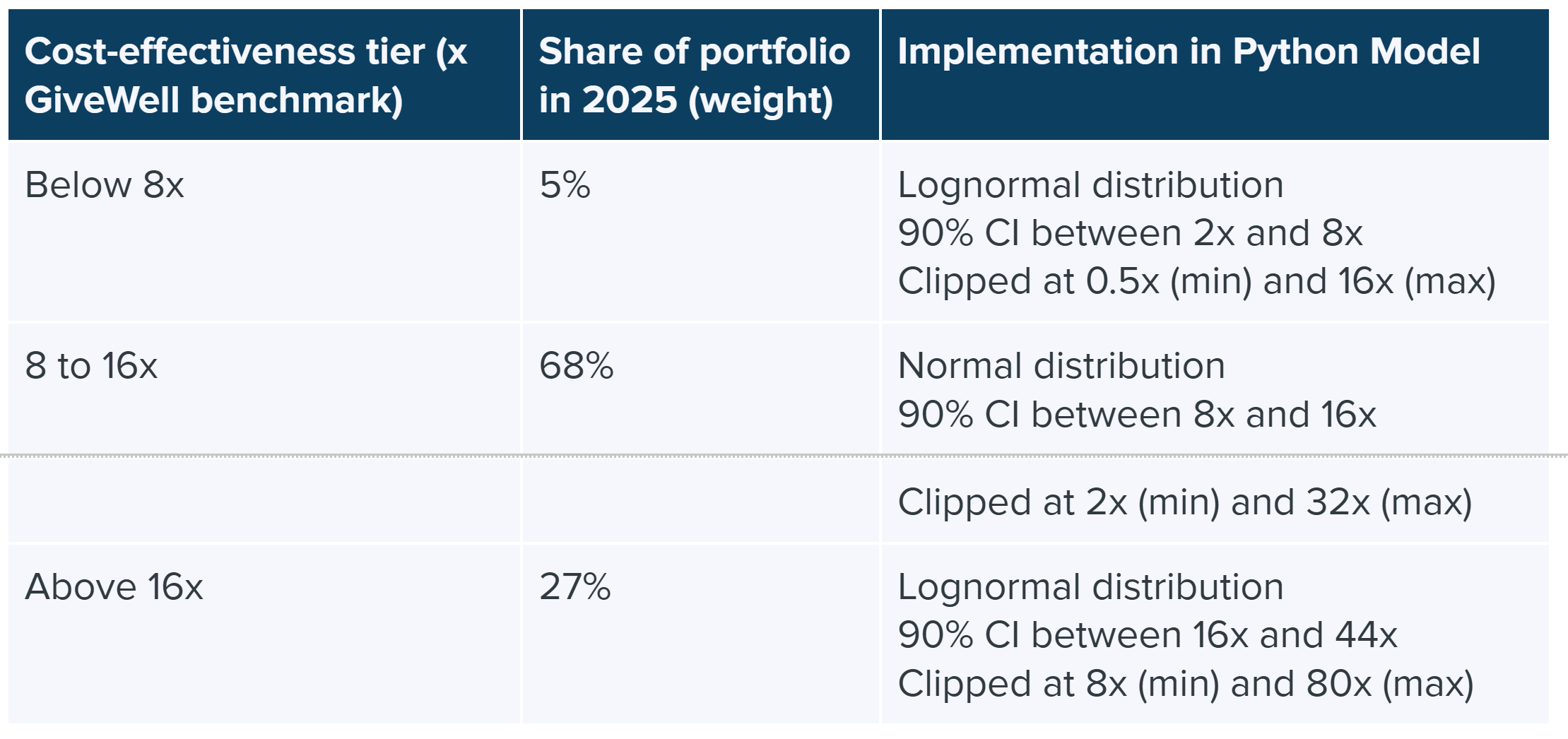
Hey Vasco. I was not involved in making this assumption, so I can only transcribe what my busy colleagues said on this. (This means I very likely won’t be able to reply to follow-up questions, if there are any. But what you or anyone may want to add on this will be read.)
The assumptions come directly from GiveWell itself. It might be true that the marginal cost-effectiveness is lower than their average for 2025, but we don’t immediately see a reason to believe that it equals their bar (which was 8x at time of publishing). We may look into how that’s changed, and where GiveWell’s current cost-effectiveness lies in the near future.
Hello Jim. I had understood you used data from GiveWell (this is mentioned in the section I linked above with your methodology). However, as far as I know, GiveWell has never said the cost-effectiveness of their marginal spending in 2025 matched the cost-effectiveness of all their grants considered together in 2025, which is what you are assuming (see the quote after my question in the comment above). Here is what they say in the post you linked.
In 2025, we generally considered funding opportunities that our research estimated to be at least 8x our cost-effectiveness benchmark. Overall, we estimate that the average cost-effectiveness of the money spent across all our grants was approximately double that: 16x our benchmark.
So GiveWell estimates the cost-effectiveness of all their grants considered together in 2025 was 16 times their benchmark. The cost-effectiveness of GiveWell's marginal spending in 2025 was lower than this. GiveWell prioritises the most cost-effective grants, and some grants had a cost-effectiveness lower than 16 times their benchmark.
The marginal cost-effectiveness of GiveWell's marginal spending in 2025 may have exceeded their bar. In principle, it could have been anything from 8 to 16 times their benchmark. In practice, I think it is close to 8 times their benchmark. Assuming they funded all grants with a cost-effectiveness higher than their bar of 8 times their benchark (considering all factors, not just the ones covered in the explicit cost-effectiveness analysis (CEA)), GiveWell granting more in 2025 would not have led to more grants with a cost-effectiveness higher than 8 times their benchmark (which would have been made anyway). It would have led to grants with a cost-effectiveness of around 8 times their benchmark (slightly below or above 8 times their benchmark because the distribution of the cost-effectiveness of the grants is not perfectly continuous).
GiveWell says "We maintain a cost-effectiveness threshold [bar] at a level where we expect to be able to fully fund all the opportunities we find above it", as I have been assuming. So I am confident it would be better to set the marginal cost-effectiveness of GiveWell's All Grants Fund (AGF) to GiveWell's bar, 6 times their benchmark in May 2026, instead of the cost-effectiveness of all the grants they made in a year.
You are currently assuming AGF has a marginal cost-effectiveness of around 16 times GiveWell's benchmark (see my 1st comment in this thread), 2.67 (= 16/6) times GiveWell's bar in May 2026. This is a significant difference in the context of global health interventions, whose cost-effectiveness is less uncertain compared to that of interventions targeting animals, and decreasing catastrophic risks neglecting effects on non-target individuals. So I suggest you update your assumption about the marginal cost-effectiveness of AGF before CCF makes more grants.
I am considering publishing a post about this on October 28. Let me know if you update your assumptions.
Hi Vasco, thanks for your pushing back here.
I think you raise a good point and I think it's quite reasonable that we've overstated the marginal cost-effectiveness of GiveWell by basing it on the average value of grants made in 2025. In doing this, we made simplifying assumptions to get an initial version of the model up and running, but I didn't see that source you're citing, and so I didn't know their bar is not just a minimum for funding but also where they anticipate funding up to. I think you're right that we could have thought more about how the marginal and average values differ, and I think your approach of anchoring on the bar makes sense as a different approach.
We're planning to do more thinking on and research into this before we change assumptions or make more grants, and we'll make changes transparent on our website when we come to that (i.e. before making more grants). But I also want to stress that our approach to updating our model is deliberative, and we have many prioritized updates in addition to this one, and so any changes most likely won't be ready in the next 12 days. I also want to refrain from speculating as to how this changes the recommended allocation from the CCF, because how the worldviews weigh shifts in average cost-effectiveness compared to uncertainty, time frame of impact, etc. is not predictable.
Thanks,
Laura
Thanks, Laura. I will link to your reply if I end up publishing a post. I am currently not planning to publish a post because it looks like you are going to make changes before you make more grants.
I do not know how much CCF's recommended allocation would change as a result of the marginal cost-effectiveness of AGF being updated to GiveWell's bar. However, the update seems very worth it to me due to taking little time (only one variable has to be updated), and GiveWell's goal of having their marginal cost-effectiveness match their bar.
Here is some context about what it means for an intervention to have a cost-effectiveness equal to 16 times GiveWell's benchark (your current assumption for the marginal cost-effectiveness of AGF). GiveWell's benchmark corresponds to paying 300 2024-$ for 1 unit of value (doubling the consumption of one of their target beneficiaries for 1 year). So GiveWell's current bar of 6 times their benchmark means they are willing to pay at most 50 2024-$ (= 300/6) for 1 unit of value. GiveWell assumes saving the life of someone with age 1 to 4 is worth 127 units of value. So GiveWell's current bar corresponds to saving someone with age 1 to 4 with 6.35 k$ (= 50*127). A cost-effectiveness of 16 times GiveWell's benchmark, 2.67 (= 16/6) times GiveWell's bar, corresponds to saving someone with age 1 to 4 with 2.38 k$ (= 6.35*10^3/2.67). GiveWell reports higher costs to save a life for the grants they made to their top charities in 2022-2024 (and the cost to save a life would be even higher for the last $ of such grants):
How could it work for prioritizing funding within a single cause area? I am in mental health and there are many different forms of interventions spread across different geographies and a major factor is huge portions of earth with near zero interventions and comparable zero research. From a small emergent beginning we have many decisions to make early before significant scaling builds momentum. Because we are so small, so emergent, CCF could significantly help shape our approaches for decades. If that is possible, a follow-up question is can a collaborative group of funders and implementers fund a team of researchers focused on running a CCF model in our cause area? If possible the next question is (also to stir your thinking of) how to do it? ie. how you package and sell your newly developed product...in house consulting only, outside modules linked to central? etc. This comment is also marketing research data for you, customers may want this. Thanks.


In this context, we aim for the Cross-Cause Fund to fill that allocation methodology gap. We want to provide donors and philanthropists with what should ultimately be conceived as a giving tool rather than another high-impact fund. We’re not asking you to blindly follow our advice; we invite you to understand and scrutinize our work. The CCF is the first fund in the EA space to be based on rigorous cross-cause modeling, with underpinning philosophical views and empirical data transparently published. This likely makes it the most thorough, evidence-based tool currently available for impact-focused giving across philanthropic areas. If you know a more rigorous one, we want to hear about it.
While we already have a robust underlying mathematical model, it has several limitations. Doing cross-cause prioritization work entails dealing with significant uncertainty, be it empirical, normative, or meta-normative. Such work is hard to do, and even harder to do well, which is why we are committed to continuously improving our model and making it as useful as possible for impact-minded donors. Our supporters, some of whom have funded our cross-cause prioritization work in the past, agree this work is important and have funded us to make necessary improvements and further develop the tool.
To that end:
For more details, see our plans below, which directly address the limitations we’ve noticed so far, and/ or read our Methodology page.
We categorize the improvements by time scale and by type.
As we work to improve the CCF and expand its scope, particularly the types of interventions and cause areas it supports, we are conducting additional foundational effective-giving research, the results of which we will develop into guidance for interested donors. This includes:

Project leadership and Coordination
What they work on: Setting the CCF’s strategy. Ensuring the model and Fund’s overall soundness, quality, and operational efficiency. Coordinating the team.
What they work on: Building the philosophical backbone of the model, i.e., how to translate different moral theories into a quantitative model, and later aggregating them.
Their mission: To produce a principled framework for fund inclusion and to evaluate potential additional funds.
Their goal: finding new funds and potentially new cost-effective interventions outside of cause areas commonly included by EA.
Their goal: Ensure that we communicate about our work effectively, and build a network among impact-minded people, enabling us to gather feedback and ensuring the work is decision-relevant.
This work is supported by our Outreach and Communications team, alongside their other RP work: Dr. Urszula Zarosa (Senior Communications Manager, content strategy and pipelines), Elisa Autric (Communications Officer, PR and editorial), and Maja Nenadov Webster (Communications Specialist, marketing and design).
The overall CCF project also depends on valuable input and feedback from Rethink Priorities' Global Health and Development, Animal Welfare, AI Strategy, AI Cognition Initiative, and Worldview Investigations departments, as well as the research these departments produce. In particular, we have sought and will continue to rely on feedback from Dr. Abbie Claire (Interim Director, GHD), Prof. Bob Fischer (Senior Research Manager, Worldview Investigations), and Samuel Hilton (Acting Director, AW).
In addition to our own staff, we are proactively sourcing input or feedback from external experts and current or potential users of our cross-cause prioritization tools, including:
We ask for these stakeholders’ input (via interviews and surveys):
We want to emphasize that this project is, and will remain, a work in progress. There is no clear-cut, easy way to model complex decision-making like cross-cause prioritization. Yet we believe that investing in improving this tool is more important than ever for the philanthropic and EA communities, as they face a major influx of funding.
We hope you'll join us in this endeavor. If you have any questions or comments, we'd love to hear them. Feel free to share them in the comments or via email at ccf[at]rethinkpriorities[dot]org.
We’re especially interested in your thoughts on:
(1) Of the improvements listed, which matters most to you, and is anything missing?
(2) What would need to change before you'd use the CCF, or recommend it to someone?
(3) Where do you think the model is most likely to be wrong?
We greatly appreciate your help in building the best possible version of the Cross-Cause model and Fund!
This post was written by Elisa Autric with input from Urszula Zarosa and Carmen van Schoubroeck. Thank you to Marcus Davis, David Moss, Lisette Reuvers, Jim Buhler, Jonathan Nelson, Hayley Clatterbuck, and Jamie Elsey for helpful feedback. The plans and ambitions described here were developed by the CCF leadership and research teams. To learn more about our cross-cause prioritization work, follow this sequence here or on our Substack.
Parts of this content were prepared with the assistance of AI tools (such as Claude and Gemini), which we use to improve efficiency and readability. All outputs are supervised, reviewed, and fact-checked by RP staff, who remain responsible for the final content.

I continue to be super impressed with RP's CCF, which is a major intellectual challenge to take on.
I've been thinking about it quite a lot since I saw it launch last year and learnt it uses the theory of moral uncertainty I co-developed, the Moral Marketplace (MMT; published in Ergo) which RP calls 'proportional allocation'. We only proposed a 'toy model' there, whereas RP has operationalised it. That prompted me to think harder about how to apply MMT in reality. I gave a talk on this at EAGxOxford last weekend to force me to do that.
I've got two main comments so far about where the model could be improved. FWIW, here are my talk slides which may not be very easy to follow as they are. I'll try and write those up into an essay in the next few weeks.
First, I think there's a more theoretically appropriate way to divide up morality than the 14 theories the CCF has. I do not think it's 'carving reality and its joints'. Moral theories are like LEGO, and built up out of the combined set of choices one makes across each debate in ethics. As such, the way that seems maximally appropriate would be having one 'bucket'/'worldview' for each possible moral theory. That ends up being way too complicated, as there are something like 6,000 distinct moral theories, and this is before one starts thinking about scalar issues. I suggest a shortcut - thinking about which moral debates are decision-relevant - but I confess I haven't fully worked it out or understood how RP's model works. But potentially the CCF's outputs are quite sensitive to how one divides up moral theories/worldviews, and there may be a better way to do this.
Second, practically - and semi-self-interestedly - another issue with the CCF is that the Happier Lives Institute's Fund doesn't feature anywhere, and isn't listed as something you're planning to look at. The maxim for MMT is that you allocate your resources to each project in proportion to your credence that it is the best. Given this, is the CCF implicitly assigning a 0% credence to (human) welfare consisting in happiness? A 0% credence that improving human happiness could be the best thing? Neither of those seem plausible, nor I assume are not what RP's staff believe. Potentially there's another explanation, but I am not sure what it would be! Hence, there seems to be at least one significant practical gap stemming from the model's design.
I'm happy to advise on further stages and, once again, congratulations with your work so far on this truly Heruclean task.
Thanks so much, Michael. This is really kind, and it’s great to hear our work has prompted further thinking on how MMT works in practice. Operationalizing a model meant making many judgment calls, so we’re glad to get feedback from someone who knows the theory so well. We’d love to read the essay when it’s ready.
We agree this is a substantive choice and that the model’s outputs may be sensitive to it. We designed our current set of worldviews as a tractable approximation. It aims to capture the distinctions most decision-relevant for allocating across causes, rather than map the full space of possible moral theories. We don’t think it’s the uniquely correct carving, and we’ve discussed alternative ways of individuating worldviews internally and want to explore them further, including how much allocations shift under different carvings. Your suggestion of building from the decision-relevant debates is close in spirit to how we think about this, so we’d be very keen to compare notes.
The absence of a particular fund from the CCF shouldn’t be read as a 0% credence in this particular fund (let alone in a theory of welfare or in a cause) being worth supporting. Credences in the model attach to worldviews. Which funds and opportunities appear partly depends on what we’ve been able to evaluate so far, so this may at the moment be a coverage gap rather than a credence judgment. Expanding that coverage is an active area of work for us, and we’re currently looking into how mental health should be represented, including whether that means adding new funding options. We hope to share more on this later in the year.