Unjournal AI-assisted research prioritization dashboard (very early prototype)
We've been experimenting with using LLMs to help identify and prioritize research for Unjournal evaluation, to work with and complement human prioritization (and learn). We now have a public prototype dashboard:
uj-prioritization-dashboard.netlify.app
What it does: Automatically discovers recent papers from NBER, arXiv (econ), CEPR, SSRN, Semantic Scholar, EA Forum paper links, and OpenAlex, then scores them using AI models (GPT-5.4 family) against our prioritization criteria — decision relevance, prominence, timing value, and methodological potential.
Important caveats:
- This is very preliminary and the AI recommendations are not yet well-calibrated. Many of the suggestions are mediocre we're sharing it for transparency and feedback, not because it's producing great output yet.
- This is supplementary to our existing Public Database of Prioritized Research on Coda (https://coda.io/d/Unjournal-Public-Pages_ddIEzDONWdb/Public-Database-of-Prioritized-Research_sutD341G#_luToq6IH
- Scores reflect evaluation priority (expected value of commissioning an independent review), not research quality.
- ATM The AI only sees paper metadata and abstracts, not full texts.
There's also a statistics page showing the breakdown by source, cause area, and score distribution.
Feedback welcome. You can also comment directly on the page via Hypothes.is, and we'll adapt


NB -- this is almost entirely AI generated, with some back and forth prompts and corrections
I'm sharing a steelman against a live assumption in Bay/EA/AIS circles: that large AI-lab-adjacent philanthropy is likely to arrive soon enough, and in a sufficiently usable form, that organizations should plan around it.
https://uj-ai-wealth-philanthropy-steelman.netlify.app/
Original motivating thread/comment: https://forum.effectivealtruism.org/posts/dtF6wBjH7yBD4kqLz/noah-birnbaum-s-quick-takes?commentId=sGRyGF5wjaaoMFmfK
@Noah Birnbaum
Some commentary. I mostly agree with the page, but I will focus on the bits where I see room for improvement:
*this is pessimistic for donations but I would actually prefer that this happen because it would lengthen timelines. so in a way it's the optimistic outcome
Fortnightly AI-wealth tracker — 31 August 2026
Latest news: Anthropic opens a $5M wellbeing-evaluations grant program. The program combines direct funding with model access and technical support for independent, open-source evaluations. It is a confirmed commitment, not a completed grant or cash-disbursement record.
The intervals are deterministic model percentiles, not empirical confidence intervals. Commitment totals may include credits, technical support, cofunding, and multi-year plans; they are not cash-paid totals. Automated fortnightly update from the maintained model.
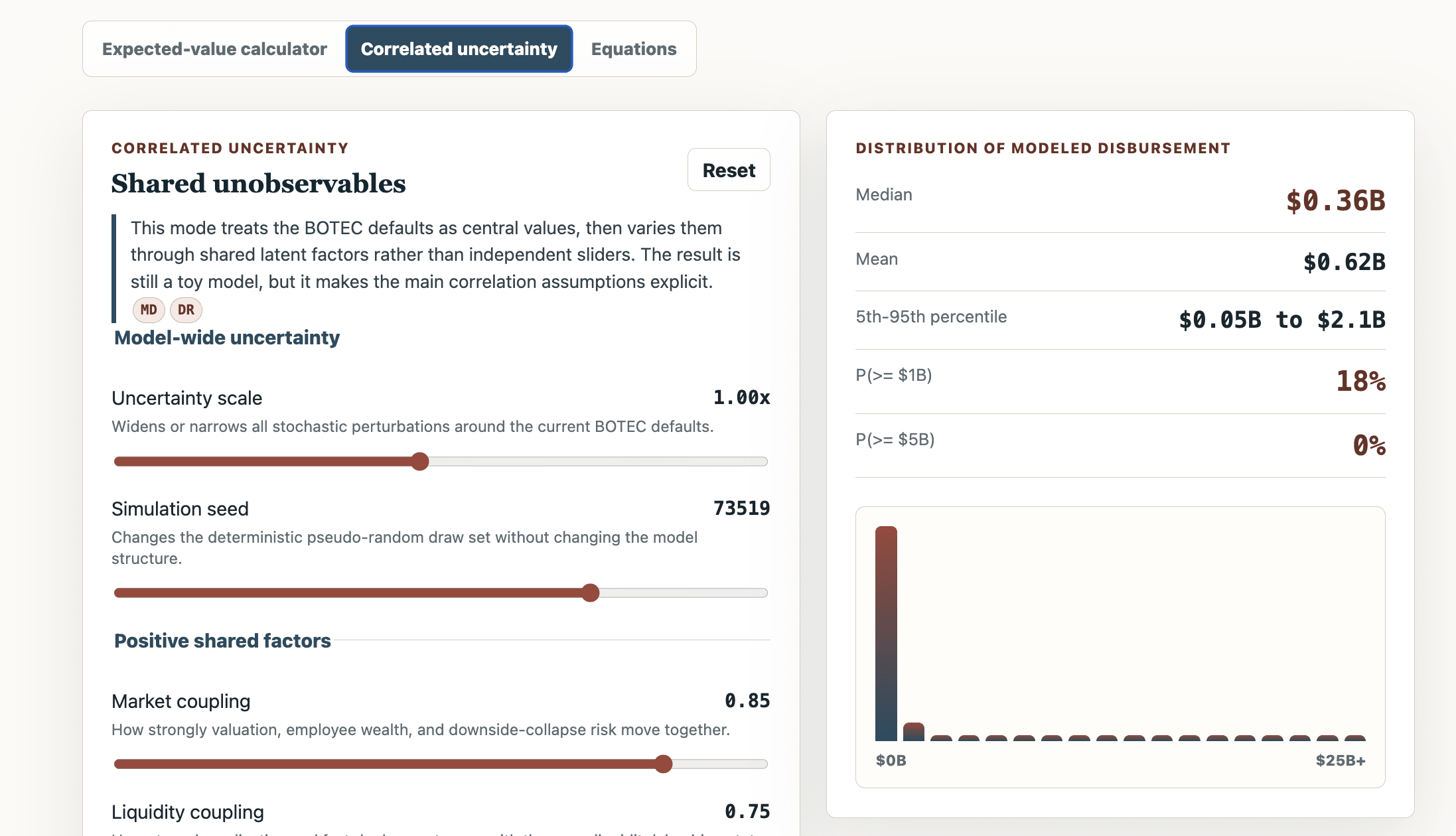
I totally agree on using distributions, that's something that can be incorporated in, I've done so in other models/interfaces like here for cultured meat. It's by no means straightforward though; the extent to which the uncertainty is dependent/correlated tends to make a big difference.
I guess I see the deterministic 'model' as more of an interface people could use as a starting point, playing around with each parameter interactively and getting a sense of how these disturbances would affect the aggregate forecast.
(Thanks. Considering each of these, will add them and discuss them in the hosted page, and then request updates.)
Added and responded to your comments on the page (the hypothesis comments), and then I asked Codex to update to these https://uj-ai-wealth-philanthropy-steelman.netlify.app/ ... I haven't inspected the latest version in detail yet, though.
Some highlights of particular interest to @MichaelDickens , Tobias, and readers/modelers
https://uj-ai-wealth-philanthropy-steelman.netlify.app/
NB it may be getting too complicated to oversee for now, we may want to simplify it
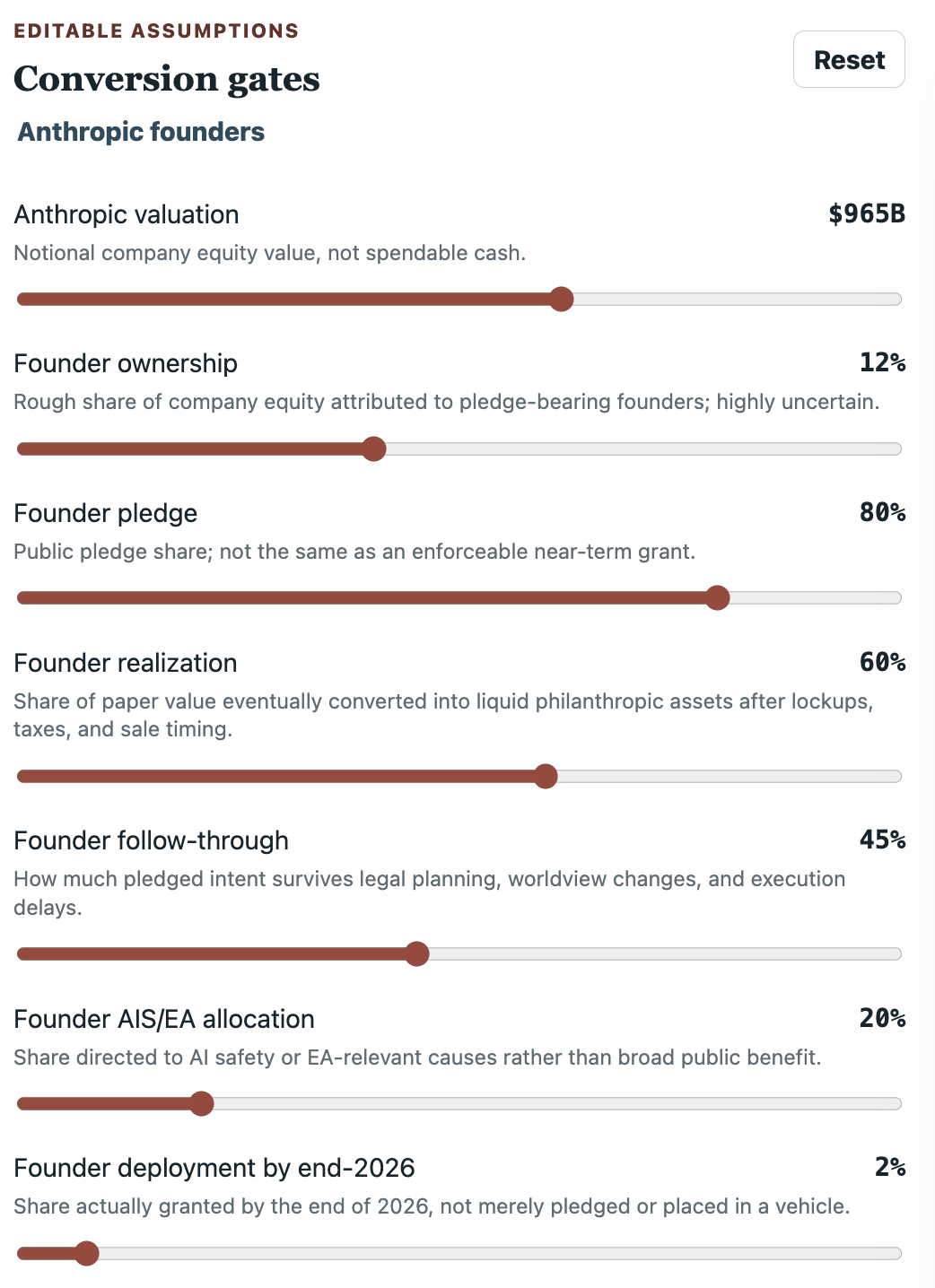
I found the 'founder deployment by end-2026' the hardest to set. It comes a bit as a surprise at the end, as I was already taking into account some considerations before, and the descriptions seem to do as well (e.g. "assets after lockups, taxes, sale timing", and "execution delays").
I submitted an estimate
having a think about this.
OK I think the revised language makes it clerer (see updated version of site ... referring to 'timing gate' etc)
Biggest (easily-fixable) outstanding issue is I still don't think it makes sense to model deployment by end-2026 because the IPO lockup probably won't have ended by then.