Summary
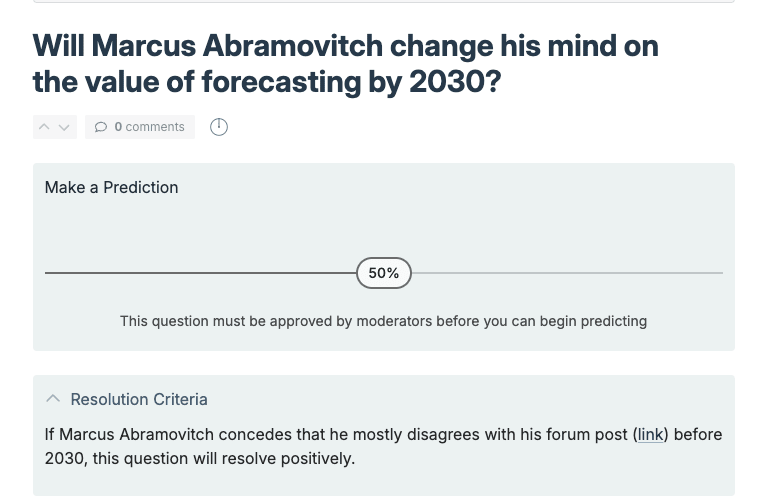
EA and rationalists got enamoured with forecasting and prediction markets and made them part of the culture, but this hasn’t proven very useful, yet it continues to receive substantial EA funding. We should cut it off.
My Experience with Forecasting
For a while, I was the number one forecaster on Manifold. This lasted for about a year until I stopped just over 2 years ago. To this day, despite quitting, I’m still #8 on the platform. Additionally, I have done well on real-money prediction markets (Polymarket), earning mid-5 figures and winning a few AI bets. I say this to suggest that I would gain status from forecasting being seen as useful, but I think, to the contrary, that the EA community should stop funding it.
I’ve written a few comments throughout the years that I didn’t think forecasting was worth funding. You can see some of these here and here. Finally, I have gotten around to making this full post.
Solution Seeking a Problem
When talking about forecasting, people often ask questions like “How can we leverage forecasting into better decisions?” This is the wrong way to go about solving problems. You solve problems by starting with the problem, and then you see which tools are useful for solving it.
The way people talk about forecasting is very similar to how people talk about cryptocurrency/blockchain. People have a tool they want to use, whether that be cryptocurrency or forecasting, and then try to solve problems with it because they really believe in the solution, but I think this is misguided. You have to start with the problem you are trying to solve, not the solution you want to apply. A lot of work has been put into building up forecasting, making platforms, hosting tournaments, etc., on the assumption that it was instrumentally useful, but this is pretty dangerous to continue without concrete gains.
We’ve Funded Enough Forecasting that We Should See Tangible Gains
It’s not the case that forecasting/prediction markets are merely in their infancy. A lot of money has gone into forecasting. On the EA side of things, it’s near $100M. If I convince you later on in this post that forecasting hasn’t given any fruitful results, it should be noted that this isn’t for lack of trying/spending.
The Forecasting Research Institute received grants in the 10s of millions of dollars. Metaculus continues to receive millions of dollars per year to maintain a forecasting platform and conduct some forecasting tournaments. The Good Judgment Project and the Swift Centre have received millions of dollars for doing research and studies on forecasting and teaching others about forecasting. Sage has received millions of dollars to develop forecasting tools. Many others, like Manifold, have also been given millions by the EA community in grants/investments at high valuations, diverting money away from other EA causes. We have grants for organizations that develop tooling, even entire programming languages like Squiggle, for forecasting.
On the for-profit side of things, the money gets even bigger. Kalshi and Polymarket have each raised billions of dollars, and other forecasting platforms have also raised 10s of millions of dollars.
Prediction markets have also taken off. Kalshi and Polymarket are both showing ATH/growth in month-over-month volume. Both of them have monthly volumes in the 10s of billions of dollars. Total prediction market volume is something like $500B/year, but it just isn’t very useful. We get to know the odds on every basketball game player prop, and if BTC is going to go up or down in the next 5 minutes. While some people suggest that these trivial markets help sharpen skills or identify good forecasters, I don’t think there is any evidence of this, and it is more wishful thinking.
If forecasting were really working well and was very useful, you would see the bulk of the money spent not on forecasting platforms but directly on forecasting teams or subsidizing markets on important questions. We have seen very little of this, and instead, we have seen the money go to platforms, tooling, and the like. We already had a few forecasting platforms, the market was going to fund them itself, and yet we continue to create them.
There has also been an incredible amount of (wasted) time by the EA/rationality community that has been spent on forecasting. Lots of people have been employed full-time doing forecasting or adjacent work, but perhaps even larger is the amount of part-time hours that have gone into forecasting on Manifold, among other things. I would estimate that thousands of person-years have gone into this activity.
Hits-based Giving Means Stopping the Bets that Don’t Pay Off
You may be tempted to justify forecasting on the grounds of hits-based giving. That is to say, it made sense to try a few grants into forecasting because the payoff could have been massive. But if it was based on hits-based giving, then that implies we should be looking for big payoffs, and that we have to stop funding it if it doesn’t.
I want to propose my leading theory for why forecasting continues to receive 10s of millions per year in funding. That is, it has become a feature of EA/rationalist culture. Similar to how EAs seem to live in group houses or be polyamorous, forecasting on prediction markets has become a part of the culture that doesn’t have much to do with impact. This is separate from parts of EA culture that we do for impact/value alignment reasons, like being vegan, donating 10%+ of income, writing on forums, or going to conferences. I submit that forecasting is in the former category.
At this point, if forecasting were useful, you would expect to see tangible results. I can point to you hundreds of millions of chickens that lay eggs that are out of cages, and I can point to you observable families that are no longer living in poverty. I can show you pieces of legislation that have passed or almost passed on AI. I can show you AMF successes with about 200k lives saved and far lower levels of malaria, not to mention higher incomes and longer life expectancies, and people living longer lives that otherwise wouldn’t be because of our actions. I can go at the individual level, and I can, more importantly, go at the broad statistical level. I don’t think there is very much in the way of “this forecasting happened, and now we have made demonstrably better decisions regarding this terminal goal that we care about”. Despite no tangible results, people continue to have the dream that forecasting will inform better decision-making or lead to better policies. I just don’t see any proof of this happening.
Feels Useful When It Isn’t
Forecasting is a very insidious trap because it makes you think you are being productive when you aren’t. I like to play bughouse and a bunch of different board games. But when I play these games, I don’t claim to do so for impact reasons, on effective altruist grounds. If I spend time learning strategy for these board games, I don’t pretend that this is somehow making the world better off. Forecasting is a dangerous activity, particularly because it is a fun, game-like activity that is nearly perfectly designed to be very attractive to EA/rationalist types because you get to be right when others are wrong, bet on your beliefs, and partake in the cultural practice. It is almost engineered to be a time waster for these groups because it provides the illusion that you are improving the world’s epistemics when, in reality, it’s mainly just a game, and it’s fun. You get to feel that you are improving the world’s epistemics and that therefore there must be some flow-through effects and thus you can justify the time spent by correcting a market from 57% to 53% on some AI forecasting question or some question about if the market you are trading on will have an even/odd number of traders or if someone will get a girlfriend by the end of the year.
Conclusion
A lot of people still like the idea of doing forecasting. If it becomes an optional, benign activity of the EA community, then it can continue to exist, but it should not continue to be a major target for philanthropic dollars. We are always in triage, and forecasting just isn’t making the cut. I’m worried that we will continue to pour community resources into forecasting, and it will continue to be thought of in vague terms as improving or informing decisions, when I’m skeptical that this is the case.

[Relevant context/COI: I'm CEO at the Forecasting Research Institute (FRI), an organization which I co-founded with Phil Tetlock and others. Much of the below is my personal perspective, though it is informed by my work. I don't speak for others on my team. I’m sharing an initial reply now, and our team at FRI will share a larger post in future that offers a more comprehensive reflection on these topics.]
Thanks for the post — I think it's important to critically question the value of funds going to forecasting, and this post offers a good opportunity for reflection and discussion.
In brief, I share many of your concerns about forecasting and related research, but I'm also more positive on both its impact so far and its future expected impact.
A summary of some key points:
More detail on some select points below. This comment already got very long (!), so I’ll reserve more elaboration for a future, more comprehensive post.
Examples of impact
Forecasting research has informed some very important decisions. Unfortunately, many of the details of the relevant evidence here cannot be made public. However, there is evidence of substantial public citation of this research, and some public evidence of affecting particular decisions.
A few examples of relevant impact include:
Some examples of more diffuse impacts — e.g., impact on public understanding of AI and research for policymakers or philanthropists, include:
For context: FRI has been operating for a little over 3 years, and we're accumulating substantially more momentum in terms of connections to top decision-makers as time goes on.
(To be clear: I am mostly discussing FRI here since it’s what I’m most familiar with.)
AI timelines, impact, and adoption forecasts drive a huge amount of career decision-making, attention, etc.
Forecasts about AI timelines and risk have had major effects on people’s career decisions and the broader AI discourse. AI 2027 underlies popular YouTube videos, 80,000 Hours advises people on career decisions based on timelines forecasts, Dario Amodei’s “country of geniuses in a datacenter by 2027” forecast informs a lot of Anthropic’s work and policy outreach, the AI Impacts survey on AI researchers’ forecasts of existential risk is highly cited, etc.
A major reason I got into this field is that many people are making very intense claims about the effect that AI will have on the world soon, and I want to bring as much rigor and reflection as possible to those claims. So far, it looks like most forecasters are substantially underestimating AI capabilities progress (with some exceptions, e.g. on uplift studies); the evidence on forecasts about AI adoption, societal impacts, and risk is less clear, but I expect we will have more evidence soon, particularly from the Longitudinal Expert AI Panel (LEAP), especially as some forecasters are predicting transformative change in the next few years.
As the expected impact and timing of AI progress is sharpened and clarified, talent and money can be allocated more efficiently.
Case study: Economic impacts of AI
In some cases, it looks to me like forecasting research is picking relatively low-hanging fruit.
The economic impact of AI is a prominent topic of public discussion right now, and it is likely that governments will spend many billions of dollars to address it in the coming years.
Currently, economists hold major sway in public policy about the economic impacts of AI. Perhaps you think top economists, as a group, are badly mistaken about the likely near-term impacts of AI, as some Epoch researchers and others believe. Perhaps you think they are likely to be fairly accurate, as Tyler Cowen, Séb Krier, or typical economists believe. It seems like a valuable common sense intervention to at least document what various groups believe, so that when we are making economic policy going forward we can rely on that evidence to determine who is trustworthy. I believe that studies like this one (and its follow-ups) will be the clearest evidence on the topic.
Relevant comparison class for forecasting research
When thinking about the impact and cost-effectiveness of forecasting, I think it’s more appropriate to compare this work to public goods-oriented research organizations (e.g., Our World in Data, Epoch, etc.) and policy-oriented think-tank research (e.g. GovAI, IAPS, CSET, etc.).
I’ve been disappointed by most impact evaluation of think-tanks and public goods-oriented research that I’ve seen. I believe this is partly because it is very difficult to quantify the impact of this type of work because it has diffuse benefits. But, I still think it’s possible to do better and I would like FRI to do better on this front going forward.
That said, I still believe there are reasonable heuristics for why this research area could be highly cost-effective. There are many billions of dollars of philanthropic and government capital being spent on AI policy topics. If there is a meaningful indication that forecasting is changing people’s views on these questions (as I believe there is; see discussion above), it seems reasonable to me to spend a very small fraction of that capital on getting more epistemic clarity.
My critiques of forecasting research
Forecasting research, and FRI’s research in particular, still has major areas for improvement.
Examples of a few key issues:
I will save other thoughts on how forecasting, and FRI’s research, could be made more useful to decision-makers for a future post.
But, to be clear: I have a lot of genuine uncertainty about whether forecasting research will be sufficiently impactful going forward. There are promising signs, and increasing momentum, but to more fully deliver on its promise, more improvements will be necessary.
Some notes on FRI-style forecasting research vs. other forecasting interventions
On the value of FRI-style forecasting research in particular:
Reasons for optimism about future impact
Finally, there are a few factors that have the potential to dramatically change the field going forward:
Stripped of all AI-centred argumentation, the reply is left mostly empty. This suggests that judgmental forecasting, at least as exercised by FRI, should perhaps be thought of as a sub-domain of AI safety. In such a case, its impact would need to be evaluated in the portfolio context of all AI safety budgets, meaning a much higher hurdle rate would have to be cleared to justify its activities.
What more broadly applies to judgmental forecasting and online betting platforms -- and is also the basis for many arguments in this defence of forecasting -- is the circular reasoning regarding the field's importance, frequently repeated by the field's own and those adjacent to it. But, in contrast to the opinionated voices, the evidence is lacking. Merely stating that forecasting has informed some policy or that career decisions have been influenced is not sufficient. Similarly, whether its impact is positive or negative is taken at face value and never substantiated.
All this isn't to say that judgmental forecasting research or its funding should be dispensed with. In fact, hybrids that combine quantitative predictive models with expert judgment are among the foundational tools of large organisations' decision-making processes. However, I believe the field's association with online betting (high time we called things for what they are) as well as over-reliance on AI for its services is actually hurting it.
Whose job is it to identify EA questions which could benefit from better forecasts?
Consider two different hypotheses:
Forecasting is only helpful for AI
Forecasting is helpful outside of AI, but AI has captured much more forecasting interest than other cause areas
How much time are non-AI org leaders spending trying to think up decision-relevant forecasts related to their cause areas?
If leaders are not spending any time trying to think up such forecasts, maybe there is low-hanging fruit here. Maybe EA has latent forecasting capability which can be tapped to improve organizational decision-making. Or maybe such forecasting capability will free up in a few years if AI turns out to be a nothingburger.
If leaders have spent a lot of time trying to think up useful forecasts, and failed, maybe forecasting really is fairly useless outside of AI.
If I was leading a non-AI EA organization, and I had a forecast I really wanted to see the result of, who would I even talk to? Which forecasting organizations are actively soliciting ideas for EA-related forecast questions?
It seems to me that a lot of what EA does is implicit forecasting in some sense, e.g. if you give someone a grant, it's an implicit forecast about the probability that they will be able to accomplish something with that grant. EA is often critiqued for neglecting "systemic change". If you want to do systemic change, being able to forecast the effects of various systemic changes is really useful. If you take any action, there's an implicit forecast that it will lead to a good outcome and not backfire somehow. Wouldn't it be better to make this forecast explicit? All else equal, wouldn't it be good to get some perspective from people outside of the organization, who are perhaps forecasting in their free time as a replacement for watching TV or other downtime activities?
My understanding of the original post's intent is that it calls for evidence of the field's impact, given the funding it receives. I don't believe it critiques judgmental forecasting as an analytical method and neither do I think that I signal this in my comment.
I stand by my opinion, however, that the community is correct to ask for tactile proof, burden of which rests on organizations that receive the funding.
I regret if this doesn't satisfy the questions in your comment.
The bulk of our funding has gone toward AI-focused forecasting projects (e.g. LEAP, AI-biorisk, economic effects of AI) or ‘automating forecasting research’-type work that has the ultimate goal of assisting decisionmakers (e.g. ForecastBench), so I think this is most of what FRI should be evaluated on.
I’m not sure what comparison class people had in mind previously, but I agree it seems broadly correct to consider this work alongside other AI-related funding opportunities. As noted above, I’d argue that it is appropriate and valuable to have “AI measurement” as an important funding domain alongside areas like “AI governance,” “Technical AI safety research,” “AI field-building,” etc. It seems valuable for one part of the AI grantmaking portfolio to be generating evidence that can be used to sharpen views on AI timelines, to assess risk in various domains (bio, cyber, catastrophic risk), to assess magnitudes of benefits (for calibrating cost-benefit analyses on policies), and to predict the likelihood and impact of various policies (e.g. the effectiveness of DNA synthesis screening for biorisk), etc. This type of fundamental research can inform and support more effective action in the other domains.
I also think forecasting research can have direct impacts on AI governance via direct decision-making partnerships like I described above: i.e., directly partnering with and advising important government agencies and frontier AI companies, among others, on high-stakes decisions related to AI regulation, implementing effective safeguards to reduce AI-cyber risk, and more. We have already seen some early impacts along these lines, as previously mentioned.
I agree. Due to confidentiality, we have primarily shared details of our impact case studies with our funders and had them assess the value of the impact we are making. Establishing evidence of impact publicly is more challenging due to confidentiality considerations. But elsewhere in the thread people have mentioned citations as one reasonable metric for evidence of impact for research organizations that have more diffuse impacts. We have targets for growing our prominent citations over time to assess our impact, and I’ve shared examples of prominent citations to FRI research in my comment above. I also hope that over time, we can share more case studies publicly and provide more of the reasoning for why we believe we had an impact and whether it was positive. The benchmarks RFP case study described above is one example that can be discussed relatively publicly.
I broadly agree on these points. We are running longitudinal expert panels, partnering with important institutions to improve their decision-making, and automating forecasting research, so I see our work as distinct from online betting/forecasting platforms.
Hi Josh, thanks for the response.
I hate to do this, especially at the start, but I want to point out for you and others who have jobs related to forecasting that it's difficult to convince someone of something when their job relies on them not believing it. I think you should assume that you will think forecasting is more useful than it is.
As for your points, I'll respond to some of them.
Not Josh, and also conflicted through the Social Science Prediction Platform (though we had pretty minimal funding from EA sources), but I wonder if it would be worth pooling non-public projects we know of and making BOTE estimates of hypothetical impact. It’s tricky because I don’t know of any RCTs (though I’m working on one now). But I’m extremely confident that across us we would think of some combination of orgs/governments that collectively spend over $100 billion per year (… I can think of that alone) that are interested in forecasts in different ways. Now, imo the vast majority of places interested in forecasting are not going to do anything substantive with it, and it’s hard to know what it means for one of these places to integrate forecasts - for example, for an org spending $X, do forecasts inform 1% of their funding or what? Of the share they inform, how much do they move the needle? If estimates from people who work on forecasts may be optimistic (I'm not paid at all for it, but I choose to work on it because I think it’s useful), happy to describe the situation to an outside observer privately.
Hi Eva,
I think the Social Science Prediction Platform (alongside a friend of mine who is doing something similar for clinical trials) are among the more interesting uses of forecasting/PMs but I'm skeptical they will be uptaken to the degree/impact you might hope for.
I'm skeptical of things of the form "small percentage chance * big number". I think humans are really bad at estimating small percentages.
Would be happy to talk privately about any situations you are thinking of.
Thanks! I agree, I'm also generally skeptical of small chance * big number things - I was not intending 1% as an anchor but as an open question - and not as a probability but as a concrete percent of the funding. For example, a big org uses forecasts, but perhaps they only use them in particular workstreams responsible for X% of funding, and those workstreams could be tracked. Then out of X%, how much do they move the needle?
Anyway, happy to chat sometime!
(COI flag: I have an application out with FRI)
"Prediction markets are increasingly being cited by government officials, and the public is paying more attention to them than ever before. Much of the impact for prediction markets specifically seems negative (e.g. via incentivizing gambling on low-value topics), but the broader cultural shift suggests there may be an opportunity for better uses of forecasting to enter public consciousness as well."
I think that this is a reason for pessimism on impact, not optimism. Kalshi and Polymarket are primarily sports gambling platforms by volume, immune to state regulation for reasons that may, in the perspective of a cynic, be related to them paying Donald Trump Jr. undisclosed sums of money for undisclosed quantities of work. This does not, I think, inspire particular trust in their efficacy or accuracy. The new legislative push could shift this (I haven't dug into it deeply), but by default I expect the shift from "odd thing some experts claim is good" to "the tool for corruption, leaking military secrets, insider trading, and sports gambling" to worsen perceptions of accuracy (broadly defined halo effect).