Comments
I appreciate this post, thanks for sharing it!
I disagree with — or feel pretty unsure about — some notable parts/interpretations of the post, and that's what this comment is focused on.[1] But I agree with some other parts, especially the specific suggestions for organization-level policies, and really like this point:
One of the things that I notice about "perks" is that they tend to shift individual lifestyle choices about how to spend your personal money into org-level decisions. I'm advocating for lots of these decisions to stay at the individual level rather than standardizing on them.
I also quite like the suggestion to make "a cultural distinction between "perks" and "business expenses" and the nudge towards transforming some ~perks for employees into services (asking people to pay, and then potentially paying more in salaries). (I should note that I haven't thought about this a lot.)
...
Disagreements with a broad interpretation of the message of the post (something like: "~be more frugal / avoid perks")
This feels like a "reverse any advice you hear" situation, potentially: one in which different people are drawn to different/opposite pitfalls, and advice targeted at some people is counterproductive to others.
My rough sense is something like:
- Biased over-justification of ~luxuries/perks is in fact a problem in EA (or has been) (I'm not sure about the frequency/extent). So some people should hear a message like: "be more suspicious of perks" or "let's be more frugal."
- Example reason for this: it's easy for people to tell themselves that something is a productivity boost, etc.
- I think the "zooming out" motion (mentioned in the post) is useful to ground our actions in something more real — it's easy to be swept up in grand arguments.
- And I worry that people fall prey to fake options or fake tradeoffs in a way that also pushes in this direction (I remember seeing some good discussion about this, but can't find it right now).
- The basic point is that some decisions are framed as a worktime-vs-money tradeoff incorrectly.
- E.g. the decision: "should you take an Uber or public transit?" If you take the Uber you'd just have an extra hour but it's not always an extra hour of proper work time and you might be counting it as if it's at least as good as the average hour of your work.
- (There's also this post on time-time tradeoffs.)
- The basic point is that some decisions are framed as a worktime-vs-money tradeoff incorrectly.
- (There's a lot more on frugality, including this post, which has some interesting points: Ways Frugality Increases Productivity)
- But it's also true that the "make time-money tradeoffs deliberately, charity cost-effectiveness is not about overhead, etc." meme has been/can be really helpful in some ways. And different people are on different sides of what seems reasonable on the "how frugal to be" spectrum, so I also think that some people should feel more allowed to accept/offer things that look like perks.
- There's a lot of writing about this (including your own :) ), which I assume is part of what's caused EA to have this meme.
- But some basic benefits of the mentality/approach might be worth flagging again:
- Lots of really useful purchases/services feel like "perks" or "luxuries" to some people who instinctively avoid them (or feel like they'll be judged).[2] It seems quite helpful to nudge some people to get those. Examples, most of which I've used and needed pushing for:
- Noise-canceling headphones, a travel keyboard/mouse, a better computer than a 4-year-old computer
- Wifi or an improved office setup
- Good clothes that make people look more professional if they're in a field that has codes about things
- Therapy
- Some paid apps/subscriptions (e.g. Text Blaze, Zapier, ChatGPT, Cold Turkey, OnePassword, SavvyCal, etc.)
- Stuff like the above is generally approached as a time-money tradeoff, but I think there are also costs to frugality like "someone just doesn't do something that would have been useful because they were blocked by the feeling that it's not frugal" (e.g. going to an event)
- Other things, like ~recruitment for specific projects, which discussed more elsewhere (e.g. here)
- Lots of really useful purchases/services feel like "perks" or "luxuries" to some people who instinctively avoid them (or feel like they'll be judged).[2] It seems quite helpful to nudge some people to get those. Examples, most of which I've used and needed pushing for:
Other thoughts prompted by the post:
- Salaries
- My weak impression is that lots of EA positions pay less what the people in them would probably be able to get outside of EA/philanthropy. (These positions also often have many benefits, like nice coworkers, which might be ignored, but still.) I don't know if you're implying (or if you believe) otherwise.
- In some cases, we have projects/roles where we just want to hire the most qualified person we can, and something like value alignment is not a serious consideration. I think maybe sometimes "how will this affect culture" is not considered enough, but sometimes this probably doesn't matter much.
- Childcare and family support are a big deal for some people. (When I personally think about how I am/will be trading personal happiness/comfort and ~impact, this is a big consideration. Related thread, and there are probably others.)
- It seems possible that a culture-first approach to looking at the problems you've listed here would be more productive than a perks-first approach. (I'm unsure, but maybe approaching this from the POV of perks is privileging the question too much; implies that the strategy of how to deal with perks is a key part of creating a healthy culture.)
- E.g. maybe we'd then discuss stuff like:
- How transparent and public to be about mistakes (both in terms of how much employees should do this within the org, and in terms of how much the org should do this)
- Social relationships among staff, and how they affect things
- How much should people be doing exclusively work that they like (e.g. because they're likely better at it)? How much of the work should be in a kind of hero mentality?
- How can we make sure that we're avoiding motivated reasoning about our projects being effective (what a lot of people tie a lot of feelings and personal status/assessment to) when they aren't
- How rigid should employees and employers be about work/personal-life boundaries
- How to encourage people to try high-upside/EV (and no-big-downside-risk) things even if the default option is that the project will mostly look mediocre/like a failure
- Relatedly: For the "signals you might send instead" section (or how it's presented), maybe it should be clearer that avoiding perks doesn't actually send all the positive signals listed there (please correct me if I've misinterpreted, but my guess is that this is supposed to be something more like an overview of what signals could be good to send)
- E.g. maybe we'd then discuss stuff like:
Again, thanks a bunch for writing this! I appreciated it and the discussion it's sparking.
- ^
I'll stress a few qualities of the post (not an exhaustive list) that I particularly appreciate: the post is generally really thoughtful and nuanced — you communicate uncertainty and you note stuff like "the best ideas are certainly going to be specific to your team or organization's goals and existing culture", I like that the focus is on culture (vs hard-to-fake signals), I love the productive spirit (suggestions!), specific examples, shared lessons from Wave (and potentially even better — sharing uncertainties about Wave), etc.
- ^
Here's an older list of "what stops EA-aligned people from spending money on themselves."
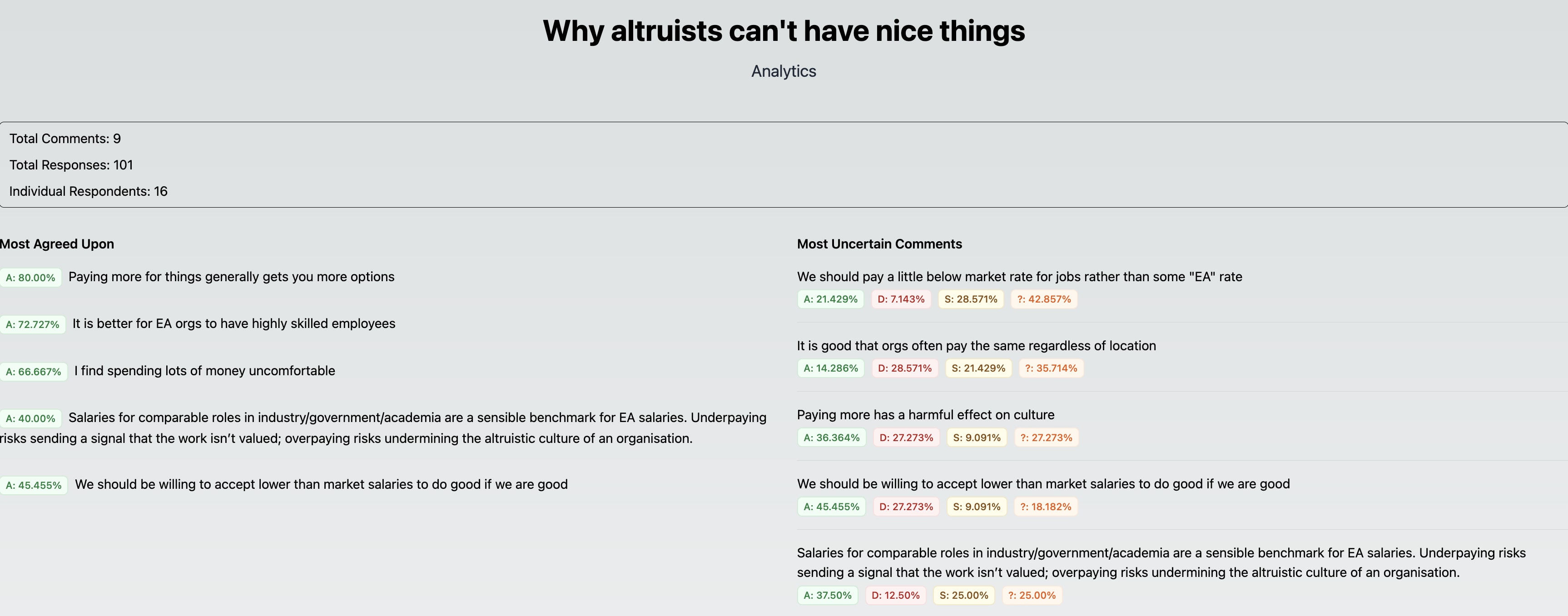


I think this principle is important, but question using Amazon as a positive counter example, and I think the reasons why are indicative of why this is hard.
My Amazon info is out of date. But back in 2015 I had many friends there, and it was a miserable place to work. The at-desk crying was past its peak, but stupid applications of frugality were so common they had a word for it (frupid).
Highly paid developers were given underpowered laptops that slowed down their work. The savings on the laptops were clearly OOM less than the cost of the developers time (even though Amazon paid less than other bigtech), but they wanted to send a message to employees. They would occasionally spend more money for a worse solution because it signaled frugality, like door desks that cost than real desks.
And that's for highly paid developers. Amazon requires warehouse employees leave all valuables in cubbies rather than bring them on the floor, but won't buy locking lockers for them.
The overwhelming message from Amazon is "fuck you, we will hurt our own interests rather than make your life easier".
Maybe this level of malice is necessary to maintain mission alignment. Maybe it's necessary with programmers spoiled by perks, but not other office staff (my non-programmer friend at Amazon Offices tend to find Amazon no worse than their last employer, maybe better, and with a salary boost that buys a lot of forgiveness). But I do think it's important to track what it takes.
Especially because EA has an ~extractive thread through it. Things like paying only enough to get by, while having a work set up that will require periods of non-payment, such that you have to spend down runway acquired elsewhere. I'd much rather solve this by paying fulfilling salaries, in part to spare us all debates about what counts as a necessary work expense, but it's important the salary be based on demands as a whole and not cherrypicked bits of the demands.