Let's imagine a story.
- I am a mid- to upper-ranking member of OpenAI or Anthropic.
- I offload some of my shares and wish to give some money away.
- If I want to give to a specific charity or Coefficient, fair enough.
- If I am so wealthy or determined that I can set up my own foundation, also fair enough.
- What do I do if I wish to give away money effectively, but don't agree with Coefficient’s processes, and haven't done enough research to have chosen a specific charity?
Is EA prepared to deal with these people?
Notably, to the extent that such people are predictable, I feel like we should have solutions before they turn up, not after they turn up.
What might some of these solutions look like, and which of them currently exist?
Things the Currently exist
Coefficient Giving
It's good to have a large, trusted philanthropy that runs according to predictable processes. If people like those processes, they can just give to that one.
Manifund
It's good to have a system of re-granting and such that wealthy individuals can re-grant to people they trust to do the granting in a transparent and trackable way.
The S-Process
The Survival and Flourishing Fund has something called the “S-process” which allocates money based on a set of trusted regranters and predictions about what things they’ll be glad they funded. I don’t understand it, but it feels like the kind of thing that a more advanced philanthropic ecosystem would use. Good job.
Longview Philanthropy
A donor advice service specifically caters to high net worth individuals. I haven't ever had their advice, but I assume they help wealthy people find options they endorse giving through.
Things that don’t exist fully
A repository or research (~EA forum)
The forum is quite good for this, though I imagine that many documents that are publicly available (Coefficient's research etc) are not available on the forum and then someone has to find them.
A philanthropic search/chatbot
It seems surprising to me that there isn't a winsome tool for engaging with research. I built one for 80k but they weren’t interested in implementing it (which is, to be clear, their prerogative).
But let’s imagine that I am a newly minted hundred millionaire. If there were Qualy, a well trusted LLM that would link to pages in the EA corpus and answer questions, I might chat to it a bit? EA is still pretty respected in those circles.
A charity ranker
As Bergman notes, there isn’t some clear ranking of different charities that I know of.
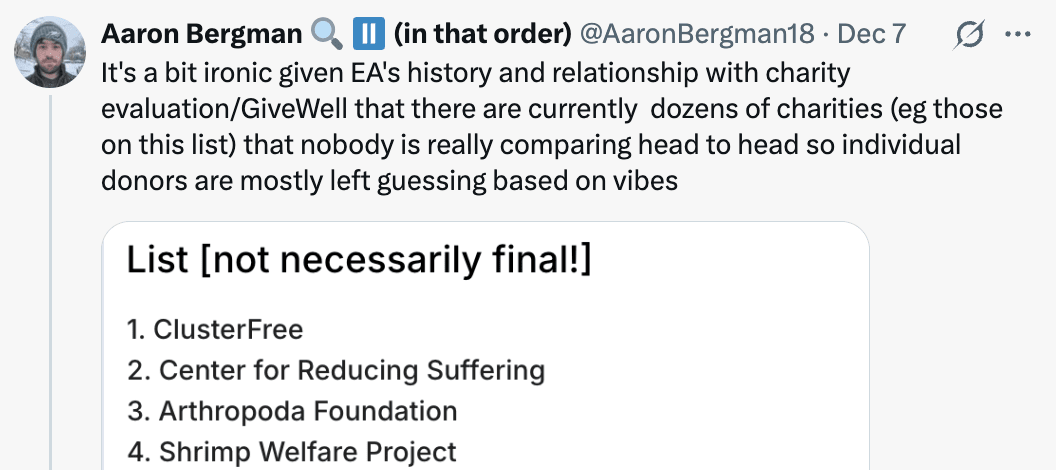
Come on folks, what are we doing? How is our wannabe philanthropist meant to know whether they ought to donate to AI, shrimp welfare or GiveWell. Vibes?
I am in the process of building such a thing, but this seems like an oversight.
Why is there not a page with legitimate criticisms of EA projects, people and charities that only show if people from diverse viewpoints agree with them.
I think this one is more legitimately my fault, since I’m uniquely placed to built it, so sorry about that, but still, it should exist! It is mechanically appropriate, easy to build and the kind of liberal, self-reflective thing we support with appropriate guardrails.
A way to navigate the ecosystem
There is probably room for something which is more basic than any of this that helps people decide whether or not they probably want to give to give well or probably to Coefficient Giving or something else. My model is that for a lot of people, the reason they don't give more money is because they see the money they're giving as a significant amount, don’t want to give it away badly but don’t want to put in a huge amount of effort to give it well.
One can imagine a site with buzzfeed style questions (or an LLM) which guides people through this process. Consider Anthropics recent interviewing tool. It’s very low friction and elicits opinions. It wouldn't, I think, be that hard to build a tool which, at the end of some elicitation process, gives suggestions or a short set of things worth reading.
This bullet was suggested by Raymond Douglas, though written by me.
A new approach
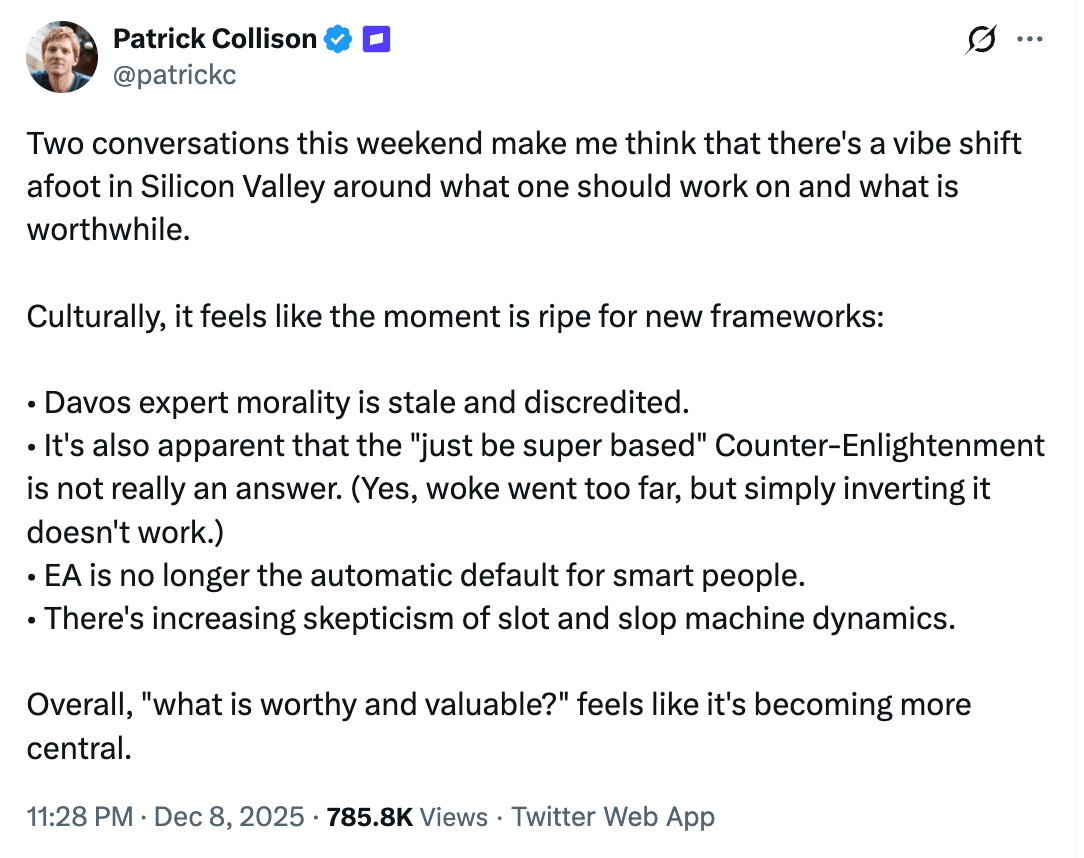
Billionaire Stripe Founder Patrick Collison wrote the following. I recommend reading and thinking about it. I think he’s right to say that EA is no longer the default for smart people. What does that world look like? Is EA intimidated or lacking in mojo? Or is there space for public debates with Progress Studies or whatever appears next? Should global poverty work be split off in order to allow it to be funded without the contrary AI safety vibes?
I don’t know, but I am not sure EA knows either and this seems like a problem in a rapidly changing world.
There is a notable advantage for a liberal worldview that is no longer supreme in that we can ask questions we are scared of the answer or of tell people to return when they find stuff. EA not being the only game in town might be a good thing.
Imagine that 10 new EA-adjacent 100 millionaires popped up overnight. What are we missing?
It seems pretty likely that this is the world we are in, so we don’t have to wait for it to happen. If you imagine, for 5 minutes that you are in this world, what would you like to see?
Can we built it before it happens, not after.
Should you wish to fund work on a ranking site or EA community notes, email me at nathanpmyoung[at]gmail.com or small donors can subscribe to my substack.
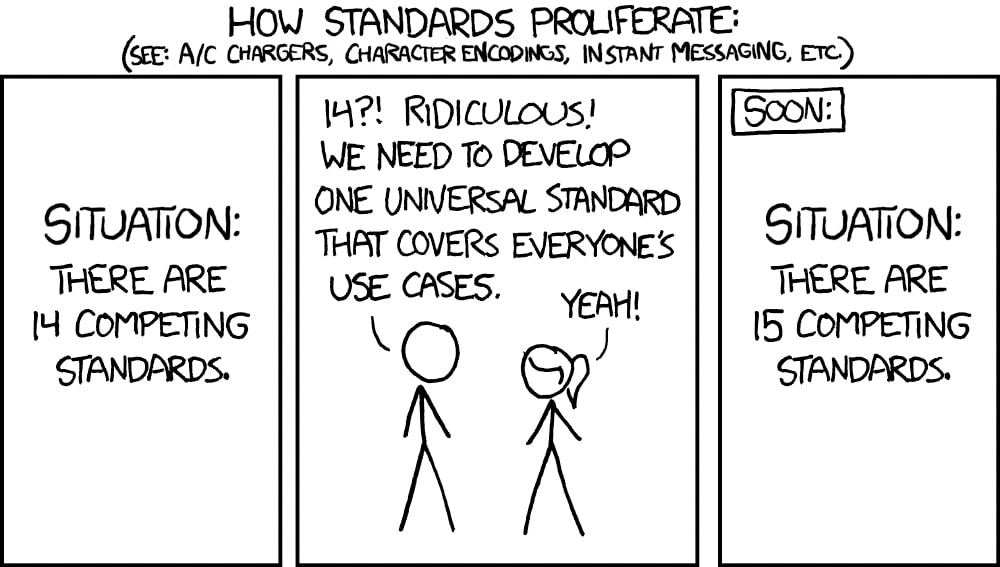
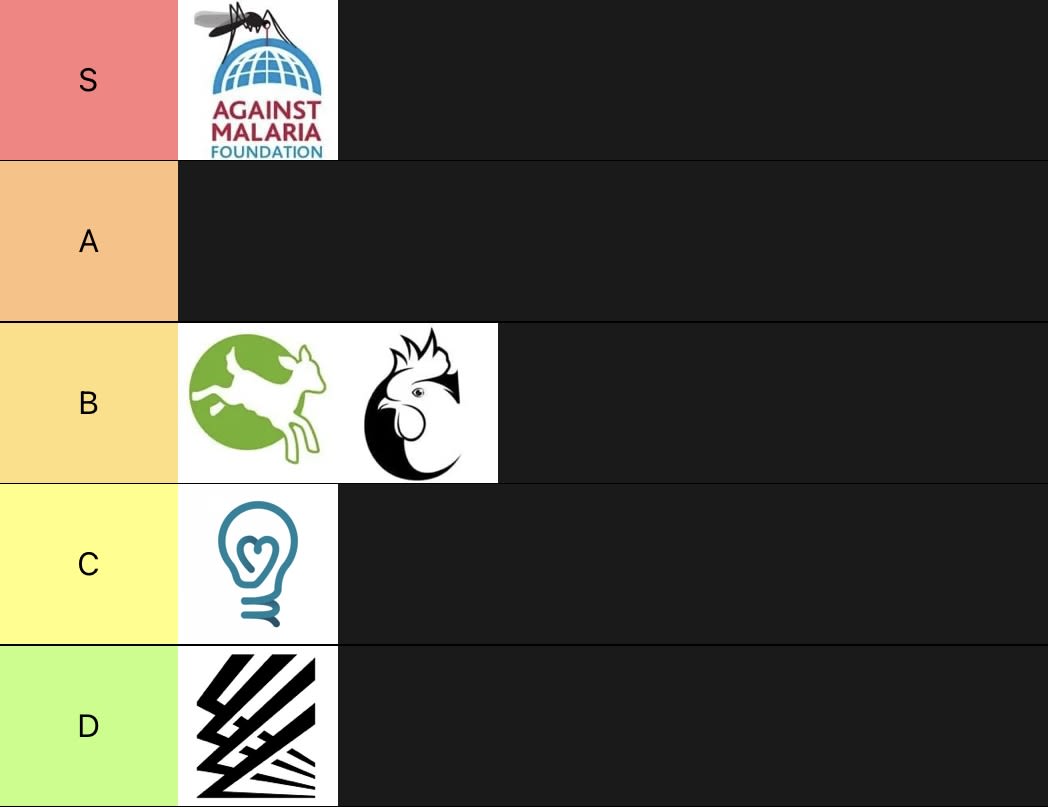



I think the moment you try and compare charities across causes, especially for the ones that have harder-to-evaluate assumptions like global catastrophic risk and animal welfare, it very quickly becomes clear how impossibly crazy any solid numbers are, and how much they rest on uncertain philosophical assumptions, and how wide the error margins are. I think at that point you're either left with worldview diversification or some incredibly complex, as-yet-not-very-well-settled, cause prioritisation.
My understanding is that all of the EA high net worth donor advisors like Longview, GiveWell, Coefficient Giving, (the org I work at) Senterra Funders, and many others are able to pitch their various offers to folks in Anthropic.
What has been missing is some recommended course prio split and/or resources, but that some orgs are starting to work on this now.
I think that any way to systematise this, where you complete a quiz and it gives you an answer, is too superficial to be useful. High net worth funders need to decide for themselves whether or not they trust specific grant makers beyond whether or not those grant makers are aligned with their values on paper.
Naaaah, seems cheems. Seems worth trying. If we can't then fair enough. But it doesn't feel to me like we've tried.
Edit, for specificity. I think that shrimp QALYs and human QALYs have some exchange rate, we just don't have a good handle on it yet. And I think that if we'd decided that difficult things weren't worth doing we wouldn't have done a lot of the things we've already done.
Also, hey Elliot, I hope you're doing well.
Oh, this is nice to read as I agree that we might be able to get some reasonable enough answers about Shrimp Welfare Project vs AMF (e.g. RP's moral weights project).
Some rough thoughts: It's when we get to comparing Shrimp Welfare Project to AI safety PACs in the US that I think the task goes from crazy hard but worth it to maybe too gargantuan a task (although some have tried). I also think here the uncertainty is so large that it's harder to defer to experts in the way that one can defer to GiveWell if they care about helping the world's poorest people alive today.
But I do agree that people need a way to decide, and Anthropic staff are incredibly time poor and some of these interventions are very time sensitive if you have short timelines, so that just begs the question: if I'm recommending worldview diversification, which cause areas get attention and how do we split among them?
I am legitimately very interested in thoughtful quantitative ways of going about this (my job involves a non-zero amount of advising Anthropic folks). Right now, it seems like Rethink Priorities is the only group doing this in public (e.g. here). To be honest, I find their work has gone over my heard, and while I don't want to speak for them my understanding is they might be doing more in this space soon.
Hi Elliot and Nathan.
I think being able to compare the welfare of shrimps and humans is far from enough. I do not know about any interventions which robustly increase welfare in expectation due to dominant uncertain effects on soil animals. I would be curious to know your thoughts on these.
I believe there is a very long way to robust results from Rethink Priorities' (RP's) moral weight project, and Bob Fischer's book about comparing welfare across species, which contains what RP stands behind now. For example, the estimate in Bob's book for the welfare range of shrimps is 8.0 % that of humans, but I would say it would be quite reasonable for someone to have a best guess of 10^-6, the ratio between the number of neurons of shrimps and humans.
Maybe I'm being too facile here, but I genuinely think that even just taking all these numbers, making them visible in some place, and then taking the median of them, and giving a ranking according to that, and then allowing people to find things they think are perverse within that ranking, would be a pretty solid start.
I think producing suspect work is often the precursor to producing good work.
And I think there's enough estimates that one could produce a thing which just gathers all the estimates up and displays them. That would be sort of a survey or something, which wouldn't therefore make it bad in itself even if the answers were sort of universally agreed to be pretty dubious. But I think it would point to the underlying work which needs to be done more.
How different is that from ranking the results from RP's cross-cause cost-effectiveness model (CCM)? I collected estimates from this in a comment 2 years ago.
I think one of the challenges here is for the people who are respected/have a leadershipy role on cause prioritisation, I get the sense that they've been reluctant to weigh in here, perhaps to the detriment of Anthropic folks trying to make a decision one way or another.
Even more speculative: Maybe part of what's going on here is that the charity comparison numbers that GiveWell produce, or when charities are being compared within a cause area in general, is one level of crazy and difficult. But the moment you get to cross-course comparisons, these numbers become several orders of magnitude more crazy and uncertain. And maybe there's a reluctance to use the same methodology for something so much more uncertain, because it's a less useful tool/there's a risk it is perceived as something more solid than it is.
Overal I think more people who have insights on cause prio should be saying: if I had a billion dollars, here's how I'd spend it, and why.
I see some value in this. However, I would be much more interested in how they would decrease the uncertainty about cause prioritisation, which is super large. I would spend at least 1 %, 10 M$ (= 0.01*1*10^9), decreasing the uncertainty about comparisons of expected hedonistic welfare across species and substrates (biological or not). Relatedly, RP has a research agenda about interspecies welfare comparisons more broadly (not just under expectational total hedonistic utilitarianism).
I definitely think this should happen too, but reducing uncertainty about cause prio beyond what has already been done to date is a much much bigger and harder ask than 'share your best guess of how you would allocate a billion dollars'.
When people write about where they donate, aren’t they implicitly giving a ranking?
Sure but a really illegible and hard to search one.
100 years of progress in the science and philosophy of consciousness should settle it. Start by reading a few books on the subject a year for a few years.
I recommend starting with Consciousness Explained by Daniel Dennett. It's one of my favourite books.
Professional philosophers don't even agree on whether dualism, eliminativism, functionalism, identity theory, or panpsychism is true, despite decades of scholarship, so don't expect to quickly find a consensus on finer-grained questions like how to quantify and compare shrimp consciousness (and whether it exists in the first place) to human consciousness. Even if you can form your own view to your own satisfaction within a year, it's unlikely that you'll convince many others that you're right.
On the other hand, you might succeed where thousands of others haven't, and become hailed as one of the greatest living philosophers/scientists.
Hi this is the second or third of my comments you've come and snarked on. I'll ask again. Have I upset you that you should talk to me like this?