[Cross posted from my substack]
In their EA Forum post last year, CEA described their ‘principles-first approach to stewardship of the EA community’.
I'm a big fan of principles-first stewardship in principle. I think EA needs a steward, and I think that stewardship should be organised around EA's core principles.
But I think CEA’s particular growth-centric approach to principles-first stewardship is stewarding EA in the wrong direction.
I think that: The key question for principles-first stewardship should be "Is EA a place that embodies and nurtures EA principles?" I think there are serious reasons to worry that it isn't such a place - that EA has become more ideological and less truth-seeking over time, and that growth focused approaches to community building like CEAs are a big part of the reason why.
A summary of my main points:
- It seems to me that EA is dying. I’m less concerned here about growth metrics, and more concerned about the health of EA as a community and a moral/ intellectual project. It seems to me that EA is losing its question-nature, and also has become something that people are less and less willing to stand behind or participate in.
- Growth is not "Community Building 101". In EA it’s often assumed that the default way to build a community is to focus on growth. I think this is wrong, there are many ways to approach community building that don’t have this focus. And more importantly, I think that part of the cause of EA ‘dying’, is the strong focus on growth. This is because…
- The 'growth funnel' approach to EA community building is in tension with open truth-seeking. In practice, this approach involves funnelling people towards particular answers to ‘How can I do the most good’. If that’s the case it stops being an open or ‘living question’ - the bottom lines in EA are often in practice already written.
- EA community building doesn't serve the people who most deeply practice EA principles. Many experienced EAs are disengaged from the community and reluctant to identify with it. I think this is partly because EA community building isn't for them, and partly because EA isn't functioning well as a place that embodies EA principles. I think the focus on growth is a contributing factor to both of these things.
- FTX was a trust problem, not just a brand problem. Framing it as a branding problem leads to a strategy focused on communications and perception, when the deeper question is whether EA is worthy of the trust people place in it.
- CEA’s brand strategy is in tension with open truth-seeking. On a deeper level, it seems to me that CEA’s brand strategy involves constructing a positive narrative about EA at the expense of an accurate one. I think this is a mistake.
I worked at CEA from 2016 - 2021 on the EA Groups team and then again from 2025 - March 2026 as a Fund Manager at the EA Infrastructure Fund.
My views are informed by my time at CEA and in EA community building more broadly, though this post focuses on CEA's public strategy rather than internal information from working at CEA.
The EA community is something I care a lot about, and my guess is the same is true for all those working at CEA. Because of this I’ve been hoping to write a piece that is more ‘constructive disagreement in service of building a better community’ rather than ‘criticism’.
I think I haven’t succeeded at that - when reading the piece back it feels more combative than I would like. I’m sorry for that. This piece has been a challenge to write and ultimately it feels like a choice between publishing it as is or not at all. I’m hoping that it’s still worth posting even if the framing is more critical than I want it to be.
I’m aiming for strongly stated, weakly held.
I’m also grateful to Claude as well as multiple humans for feedback they’ve given on this piece.
It seems to me that EA is dying
The ‘Growing the EA Community’ section of CEA’s 2026 progress report gives metrics for growth across CEA’s engagement funnel, and also includes the following comment:
Anecdotally at least, it seems that we have already been largely successful in moving beyond narratives about the “death” of EA. I had a journalist tell me at the beginning of 2025 that they wanted to write a piece about how EA isn’t dead, but they couldn’t because they didn’t have the data to back it up; now we have receipts.
I think that, sadly, EA is in fact dying.
Though the kind of death I’m worried about isn't primarily about declining membership or engagement metrics. It's about the health of EA as a community and as a moral and intellectual project.
EA as a question
A common way of describing EA is as a ‘question, and not an ideology’. And EA’s question-nature seems to be a core part of what EA is - if EA were to become ideological, it would in an important sense no longer be EA.
But EA seems increasingly ideological to me, it seems to be a lot less concerned with asking and answering a genuinely open question, and a lot more concerned with causing people to follow established paths to impact.
I don't think I'm alone in having these concerns. A 2022 twitter poll found 70% of respondents saying "yes" to "Is effective altruism an ideology?"
Kerry Vaughan, previously Head of EA Grants and Individual Outreach at CEA, made a similar claim on twitter in 2022.
Any community organised around shared principles will, to some degree, converge on shared conclusions and perspectives - being completely non-ideological seems impossible, or at least the wrong target to aim for.
That said, I think the convergence that does exist within EA is increasingly better explained by social dynamics - selection effects, incentive structures, and how community building is implemented - than by open truth-seeking and application of EA principles, and EA is becoming more ideological over time.
It also seems to me that EA is dying as a community. For example:
- People are often reluctant to identify as EAs, and instead describe themselves as ‘EA-adjacent’. EA does not seem to be something that people seem willing to stand for or behind, especially for people who have been around EA for longer.
- Longer-standing EAs also don’t seem to engage much with EA infrastructure. Of the EAs I know who've been around for a while, I don't know any who are part of a local group, and only a small handful actively engage on the Forum.
- When people do engage with EA infrastructure, eg. attending EAG and so on, it seems to be less because EA is something that they are excited about/ care about, and want to participate in and contribute to - and more because engaging with EA is going to be in some way instrumentally beneficial.
- Many past leaders of EA no longer seem to support it, and many seem to actively disavow it.
Various posts which inform my conception of EA death
In her post Ayn Rand's model of "living money", Anna Salamon describes how processes can ‘lose their relationship to the unknown’, for example scientists that ‘get stuck defending some fixed theory’. I worry that EA is a process that is losing its touch with the unknown.
In his post On Sincerity, Joe Carlsmith differentiates between ‘fake’ and ‘real’ ways of asking a question ‘Should I do x?’. I worry that the question ‘How can I do the most good?’ as asked in EA contexts, is becoming increasingly less ‘real’.
In his post Geeks, Mops and sociopaths in subculture evolution, David Chapman gives a model of the lifecycle of subcultures, and describes how they can go from generative to hollow and focused on resource acquisition. I worry that EA is becoming less generative and more hollow in this way.
In the EA of yesteryear, people often discussed potential failure modes — dilution, ossification, disconnect between leadership and community (eg. see Rebecca Baron's post on movement collapse scenarios). My sense is that several of these are now actively playing out.
CEA's strategy post:
‘The cornerstone of momentum will be growth: this is Community Building 101’
This seems wrong to me.
Of other communities that I'm part of or know of, few focus strongly on growth, if at all (I like Richard Bartlett's writing on microsolidarity as an example of an approach to community building which isn't centred on growth).
If I had to complete 'growth is ___ 101', my answer would be 'startups'.
It seems to me that startup philosophy has heavily shaped how EA approaches community building. Both CEA and 80,000 Hours participated in Y Combinator. The main model for EA community building is the "engagement funnel." Strategy discussions are framed in terms of metrics, users, product-market fit, and scaling.
But building a truth-seeking community is quite different from building a startup. In particular, startups optimise for a legible, quantifiable goal - revenue, users, growth. "Doing the most good" is a lot less legible and quantifiable, and treating it like a startup metric is liable to run into Goodhart's Law: when a proxy for some value becomes the target of optimisation pressure, the proxy will cease to be a good proxy.
A big part of my story of the cause of death for EA: community building has focused on proxies like 'career changes,' and that focus has undermined the community's integrity as a place of open truth-seeking (more on this in the next section).
The growth funnel model is in tension with open truth-seeking
Targeting high impact careers and donations
A main focus of EA community building is growing EA's resources - talent and funding flowing into organisations viewed as high impact or EA aligned. Community building is often judged successful based on whether these goals are achieved.
There's a big tension here with EA being a community of open truth-seeking. If the purpose of the community is to funnel people toward conclusions that community builders have already reached, then "How can I do the most good?" isn't really an open question - the bottom line is already written.
An example of this - when I managed CEA's Community Building Grants programme (2018–2021), the main way we evaluated grants and made decisions about additional funding was through evaluating case studies - instances where a group member had gone on to land a role that was potentially impactful.
In retrospect, I think this was a mistake. This meant a setup where group organisers had a strong incentive to push members toward careers we'd recognise as "highly impactful," regardless of whether they agreed with the assessment or whether it made sense for the individual. It’s difficult to tell exactly what effect this had, though I imagine this put group organisers in a difficult position.
For example, group organisers often did 1-1 career advising, and I expect it to be very tricky to maintain openness about what career an advisee should do when their conclusion affects whether you will or won't receive further funding (if I knew a university guidance counselor’s job was dependent on people going into specific careers, I’d be very wary about students going to them for career support).
(My sense is that evaluating community building in this way is still relatively common practice, though I don’t actually know this to be the case)
As per the Peter Singer quote, "Beginning to reason is like stepping onto an escalator that leads upward and out of sight. Once we take the first step, the distance to be travelled is independent of our will and we cannot know in advance where we shall end." But within the EA funnel, we often have a pretty good guess of where people will end - in large part because the funnel is designed to take them there.
Not all EA community building metrics are about "high impact careers." Some target engagement itself - people becoming engaged EAs, growth of particular programmes, attendance at events. I think these are less distorting than career-change metrics, but similar problems can arise. It may not always be the most impactful thing for a given person to engage more deeply with EA. And growth of engagement metrics is only good if the ecosystem people are engaging with is actually functioning well.
Selection effects
Even without explicit growth efforts, communities naturally select for people who conform to the community's worldview - not just those who share its underlying principles. Eliezer Yudkowsky's Evaporative Cooling of Group Beliefs describes the basic dynamic.
The EA worldview includes:
- Explicit beliefs - eg. the importance of AI safety, animal welfare, global health
- Implicit assumptions - eg. a preference for quantitative methods, framing things in terms of economic theory, particular epistemological commitments. (see James Fodor's Effective Altruism is an Ideology, not (just) a Question for more on this)
- Principles - eg. scout mindset, impartiality etc.
Many people are genuinely committed to EA principles but don't share the full worldview - either the explicit conclusions or the implicit assumptions.
These people tend to get filtered out through subtle mechanisms. They're perceived as less "EA-aligned." They feel less of a sense of belonging. They're seen as weaker candidates for opportunities. They have less reason to engage, so they drift away and the community becomes more homogeneous.
Growth efforts that target engagement turbocharge these selection effects. It's much easier to generate engagement among people who already agree with the EA worldview than among those with reservations. Even a careful growth strategy will tend to pull in people who conform and push out people who don't.
To CEA's credit, there's a bunch of things they do that push against insularity - the criticism contest, principles-based EAG admissions, and a commitment to welcoming diverse cause prioritisations. I think these things are good. But I also think they function more as patches on a system whose structural dynamics push the other way.
And some are hard to implement at scale - assessing whether someone genuinely understands EA principles, versus just displaying EA identity markers (working at the right organisations, having read the right books, using the right language), is a much harder evaluation problem.
Growth is only good if EA is functioning well
CEA's strategy post gives two main justifications for growth:
‘Most directly, there's the impact people have through their careers or donations when they put EA principles into practice.’
It’s not obvious to me how much it makes sense to describe what happens in EA outreach as people putting EA principles into practice, as opposed to being led down a recruitment funnel. (I definitely think it’s part of the picture, but not the whole picture, and I worry that it’s becoming a smaller and smaller part of the picture).
If a primary justification for growth is that people will have more impact by applying EA principles, it seems to me to be important to be confident that that’s what is happening.
Another possible motivation for EA growth, which I think is relatively common, is thinking that EA-recommended areas are high impact, and that it's good to funnel people towards these (AI safety in particular, though not exclusively). If that's the motivation, I think it's more honest to do outreach for those areas directly.
‘And more indirectly, achieving growth would be strong evidence that EA is bouncing back from the damage done by FTX. It would be among the clearest possible signals to our stakeholders - funders, community builders, the community itself, potential community members, and the world at large - that EA is worth listening to, committing to, and investing in.’
This seems wrong to me as a matter of fact - I don’t think it’s the case that growth amounts to the clearest signal that EA is worth listening to, committing to, and investing in by various stakeholders.
Though even if it were the case, I think that this would be a sign that something was going wrong with EA. I’d hope that the clearest signal that EA is worth listening to would be that EA has true and valuable things to say, rather than that it’s growing. And if it turns out that stakeholders are more interested in whether EA is growing that whether it’s eg. saying true and valuable things, I think this is a sign that the strategy is focusing on the wrong stakeholders.
EA community building doesn't serve the people who embody EA most deeply
Many people who've been involved with EA for years - people whose careers, donations, and thinking have been deeply shaped by EA principles - don't describe themselves as EAs. They say "EA-adjacent," or they've dropped the label entirely.
My sense is the standard view here is that people don’t want to associate with EA because of reputational cost (and perhaps also that not affiliating with EA is in some way a 'defection'). I think reputational cost is part of what's going on.
Though I also think that for many experienced EAs, the community and culture no longer reflects their values, and it isn't something they want to stand behind. And I expect for some, it's because EA just doesn’t feel very alive any more.
Relatedly, experienced EAs don't seem to engage much with EA infrastructure. Of the EAs I know who've been around for a while, I don't know any who are part of a local group, and only a small handful actively engage on the Forum. This seems to be getting more pronounced over time.
I think a big part of what's going on is that EA community building isn't really for established EAs. It's for funnelling people toward established paths to impact. Once someone has reached the bottom of the funnel - once they've landed a ‘high impact’ role or made their career pivot - there isn't much reason for them to keep engaging. The funnel was designed to move them to an endpoint, not to support their ongoing development.
A related point - EA community building seems less about helping people have an impact by their own lights, and more about having an impact by the lights of the community builders. Will MacAskill has recently argued that EAs should feel a kind of "civic duty" to affiliate with and engage with EA. I'm not sure. I think part of the reason EAs don't feel this civic duty is that community building isn't designed to serve them but to affect them.
This feeds into EA's 'death’. A lot of what's most valuable about EA is implicit - virtues, patterns of thinking, cultural norms and such that are not easily formalised. If those people are disengaged, the community will fail to transmit much of what makes EA valuable.
A possible alternative approach would focus less on funnelling and more on creating something that the most thoughtful, experienced EAs genuinely want to be part of. Paul Graham's startup advice "make something people love" seems important here (my disinclination towards startups as a model for EA notwithstanding), though in particular, where the ‘people’ are those who embody EA principles the most.
FTX was a trust problem, not just a brand problem
My sense is that CEA's strategy frames the post-FTX challenge largely in terms of brand damage and recovery. The stewardship post talks about how "we've let critics define us and lost ground in public discourse," and the response focuses on communications, storytelling, and messaging.
There's some truth to the brand framing - people can and do end up with wild misunderstandings of EA, and better communication can help. But I think the deeper issue is different.
FTX didn't just happen to EA - it also happened within EA. SBF was supported, celebrated and elevated by many parts of EA leadership. The damage wasn't primarily to EA's brand; it was to the trust people had placed in EA - and that loss of trust was at least partially warranted.
This distinction matters because trust and brand call for different responses. A brand problem calls for better communications. A trust problem calls for becoming more trustworthy.
EA has a culture of deferring to leaders and people in positions of expertise, and for good reason - it's impossible for everyone to figure out everything from first principles, and relying on others' judgement is essential for doing good at scale. But this means it's very important for EA to be a trustworthy community. EA's impact depends a lot on people being able to trust each other, and on that trust being deserved.
The most important post-FTX question, to my mind, isn't "How can EA's brand recover?" but "How can EA become a community that's worthy of the trust people place in it?" That question leads to different priorities than a communications-focused strategy. It leads to questions about governance, transparency, accountability, and the quality of EA's internal epistemics.
CEA has done some work here which I think has been valuable - the Reflections and lessons from Effective Ventures post as an example. But in the overall strategy, this seems secondary to growth and brand recovery. I think the balance should be reversed. I worry that a strategy centred on "improving the brand" risks treating the symptom rather than the underlying condition.
CEA’s brand strategy is in tension with open truth-seeking
It seems to me that CEA is trying to create a positive narrative about EA. This is somewhat explicit in the ‘Improving the Brand’ section of the strategy document:
We want revitalized EA communications to be: Proactively driven by people aligned with EA principles, resulting in Honest and positive messaging [...]
I think that there’s a tough question for such a strategy - what if there are true and relevant things to say about EA that aren’t positive?
In general, the picture that CEA presents is often a lot more positive than the picture that I have. And CEA’s picture also seems importantly incomplete or inaccurate to me. For example:
- As above, I think the discussion of FTX in CEA’s strategy document misses the ways in which FTX was something that happened within EA, not just to it.
- It seems to me that EA is dying, whereas CEA thinks ‘we have already been largely successful in moving beyond narratives about the “death” of EA’
- To me the vibe of effectivealtruism.org seems more oriented to persuade rather than inform, as per this comment I made previously.
- It seems to me to be something of a stretch to call CEA’s strategy ‘principles-first stewardship’. I’d expect such a strategy to be a lot more focused on ensuring that EA is in fact a place that embodies EA principles than CEA’s actual strategy does.
I think that the attempt to create a positive narrative ends up running counter to ensuring people have a full understanding. And I think this is bad:
- This strategy will select against people that care about truth over positive narratives. Having people that care about truth seems very important for EA.
- It’s important for people to have self-awareness within EA. It’s important for people to have an accurate understanding of questions like ‘Is EA dying?’ and ‘Is EA trustworthy?’.
- On a personal level, I don’t like it. I don’t want to be in a community which is trying to cultivate my impressions in a positive direction. I would like it to be left up to me whether to view what is happening in EA positively or negatively.
What principles-first stewardship could look like
This post mostly focuses on ways in which CEA's approach diverges from my sense of 'principles-first stewardship'.
I want to give a few comments on what a 'principles-first approach to stewardship' would look like to me:
Primarily, I think this would be guided by the question: Is EA actually a place that embodies and nurtures EA principles, both individually and collectively? And the strategy would flow from taking seriously the possibility that the answer might be "not as much as we'd like."
This might mean:
Aiming to understand the question: Are EA community members applying EA principles? Are EA organisations? How can we tell? What do they need to support them in this?
Designing the EA community for truth-seeking, not conversion: Seeing success not as increased engagement metrics, but as a flourishing epistemic environment. This is a lot harder to measure, but a lot closer to the EA raison d'être.
Rebuilding from the core outward. Focus first on creating something that experienced, thoughtful EAs want to be part of and/ or are willing to stand behind.
A comms strategy that is based around aiming to inform rather than persuade. Ensuring that people have a full picture of what is going on with EA, warts and all.
Treating the post-FTX challenge as a trust problem as well as a brand problem. Focusing on ensuring that the community and ecosystem is worthy of the trust people put in it.
Taking seriously the possibility that the EA worldview has blind spots. Actively seeking out people who share EA principles but bring different worldviews and assumptions. Doing more good stuff like criticism contests.
I think CEA's current strategy puts growth and brand recovery at the centre, with epistemic health and trust as secondary concerns. In my view of ‘principles-first stewardship’, that would be reversed, not because growth and communications don't matter, but because they're only valuable insofar as the thing being grown and communicated about is actually good. And I think the question of whether EA is functioning well as a truth-seeking community deserves more attention than it’s getting.
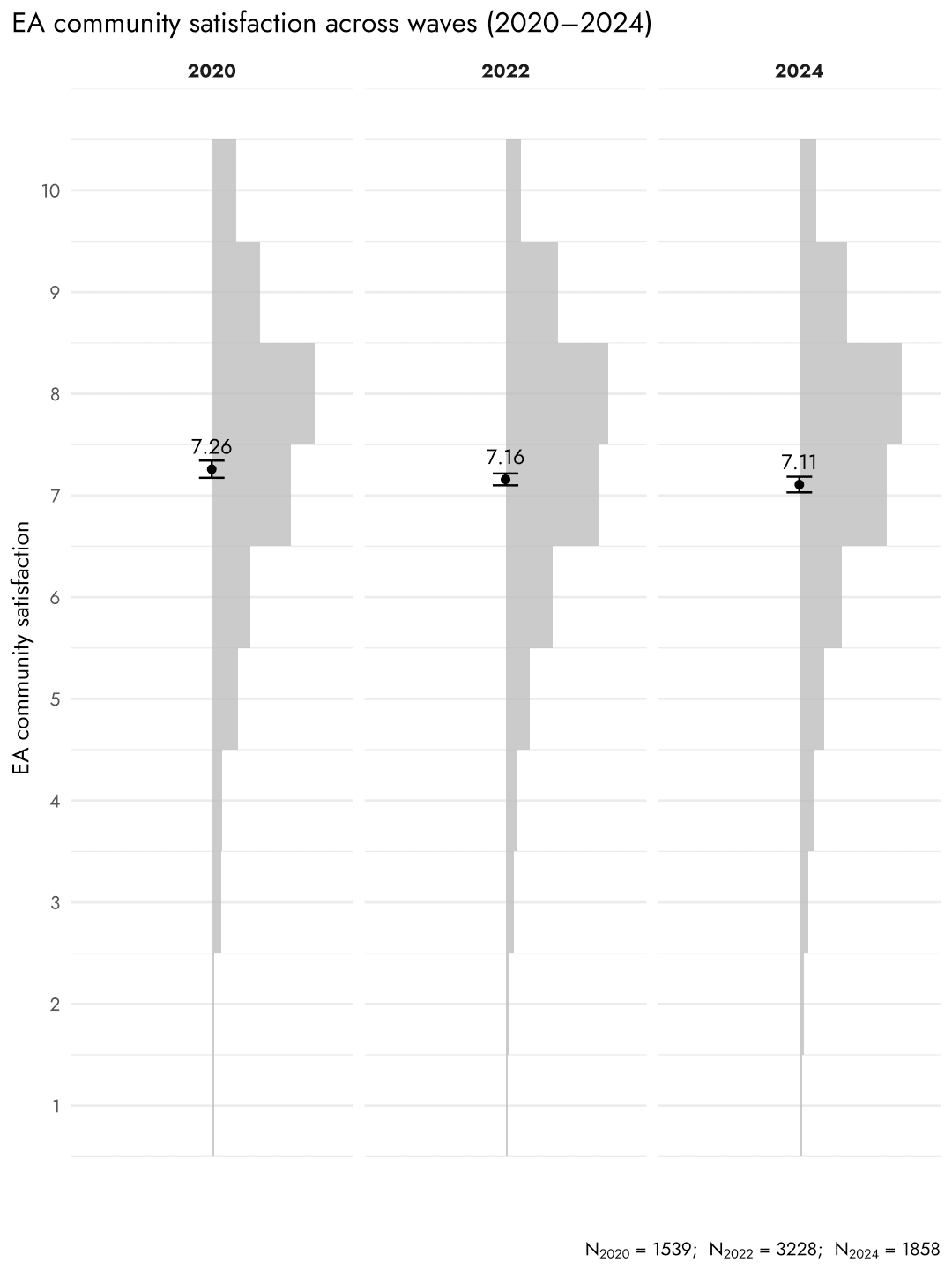
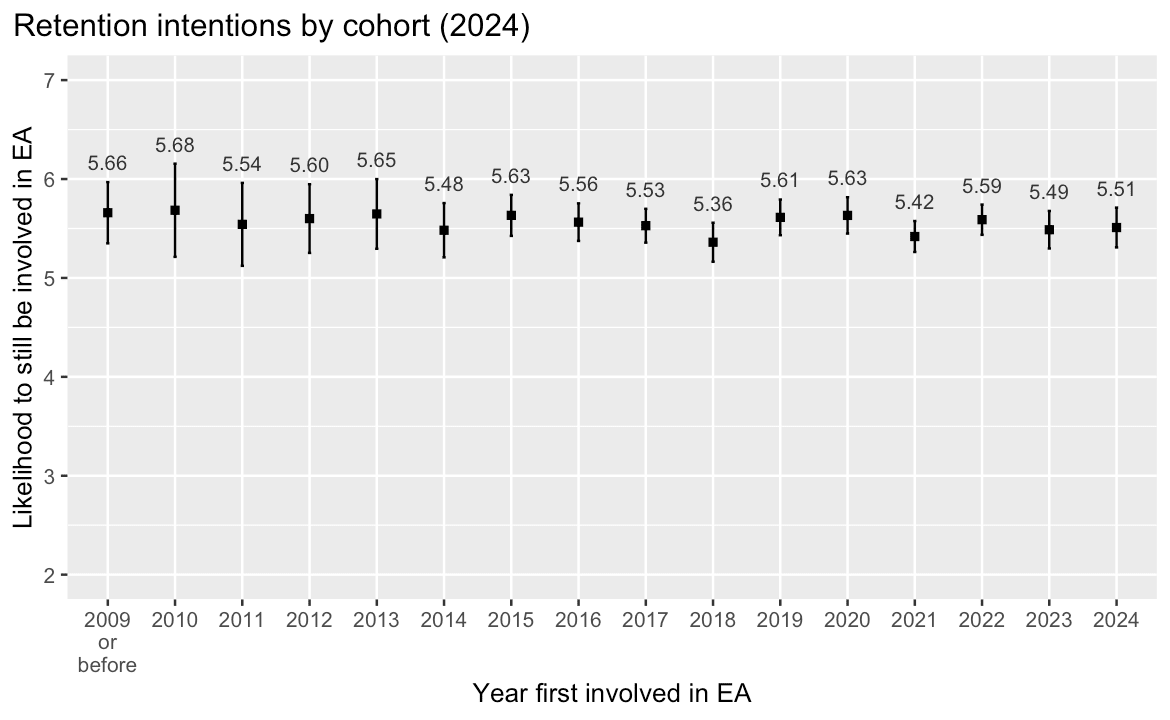
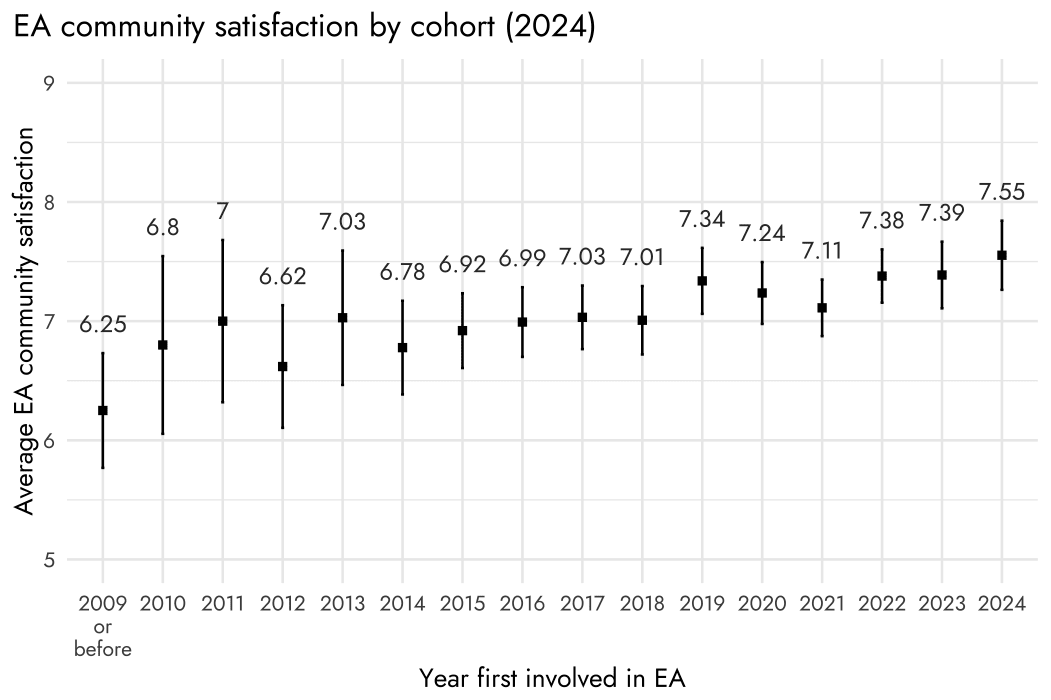
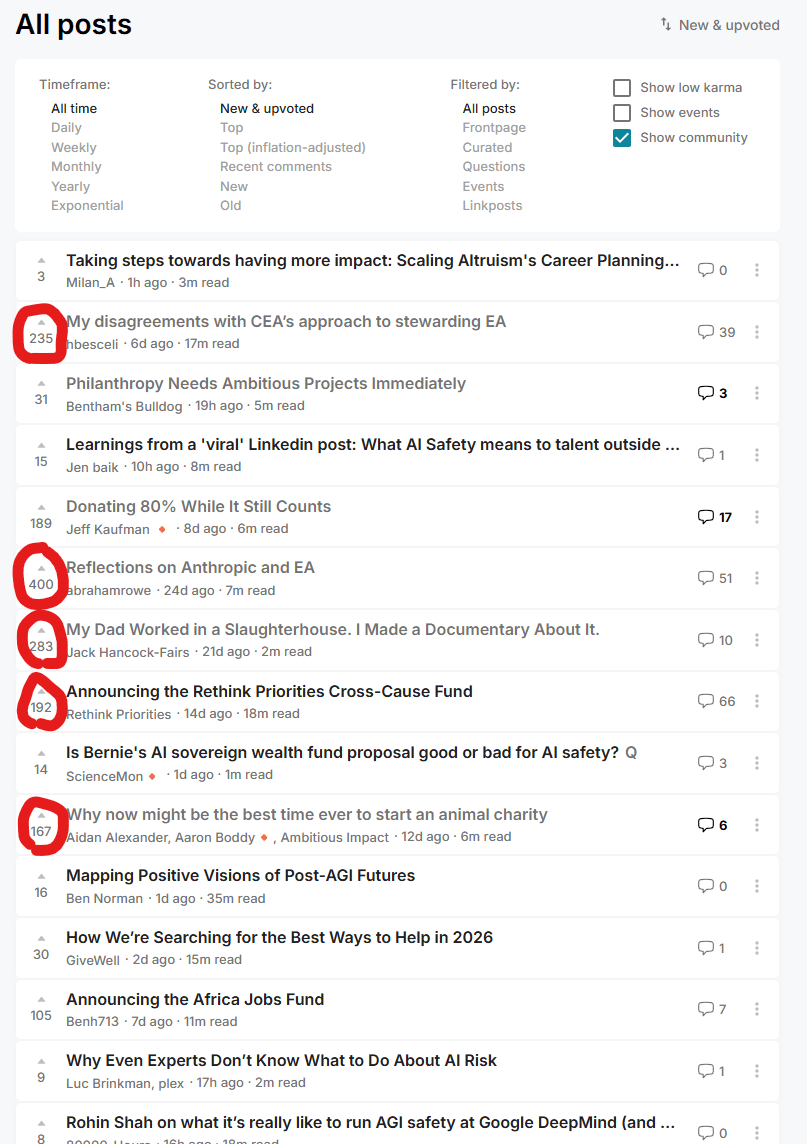


It doesn't feel to me like EA is dying for the long-time EAs. I think I count as a long time EA, & to me it seems like it went through a bit of a fallow period post FTX but is back, & that the long-time EAs don't hang out on the forum / go to their local groups / talk about EA as much on twitter, but they still "do EA (i.e. work on & donate to important interventions)" & hang out with other EAs & talk & reason about how to do the most good, quite a lot.
I do think that, with shorter AI timelines, there's a feeling of there being less time for debate / intellectual exploration & more need to act quickly even under significant uncertainty. So that reduces the "EA as a question" vibe, which is reasonable to be sad about. But it seems pretty legit to me to be sensitive to that, since EA has always been about doing what seems genuinely good for the world not just talking / thinking hard about what's good.