This is a cross-post and you can see the original here, written in 2022. I am not the original author, but I thought it was good for more EAs to know about this.
I am posting anonymously for obvious reasons, but I am a longstanding EA who is concerned about Torres's effects on our community.
An incomplete summary
Introduction
This post compiles evidence that Émile P. Torres, a philosophy student at Leibniz Universität Hannover in Germany, has a long pattern of concerning behavior, which includes gross distortion and falsification, persistent harassment, and the creation of fake identities.
Note: Since Torres has recently claimed that they have been the target of threats from anonymous accounts, I would like to state that I condemn any threatening behavior in the strongest terms possible, and that I have never contacted Torres or posted anything about Torres other than in this Substack or my Twitter account. I have no idea who is behind these accounts.
To respect Torres's privacy and identity, I have also omitted their first name from the screenshots and replaced their previous first name with 'Émile'.
Table of contents
Introduction
My story
Stalking and harassment
Peter Boghossian
Helen Pluckrose
Demonstrable falsehoods and gross distortions
“Forcible” removal
“Researcher at CSER”
Giving What We Can
Brief digression on effective altruism
More falsehoods and distortions
Hilary Greaves
Andreas Mogensen
Nick Beckstead
Tyler Cowen
Olle Häggström
Sockpuppetry
“Alex Williams”
Conclusion
My story
Before I discuss Torres’s behavior, I will provide some background about myself and my association with effective altruism (EA). I hope this information will help readers decide what biases I may have and subject my arguments to the appropriate degree of critical scrutiny.
I first heard about EA upon attending Aaron Swartz’s memorial in January 2013. One of the speakers at that event was Holden Karnofsky, co-founder of GiveWell, a charity evaluator for which Aaron had volunteered. Karnofsky described Aaron as someone who “believed in trying to maximize the good he accomplished with each minute he had.” I resonated with that phrase, and in conversation with some friends after the memorial, I learned that Aaron’s approach, and GiveWell’s, were examples of what was, at the time, a new movement called “effective altruism.”
Despite my sympathy for EA, I never got very involved with it, due to a combination of introversion and the sense that I hadn't much to offer. I have donated a small fraction of my income to the Against Malaria Foundation for the last nine years, but I have never taken the Giving What We Can pledge, participated in a local EA group, or volunteered or worked for an EA organization.
I decided to write this article after a friend forwarded me one of Torres’s critical pieces on longtermism. I knew enough about this movement –– which emerged out of EA –– to quickly identify some falsehoods and misrepresentations in Torres’s polemic. So I was surprised to find, when I checked the comments on Twitter, that no one else was pointing out these errors. A few weeks later, I discovered that this was just one of a growing number of articles by Torres that attacked these ideas and their proponents. Since I also noticed several factual inaccuracies in these other publications, I got curious and decided to look into Torres’s writings more closely.
I began to follow Torres's Twitter presence with interest and to investigate older Twitter feuds that Torres occasionally references. After looking into these and systematically checking the sources Torres cites in support of their various allegations, I found Torres’s behavior much more troubling than I had expected. Specifically, I learned that Torres had not only misrepresented and distorted many people's views and made various other demonstrably false claims, but had also engaged in stalking, harassment, and sockpuppetry.
My original plan was to spend a day or two examining this material, but the project took more than a week of my spare time. Furthermore, the initial draft was about 60% longer than the article you are now reading. To publish what I ultimately decided to leave out would have taken a lot more time and effort, and I currently have a limited budget for these side projects.
I tried to document every claim in the article rigorously. If you spot any mistakes, however, please let me know, anonymously or otherwise, using this form.1 You are also welcome to contact me if you have additional evidence corroborating my findings or other documented examples of concerning behavior by Torres. Please note that I have a real life and a real job, and that I may be unable to respond to your messages or suggestions.
In what follows, I discuss:
How Torres harassed and stalked multiple people, and made racist comments about at least one person. [more]
How Torres repeatedly made demonstrably false claims. [more]
How Torres grossly distorted the views of several people. [more]
How Torres created multiple fake accounts to harass their targets, evade bans, and discredit their opponents. [more]
Stalking and harassment
Peter Boghossian
For much of the 2010s, Torres was heavily involved with New Atheism and was close with several prominent New Atheist figures, including Peter Boghossian, back then a professor of philosophy at Portland State University. In 2016, for example, Torres published a Time magazine article with Boghossian and James Lindsay, entitled “How to Fight Extremism with Atheism.”
In a pattern that has repeated itself with several people Torres was friends with and communities Torres was part of, around late 2017 Torres switched from regarding Boghossian as a “brilliant” scholar to the sort of person who “defends Nazis.”
(It is beyond the scope of this article to examine Torres's violent "sign reversals" in their assessment of people and communities. But it is striking by how often these shifts in opinion appear, upon closer inspection, to be triggered by Torres experiencing a feeling of rejection, such as being denied a job, not being invited to a podcast, or having a book collaboration terminated. Torres’s subsequent “realization” that these people and communities, once held in such high esteem, were in fact profoundly evil or dangerous routinely comes after those personal setbacks, as a post hoc rationalization. A future article may explore these incidents, which shed so much light into Torres’s character and motives, in much greater detail.)
In February 2018, when Boghossian tweeted about a seminar he would teach, Torres replied with a link to an unrelated Buzzfeed story, prompting Boghossian to block Torres. Torres responded by creating a second account and leaving further replies to Boghossian, who also blocked the second account. Astonishingly, Torres then made a third account to further evade Boghossian’s block and leave even more comments.
At the same time as Torres was harassing Boghossian and creating these accounts, they were also tweeting about Boghossian from their main account. In a disturbing tweet, Torres gloats about having informed Boghossian that they would visit Portland and sit in the front row of his class:

Torres then contacted Portland State University (without disclosing that they had been stalking Boghossian) with the apparent intention of going ahead with their plan.

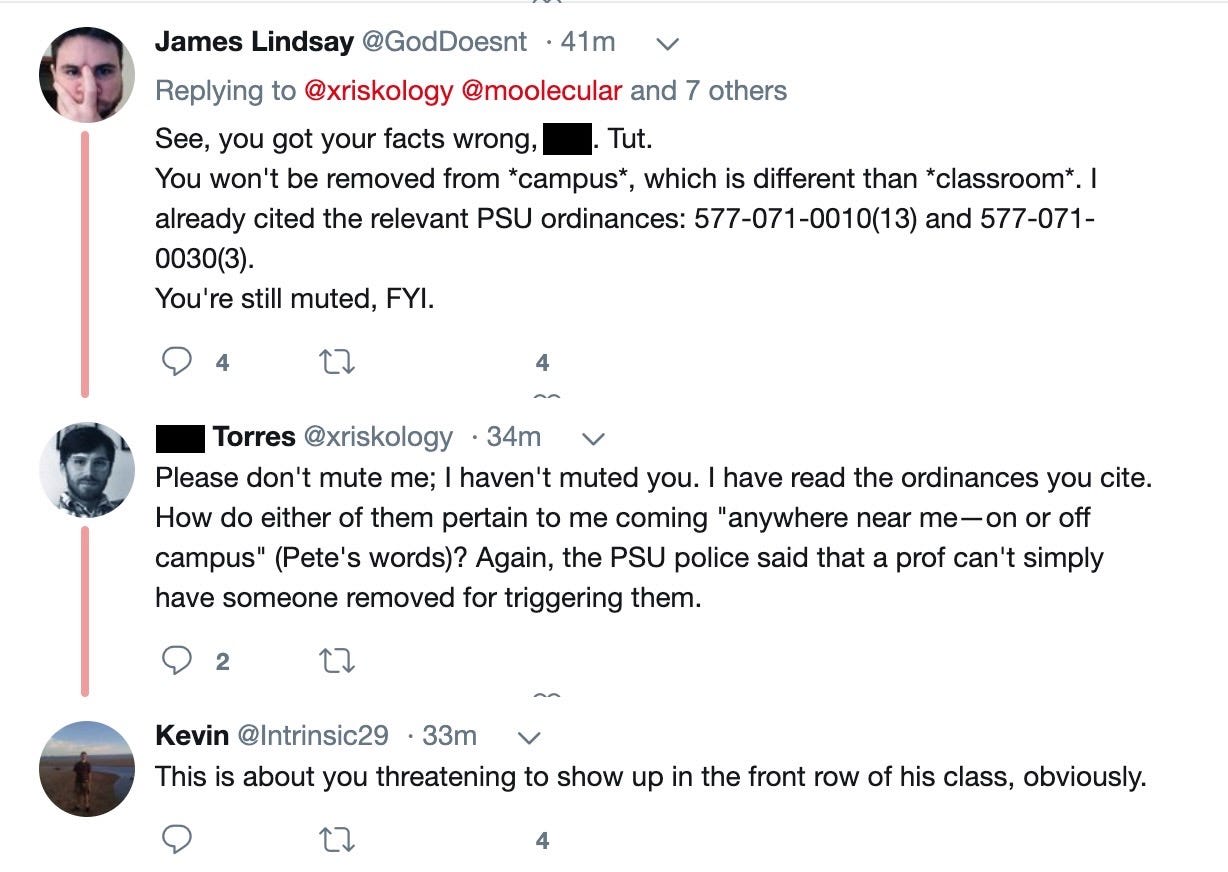
When confronted by a user, Torres even admitted that Boghossian was justified in perceiving their email as threatening:
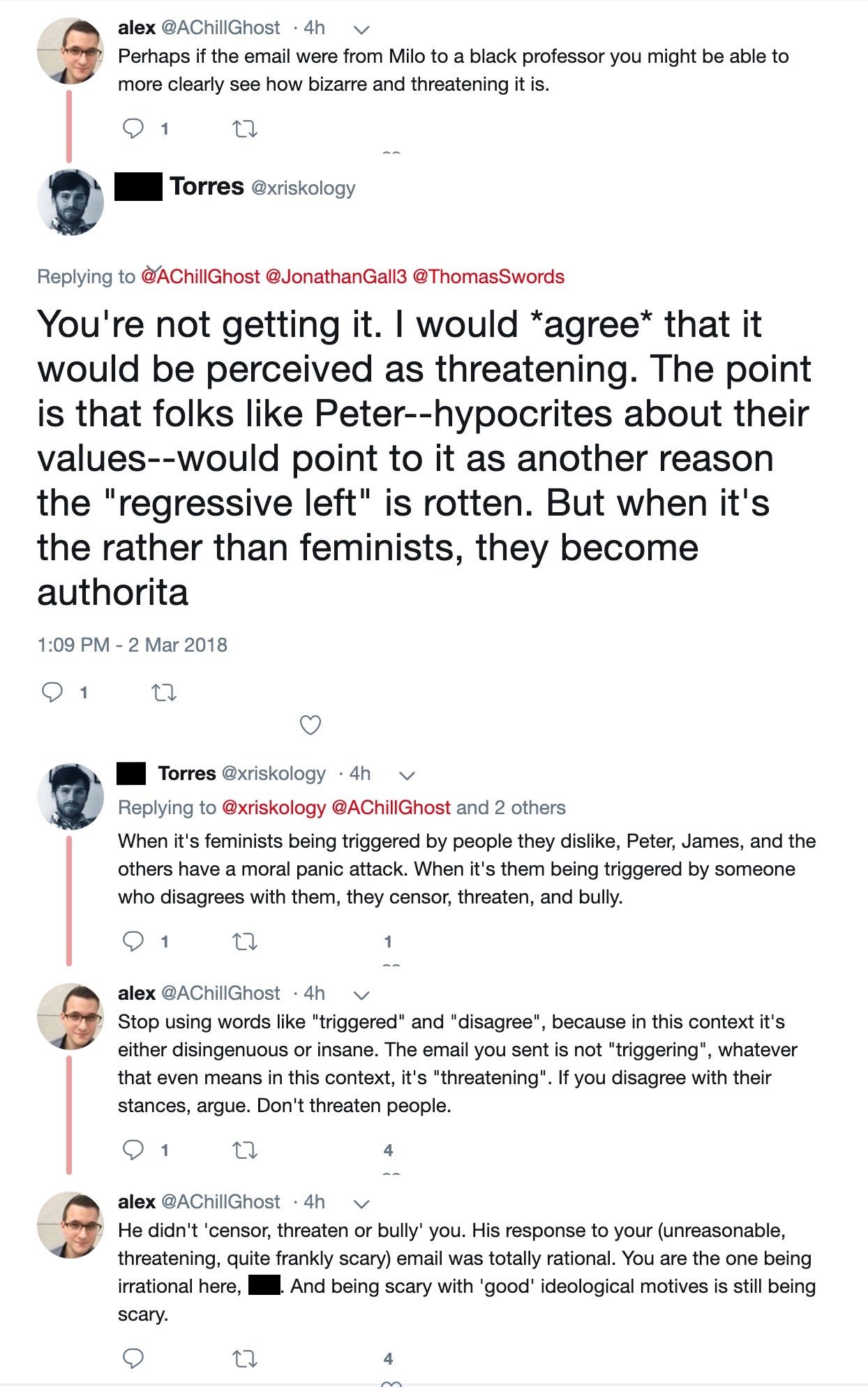
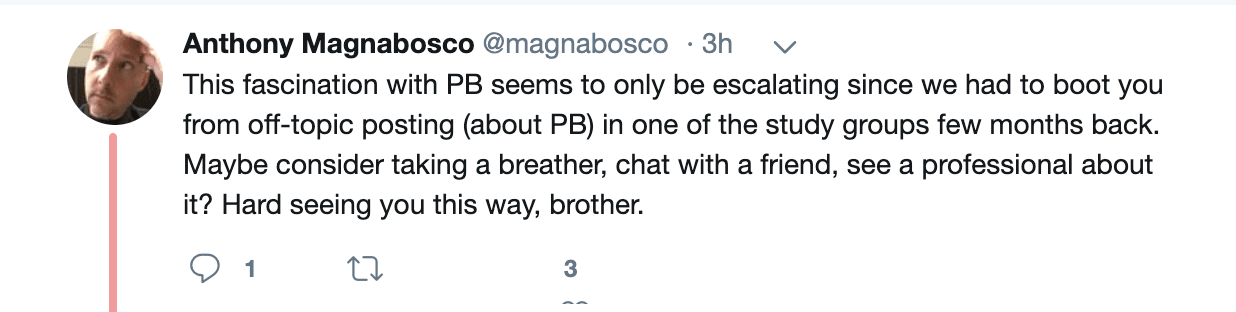
Aside from harassing Boghossian, Torres inundated various Facebook groups with posts about Boghossian unrelated to the groups’ purposes. People who appeared to be on good terms with Torres began to worry about his mental health:
Torres also accused Boghossian of being a sexual predator:
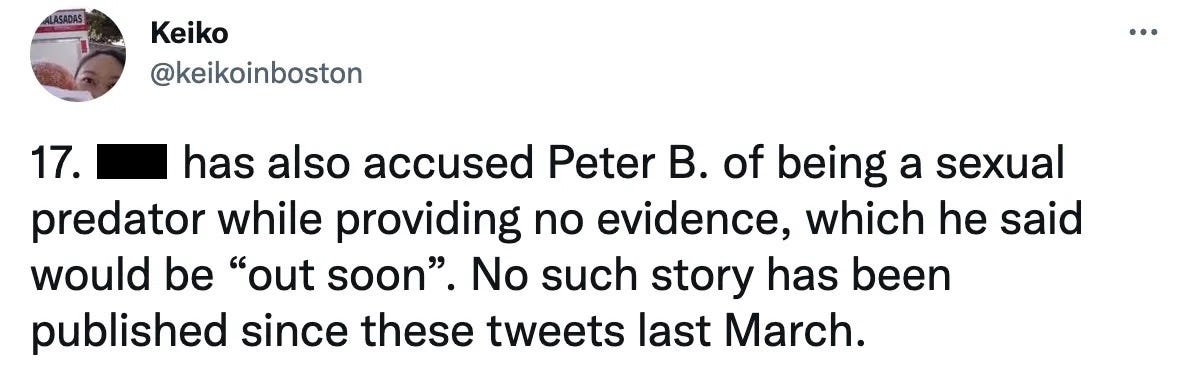
When questioned by a user, Torres explained that the evidence “should be out soon.”
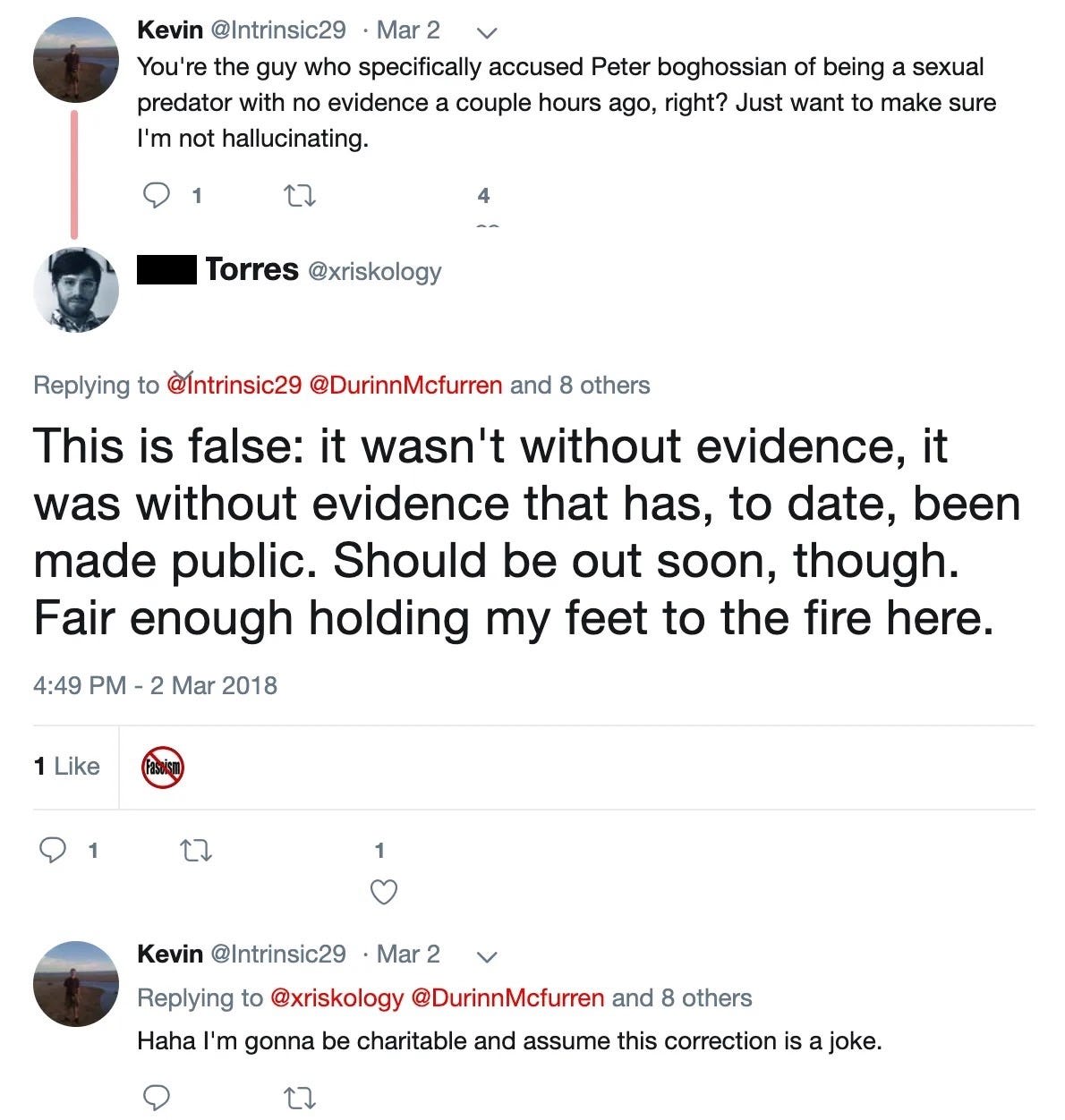
This was in March 2018. Five years on, they have yet to deliver on that promise.
Another disturbing incident occurred when, from one of their secondary accounts, Torres urged Boghossian’s followers to “freak [Boghossian] out by “jok[ing] about adopted Asian children”:
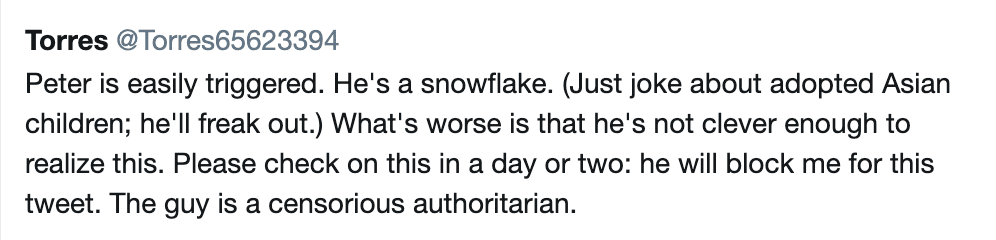
The reference to “adopted Asian children” is Torres’s way of alluding to Boghosian’s daughter:
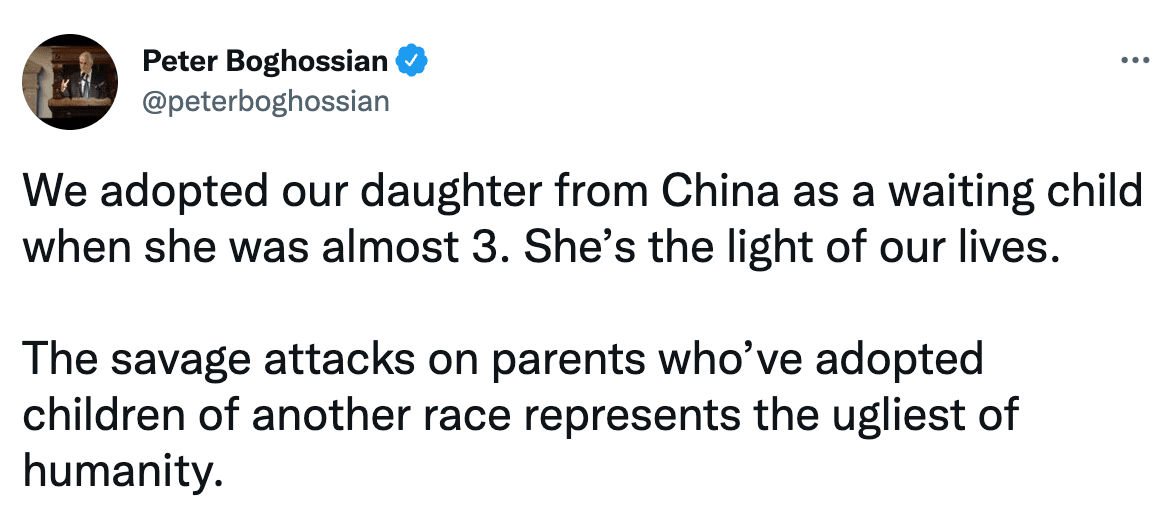
I don’t like to accuse people of racism lightly, but the accusation seems appropriate in this case. Even if Torres had intended to provoke Boghossian by encouraging his followers to ask him about his daughter, the reference to her race seems completely gratuitous. Consider what the reaction would have been if Torres had joked about “adopted Black children.”
[Update: Torres silently deleted the racist tweet after this post was published. An archived copy of it has been preserved here.]
In sum, there is clear evidence that Torres did the following: began posting obsessively about Boghossian and being openly hostile; in this context, threateningly told Boghossian he was going to show up at his class; laughed about how this made Boghossian uncomfortable; referenced Boghossian's daughter as “adopted Asian children”; and encouraged their followers to “freak [Boghossian] out” by messaging him about his daughter.
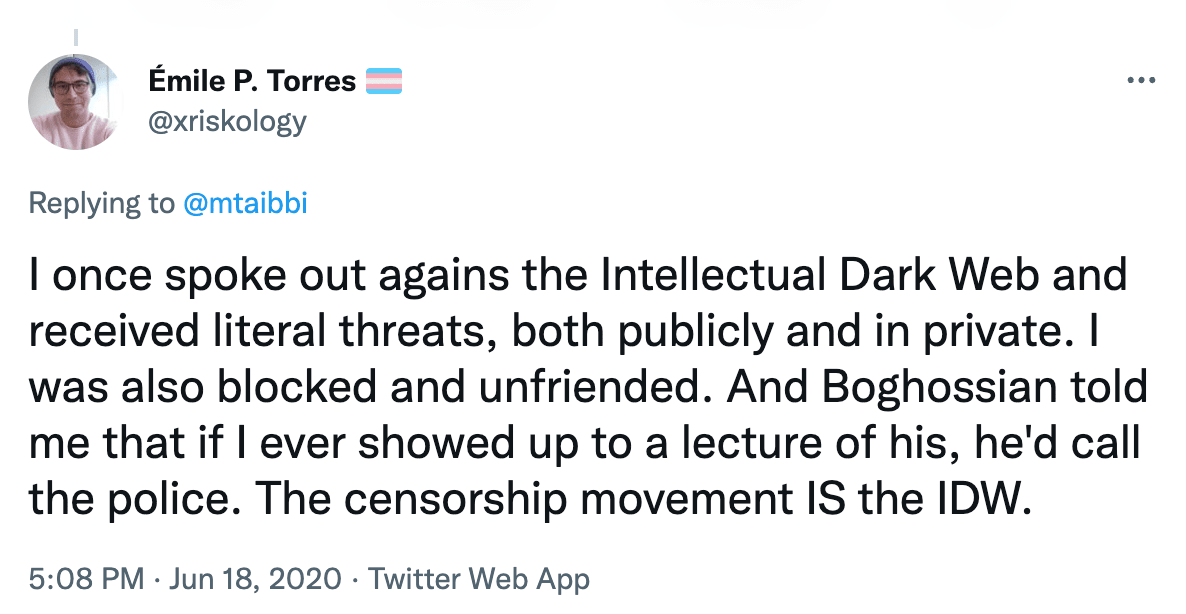
Yet, in recounting this incident years later, Torres makes it sound like Boghossian told Torres that he'd call the police in response to Torres's criticisms. There is no mention of the persistent harassment, the multiple accounts, or the incitement to “freak [Boghossian] out by “jok[ing] about adopted Asian children.”
Helen Pluckrose
Another victim of Torres' harassment is Helen Pluckrose, a British author and liberal humanist. In this case, the harassment began when Pluckrose pleaded with Torres to stop stalking Boghossian. In response, Torres sent Pluckrose a torrent of tweets, upon which Pluckrose, fearing for her safety, asked Torres to stop tweeting at her.
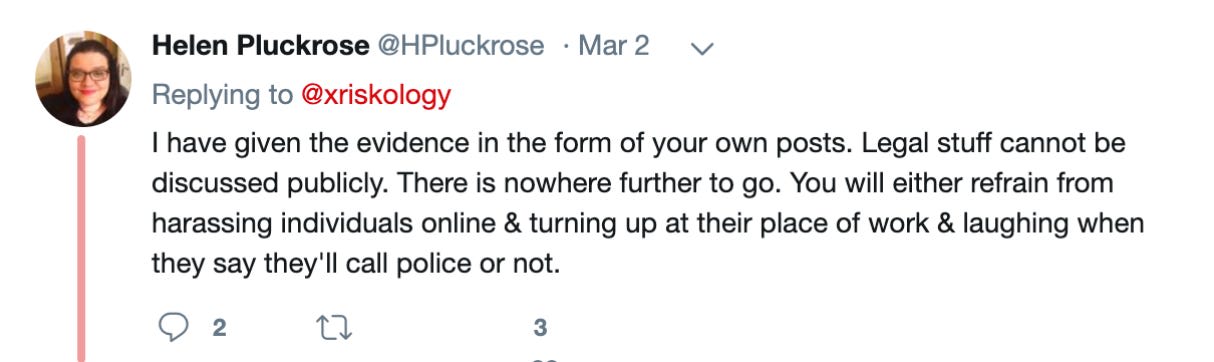
In that same thread, Pluckrose tells Torres: "I really don't want a connection with you. You scare me."
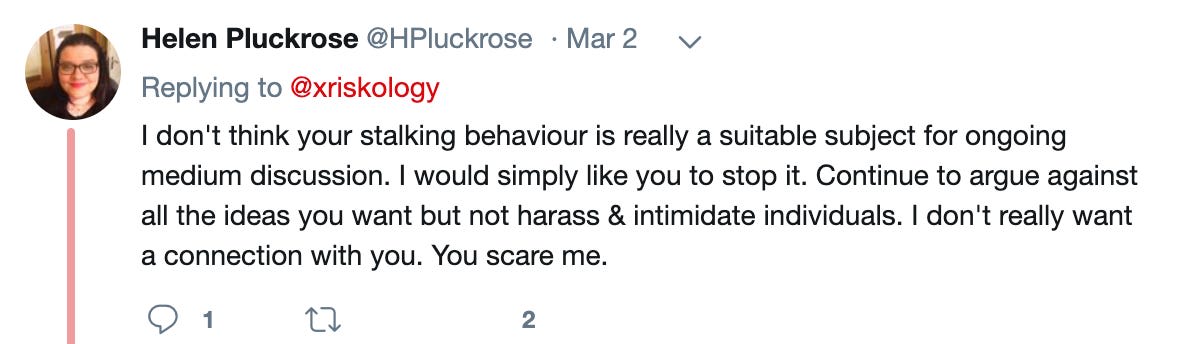
Torres, however, continued tweeting at Pluckrose, ignoring her request.
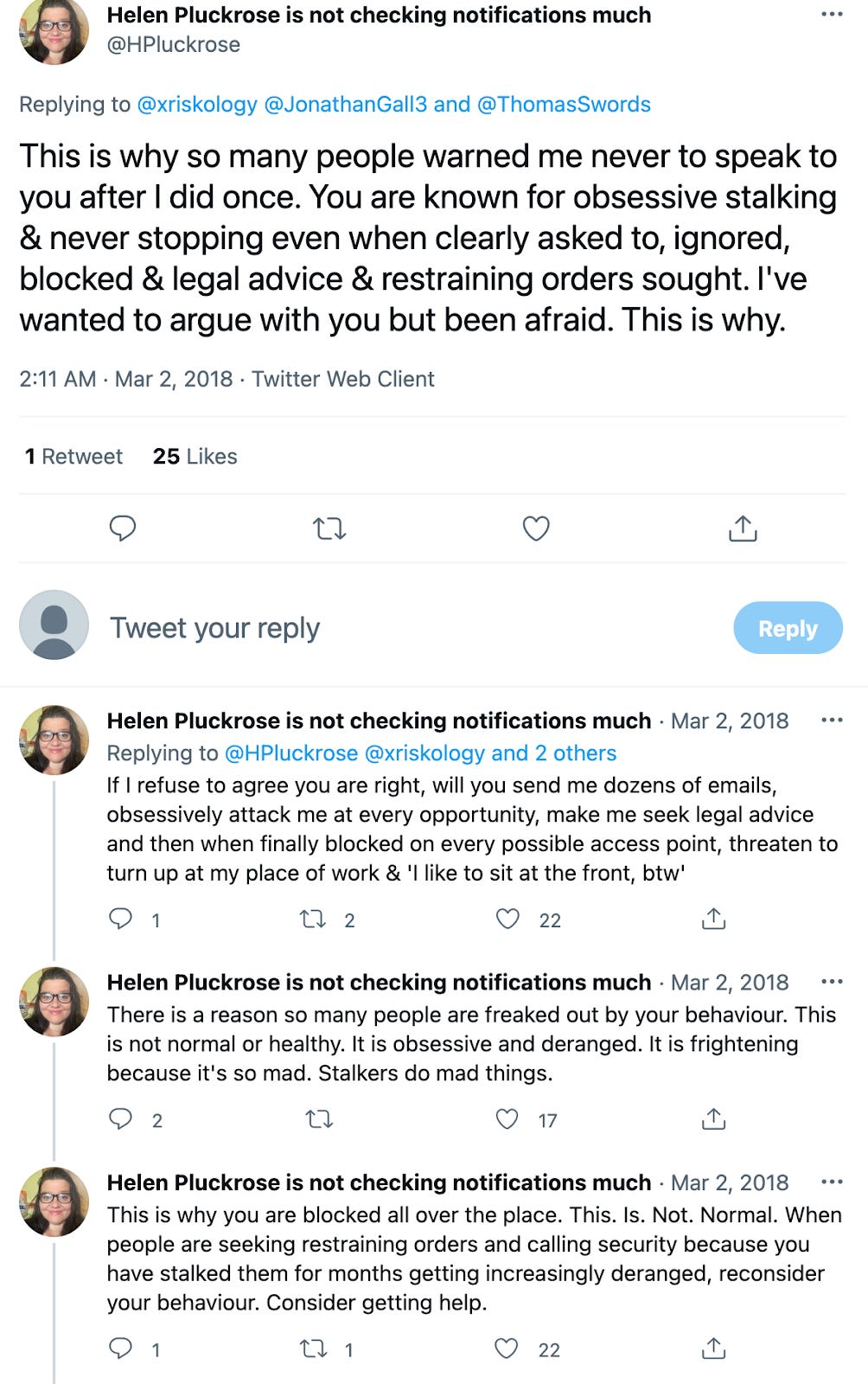
Disturbingly, Torres responds by accusing Pluckrose of harassing them:

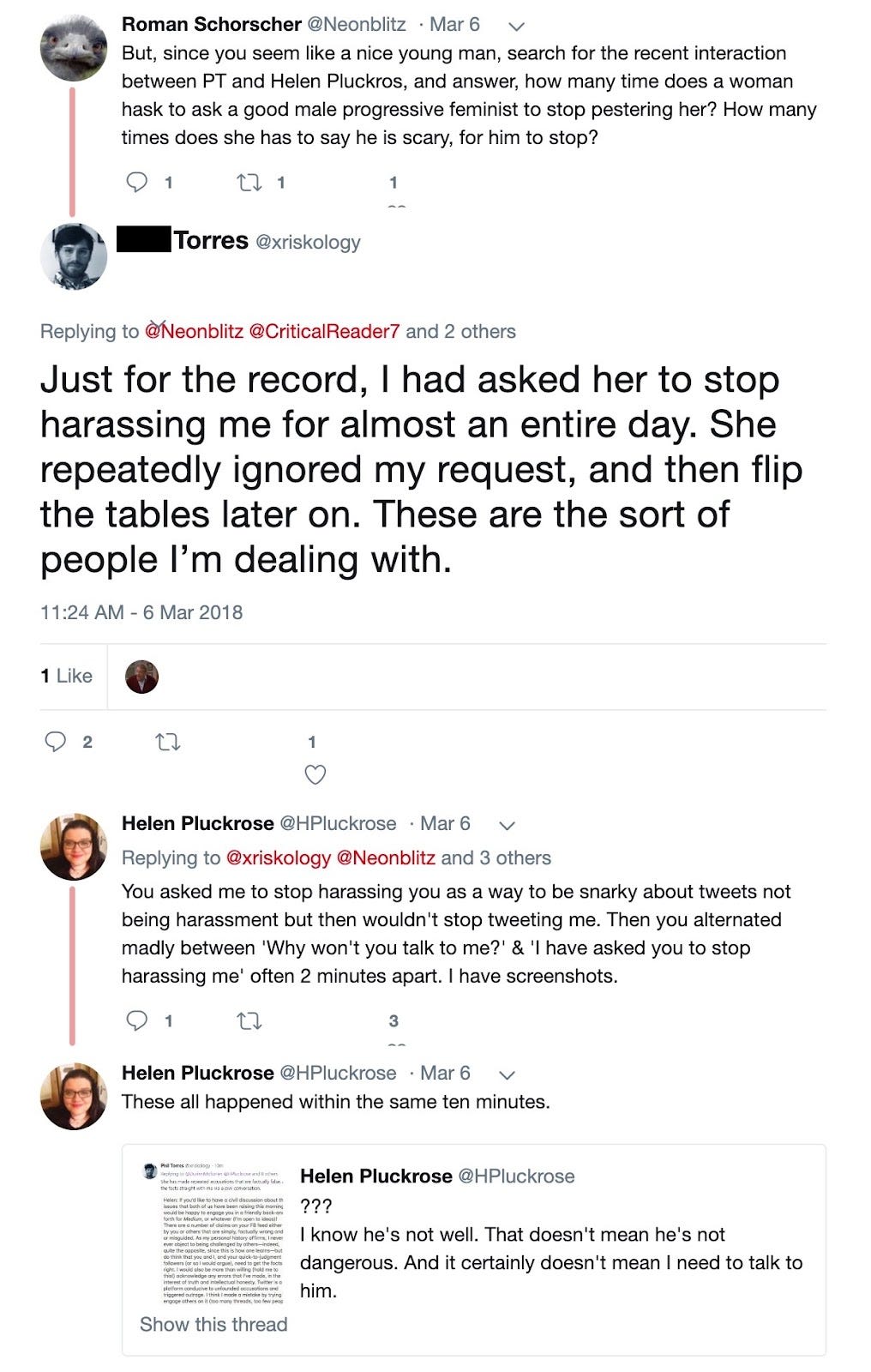
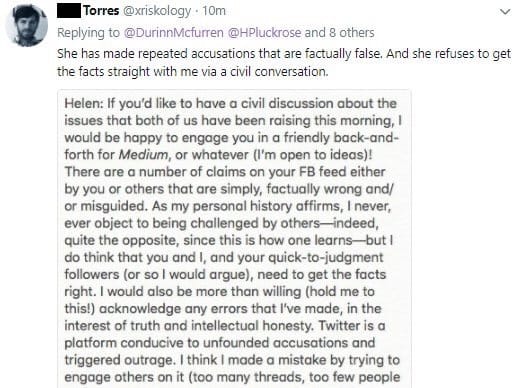
After Torres made Pluckrose their new harassment target, other users intervened, but Torres still refused to back down:

Describing these events year later, Torres claimed that Pluckrose –– “who has made a career out of lying about people” –– had blocked them over a single Twitter DM. However, as documented in the screencaps above, Torres admits that they were tweeting at Pluckrose "almost for an entire day", and complains that she "ignored" Torres. This was after Pluckrose had said, on March 2, that she was afraid of Torres due to their behavior regarding Boghossian, whom (as we’ve seen) Torres had been stalking for months. Just as with Boghossian, Torres recounting of their behavior paints a very distorted picture of the actual events.
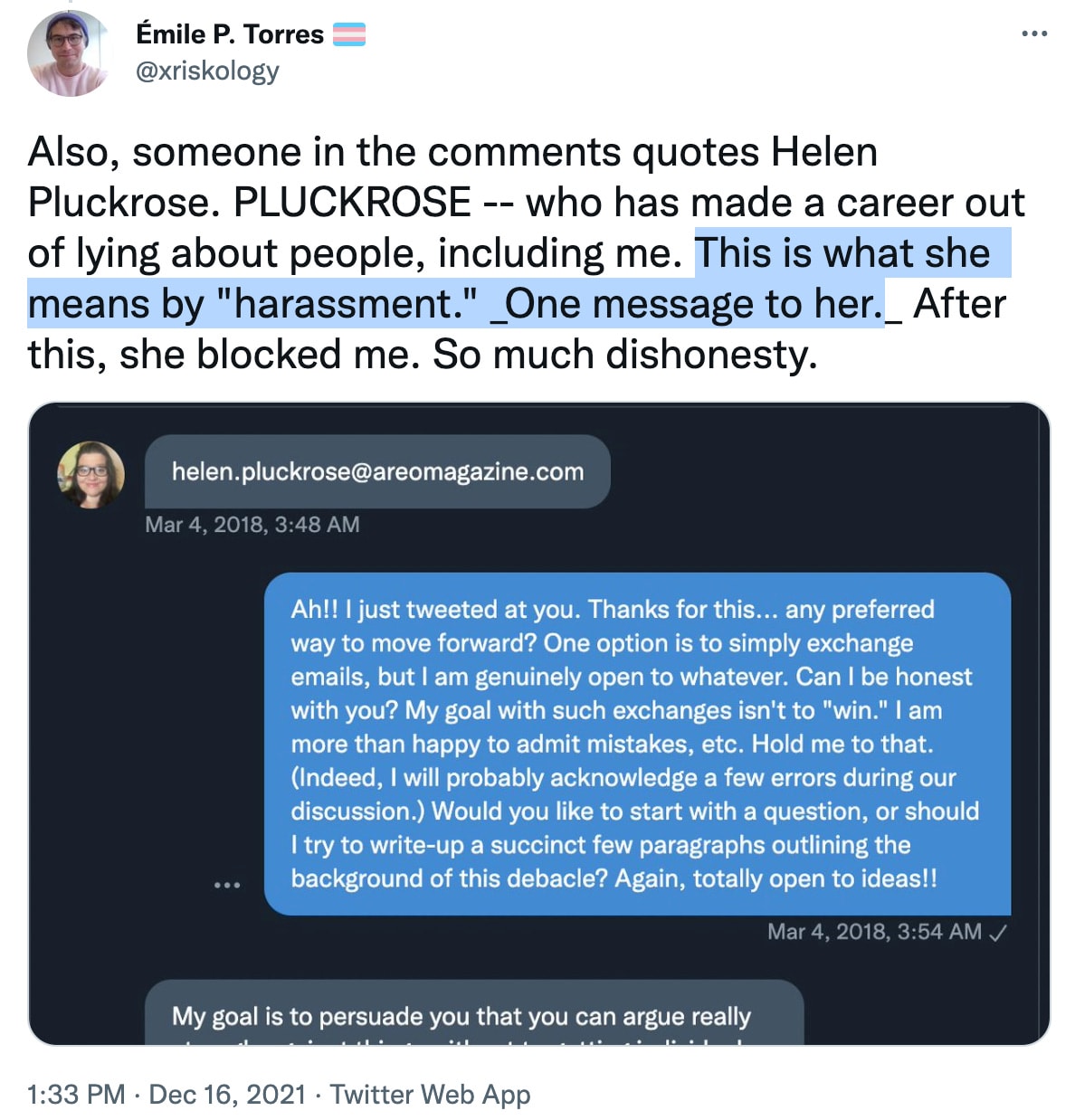
In part as a result of the abuse she received from Torres and others over the years, Pluckrose suffered serious mental health issues, was in psychiatric care, and has mostly withdrawn from public life.
Demonstrable falsehoods and gross distortions
“Forcible” removal
In December 2021, Carla Zoe Cremer, a Research Scholar at the Future of Humanity Institute, and Luke Kemp, a Research Associate at the Centre for the Study of Existential Risk, released a paper entitled “Democratising Risk: In Search of a Methodology to Study Existential Risk.”
The following year, Torres made the startling revelation that the paper had been written by three people: Cremer, Kemp… and Torres. Indeed, Torres indicated that they (Torres) were the first author. Torres also noted that, when the paper was near completion (“penultimate draft”), Torres was “removed [f]orcibly” after Cremer and Kemp “were instructed that Torres could not be part of the collaboration.”

However, when Torres's tweet was discussed on the Effective Altruism Forum a few days later, Cremer gave a substantially different account of what happened.
Cremer first observed that Torres’s contribution to the paper was restricted to collaborating with Kemp on “a very early draft” that, according to Cremer, required “major re-writing of both tone and content.” The paper that Cremer and Kemp eventually published “was completely different” and, as Cremer put it, “in such a totally different state and it would have been misplaced to call it a collaboration with Torres.”
Moreover, Cremer stated that no one had instructed her to abstain from collaborating with Torres, and that she did not remember being "forced" to take Torres off the collaboration. In fact, it was Cremer and Kemp who decided to end Torres' involvement, and Cremer notes that “Torres agreed with those plans.”
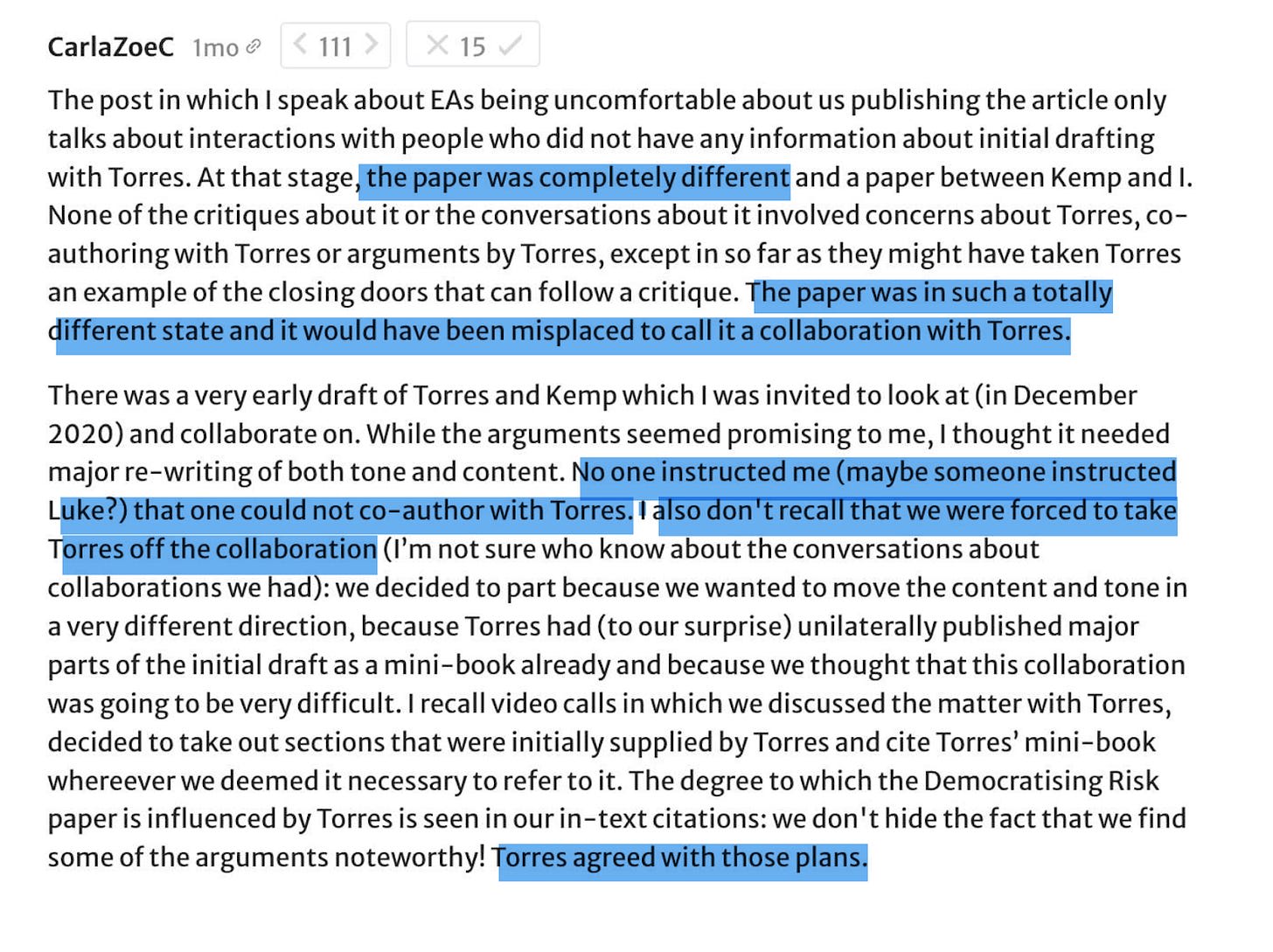
Surprisingly, in their reply, Torres thanked Cremer “for correcting the record” and apologized “if I’d misremembered some of this.”

A user then asked Torres to explain how it was possible for Torres to misremember something as peculiar as having been “removed forcibly”:
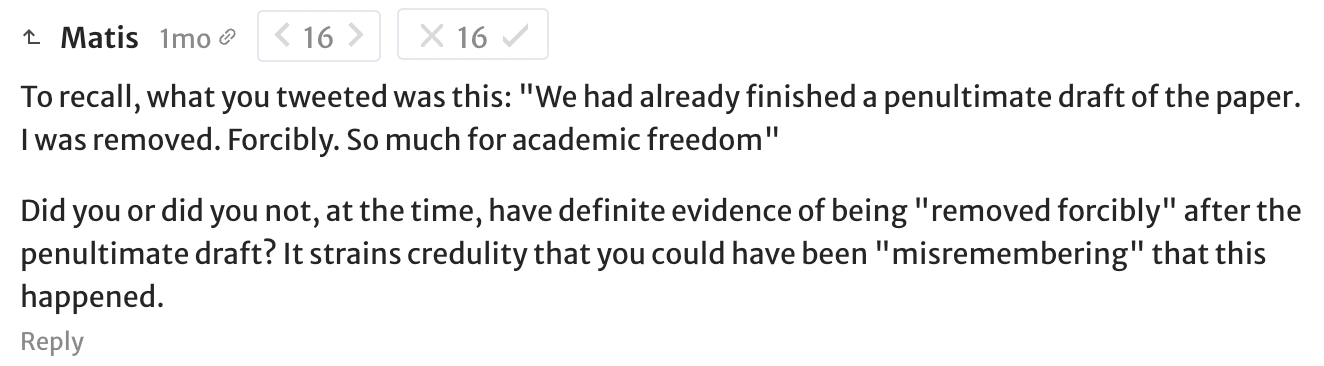
Torres never answered the question.
“Researcher at CSER”
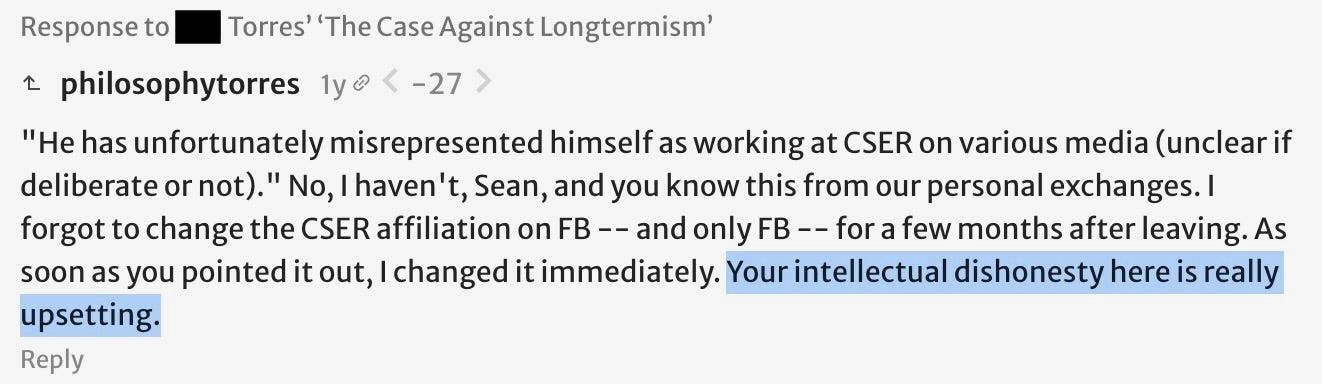
Another occasion in which Torres conveniently forgot something relates to Torres’s involvement with the Centre for the Study of Existential Risk (CSER). Although Torres was only a visitor for a couple of months, years later Torres was, intentionally or otherwise, presenting themself as still working at that institution. When Seán Ó hÉigeartaigh, then CSER’s co-Director, pointed this out on the Effective Altruism Forum, Torres responded with a series of uncivil comments.
In one comment, Torres tells Ó hÉigeartaigh: “your intellectual dishonesty here is really upsetting.”
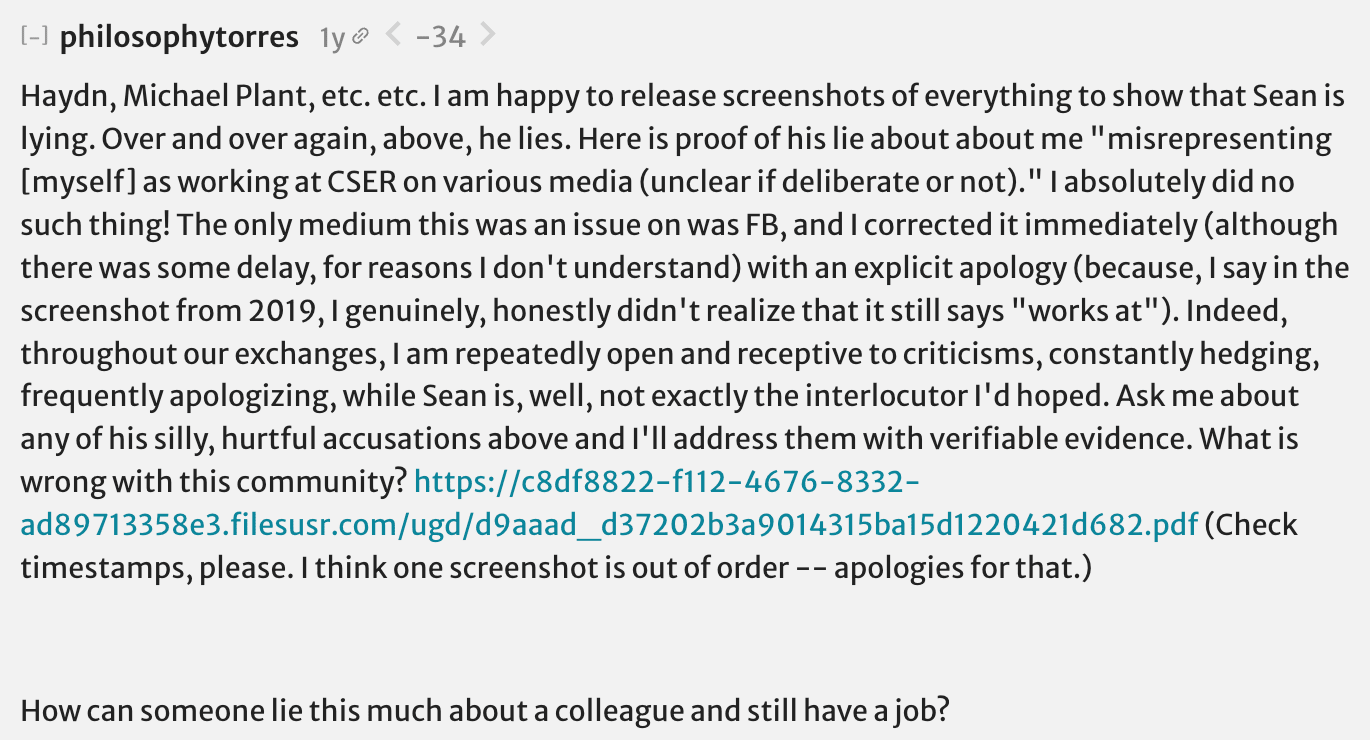
In another comment, they accuse Ó hÉigeartaigh of “lying… over and over again” and ask: “How can someone lie this much about a colleague and still have a job?”
In a third comment, a “pretty f*cking upset” Torres calls Ó hÉigeartaigh “a jerk.”
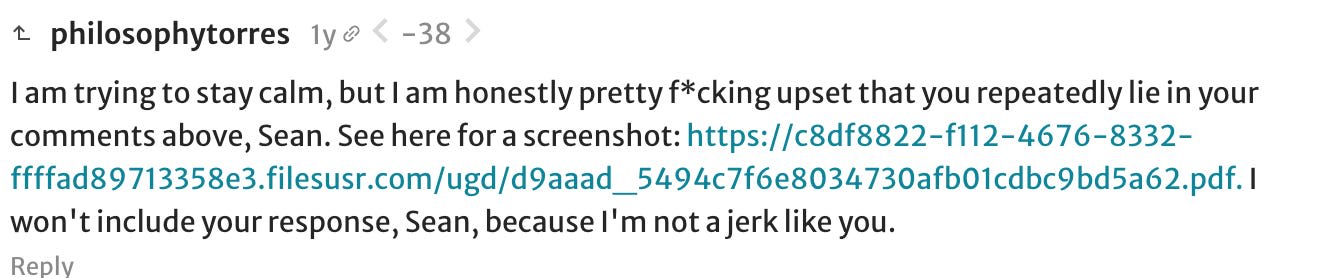
But Ó hÉigeartaigh was not lying: as he explains in his response, years after Torres’s CSER visitorship had ended, Torres was still listing themself as a "Researcher at Centre for the Study of Existential Risk, University of Cambridge” on LinkedIn, the most popular professional networking platform. In their defense, all Torres could say was, once more, that they had forgotten about it –– tacitly admitting that Ó hÉigeartaigh was right all along.
Giving What We Can
In a series of tweets published in October 2022, Torres implied that William MacAskill had not co-founded Giving What We Can. To back up this audacious allegation, Torres cited a clip from a 2016 talk in which MacAskill said he first met Toby Ord in 2009, and a snapshot from the Wayback Machine showing that Giving What We Can’s website existed already in 2007.
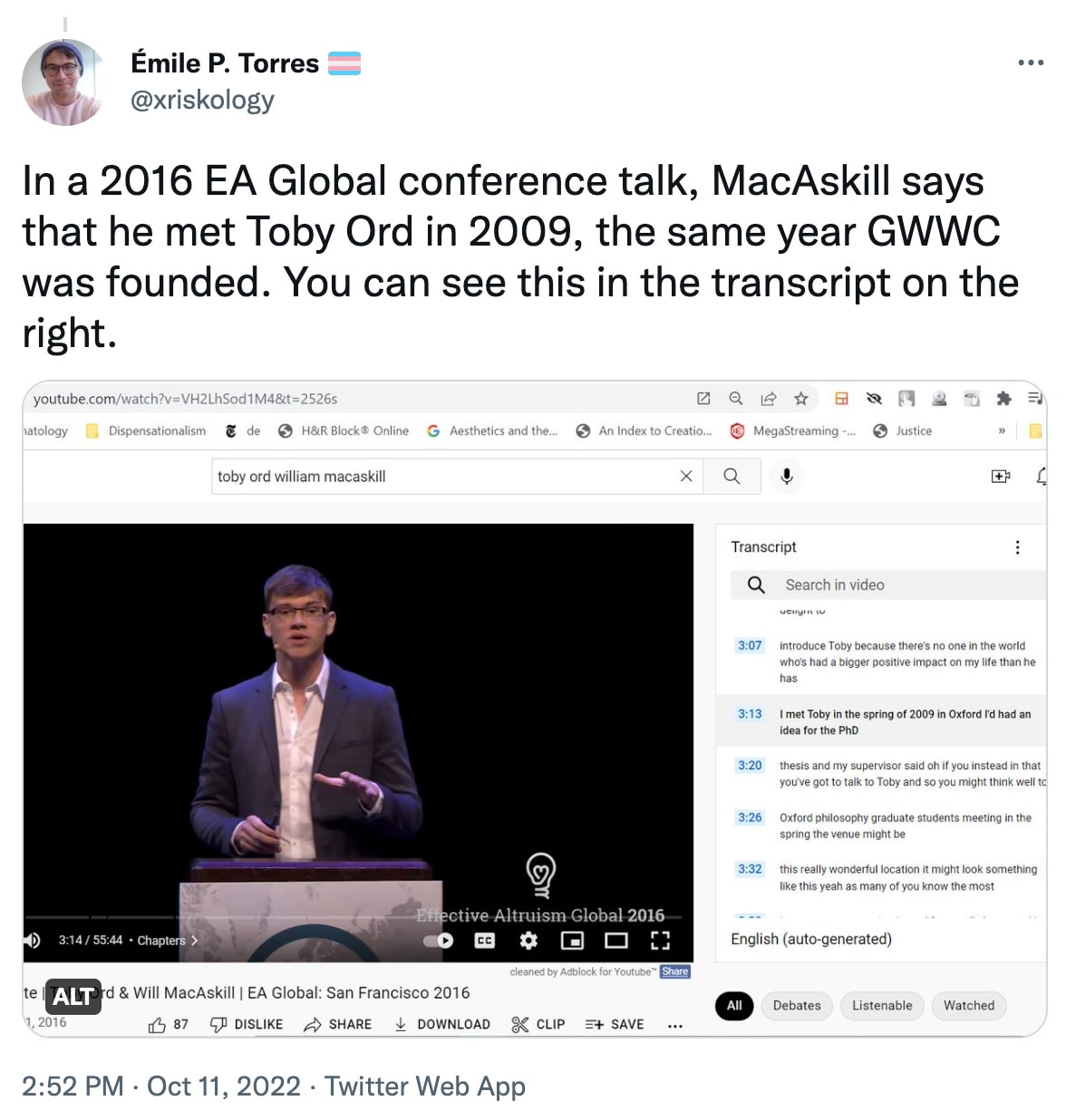
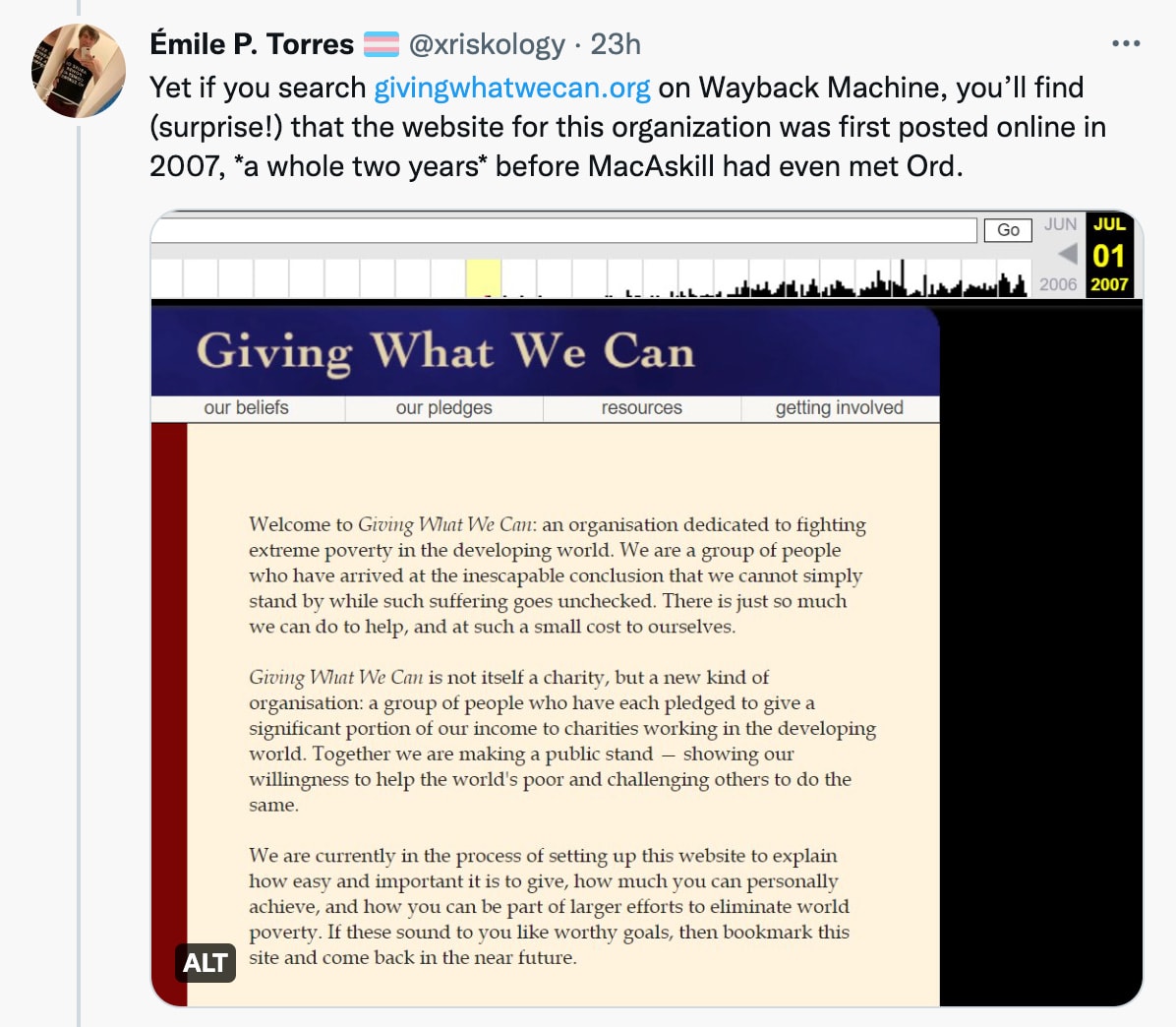
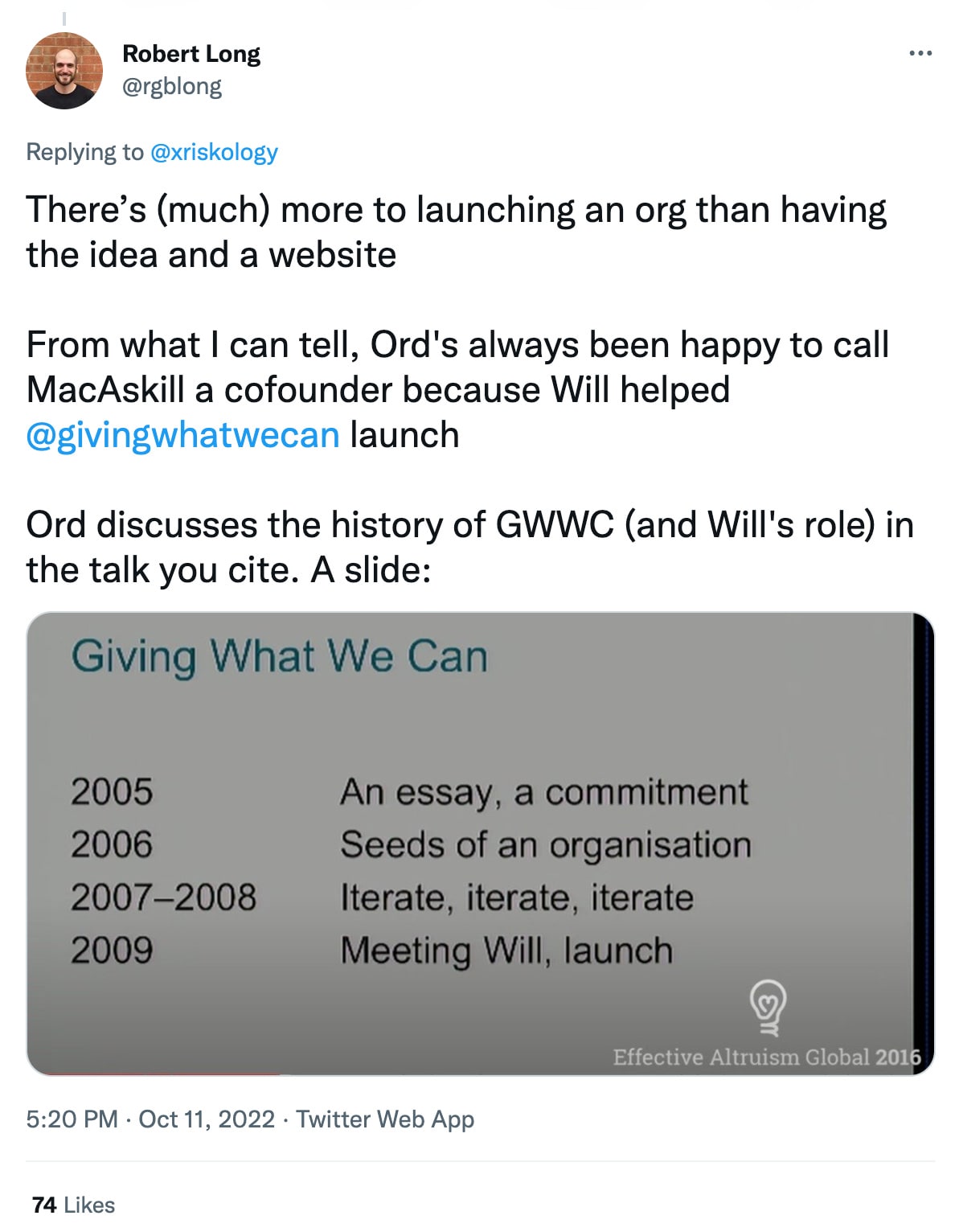
I watched the talk and was flabbergasted by Torres’s accusation. Torres neglects to mention that this very same talk includes Toby Ord's story of the early years of Giving What We Can, in which Ord acknowledges that the idea of Giving What We Can pre-dates MacAskill. Far from being a shocking secret unearthed from a forgotten video recording, MacAskill and Ord have both acknowledged that the idea of Giving What We Can was Ord’s. MacAskill is regarded as a co-founder because he helped Ord launch it as a public-facing international community, as several Twitter users pointed out:
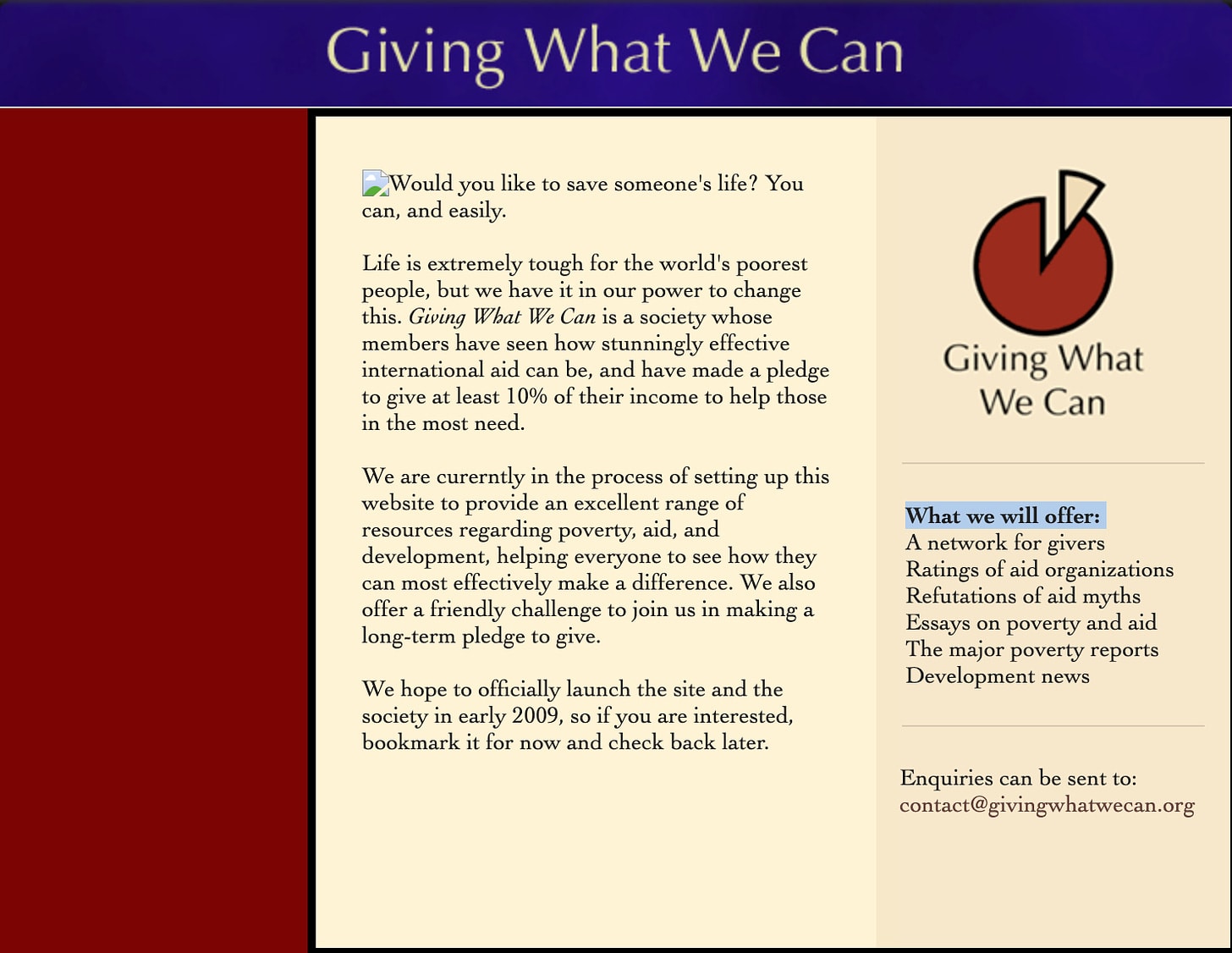
Additionally, another Wayback Machine snapshot, which Torres chose not to link to, proves that, even though the website did exist in 2007, the organization hadn’t yet launched: the sidebar lists a bunch of content and services that they “will offer.”
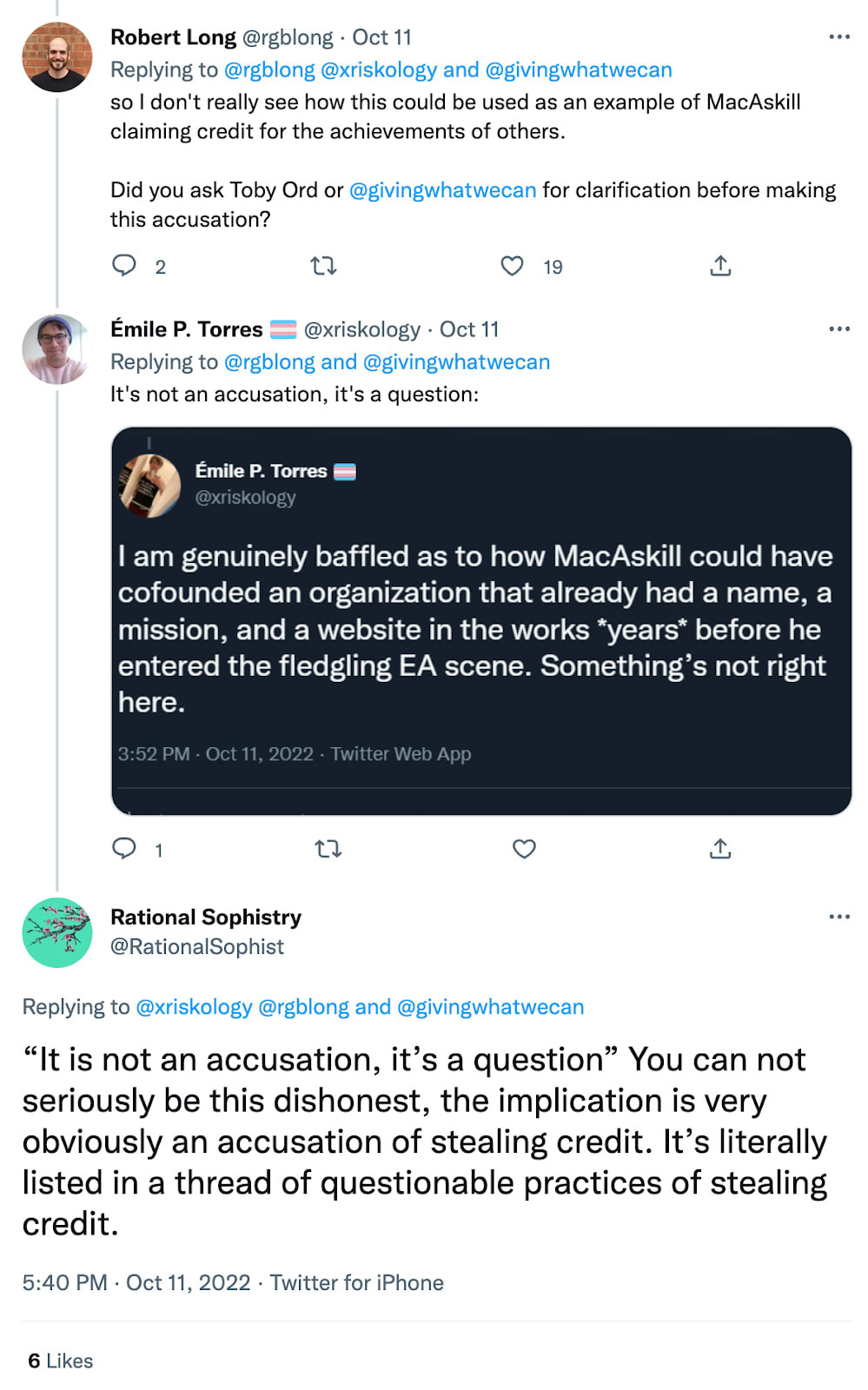
When users on Twitter asked Torres if they had reached out to Toby Ord or Giving What We Can for clarification before making their accusation, Torres responded that they were merely asking "a question":
Brief Digression on Effective Altruism
Torres has levelled some serious accusations against certain figures in the effective altruism (EA) movement, which we will examine shortly. But before we do so, I will provide a brief overview of EA, which should help those unfamiliar with it to understand the discussion that follows.
Effective altruists (EAs) are primarily interested in answering the question of how to use the available resources to best help others. Many EAs believe that supporting charities focused on global health is the best way to help the global poor. Other EAs, however, have argued that something else might be even more beneficial: reducing the risk of global catastrophes that threaten future generations. My understanding is that this group of EAs –– sometimes known as “longtermists” –– see this position as a natural extension of the principle of “radical empathy”, or “working hard to extend empathy to everyone it should be extended to, even when it is unusual or seems strange to do so.” In particular, longtermists EAs believe that empathy should be extended not only to other historically neglected groups, such as people in other countries and animals from other species, but also to people in the distant future. As Fin Moorhouse writes,
For much of history, we lived in small groups, and we were reluctant to help someone from a different group. But over time, our sympathies grew to include more and more people. Today, many people act to help complete strangers on the other side of the world, or restrict their diets to avoid harming animals (which would have baffled most of our earliest ancestors). […] Yet, expanding the moral circle to include nonhuman animals doesn't mark the last possible stage — it could expand to embrace the many billions of people, animals, and other beings yet to be born in the (long-run) future.
So, whether the best ways to do good involve helping the global poor, reducing animal suffering, or protecting future generations (or something completely different) is an area of active debate among EAs. What's critical for our purposes is that Torres has repeatedly done the following:
Quote someone explaining why and how longtermism implies that donating to prevent (e.g.) engineered pandemics is even more cost-effective than donating to global poverty causes.
Characterize that person as advocating for actively taking money from poor people and giving it to rich people.
I will now review some examples of Torres doing this.
More falsehoods and distortions
Hilary Greaves
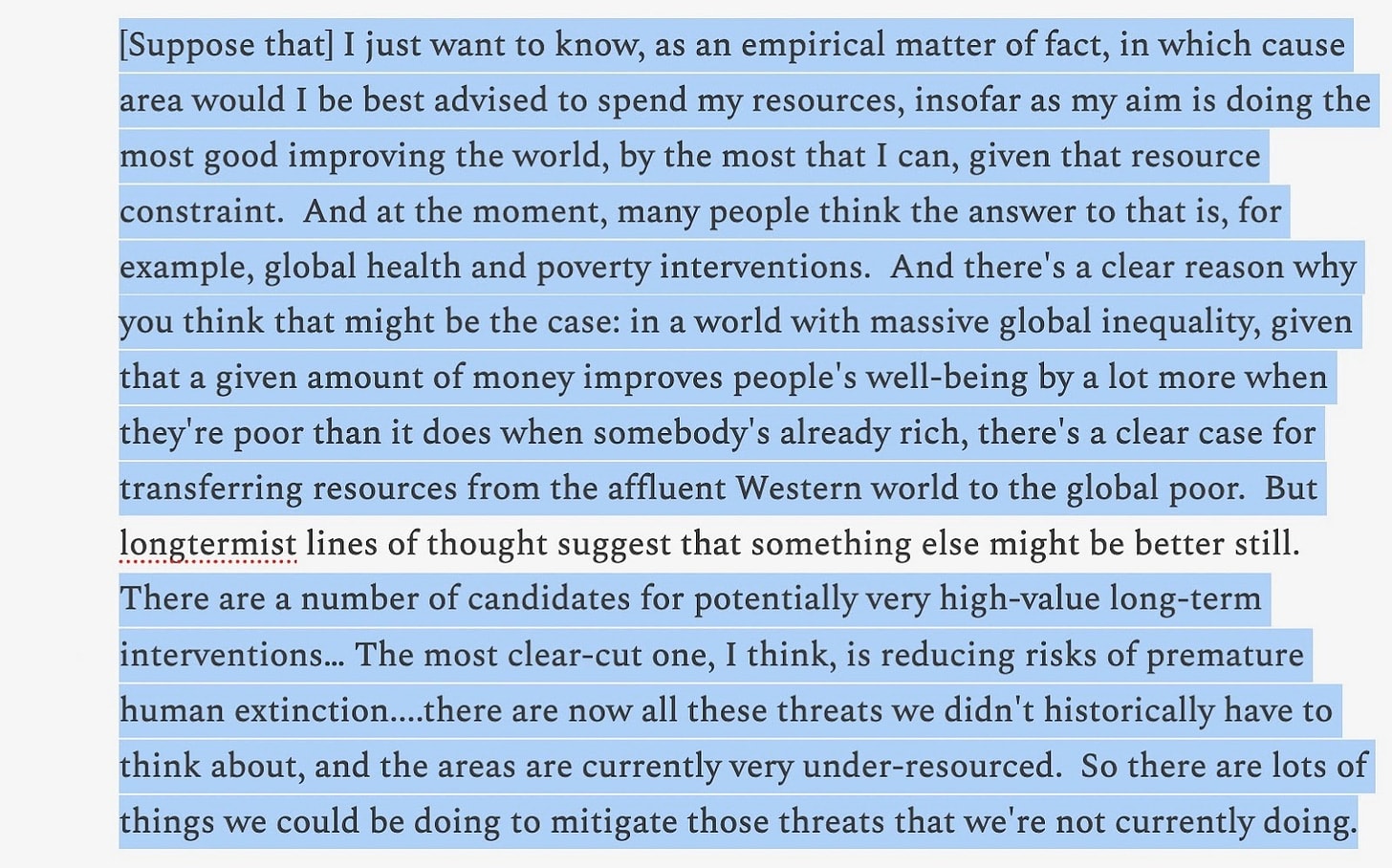
Torres's first target is Hilary Greaves, Director of the Global Priorities Institute. In 2020, Greaves conducted a video interview as part of a series featuring prominent philosophers discussing their work. Torres’s polemical Salon article, “Understanding longtermism,” focuses on one remark Greaves made during the interview:

However, nowhere in that interview (or anywhere else) does Greaves say that “transferring wealth in the opposite direction” would be better still. It is a fabrication by Torres.
In the interview, Greaves merely notes that, while some global health interventions are very cost-effective, other interventions could be even more so. The reason is that (I) relatively few resources are being spent on preventing risks that could lead to humanity’s premature extinction, and (II) humanity could have a very long and flourishing future if it does not go prematurely extinct. Analogously, climate change activists or animal rights activists might argue that preventing climate catastrophe or reducing animal suffering is currently even more cost-effective than improving global health, because of the sheer number of people or animals involved. No matter what one thinks of this argument, these activists are evidently not advocating for poor-to-rich wealth transfers. Nor is Greaves.
To leave no room for doubt about this point, here is a transcript of the relevant passage in the interview, with the parts omitted by Torres highlighted:
When Hayden Wilkinson, a researcher at the Global Priorities Institute, confronted Torres, Torres pretended that they had never attributed those views to Greaves:


It is perplexing that Torres would accuse Wilkinson of putting words in their mouth, when Torres did attribute to Greaves, as we just saw, a view she never defended.
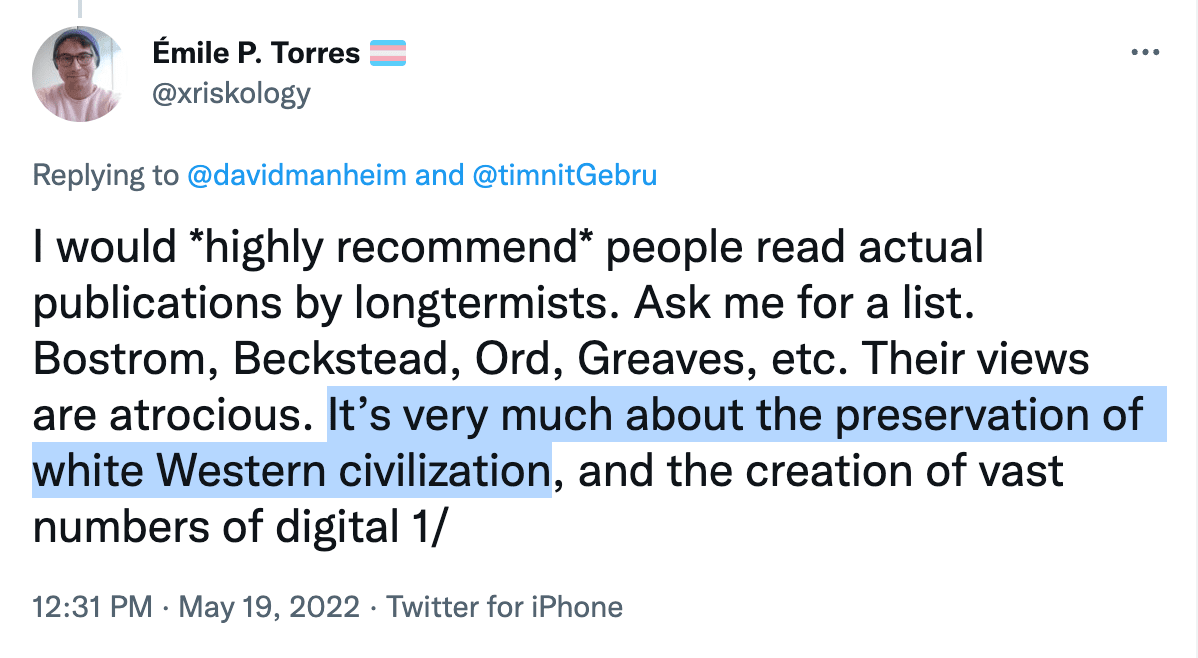
Torres then relied on that fabricated attribution to even claim that Greaves, along with other longtermists, endorses “atrocious” views, which are “very much about the preservation of white Western civilization”:
Andreas Mogensen
Torres has also made similar critical remarks about Andreas Mogensen, another researcher at Oxford University:
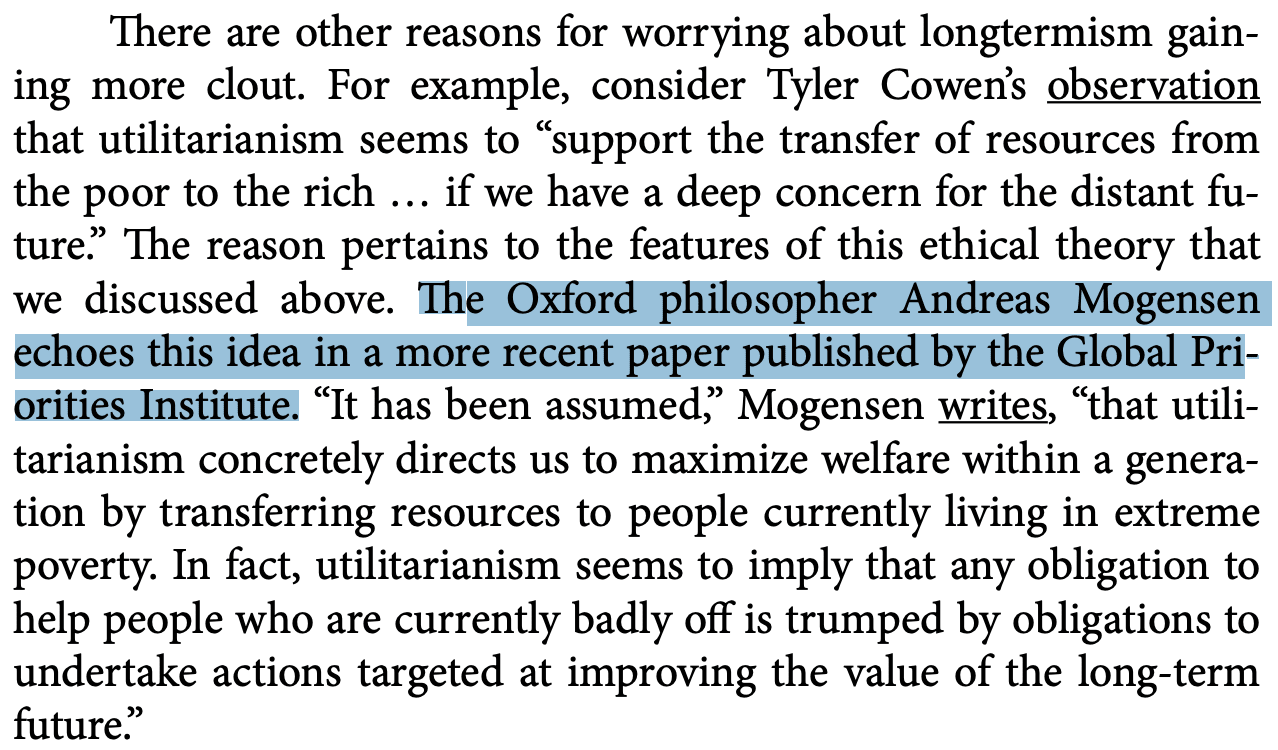
However, Mogensen here describes what he considers to be the implications of utilitarianism. Mogensen is not himself endorsing this view.2 In fact, Mogensen is not a consequentialist, let alone a utilitarian, as one can verify online:
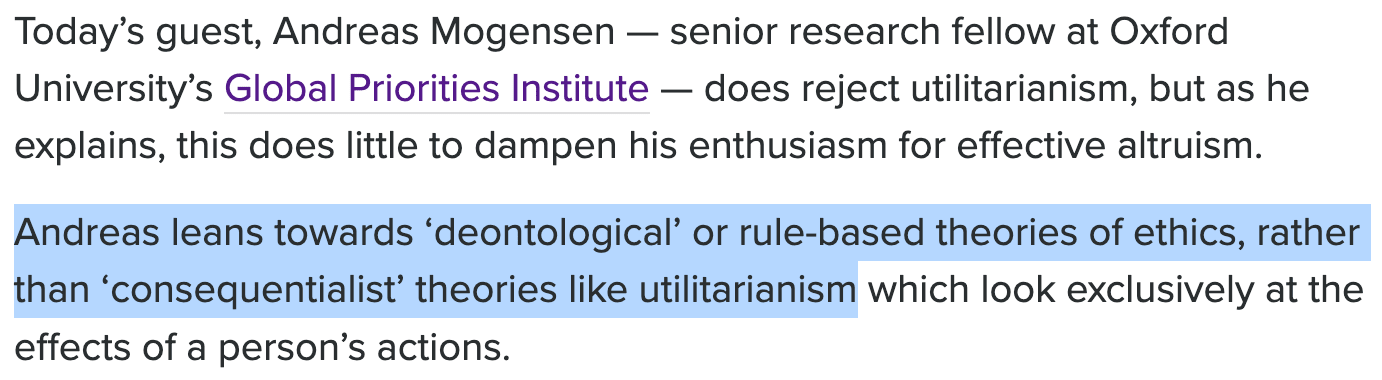
Moreover, and more seriously, Torres again falsely equates the claim that there are more urgent moral requirements than transferring resources from the rich to the poor with the claim that there is a requirement to transfer these resources in the opposite direction. Mogensen never claimed that utilitarianism requires this, let alone endorsed such a view himself.
Having mischaracterized Mogensen’s position, Torres (just like they did with Greaves) again draws the conclusion that these claims are “clearly white supremacist”:

Torres draws this conclusion even though, as noted, (I) Mogensen is not endorsing –– and, in fact, rejects –– the view whose implications he describes and (II) Mogensen never claimed that this view had the implications Torres attributes to it.
Nick Beckstead
Torres is especially critical of Nick Beckstead, an early and respected member of the effective altruist community. Torres criticizes Beckstead in several publications and mentions him ad nauseam in over 30 separate tweets from 2022 alone. However, virtually all of Torres’s critical mentions focus on a single passage from Beckstead’s unpublished doctoral dissertation. Here is the passage in question:
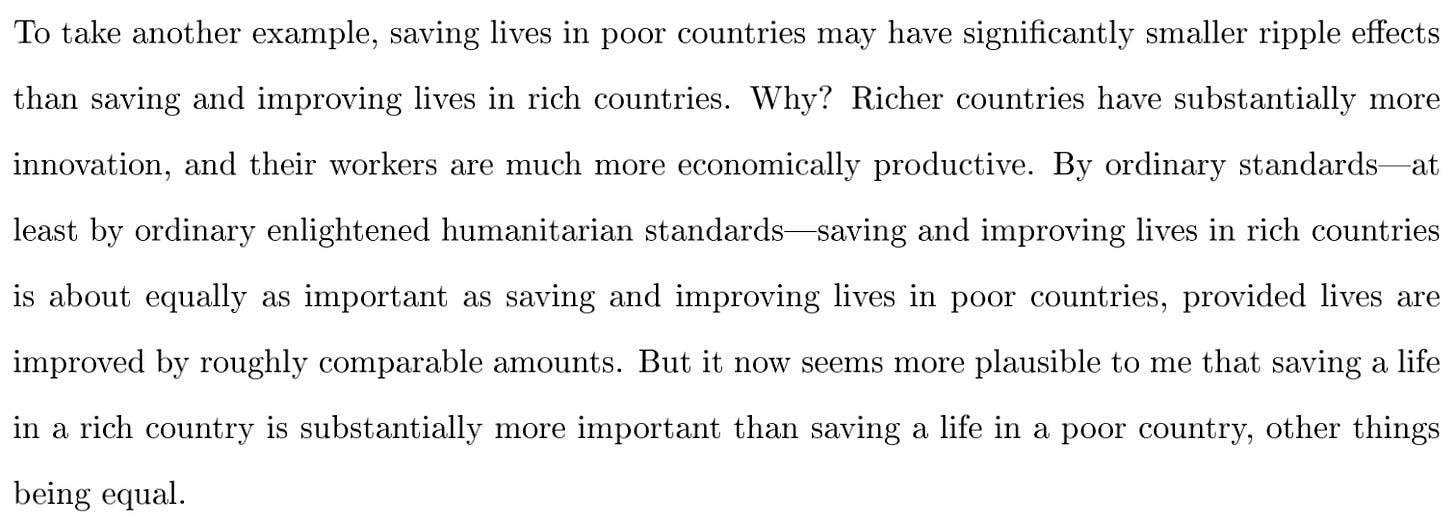
Torres has summarized this passage as “claim[ing that] we should actually care more about people in rich countries than in poor countries”; as noting that “‘giving to the rich’ is the obvious conclusion”; and as “literally arguing that, given the longtermist framework, we should value the lives of people in rich countries more than the lives of people in poor countries.” And Torres has, based on these summaries, drawn the conclusion that Beckstead’s views are “overtly white-supremacist”3 and in “the spirit of eugenics.”
It would be surprising if this characterization of Beckstead were true, given that he has a long track record of working to support global health and development. According to this Wiki article, Beckstead founded the first US chapter of Giving What We Can and pledged to donate 50% of his lifetime income to organizations fighting global poverty in developing countries, such as the Against Malaria Foundation.
And in fact, as we will now see, Torres’s summaries and characterizations of Beckstead’s views are grossly inaccurate.
Beckstead is not arguing here that “we should actually care more about people in rich countries” or that “we should value the lives of people in rich countries more than the lives of people in poor countries.” As an effective altruist, Beckstead believes that we should care about all lives equally. In the passage cited, Beckstead discusses only what effects saving lives in different countries will have on the future. Put differently, Beckstead is making an empirical claim about the long-run consequences of different actions, rather than a normative claim about the intrinsic value of different lives.
Similarly, Beckstead never once indicates that there should be global transfers of wealth from the poor to the rich, and in fact believes the opposite (and his track record of donations reflects this belief). The wellbeing of the poor should be prioritized precisely because they are poor, and therefore don’t have access to even the most basic medical care. Even if, all other things being equal, saving a rich person’s life causes greater economic flow-on effects that have greater benefits for future generations, one can save hundreds or thousands of times as many lives by focusing on healthcare for the extremely poor than one can by focusing on healthcare for the rich.
Beckstead explained his views to Torres when Torres first published the criticism, leaving a Facebook comment correcting many of these misrepresentations:

Since Torres responded to Beckstead's comment, we know that, when Torres published their critical tweets and articles, they did so fully aware that they distorted Beckstead's views.
Tyler Cowen
In the passage containing the quote by Mogensen examined previously, Torres also quotes Cowen, a professor of economics at George Mason University, who is not actually a longtermist:

However, Torres seriously misquotes Cowen. The ellipsis in the passage quoted separates two clauses that occur 20 lines apart in the original text. By omitting all the content, Torres leaves out context that is critical for a proper understanding of Cowen’s argument. In the screenshot below, I have highlighted Torres’s omissions:

Torres’s truncated quote portrays Cowen as attributing to utilitarianism the view that “the lives of people in rich countries matter more than the lives of people in poor countries.” But Cowen is not saying this. His point, instead, is that utilitarians who agree with Piketty (that returns to capital exceed the rate of growth of the economy as a whole) should expect actions that primarily benefit the rich in the present to benefit the poor in the future. Since utilitarians with a concern for the future will be more concerned about these future poor people, utilitarians who agree with Piketty may favor wealth redistribution from the present poor to the present rich, out of concern for the future poor people whom this wealth transfer will benefit. In other words, the key contrast here is not “poor vs. rich”, but “present poor vs. future poor.” One may or may not agree with the argument, but it bears little resemblance to the argument Torres attributes to Cowen.
Olle Häggström
As evidence that longtermism has "profoundly harmful real-world consequences", Torres quotes Olle Häggström, a professor of mathematical statistics at the Chalmers University of Technology:
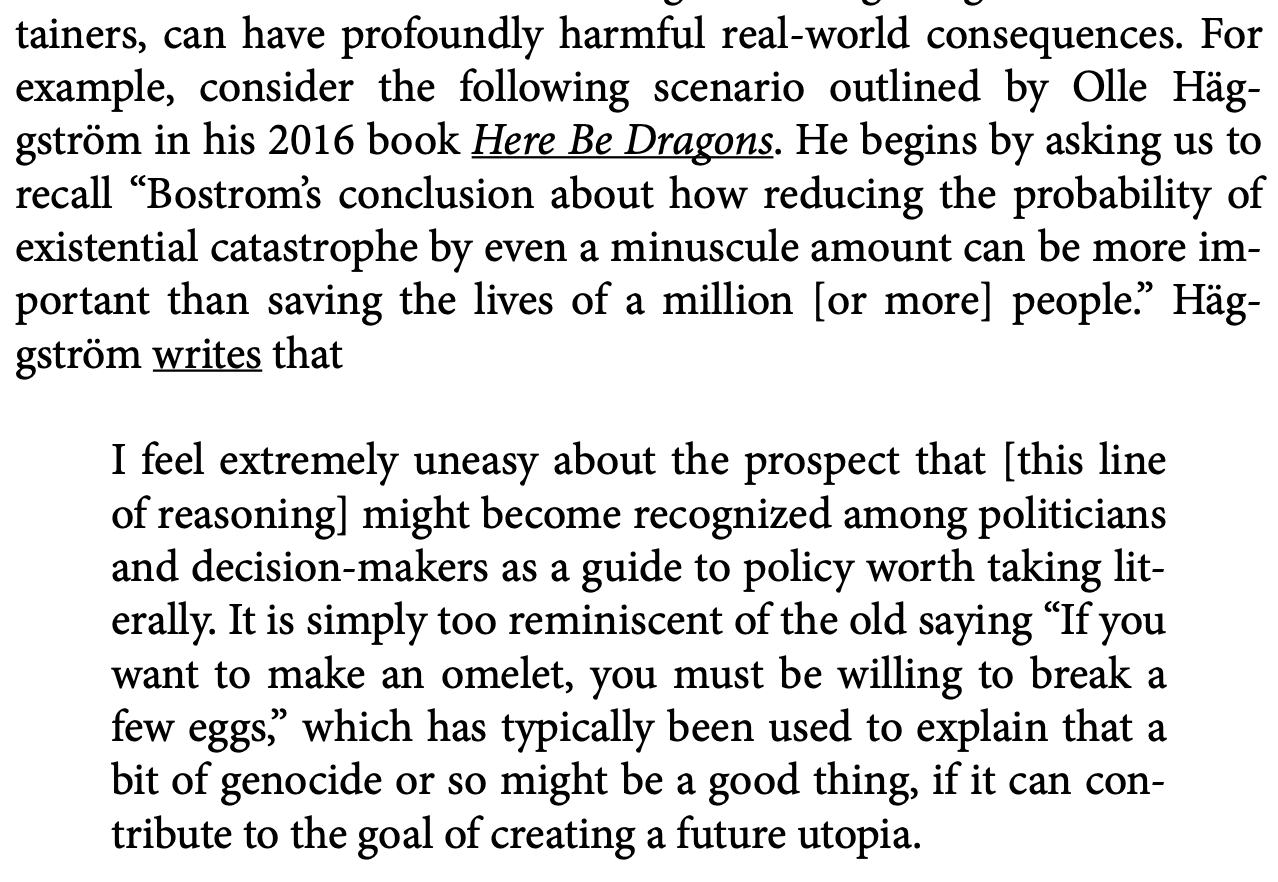
However, Häggström is not discussing here longtermism, but Nick Bostrom’s views specifically. The distinction is not pedantic: there are many types of longtermism, of which Bostrom’s version is but one. In fact, Häggström is sympathetic to longtermism, despite the impression one gets from reading the passage.
But why does one get this mistaken impression? Because Torres has truncated its first sentence to make it seem as if Häggström disagrees with Bostrom to a much greater degree than he actually does. Here is the sentence in full, with Torres’s omissions highlighted:4

That is, Häggström is not rejecting the conclusion as "patently absurd and wrong", as Torres implies. Indeed, just a page later, Häggström states his position clearly:

Back in 2020, Häggström contacted Torres to complain that Torres had misquoted him and that he did not say what Torres had portrayed him as saying. Torres, however, refused to issue a correction and, in fact, continued to misrepresent Häggström’s views in other articles, even including the exact same mutilated quote in a piece published as recently as October 2021. This, despite professing to “really care about getting the facts right”:
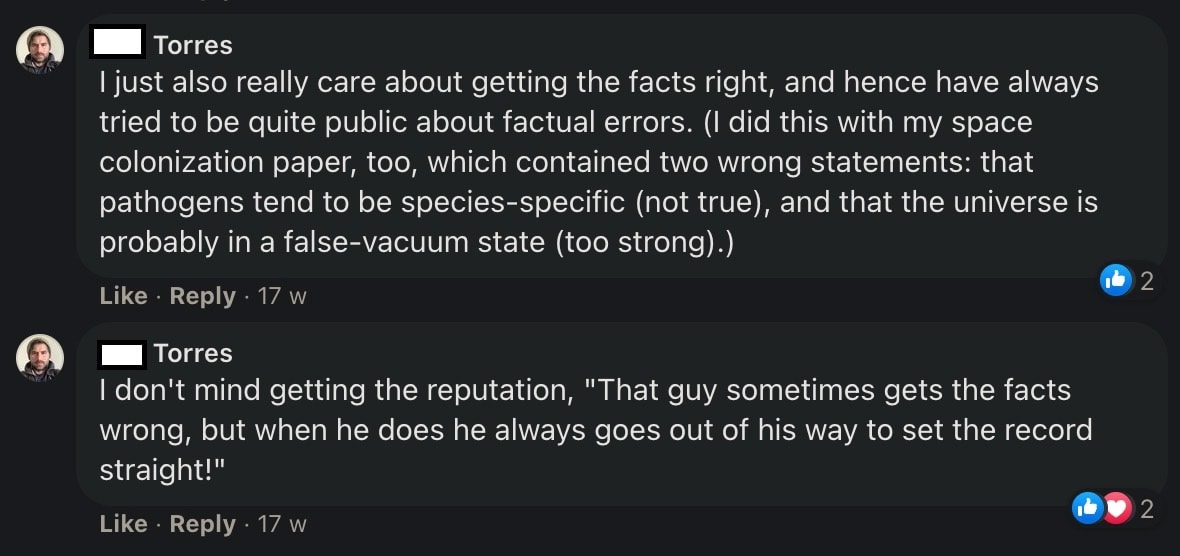
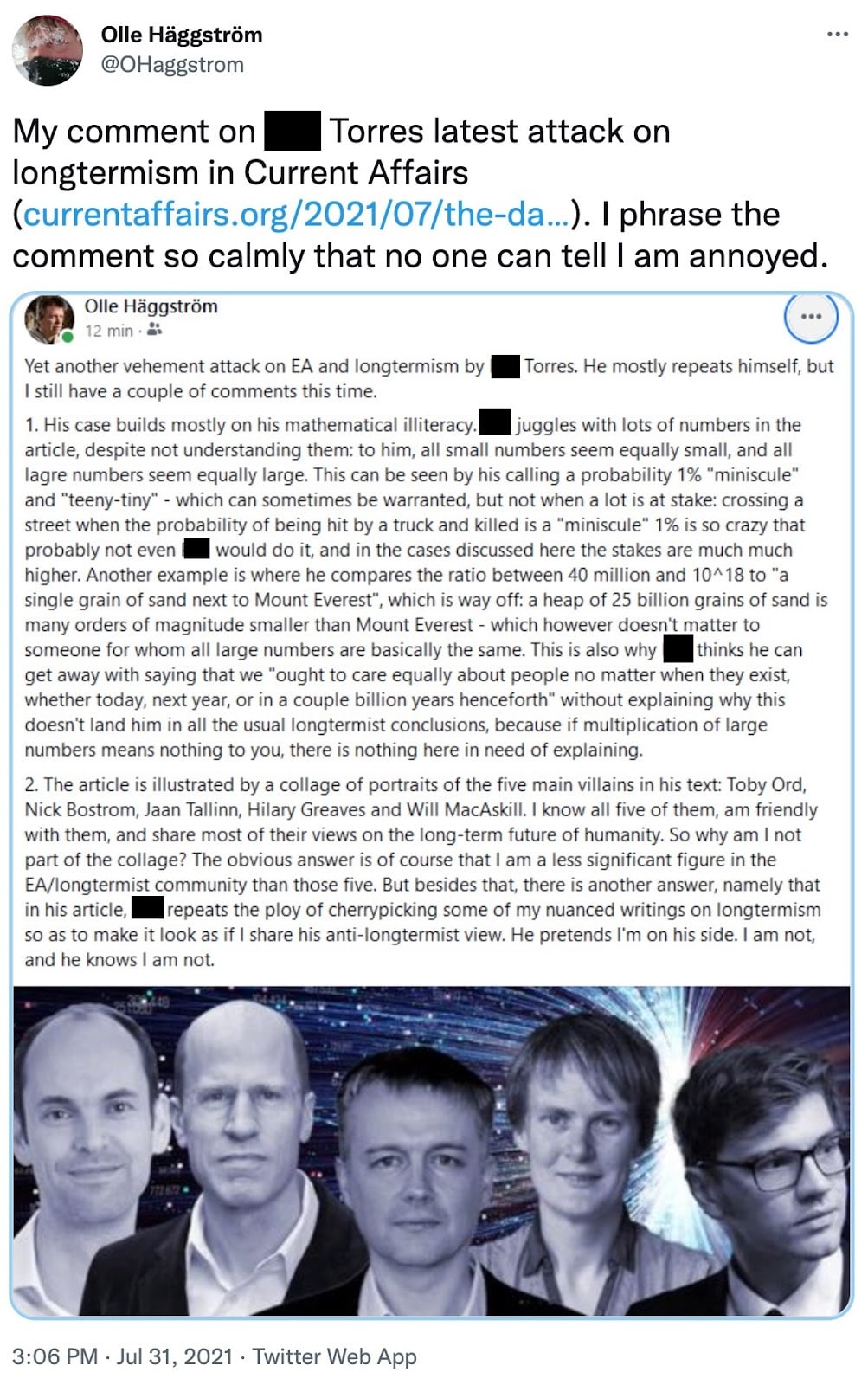
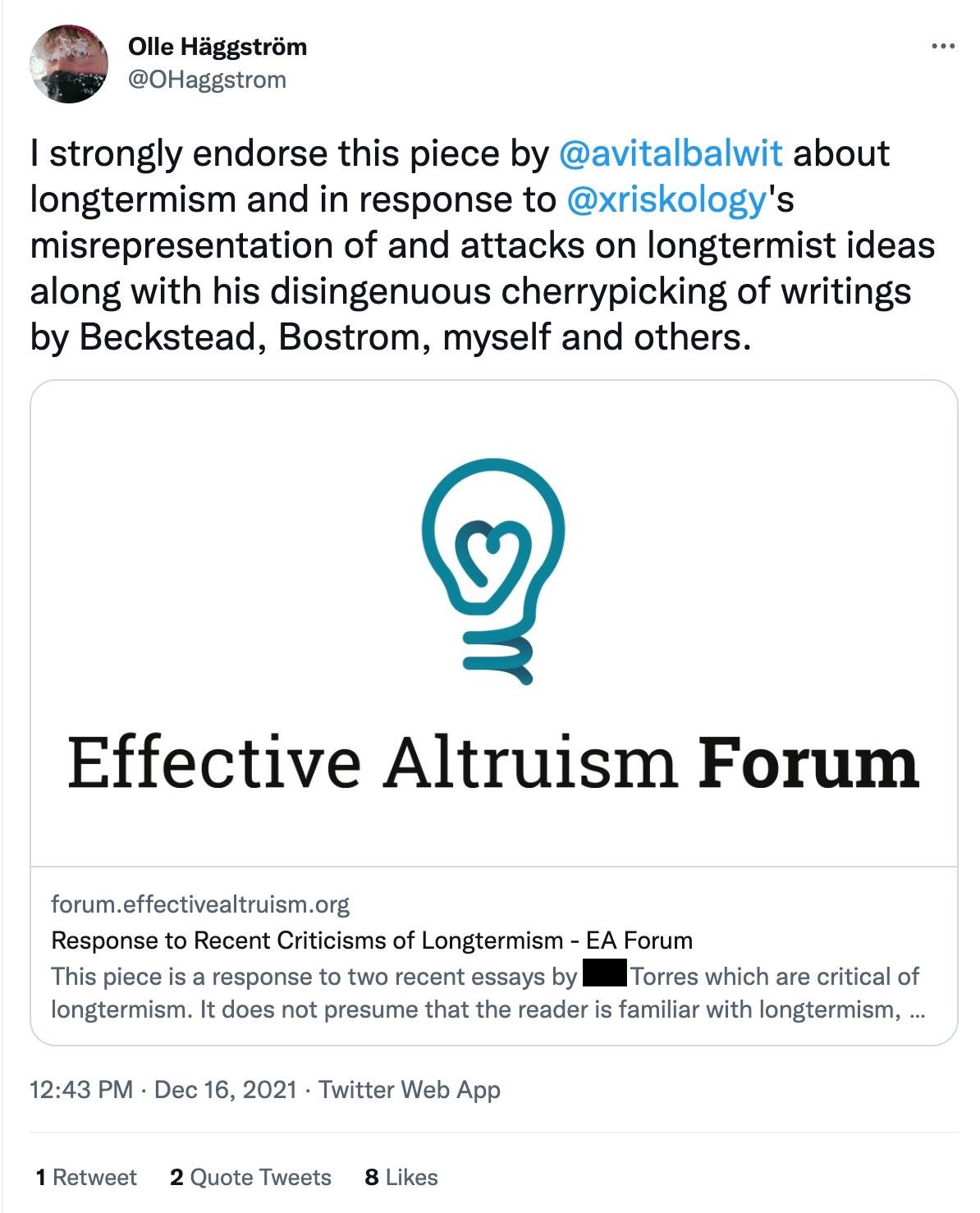
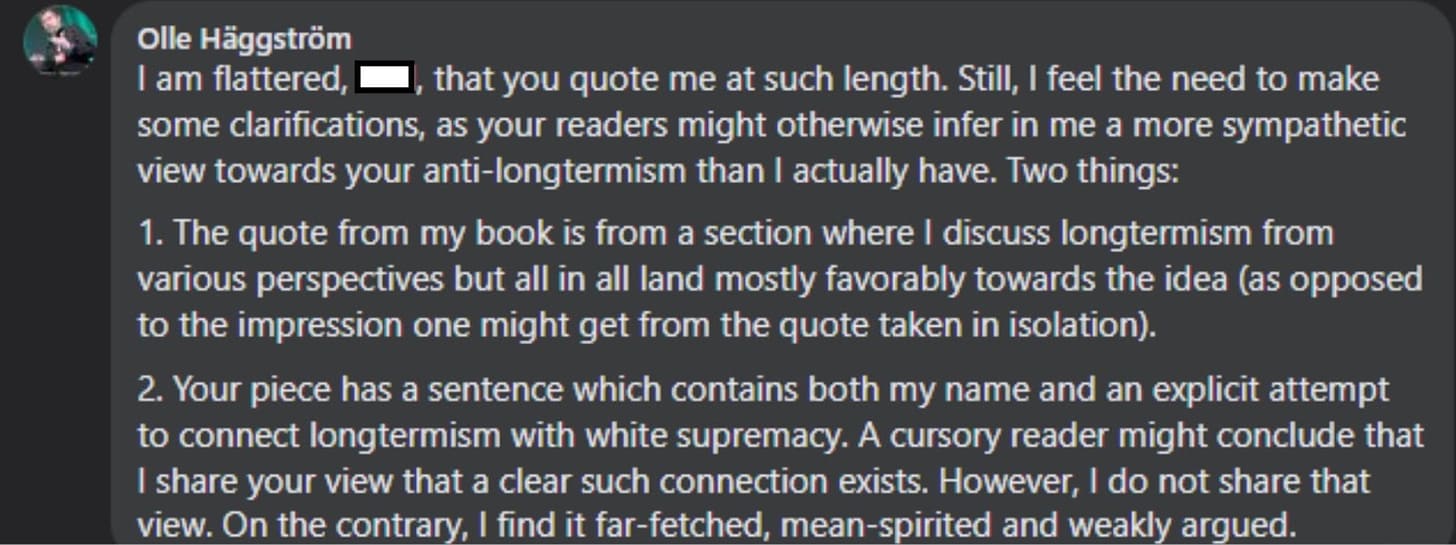
Eventually, Häggstrom became so frustrated with Torres’s misrepresentations that he made several public statements to correct the record. In those statements, Häggstrom characterizes Torres’s attempt to connect longtermism with white supremacy as “far-fetched, mean-spirited and weakly argued”; notes that “this is far from the first time that [Émile] Torres references my work in a way that is set up to give the misleading impression that I share his anti-longtermism view”; and denounces Torres’s “misrepresentation of and attacks on longtermist ideas along with his disingenuous cherrypicking of writings by Beckstead, Bostrom, myself and others.”
Sockpuppetry
As documented previously, Torres is known to have created multiple Twitter accounts to evade blocks and continue harassing their targets. But this isn’t the only instance in which Torres was caught posting under a false identity.
“Alex Williams”
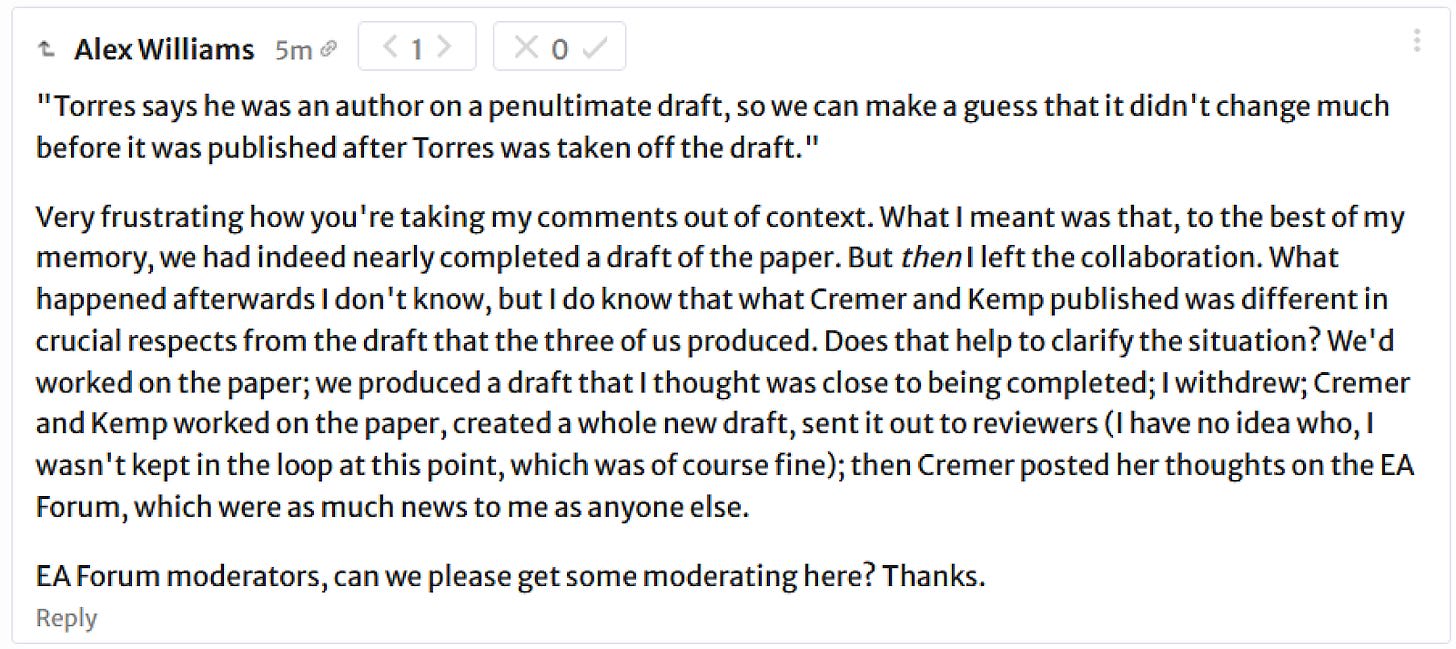
In August 2022, Torres made the careless error of responding to a critic on the Effective Altruism Forum from the account of one "Alex Williams." This "Alex" replies in a thread about and involving "philosophytorres", Torres's Effective Altruism Forum username. It is evident that “Alex” is no other than Torres themself, using the wrong account. That is, Alex Williams is a sockpuppet of Émile P. Torres (a “sockpuppet” is a false online identity used for the purposes of deception).
Minutes after posting their first comment, Torres left a second reply, also from Alex’s account. Ironically, the comment complains that one of Torres’s critics had failed to disclose their true identity:
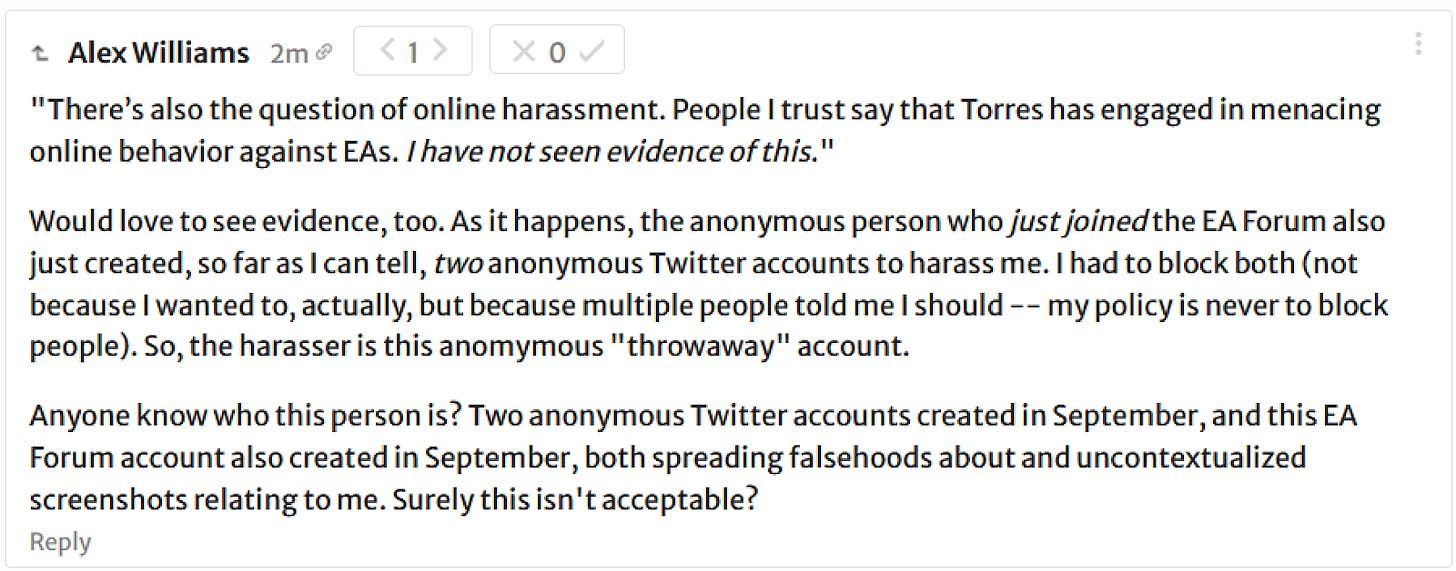
In a further ironic twist, moments later, in a comment posted under their real account, Torres addressed the EA community and asked whether its members were okay with people creating anonymous Forum accounts to discredit others:
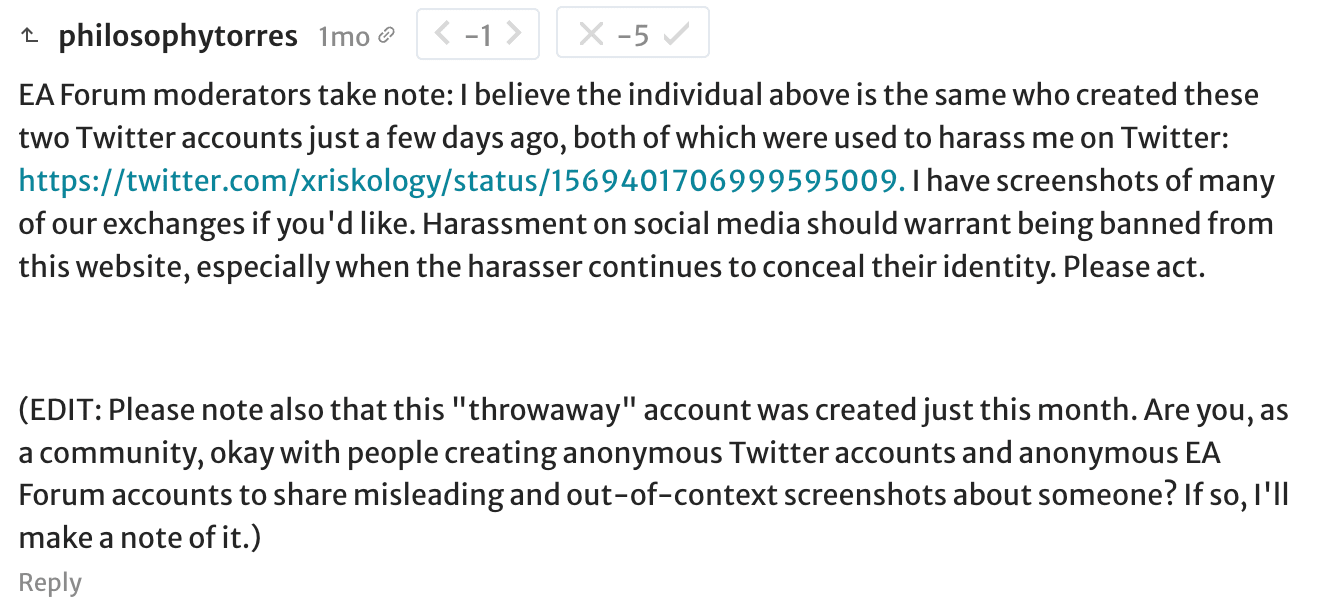
Upon discovering their mistake, “Alex” (i.e., Émile) proceeded to delete the comments, attempting to quickly conceal evidence of their deception.
In creating this fake account, Torres was deliberately circumventing a ban that had been imposed on them for “[c]alling someone a jerk and swearing at them” (see above), still in effect on the date the account was created:
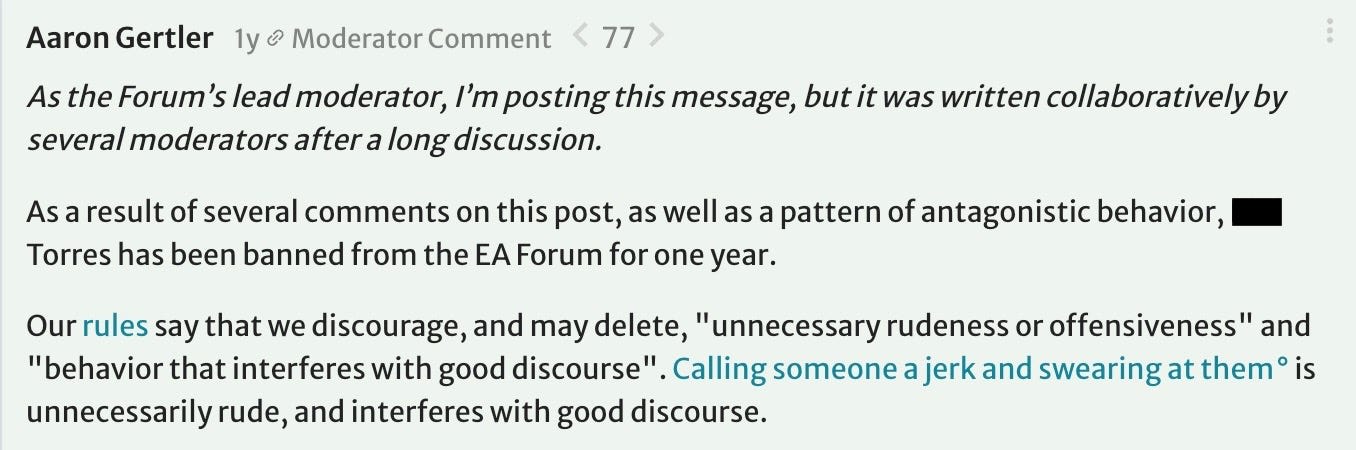
Torres then used the Alex Williams fake account, among other things, to ask a seemingly innocent question about Bostrom’s simulation argument. In fact, this was all disingenuous. By this point, Torres had already concluded that Bostrom's argument was flawed and wanted to find ways to discredit him.
In response to a user who had provided an answer to Torres’s question, Torres leaves two comments expressing “surpris[e]” that people took Bostrom’s argument seriously and that Bostrom’s paper made it through peer review:


After this user further responds to Torres’s insistent questions, Torres again is puzzled that “people take the argument seriously” and that “the peer review process didn’t pick up this problem”:

That this was part of an effort to discredit Bostrom is confirmed by a tweet Torres posted under Torres’s real account just some hours before they posted the EA Forum comments under the fake account:
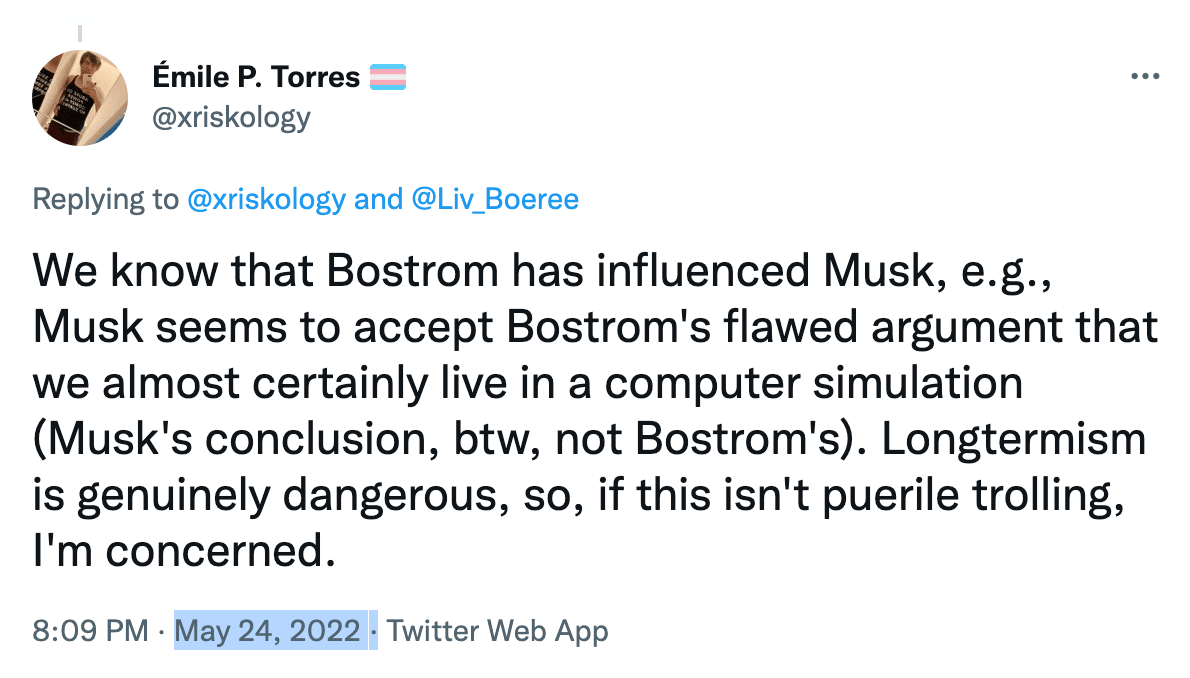
In sum, Torres insulted and called someone a liar for telling the truth; was banned for this uncivil behavior; created a fake account to evade this ban; and used that account to discredit another person, abusing the trust of the EA community.
Conclusion
At the beginning of this post, I announced that I would show
How Torres repeatedly made demonstrably false claims.
How Torres grossly distorted the views of several people.
How Torres created multiple fake accounts to harass their targets, evade bans, and discredit their opponents.
How Torres harassed and stalked multiple people, and made racist comments about at least one person.
I have now presented the evidence supporting all those allegations. As a result of these findings, I believe any claims Émile Torres makes should be viewed with extreme skepticism.
I noted at the beginning that the above represents only about 40% of the evidence I have collected. Given that Torres deleted all tweets between 2017-2019 and was known to be harassing people during this time, I suspect there are many more issues that I don't know about. Indeed, we only know about the Boghossian and Pluckrose incidents because someone took the time to save some of the relevant tweets to an online archive.
The purpose of this post was only to document some examples of Torres’s misbehavior. For a more detailed examination of Torres’s criticisms of effective altruism and longtermism, you can check out this piece by Avital Balwit. Torres wrote a reply, which you may want to read as well.
Added November 23rd, 2022:
In a disturbing tweet, Émile P. Torres claims that I have been "stalking, harassing, lying about, impersonating, and threatening [them] with physical violence."
This is an complete fabrication.
To repeat what I wrote above, I have never messaged Torres, let alone done any of the things they accuse me of.

Since I am not behind these attacks and Torres cannot conceivably have come to this conclusion, it seems fairly clear that Torres is knowingly lying about me.
Added February 15th, 2023:
Andreas Kirsch, a DPhil student at Oxford University unaffiliated with the EA movement, recently decided to fact-check this piece after Torres claimed it was "defamatory and false". His conclusion was that Torres's claims were unfounded and that the article was substantially true. You can read Andreas's thread here.

Andreas Kirsch @BlackHC
(CW: not an ML thread) A while ago, I retweeted a link about @xriskology, which they said was defamatory and false. I deleted my retweet and said I'd follow up. Now I've checked & the link is not defamatory bc it's substantially true. Thus, here it is:
markfuentes1.substack.comÉmile P. Torres’s history of dishonesty and harassmentAn incomplete summary
10:38 AM ∙ Feb 2, 2023
87Likes7Retweets
References
Beckstead, N. (2013). On the Overwhelming Importance of Shaping the Far Future. PhD Thesis.
Boghossian, P. (2020, September 28). “We adopted our daughter from China as a waiting child when she was almost 3.” Twitter.
Cowen, T. (2018). Stubborn Attachments: A Vision for a Society of Free, Prosperous, and Responsible Individuals. San Francisco: Stripe Press. p. 89-90.
Cremer, C. Z. (2022, September 14). “The post in which I speak about EAs being uncomfortable about us publishing the article only talks about interactions with people who did not have any information about initial drafting with Torres.” EA Forum.
Gertler, A. (2021, March 8). “As the Forum’s lead moderator, I’m posting this message, but it was written collaboratively by several moderators after a long discussion.” EA Forum.
Häggström, O. (2016). Here Be Dragons: Science, Technology and the Future of Humanity. Oxford: OUP. p . 240-1.
Häggström, O. (2021, July 13). “My comment on [Émile] Torres latest attack on longtermism in Current Affairs.” Twitter.
Häggström, O. (2021, August 6). “Many thanks for this, Rohin.” EA Forum.
Häggström, O. (2021, December 16). “I strongly endorse this piece by @avitalbalwit about longtermism and in response to @xriskology’s misrepresentation of and attacks on longtermist ideas along with his disingenuous cherrypicking of writings by Beckstead, Bostrom, myself and others.” Twitter.
Karnofsky, H. (2017, February 16). Radical Empathy. Open Philanthropy.
Long, Robert. (2022, October 11). “There’s (much) more to launching an org than having the idea and a website.” Twitter.
Magnabosco, A. (2018, March 3). “This fascination with PB seems to only be escalating since we had to boot you from off-topic posting (about PB) in one of the study groups few months back.” Twitter.
Matis (2022, September 15). “To recall, what you tweeted was this.” EA Forum.
Ó hÉigeartaigh. (2021, Mach 8). “A quick point of clarification that [Émile] Torres was never staff at CSER.” EA Forum.
Pluckrose, H. (2018, March 2). “I don't think your stalking behaviour is really a suitable subject for ongoing medium discussion.” Twitter.
Pluckrose, H. (2018, March 2). “I have given the evidence in the form of your own posts.” Twitter.
Pummer, T. (2020, April 19). Hilary Greaves talks longtermism.
Torres, É. P. (2016, September 16). “My @TIME magazine article about atheism, co-authored with two brilliant scholars.” Twitter.
Torres, É. P. (2018, March 1). “Hahaha. I actually emailed Peter about being in Portland soon and wanting to sit in on his class.” Twitter.
Torres, É. P. (2018, March 1). “Lol. I actually wrote to the PSU police.” Twitter.
Torres, É. P. (2018, March 2). “Please don't mute me.” Twitter.
Torres, É. P. (2018, March 2). “You're not getting it.” Twitter.
Torres, É. P. (2018, March 2). “I have repeatedly asked you to stop pestering me.” Twitter.
Torres, É. P. (2018, March 2). “Well, why does she keep making false claims?” Twitter.
Torres, É. P. (2018, March 3). “I try to ignore these guys, then something pops into my feed.” Twitter.
Torres, É. P. (2018, March 6). “Just for the record, I had asked her to stop harassing me for almost an entire day.” Twitter.
Torres, É. P. (2018, March 6). “Peter is easily triggered.” Twitter.
Torres, É. P. (2021). Is Existential Risk a Useless Category? Could the Concept Be Dangerous?
Torres, É. P. (2021). Were the great tragedies of history “mere ripples”? The case against longtermism.
Torres, É. P. (2021, Abril 27). “Haydn, Michael Plant, etc. etc.” EA Forum.
Torres, É. P. (2021, Abril 27). “He has unfortunately misrepresented himself as working at CSER on various media (unclear if deliberate or not).” EA Forum.
Torres, É. P. (2021, Abril 27). “I am trying to stay calm, but I am honestly pretty f*cking upset that you repeatedly lie in your comments above, Sean.” EA Forum.
Torres, É. P. (2021, Abril 27). “That I didn't know about, Sean, nor did you mention it.” EA Forum.
Torres, É. P. (2021, July 28). The dangerous ideas of “longtermism” and “existential risk.” Current Affairs.
Torres, É. P. (2021, October 19). Why Longtermism Is the World’s Most Dangerous Secular Credo. Aeon.
Torres, É. P. (2021, December 16). “Also, someone in the comments quotes Helen Pluckrose.” Twitter
Torres, É. P. (2022, May 19). “I would *highly recommend* people read actual publications by longtermists.” Twitter.
Torres, É. P. (2022, May 24). “We know that Bostrom has influenced Musk, e.g., Musk seems to accept Bostrom’s flawed argument that we almost certainly live in a computer simulation (Musk’s conclusion, btw, not Bostrom’s).” Twitter.
Torres, É. P. (2022, August 20). Understanding ‘longtermism.’ Salon.
Torres, É. P. (2022, September 9). “No, they wouldn't.” Twitter.
Torres, É. P. (2022, September 15). “EA Forum moderators take note.” EA Forum
Torres, É. P. (2022, September 15). “Thank you for correcting the record, Zoe, and my apologies if I'd misremembered some of this.” EA Forum.
Torres, É. P. (2022, October 11). “Yet if you search givingwhatwecan.org on Wayback Machine, you’ll find (surprise!) that the website for this organization was first posted online in 2007, *a whole two years* before MacAskill had even met Ord.” Twitter.
Torres, É. P. (2022, October 11). “It's not an accusation, it's a question.” Twitter.
Wiblin, R. (2022, September 8). Andreas Mogensen on whether effective altruism is just for consequentialists. 80,000 Hours.
Wilkinson, H. (2022, September 8) “Another out-of-context quote from someone who disagrees with the view expressed when it's taken in isolation?” Twitter.
Wilkinson, H. (2022, September 8) “"It seems more plausible to me that X" doesn't mean "I'm convinced of X".” Twitter
Wilkinson, H. (2022, September 8) “Just a reminder that, regardless of whatever actions you speculate that other particular longtermists *would* endorse or *should* endorse, it’s still a lie that greaves has *in fact* advocated for poor-to-rich wealth transfer.” Twitter.
Williams, A. [Torres, É. P.] (2022). Comments on the EA Forum. EA Forum.
1
Please note that ‘Mark Fuentes’ is a pseudonym I am using to protect my safety, since I fear that, were I to post under my real name, I would become Torres’s next harassment target. As I hope readers who have read this article will agree, these fears are not unwarranted.
2
Indeed, in the concluding section of his paper, Mogensen makes it clear that, because utilitarianism has these implications, he is inclined to the view that it is a less plausible moral theory overall.
3
Revealingly, in another version of this article, Torres calls Beckstead’s views “unambiguously white-supremacist.”
4
Häggström, Here Be Dragons: Science, Technology and the Future of Humanity. Oxford: OUP. 2016. p . 240.







Broadly I think that both Torres and Gebru engage in bullying. They have big accounts and lots of time and will quote tweet anyone who disagrees with them, making the other person seem bad to their huge followings.