Comments
AI Czar attacks EA. (Again.)
Today in this post on X, the U.S. 'AI Czar' David Sacks directly attacked Humans First, an AI safety advocacy organization, by claiming that it's nothing more than 'censorship power play', a shadowy campaign by Effective Altruists to turn the conservative right against the AI industry, and to block technological progress.
He quote-posted this blog by Jordan Schachtel titled 'Built to Deceive: How the Effective Altruist Machine Infiltrated the Conservative Right on AI'.
As an AI Safety advocate, a member of Humans First, an Effective Altruist, and a political conservative, I'm angry about this misrepresentation of AI safety campaign. And I think EAs should fight back harder against senior federal officials smearing our movement.
Any suggestions on how to respond? I don't have time this week to write a detailed rebuttal, but I'd be happy to link and promote anything that others write.
(Not a solution, but a general observation about people who engage in bashing EA.)
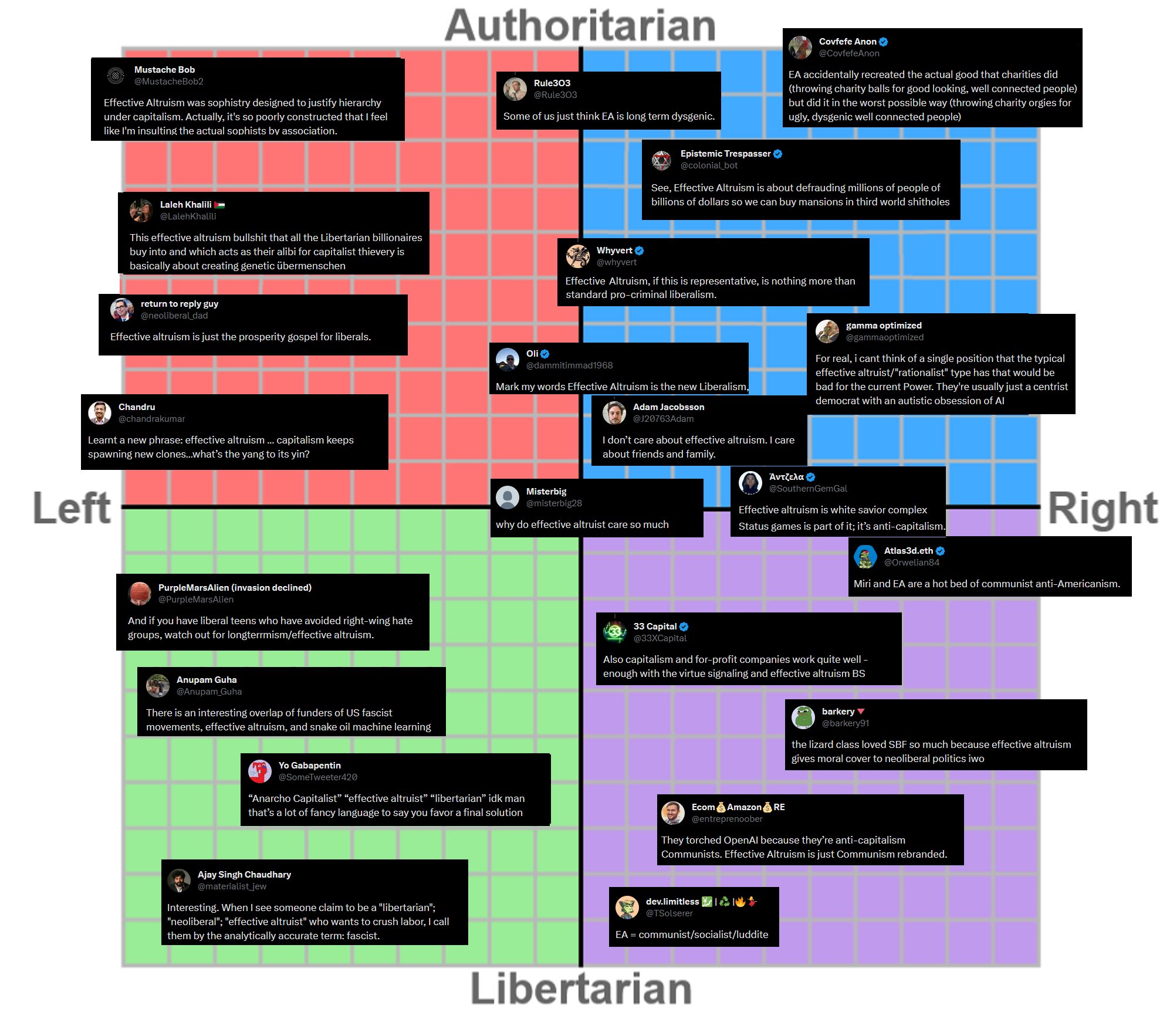
The "dot connectors" will always connect the dots, infer or invent nefarious motivations, and try to bucket you as they like. The problem is that you can't neatly map EAs onto the political spectrum -- yes, there are dominant trends, but the variance in views is sufficiently high that commentators have genuinely no clue where EAs belong. This makes sense because most major movements in history have been political ones, so when assessing EA, most people pull out their internal political philosophy detector and you end up with a mess like the chart below!
But EA is a moral philosophy movement, and the chain of thinking is genuinely different. Instead of thinking how to organize society and labor, EAs unanimously agree on beneficentrism and deal with questions like, "What morally matters? To what degree? Which interventions are most effective? How do you even assess what is most effective?" When you organize a movement around these set of questions, you end up with:
I don't know what the best solution for combatting EA bashing is, but spreading the idea that EA is more politically and intellectually diverse than people think should help.
This is a slow-burn solution, but the most effective support and rebuttals will come from people who aren't EAs, but are just fair/principled, and have had enough exposure to EA to know when attacks are unfair. E.g. See Dean Ball this week. So the more surface area EAs can create with those sorts of people, the better the position EA is in. For example, I think Andy Masley's datacenter water use posts created a lot of surface ara with such people and has been better for the EA 'brand' than any specific rebuttal.
(A part of this strategy involves, as a general principle, "behave with as much dignity, integrity and fairness as possible, even when others aren't). (Admittedly my own responses usually involve gently poking fun, but I do try to stay good natured).
I think we could use a documentary series where we just go follow around orgs or individual EAs for a couple days and see how they talk, live and act. It would be pretty cheap at the very least.
My new interview (48 mins) on AI risks for Bannon's War room: https://rumble.com/v6z707g-full-battleground-91925.html
This was my attempt to try out a few new arguments, metaphors, and talking points to raise awareness about AI risks among MAGA conservatives. I'd appreciate any feedback, especially from EAs who lean to the Right politically, about which points were most or least compelling.
You mention having “an ambition, even a prayer for [the AI developers]” (~12 min). You might mean this figuratively, but many viewers of that channel will probably take it literally. When you admit elsewhere that you don't believe in god and don't practice any religion, they likely see this as a contradiction and suspect you’re not being genuine once you become more popular.
My guess is that it's better to be upfront about not being a Christian in order to retain authenticity. You'll probably always be regarded as an outsider by the conservative right (just for another example: your twitter handle includes 'poly', and you've spoken at length online about being polyamorous), but you could hope to be perceived as 'the outsider who gets us'. This kinda worked for a while for Sam Harris or Milo Yiannopoulos.
Tobias -- I take your point. Sort of.
Just as they say 'There are no atheists in foxholes' [when facing risk of imminent death during combat], I feel that it's OK to pray (literally and/or figuratively) when facing AI extinction risk -- even if one's an atheist or agnostic. (I'd currently identify as an 'agnostic', insofar as the Simulation Hypothesis might be true).
My X handle 'primalpoly' is polysemic, and refers partly to polyamory, but partly to polygenic traits (which I've studied extensively), and partly to some of the hundreds of other words that start with 'poly'.
I think that given most of my posts on X over the last several years, and the people who follow me, I'm credibly an insider to the conservative right.
'3 Body Problem' is a new 8-episode Netflix TV series that's extremely popular, highly rated (7.8/10 on IMDB), and based on the bestselling 2008 science fiction book by Chinese author Liu Cixin.
It raises a lot of EA themes, e.g. extinction risk (for both humans & the San-Ti aliens), longtermism (planning 400 years ahead against alien invasion), utilitarianism (e.g. sacrificing a few innocents to save many), cross-species empathy (e.g. between humans & aliens), global governance to coordinate against threats (e.g. Thomas Wade, the UN, the Wallfacers), etc.
Curious what you all think about the series as an entry point for talking about some of these EA issues with friends, family, colleagues, and students?
I haven't seen the series, but am currently halfway through the second book.
I think it really depends on the person. The person I imagine would watch three-body problem, get hooked, and subsequently ponder about how it relates to the real world, seems like they also would get hooked by just getting sent a good lesswrong post?
But sure, if someone mentioned to me they watched and liked the series and they don't know about EA already, I think it could be a great way to start a conversation about EA and Longtermism.
I think there's a huge difference in potential reach between a major TV series and a LessWrong post.
According to this summary from Financial Times, as of March 27, '3 Body Problem' had received about 82 million view-hours, equivalent to about 10 million people worldwide watching the whole 8-part series. It was a top 10 Netflix series in over 90 countries.
Whereas a good LessWrong post might get 100 likes.
We should be more scope-sensitive about public impact!
I think I am misunderstanding the original question then?
I mean if you ask: "what you all think about the series as an entry point for talking about some of these EA issues with friends, family, colleagues, and students"
then the reach is not the 10 million people watching the show, it's the people you get a chance to speak to.
I completely agree Geoffrey! I originally read Liu Cixin's series before I became involved in EA, and would highly recommend to anyone who's reading this comment.
I think the series very much touches on themes similar in EA thought, such as existential risk, speciesism, and what it means to be moral.[1]
I think what makes Cixin's work seem like it's got EA themes is that a lot of the series challenges how humanity views its place in the universe, and it challenges many assumptions about both what the universe is, and our moral obligations to others in that universe, which is quite similar to how EA challenges 'common-sense' views of the world and moral obligation.
(I also referenced it in this reply to Matthew Barnett)
PS: Fun fact: after my coauthor Peter Todd (Indiana U.) and I read '3 Body Problem' novel in 2015, we were invited to a conference on 'active Messaging to Extraterrestrial Intelligence' ('active METI') at Arecibo radio telescope in Puerto Rico. Inspired by Liu Cixin's book, we gave a talk about the extreme risks of active METI, which we then wrote up as this journal paper, published in 2017:
PDF here
Journal link here
Title: The Evolutionary Psychology of Extraterrestrial Intelligence: Are There
Universal Adaptations in Search, Aversion, and Signaling?
Abstract
To understand the possible forms of extraterrestrial intelligence (ETI), we need not only astrobiology theories about how life evolves given habitable planets, but also evolutionary psychology theories about how intelligence emerges given life. Wherever intelligent organisms evolve, they are likely to face similar behavioral challenges in their physical and social worlds. The cognitive mechanisms that arise to meet these challenges may then be copied, repurposed, and shaped by further evolutionary selection to deal with more abstract, higher-level cognitive tasks such as conceptual reasoning, symbolic communication, and technological innovation, while retaining traces of the earlier adaptations for solving physical and social problems. These traces of evolutionary pathways may be leveraged to gain insight into the likely cognitive processes of ETIs. We demonstrate such analysis in the domain of search strategies and show its application in the domains of emotional aversions and social/sexual signaling. Knowing the likely evolutionary pathways to intelligence will help us to better search for and process any alien signals from the search for ETIs (SETI) and to assess the likely benefits, costs, and risks of humans actively messaging ETIs (METI).
The book in my opinion is better, and relies so much on vast realizations and plot twists that it's better to read it blind—before the series and before even the blurb at the back of the book! So for those who didn't know it was a book, here it is: https://www.amazon.fr/Three-Body-Problem-Cixin-Liu/dp/0765377063
I didn't know about this, now I think I have a new netflix shot to watch! thanks!
On the topic, I hear season 7, episode 5 of young sheldon is abput a dangerous AI. Edit: I watched the episode, it's not.

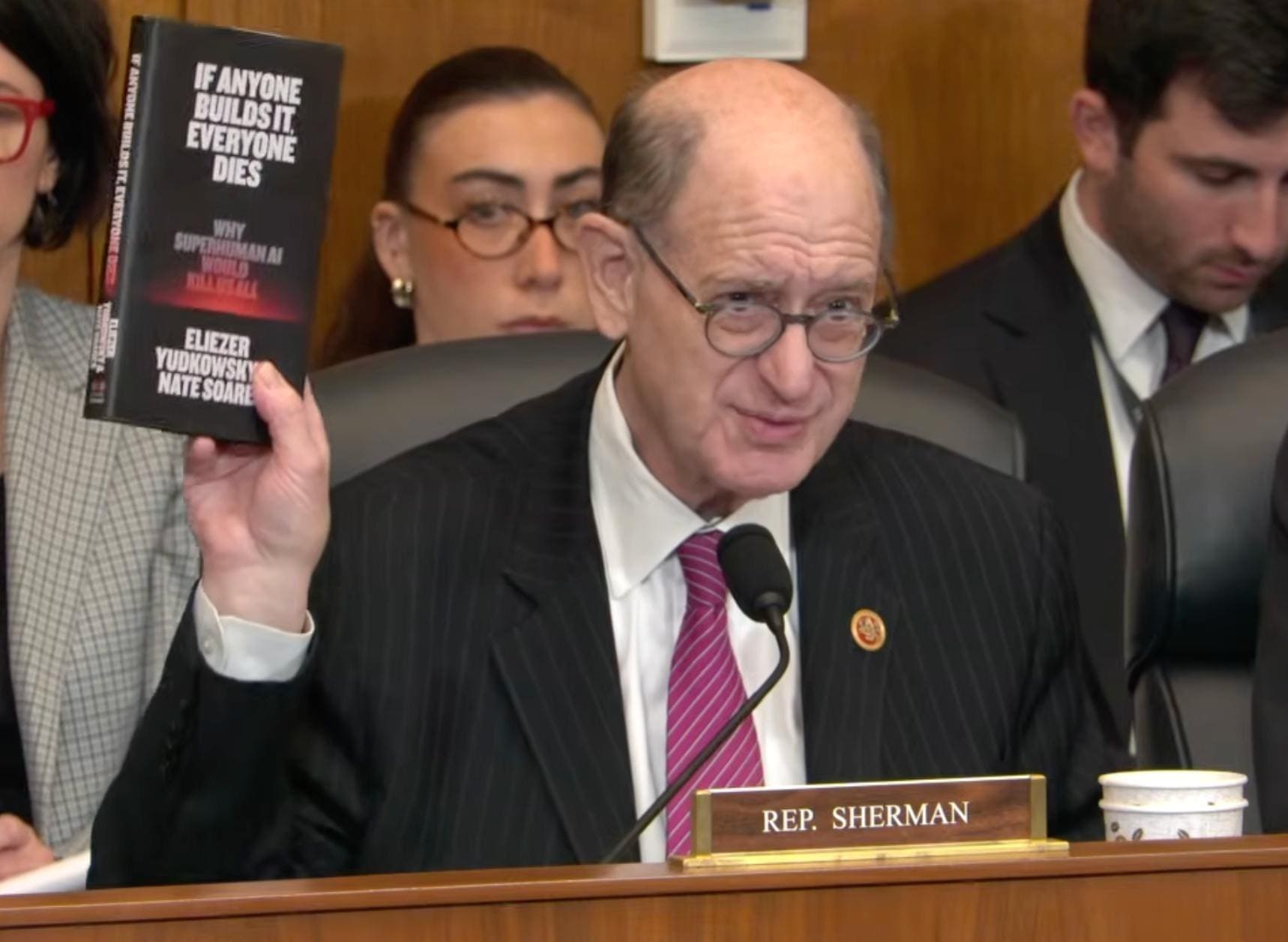


EA is facing its most serious PR crisis in history, and nobody in EA seems to be discussing it or doing anything effective about it. Everyone seems to be carrying on as if this is business as usual.
President Donald Trump, AI Czar David Sacks, and the Department of War have launched a coordinated campaign in the last week to portray EA as treasonous and toxic.
Their campaign motto is 'Americanism, not Effective Altruism'. Tens of thousands of MAGA political influencers are attacking EA (often from positions of total ignorance) on social media platforms such as X, Truth Social, and Facebook. They're also portraying all concerns about catastrophic risks from AI as a 'hoax', a 'psyop', and a CCP influence campaign -- part of a 'Doomer Industrial Complex'.
This is unprecedented. It's far worse than any previous scandal or crisis that EA has faced. Even the SBF/FTX debacle didn't lead to key American leaders and legions of influencers directly attacking EA.
Are we going to do anything about this, or just let the pro-AI accelerationists, in the current White House administration and the Pentagon, trash-talk the movement that we've spent the last 15 years growing and defending?
I definitely not the "worst" PR crisis. The DOW account is a random poster for the Office of the Under Secretary of War for Research and Engineering, not Hegseth.
But I agree that it would be best for Republicans not to be polarized against AI safety. They aren't so far; thanks in part to Speaker Johnson. I suggest not letting random trolls goad us into abandoning courtesy and the presumption of good will. It is counterproductive to respond to much of this stuff, as that imbues it with more seriousness than it deserves.
It's rather patronizing and dismissive to call the President of the US, and the AI czar, 'random trolls'.
They have enormous power to shape public perception. I've followed the discourse on X very closely. Many thousands of influential people who knew nothing about EA until a couple of weeks ago are now repeating the partisan message from POTUS that EA is 'un-American' and a 'degenerate cult' and 'decels' and 'CCP stooges'.
This deserves to be taken seriously, not dismissed. EA has suddenly become infamous, and politically stigmatized, among tens of millions of people who had never heard of it.
Not "random", but I think it's kind of hard to argue that they are not doing a massive amount of trolling, ad hominem, and bad faith.
E.g., https://truthsocial.com/@realDonaldTrump/posts/115398251623299921 for a very small tip of the bizarre iceberg.
Has Trump himself shared the ‘Americanism not effective altruism’ stuff?
I think I agree with the assessment, but what proposals have you thought about to stem this tide?
Good question. I think it's very important for EAs (ideally those with more tact and patience on social media than me) to engage on X and other social media platforms to gently by clearly correct all the slanders and misinformation that are being thrown against EA.
In EA, there seems to be a real leadership vacuum on this point. I don't know what the leaders of the big, rich EA groups, funders, and think tanks are doing. But their PR comms people seem to be utterly disengaged, or ineffective, or are following some kind of silent 'wait and see' strategy that is not working.
I'm doing my best to counter some of the more extreme slanders on X. But it feels like a very lonely fight at the moment.
Good. I'm trying/will keep trying to do my part with this. I think a lot of EAs, though (perhaps some of the leadership?) actually consider the current turn of events as positive, from a model of the type: this gives us visibility and positions us as anti-Trump/Maga at a time when Republicans will likely lose midterms and possibly the next election cycle; plus, this makes us more visible and attractive to a prospective audience of young, left-inclined people who are a better target audience than people on the right.
Oh no, I think that's a very bad strategy.
EA has tried very hard for 15 years to stay non-partisan, and to remain welcoming to a wide range of political views.
If we abandon that, we'll become just another leftist activist movement, and conservatives will (rightly) see us as their enemies.
It's already bad enough being a conservative member of EA; if EA becomes more overtly hostile to conservatives, it will be abandoning its historical commitment to nonpartisanship.
And yet on Bluesky I’m getting threads trashing EA as doing the bidding of Elon Musk and big tech, being a cult, and not caring about poor people. (Threads citing this post: https://www.realtimetechpocalypse.com/p/effective-altruism-is-a-dangerous )
Sigh
I agree this moment presents an opportunity for some truth-tracking comms, and I'm sad that the administration isn't into AI safety, but I disagree with your vibe. EAs don't need to "defend" EA on social media. They can just go on doing good. Winning hearts and minds is nice but not super important; I feel unthreatened by the "trash-talk." And the truth is convergent; just doing good is a great way to improve your reputation in the long run.
This seems naive, and inconsistent with EA strategies over the last 15 years, which have focused heavily on 'winning hearts and minds', through community-building, through publishing popular books, through forming campus groups, through doing podcasts and interviews, etc.
We do need to defend EA on social media, because social media is where the public discourse happens, and where impressions of EA are formed among billions of people -- including among politicians, policy experts, donors, experts, and future EA talent.
Trump tweeting remarks is less of a PR crisis than FTX collapsing was. Trump says wild stuff constantly. Are we actually gonna invade Greenland? Probably not.
It is for sure sad that this is likely going to increase the polarization of AI Safety.
But its not a scandal, and FTX very much was.
I wouldn't use the word "scandal". There is no scandal here, or at least I don't see anything in the Trump attacks that suggests the accusation of a scandal.
But it may be more serious than the FTX situation.
If EA is suddenly perceived by the public as a scandal, then it's a scandal. That's how scandals work.
The people or groups being stigmatized by the scandal don't get to decide whether it's a scandal. The public does.
And judging from the replies here, many EAs think we don't even need to fight back, or to correct misunderstandings of EA that have now taken root among tens of millions of people.
It's not actually clear that we actually should respond. There's a lot of aura in deciding that attacks are beneath you and you're not going to respond to them.
If we consider direct attacks on EA from the President of the United States to be 'beneath us', EA is not going to last much longer.
IMHO, our movement is far more vulnerable to adverse public opinion, and to political persecution, than people within this EA Forum bubble seem to think.
I wouldn't assume that Trump's attacks will be an ongoing thing. Responding may simply draw more attacks. Honestly, I think we should just brush it off. Maybe his attention moves onto something else next week.
Sure, Trump's attention may move on to other things next week.
But in the meanwhile, his anti-EA messaging has already radicalized many political influencers to attack EA, and those influencers have already led their millions of followers to form very negative views of EA.
The damage to EA's reputation is being done, right now. We can either acknowledge that and do something about it, or we can pretend it isn't happening, or we can stay passive and silent, and hope for the best. I worry that the latter strategy is far from optimal.
I'm not sure what a reasonable response to this would be. I can see engaging with conservatives and even maybe with people who identify as MAGA.
At the risk of stating the obvious/strawman, I think interacting with the famous tweets and threads coming from Trump and Hegseth seems unlikely to be fruitful.
I think it's only a slight exaggeration to say that Trump basically does not respond to evidence or logic, and they tend to lash out vindictively against criticism. The only approach that seems to reliably get Trump on your side is to give him and his family money or to praise him.
I guess someone could make the case that those latter approaches would be the right way forward, but they have obvious downsides:
But perhaps this is also a straw man. I don't know if anyone here is advocating that AI safety advocates should donate to and praise Trump
To be fair, MAGA is basically the antithesis of all that Effective Altruism stands for, so it would not be surprising that we would be natural enemies and this would eventually happen.
MAGA is about contracting the moral circle of concern to "real Americans". This is literally the opposite direction as EAs wanting to expand the moral circle to animals. MAGA is flagrantly anti-intellectual. A stereotypical example of a MAGA is a gun-loving hunter who shoots animals for sport and brags about being a red-meat eating tough guy.
Like, the socialists disagree with us about the methods (we advocate individual action like charity and career change, while they advocate systemic change) but ultimately we share the ends of equality and wanting a better future. We compete in terms of recruiting for the idealistic altruists in the world. We both tend towards internationalism and some form of the common good for all.
MAGA doesn't share any of that. They harken to past national glory, see the people we donate bednets to as subhuman, see the elites we listen to as inherently untrustworthy, denigrate empathy and glorify egoism, etc. I just don't see why we should expect anything else from them than pure disdain.
In theory, AI x-risk is more important than all of that, and we do have a single common cause in not wanting to be dead, but I see little else we can even attempt to agree on.
This is outrageously partisan, and it exemplifies why EA has alienated so many conservatives. Your description of MAGA people is wildly misinformed and patronizing.
Do you have any MAGA friends? Have you conversed with any intelligent MAGA supporters for more than ten minutes?
Your stereotypes are not going to do us any favors in winning hearts and minds.
If EA portrays MAGA as 'the antithesis of all that EA stands for', then of course the 77 million Americans who voted for Trump are going to act like EA is their sworn enemy.
Well, my mom is a devout fundamentalist Christian who supports Trump, so she could technically be considered MAGA-adjacent (even though we are Canadian). We stopped talking about politics a long time ago because we disagree so completely.
I'm talking about the extremes. There are many more people who have supported Trump in the election than who are full-throated MAGA. I'm not talking about the former. I'm talking about the latter, the people who marched on January 6th and are loud and obnoxious on Twitter and who drown out any reasonable voices that might exist in the movement.
With respect, it still sounds as if your impression of MAGA is based almost entirely on 'mainstream' (i.e. left-learning) news sources, rather than on understanding what MAGA supporters actually value and care about.
My impression of MAGA is from a mixture of talking with my mom at length about what she believes, Facebook convos with friends who are MAGA-sympathetic, reading things like Project 2025 to try to understand what they actually want and believe, reading randos who claim to be MAGA on Twitter as they dogpile and generally act hostile to anything resembling reasonable discourse, and yes mainstream news coverage of things like how Trump is once again threatening to annex my country (Canada).
I will admit it is a mixed bag of sources. If you could provide other sources that show what MAGA supporters actually value and care about to dispell my apparent misunderstandings, sure, I'll look at them too, for the sake of steelmanning and fairness.
Hi Joseph,
Appreciate your genuine curiosity about all this.
Honestly the best introduction to 'national conservatism' that's been highly influential in MAGA circles would be the book 'Conservatism' by political theorist Yoram Hazony. He also organized the National Conservatism (NatCon) conference.
Their YouTube video channel has a lot of relevant content and past talks: https://www.youtube.com/@NationalConservatism
I mentioned my talk at NatCon 2025 in a previous EA Forum post: https://forum.effectivealtruism.org/posts/g44SMGzwKGTYhqSXM/my-talk-on-ai-risks-at-the-national-conservatism-conference
The actual video of my talk is here:
This is definitely not going to help:
https://forum.effectivealtruism.org/posts/yPi9W46rurF7MPfTY/about-the-altruists-the-netflix-series-on-ftx
One thing I notice is that a lot of people are talking about "we" as members of the "EA community", but these people seem to have very different interpretations of what that means. It seems EA has outgrown itself.
At this stage, for me personally, the EA label feels like a liability. Membership to a club that I don't really want to be a part of. I want to be altruistic, effectively. But there are so many other things that seem to have become associated with EA that I really don't want to be.
I appreciate being part of this forum, though, because one characteristic of many EA individuals seems to be "thoughtful". I can't help but think there might be others who lurking around EA that feel the same way.