Cross-posted from my Substack
To start off with, I’ve been vegan/vegetarian for the majority of my life.
I think that factory farming has caused more suffering than anything humans have ever done.
Yet, according to my best estimates, I think most animal-lovers should eat meat.
Here’s why:
- It is probably unhealthy to be vegan. This affects your own well-being and your ability to help others.
- You can eat meat in a way that substantially reduces the suffering you cause to non-human animals
How to reduce suffering of the non-human animals you eat
I’ll start with how to do this because I know for me this was the biggest blocker. A friend of mine was trying to convince me that being vegan was hurting me, but I said even if it was true, it didn’t matter. Factory farming is evil and causes far more harm than the potential harm done to me.
However, you can eat meat and dramatically reduce the amount of suffering you cause.
Here’s my current strategy, but I’m sure there is a lot of room for improvement (and if there is anybody who feels nerdsniped by this, then I’ll consider this post to be a success):
- Mussels and oysters. They are quite unlikely to be sentient (very few neurons, mostly immobile so less evolutionary reasons to develop things like fear or pain). If they are sentient, farming practices are pretty similar to their evolutionary environment, so it’s probably not bad.
- Wild caught fish. They are not factory farmed, which removes most of the suffering. Then it’s just counterfactually killing them earlier than they would have died anyways, and in ways that might actually be faster and less painful than the “natural” ways (starvation, disease, predation from other animals). Here’s a good case for sardines in particular.
- Beef, especially pasture-raised (different from grass-fed). Factory farming of cows is far less bad than other animals. They often have access to the outdoors for a large percentage of their lives. They are cuter so we treat them better. Also, since they’re massive, even if their lives are quite bad, if you ate exclusively cow for a year, you most likely wouldn’t finish a single cow. Compare that to a chicken, which might last you a day. The same logic applies to dairy.
- High welfare eggs. Be careful with this one. Regular factory farmed eggs have nearly the highest suffering-per-meal of any animal product. However, there are certain welfare standards that are rigorously defended where I’m pretty sure the hens have better lives than the median human. Do your research based on where you are and find a brand you can trust. Look for ones that don’t do beak trimming and are pasture raised (different from “free range”). If you have the ability, have your own hens. It’s a really rewarding experience and then you can know for sure that the hens are happy and treated well.
Avoid pig, chicken, factory-farmed fish and eggs. They cause some of the most suffering-per-meal.
You can also consider offsetting, by donating to an animal welfare charity.
Being vegan is (probably) bad for your health
First off, even the most dedicated vegans will tell you that to stay vegan you need to take medicine to not die - B12.
Not to mention all of the vitamins that technically you could get enough of in vegan diet, but in practice you never will because nobody wants to eat a cup of sesame seeds a day and 2 bags of spinach or the like. Things like iron, DHA omega 3, calcium, zinc, choline, coenzyme Q10, collagen, vitamin K2, selenium, taurine, vitamin D, creatine, or carnosine.
And that’s just what we know of.
Nutrition science is at about the level of medicine in the 1800s. We know enough not to remove half of your blood if you’re sick, but we’re still doing the equivalent of not washing hands between surgeries.
Here is a list of just the antioxidants that we know about in thyme:
“alanine, anethole essential oil, apigenin, ascorbic acid, beta-carotene, caffeic acid, camphene, carvacrol, chlorogenic acid, chrysoeriol, derulic acid, eriodictyol, eugenol, 4-terpinol, gallic acid, gamma-terpinene, isichlorogenic acid, isoeugenol, isothymonin, kaemferol, labiatic acid, lauric acid, linalyl acetate, luteolin, methionine, myrcene, myristic acid, naringenin, rosmarinic acid, selenium, tannin, thymol, trytophan, ursolic acid, vanillic acid.”
Excerpt from In Defense of Food by Michael Pollan
Have you ever heard of rosmarinic acid? What does it do in the body? If anything? How does it interact with myristic acid? What about with all of the other ones?
Or take a look at this simplified chart of human metabolism (that we know about so far!)
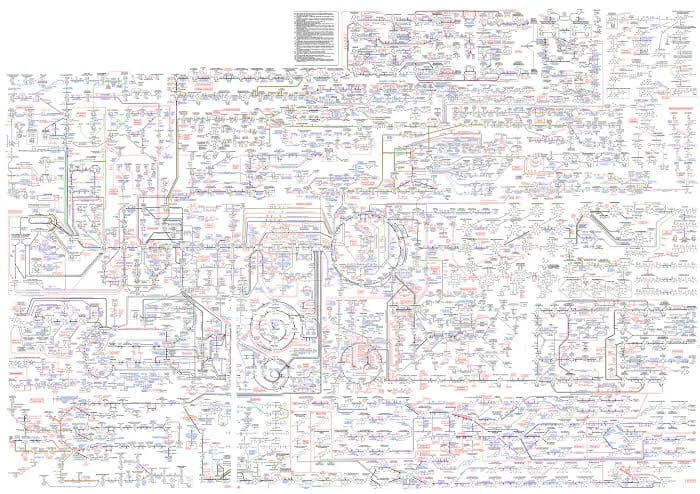
I highly recommend Michael Pollan’s book, In Defense of Food. It’s basically about the meta field of nutrition and how little we know, how most of nutrition science is fundamentally difficult, and is just one giant case for epistemic humility when it comes to nutrition.
Now, of course, being vegan won’t kill you, right away or ever. But the same goes for eating a diet of purely McDonald’s or essentially just potatoes (like many peasants did). The human body is remarkably resilient and can survive on a wide variety of diets. However, we don’t thrive on all diets.
Vegans often show up as healthier in studies than other groups, but correlation is not causation. For example, famously Adventists are vegetarians and live longer than the average population. However, vegetarian is importantly different from vegan. Also, Adventists don’t drink or smoke either, which might explain the difference.
Wouldn’t it be great if we had a similar population that didn’t smoke or drink but did eat meat to compare?
We do! The Mormons. And they live longer than the Adventists.
The problem with vegans is that it selects for a very particular sort of person - somebody who can control what they eat far more than the average population.
Not to mention it controls for the people who don’t have such severe health effects that they drop the diet. Many people tried vegan and then stopped because it caused health issues for them.
There are also undoubtedly plenty of effects that we do not measure well, haven’t thought to study, or what not, that are caused by veganism. A common pattern I had with a friend of mine is that they’d think their life was falling apart and they’d pick fights with everybody until I asked, as tactfully as I could, when was the last time they took their iron pills. I’d always find out they’d accidentally slipped for a week or so. They felt better within a day or two of restarting.
As far as I’ve seen, nutrition studies rarely measure things like irritability. What other symptoms are we experiencing from eliminating a whole food group from our diet that we don’t know about? There are already some indicators in studies that need way more follow up.
There was that RCT showing that creatine supplementation boosted the IQs of only vegetarians.
Calcium is one of the only nutrients we know of that can reduce the mood symptoms of PMS for women and it is practically impossible to get enough calcium from real food from vegan sources (you’re stuck taking medicine for it in the form of supplements or eating artificially fortified sources, like soy milk).
Here’s a list of negative health effects found in studies, with the usual caveat that correlation isn’t causation and doing RCTs on long term effects of diets is almost impossible:
- Vegans/vegetarians had over twice the odds of depression (OR ~2.14) compared to omnivores
- Among those who lived to 80, vegetarians/vegans had higher rates of cognitive impairment: vegetarians had over 2× the odds of cognitive impairment (OR ~2.05) and also more physical disabilities and chronic diseases by age 80. The analysis suggested a dose-response, with the stricter vegan diet linked to more adverse outcomes than ovo-vegetarian or pesco-vegetarian diets
- Vegans had over 2× the risk of hip fracture (HR 2.31, CI 1.66–3.22) compared to meat-eaters
- Meat consumption is a predictor of longer life expectancy. This relationship remained significant when influences of caloric intake, urbanization, obesity, education and carbohydrate crops were statistically controlled.
- In multivariate analysis, vegetarians had 35% lower odds of healthy aging (OR ~0.65), and specifically vegans had ~57% lower odds (OR 0.43) of healthy aging compared to omnivores
- In the EPIC-Oxford cohort, average B₁₂ intake among vegans was well below recommendations, and even though ~50% of vegans reported taking B₁₂ supplements, many still had biochemical evidence of B₁₂ deficiency
- Such neurological symptoms have been documented in vegans who forego B₁₂ supplements for years. They are often reversible with B₁₂ therapy if caught early, but can be permanent if prolonged
- A small study found 26.5% menstrual irregularity in vegetarians vs 4.9% in non‑vegetarians. Low B₁₂ and iron can lead to anemia and ovulatory problems; low zinc may disrupt menstrual cycles; inadequate iodine or selenium can affect thyroid function, which is crucial for fertility.
But honestly, the best we have most of the time are observational studies or RCTs done on a short time frame, measuring only a small fraction of all the relevant possible outcomes, with no or few ways to see if people actually followed the diet. So consider this just light evidence pointing in the direction that eliminating a whole source of nutrition has negative side effects.
There are many other pieces of evidence that point that direction.
There’s the sniff test. A large percentage male vegan influencers look pale and sickly. (I’m not going to name names, but if you follow the space at all, you’ll know who I’m talking about, because it could refer to so very many of them.) Of course, you can build muscle and be fit as a vegan, but it is much harder, and we know that muscle mass is a significant predictor of all sorts of positive health outcomes.
In fact, weight loss is a common side effect of a vegan diet, which could explain all or most of any health upsides, rather than being vegan itself. Being overweight leads to poor health outcomes independent of the source of weight.
Not to mention that of all of the hunter gatherer tribes ever studied, there has never been a single vegetarian group discovered. Not. A. Single. One.
Of the ~200 studied, ~75% of them got over 50% of their calories from animals. Only 15% of them got over 50% of their calories from non-animal sources.
Of course, what we did in our ancestral environment is not always good for us (there was a lot of infectious disease and murder there). And there’s a ton of variety in hunter-gatherer lifestyle. However, it is a good prior to assume that our bodies are evolved for our ancestral environment, so start with the prior that if all of our hunter-gatherers did a certain thing, it is more likely than not that that thing is good for us. The burden of evidence should be on people proposing a diet that eliminates the majority of foods we ate in our ancestral environment.
Health is important for your well-being and the world’s
Now, why should you care about your health? Well, I’m just going to assume that you care about your own suffering at the very least.
But this also affects your ability to help others. Health problems directly affect your ability to work on altruistic activities by preventing you from working or forcing you to take time off. Affecting your cognitive abilities affects your ability to choose good strategies, which can be the difference between being net negative and net positive.
Affecting your mood is an underrated side effect of poor health. You might be feeling tired and sad because your job isn’t a good fit. Or you might be deficient in something.
You might be missing one of the things we know that you need and is hard to get with a vegan diet, or you might be missing one of the innumerable bioactive compounds that we haven’t researched enough yet to know. Or maybe ones we haven’t discovered yet. Choline was only recognized as an essential nutrient in 1998.
I once had to take time off of work due to depression. There are many things that could have led to a cure, but one thing correlates is when I recovered, I’d secretly started consuming dairy again. Vitamin B12 deficiency includes fatigue, depression, loss of appetite.
I kept it secret because I felt I couldn’t tell my vegan friends what I was doing. They would think that I didn’t care about animals. But I do care about animals. A lot.
I wish that we could be optimally healthy without eating animals. Honestly, I’d prefer not to eat plants either, because I put a disconcertingly high probability that plants are also sentient.
But we are what we are. I do not wish to kill all lions because they cause suffering to the gazelles. I do not wish to force all lions to live on a vegan diet that slowly kills them, or live semi-healthily with medical intervention of pills to keep away the known deficiencies. Likewise, I do not wish for humans to sacrifice their health for others.
You could make the argument that taking supplements and having greater risk of various health issues is worth the guaranteed harm you’ll cause to animals.
The argument against that is:
- You can reduce the amount of suffering you cause by a ton, such that that argument is substantially weakened.
- Most people would consider sacrificing their health for others to be too demanding an ethical framework.
Another argument could be that you simply try vegan, then switch back if you experience health issues. This is actually already the default for most people.
The problem with this is when it’s unclear whether the diet is causing health issues. For example, it might be affecting people’s IQs by just a handful of points. You wouldn’t be able to subjectively tell, but this could be massively affecting your life and ability to do good in the world.
One of the most common side effects of deficiencies are mood disorders, which are extremely hard to notice as such. The default is for our brains to blame sadness, anxiety, or anger on external things (your job, your partner, the weather, society, politics) and it’s very hard for us to notice that it might be based on nutrition.
I never considered that perhaps my depression was caused by B12 deficiency. I was supplementing and eating fortified vegan foods. I thought it was because of my job and my relationship. And I still think it might have been those things! The human mind is complex and we do not really understand it, even our own.
My friend who got irritable never noticed that it was iron deficiency, even when they had such frequent and clear feedback loops.
It’s made worse by the fact that nutrition effects often happen in unintuitive ways. You body can store vitamin B12 for years before it runs out, leaving you to develop deficiency symptoms years after you go vegan. You maybe be taking supplements or eating vegan alternatives, but not absorbing the nutrients well.
One could feasibly do something like eat a regular diet, systematically measure as many possible figures as you can, then take the same measurements at a few points later on (shorter term and longer term) and see if there were any differences.
For myself, the things I most worry about are mood issues, which I know I cannot measure well enough to be of use in this sort of experiment. I regularly track my happiness on a scale of 1 to 10, and in one period, I was experiencing depression severe enough to make me stop working. I recorded an average 6.5 out of 10 compared to my average 7.5, because my coping mechanisms allowed me to feel neutral, as long as I was completely engaged in the most entertaining entertainment I could find. The moment I “returned to the real world”, the emotions would come crashing down again. So at the end of the day, I would record a 6 or a 7 for happiness - because while I was completely distracted, I felt alright.
If veganism caused anything less than full on depression, I most likely wouldn’t be able to detect it with my measurements.
Not to mention, given the suffering mitigation strategies, it’s unclear to me whether this is worth the time or effort.
The world is full of things I could stop consuming that probably cause some amount suffering.
For example, a large percentage of chocolate comes from slave labor and I am very against slavery. But the marginal effects on my chocolate consumption on slavery seem small enough that most people wouldn’t consider sacrificing chocolate due to this.
I think this is rational. There are nearly infinite things you can do to make the world better. It’s best to focus on the things that have the highest returns on investment, since you have limited amounts of energy and time.
You could also start from a stronger prior that you should require very strong evidence to do something that none of your ancestors did in the ancestral environment. Or a strong prior that you should not sacrifice your health for others.
Anyways, it’s complicated. Like any time you try to make the world better.
So, if you want to maximize the good in the world, don’t martyr your health to a proof-of-virtue diet or think in black-and-white of vegan vs carnivore. Choose welfare-optimized animal products, consider offsetting with targeted donations to animal charities, and remember that thriving humans - sleeping well, thinking clearly, not anemic or depressed - are the ones who best help all sentient beings.




I agree that removing the 10% of animal products from your diet that causes the least suffering is not that important, and otherwise clear-headed EAs treat it like a very big deal in a way they don’t treat giving 10% less to charity as a very big deal (even though it only takes small amounts of base giving for the latter to be a far bigger deal). There is a puritanical attitude to diet that is surprisingly pervasive on the forum which I think is counter-productive.
Another commenter (Tristan) is right to point to other and second-order benefits of veganism, but some of the common ones I hear I don’t find persuasive. For example, it’s not clear to me whether the signaling value of being 100% vegan and strict about it (which many people now pattern match with being shrill and judgmental) is positive, or at least more positive than being 90% vegan (signaling that change doesn’t have to be all or nothing, that taking intermediate first steps is good etc.)
But this post’s title that ‘you SHOULD eat meat if you hate factory farming’ goes too far. I don’t find the case compelling. So upvoting and disagreeing :)
Hey, I agree that many people associate veganism with 'annoying people'. But that's actually...more reason to call yourself vegan, if you're not an annoying person yourself! Break the stereotype, and normalise being standing for vegan values :)
My sense is that a lot of people in EA are against factory farming, but still buy into human supremacy and are ok with free-range farming. Then the 90% approach reflects the appropriate attitude and is fine. But for those like myself who have long-term hopes of ending animal exploitation altogether, I think it makes sense to signal that we oppose all of it. Requiring others to be strict is certainly counter-productive, though. I also don't think change has to be all or nothing - I actually think it's really good for people who make exceptions sometimes to call themselves vegan.
To be clear, I want to see factory farming ended, I’m vegan (except occasional bivalves), and co-founded an animal welfare charity.
I’m with you on the goal.
But while all the vegans I know seem to take it as self-evident that being vegan is the best diet choice in terms of social signalling, I’m not convinced.
You’re right that it’s possible to be a non-judgmental strict vegan, and everyone should aspire to be. But in my experience, the average vegan doesn’t meet this standard. And so rather than assuming a marginal vegan will be the best case scenario, I assume they’ll be average, and I think that could be negative.
[Of course, I don’t have good data on how judgmentally the average vegan behaves — but neither do the people who assume they’re positive signaling value. It’s also likely that my and most people’s perceptions of vegans is skewed by a vocal minority. But the result is that omnivores are often very defensive around vegans, even when the vegan isn’t being judgmental and is just silently being a strict vegan. I suspect that for someone to know that you’re a strict vegan and not feel judged would require you to actively demonstrate to them that you don’t judge them. And that’s actually quite hard to do]I’m
My guess is that the people reading the EA Forum are much less judgmental than the average vegan and generally, there will be a selection effect such that people who are actually willing to think reasonably and be 90% vegan won't be the judgmental ones anyway. So, probably for people here, it's not harmful to recommend people be non-judgmental strict vegans for signalling reasons.
They're probably less judgmental than average. Also perhaps poorer social skills on average. Do I back us to have the required tact? :P
But in all seriousness, the answer to "is it positive for social signalling to have an extra vegan EA forum reader" could defs be different to "is it positive for social signalling to have an extra vegan". I had the latter in mind when I questioned the signalling value
That's fair. I would love it if we had data on this, and to be honest I am unsure about whether being strictly vegan is always right - my stronger objection to this article was about not being strictly vegetarian. That is easier to do and I think is perceived as less strict, at least in western societies. On the other hand, as I said in another comment I think that it's very hard to eat meat and fully internalise nonspeciesism at the same time. A true nonspeciesist should be disugsted by meat, because that's literally a dead body in front of you. So I think it's worth it to be strictly vegetarian primarily to reinforce your own values, internally - but also for the signalling effect.
Given this, why are you vegan?
(I'm also ~vegan but wrestle with the relative importance of it given how difficult can be; the signalling value to others is one of the reasons I think it's good.)
Good question! I think (a) having to think about which is the 10% and “should I eat this” every meal uses too much bandwidth. I find a simple rule easier overall. It’s kind of like how I don’t calculate the consequences of my actions at every decision even though I’m consequentialist. I rely on heuristics instead. (b) I found it really hard to get to my current diet. It took me many years. And I think that personally I’ll find it hard to re-introduce 10% of the animal products without being tempted and it becoming 50%. (c) I think the things I say about veganism to other vegans / animal people are more credible when I’m vegan [as I’m clearly committed to the cause and not making excuses for myself].
As someone who endorses offsetting (or donating to animal charities in excess of offset) as a form of being an ally to animals, would not being an omnivore who donates far in excess of the offset make you more credible regarding this position?
No, not to many animal advocates and vegans. I’ve had plenty reach out to check my “vegan credentials” to determine whether (in their view) I’m “on their side”
Yeah, I understand the need for credibility with the animal rights community, but it probably would be helpful if there were more prominent omnivores who emphatically identified as animal advocates. Probably one of the reasons factory farming can be so successful is that there's a perceived barrier to entry to fighting it as becoming vegan. The more that vegans reinforce the narrative that "to be on our side, you need to be vegan", the more they are alienating potential allies and making it easier for the monstrous system to persist. I think what might be the most important in broadening the movement would be prominent animal rights activists who are omnivores.
Agreed! We're trying to find people with audiences who are sympathetic the cause but unwilling or unable to change their diet (e.g. Sam Harris) and provide them with a non-diet-related solution that they can speak to their audience about without having to fear backlash due to perceived moralising about people's diets
I guess it's an interesting position you're in - you might personally want to be strictly vegan, but also in some ways the whole point of FarmKind is that you don't need to do that/doing that doesn't have all that large an impact.
Which also puts you in a bit of a bind bc as you say there are animal advocates who will see not being vegan as a mark of unseriousness.
Getting FarmKind featured by Sam Harris would be a real coup.
You can also do both to some extent - when people query it you can say that you're vegan but that the impact of doing so is far less than e.g. one's own personal giving to animal orgs.